This is the blog. Click here to go to the Zenopus Archives website.

Note: Many older posts on this blog are missing images, but can be viewed at the corresponding page in the Internet Archive

FEATURED POST

The Forgotten Smugglers' Cave: Index of Posts

An index of posts describing the Forgotten Smugglers' Cave, an adventure for Holmes Basic characters levels 2-4.                    ...

Showing posts with label Sutherland. Show all posts

Thursday, September 5, 2024

Holmes Basic metal sign from Ata-Boy


Image from the product page

The company Ata-Boy is offering a cool metal sign featuring the Holmes Basic Set cover art, by David Sutherland over on Amazon for $11.99, with their storefront stating that their products are officially licensed. Find it here:

Holmes Basic metal sign from Ata-Boy

The dimensions are 8.25 inches by 11.5 inches, and each corner has a small round hole to aid in hanging. The front faithfully reproduces the actually cover from a later printing of the Holmes Basic set, where the angled banner incldues the words "With Introductory Module", except that the TSR logo in the lower left corner has been replaced with a Wizards of the Coast logo. A bit of the art on each side is clipped off, but at the top there's a bit of extra art from the top side of the box. Compare the image above with a boxed set cover image from the Acaeum:


Holmes Basic set box cover, fourth print. Source: Acaeum


I ordered and received one myself and the quality is good for what it is; i.e., a thin metal sign with the artwork printed on it. The back side is unpainted golden metal (like a cookie tin) and there's a thin lip around the back side edge, so it's not completely flat. I haven't hung mine up yet, but here are photos of the front and back of it:


The Ata-Boy store also has some other items that may be of interest, including a similar metal sign with the AD&D Players Handbook cover artwork and refrigerator magnets with the Holmes Basic set cover and the Players Handbook cover.


Friday, October 1, 2021

Sutherland Dragon Details


As promised in my earlier post about on the exhibit of the Holmes Basic cover art ⁠— aka the Sutherland Dragon ⁠— here are several close-ups of different portions.


The Fighter


The greens are more apparent, including in details such as the "emeralds" circling the pommel of the sword poking out from the treasure pile.

In the dragon's chest in the upper portion of this image you can clearly see multi-colored gems encrusted between the belly plates. A few are even gleaming, a detail which doesn't show up well because the gleams are white on a yellow background. 

Note Sutherland's signature, just visible below the shield. This portion of the image appeared on the bottom edge of the box set cover, where a bit more of his name can be seen than here.


The Magic-User


Here we see the wizard unobscured by the TSR logo and the other writing on the box cover.

Sutherland's attention to the lighting is very apparent in the yellow highlights and deep shadows applied to the wizard's blue robe.


The Dragon


Yellow bands of light radiate out from the wizard's torch, a detail that doesn't reproduce well on the boxed set cover. 

The motion lines accentuate the mood that the dragon has just been surprised. Sutherland used motion lines in other illustrations, particularly sword swings, such as on the title page of the Holmes Basic rulebook, as can be seen here.

As a reminder, the exhibit featuring this painting is at the Norman Rockwell Museum in Stockbridge, MA through Halloween, and then will be at the Hunter Museum of American Art in Chattanooga, TN from May 20 to September 5, 2022, and then at the Flint Institute of Art in Flint, MI from September 23, 2002 through January 8, 2023.

Friday, August 20, 2021

The Holmes Basic Set Cover Art: Exhibited!


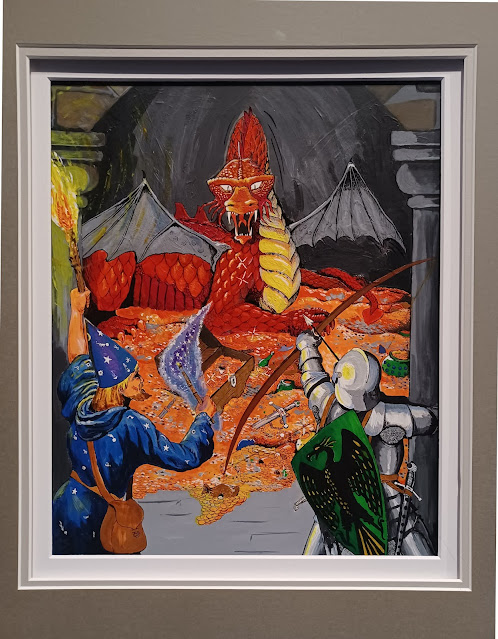
"The Sutherland Dragon" on display, photo by myself


About two weeks ago, while on vacation, I saw a cryptic post on FB implying that the original Holmes Basic Set cover art  which I often refer to as "The Sutherland Dragon", after the artist  was on display in public ... somewhere. After a bit of searching, I confirmed that it was indeed being exhibited, as part of the show Enchanted: A History of Fantasy Illustration at the Norman Rockwell Museum in the town of Stockbridge in western Massachusetts. I hadn't heard of the show until that moment, but at the time I just happened to be within reasonable driving distance of the museum, and would not be as close again for some time, so a quick decision was made to take a previously unplanned side trip to the museum!

A Painting Rediscovered

Not all original D&D art still exists, but I've known for a while that Sutherland's painting does, because back in 2013 Steve Winter reported on Twitter that it had been found, like the Lost Ark of the Covenant, "in a crate in WotC's warehouse". Steve provided a photo, observing that the "detail is amazing", which showed that the art had slipped inside its framing while in storage:


(As an aside, I joined Twitter for the first time just so I could comment on Steve's tweet, which eventually led to regular usage, and I recently passed 700 followers).

At the time, Steve also wrote on his blog Howling Tower about the find, which he coincidentally posted on Holmes' date of birth.

I also have a vague recollection of hearing later that it was now hanging up at the WOTC offices. I've played in several games with Steve at NTRPG Con and Gary Con over the years since (Gamma World, for example), so I may have asked him about it at one point.

Update: I was reminded on Twitter that on page 394 of Art & Arcana (2018), there is a small inset showing a WOTC employee holding the Sutherland Dragon with the caption: "Wizards employee Curt Gould poses in front of the beast with a red dragon of his own — the original Dave Sutherland basic box painting that he discovered in a Wizards of the Coast warehouse in 2013". The painting is in the same frame as the current exhibit. This may have been the source of my vague recollection mentioned in the paragraph above.

The Exhibit Curator on Sutherland's Illustration

The Enchanted exhibit opened in mid-June, after which the museum held a virtual symposium, which included a keynote talk (archived here on Google) by the exhibition curator, Jesse Kowalski, who at one point shows Sutherland's art (at ~41:00) and says that "it is probably the painting I was most thrilled to have in the exhibit", and that "I believe it is the first time on view to the public. It's on loan from Wizards of the Coast", and while "...it's not the best painting, however, it's such an iconic work that started a whole generation of kids in the basement rolling dice".

Visiting the Museum

After driving several hours we arrived in Stockbridge, where Rockwell had lived, and then at the museum, which is in a beautiful leafy setting with picnic tables and sculptures, which currently includes a complimentary exhibit of contemporary fantasy sculpture, titled Land of Enchantment: A Fantastical Outdoor Sculpture ExhibitionIn addition to the museum proper, which counts George Lucas and Steven Spielberg as donors, Rockwell's actual studio is also on the grounds, having been moved there from another location in town. 

Update: Thanks to a user on reddit, I've learned that Stockbridge is also famous as the setting of Arlo Guthrie's song Alice's Restaurant.

Seeing The Sutherland Dragon

After paying our entry fee and applying my sticker, I zipped through the rooms of the exhibit until I found what I was there for, which was hung next to another classic from the same era, David Trampier's Pseudo-dragon from the AD&D Monster Manual:


It was stunning to finally see the Sutherland Dragon in the person. 
The colors in the original are *much* brighter than the published image on the box cover, and many details are more apparent, such as the colorful, glinting gems stuck in the crevices between the dragon's belly scales, like Smaug in the Hobbit. I'll make a follow-up post with a few closer photos of details of the painting, so here I'll just talk about some overall impressions of the painting as it is on display in the exhibition.

The painting, which the wall text indicates is "acrylic on board", has been re-framed since 2013, and now includes triple matting (see the picture at the top of this blog). I imagine this was done by Wizards of the Coast, who the wall text indicates are still the owners. The catalog for the exhibit (see below for more on this) lists the size as 24 5/8" x 22", which I believe refers to the entire framing, or perhaps just the painted board inside. The new matting is more aggressive than in the earlier frame, limiting the visible portion of the painting to about 10" by 12", which is just a bit larger than the original box cover, which is about 9" by 11". I can guess why this was done, as it has the effect of focusing the presentation on the action of the scene: the wizard and warrior confronting the looming red dragon. And it also emphasizes that Sutherland was painting something just a bit larger in scale than what was needed for the product as published. 

Unfortunately, WOTC's new matting covers up some significant details from Sutherland's original painting. Like other TSR boxed games from this era, the cover art was printed not just on the top of the box lid, but also wraps around to the sides. In the case of the Holmes Basic Set, the left, top and right sides each show the blocks of dungeon walls, which were all part of Sutherland's painting. Since this is an exhibition focusing on illustration, I would have preferred to see the entire painting, along with discussion of how Sutherland arranged a composition that was intended for a wrap-around box top. 

The matting also shifts the "visible portion" of the painting downward from the published box cover, which covers up most of a significant detail that is visible at the top of the published box cover: the archway that connects the top of the columns and frames the dragon. As a positive, this shift keeps uncovered most of what was shown on the bottom box edge, allowing for an fuller unobstructed view of the two adventurers, which I enjoyed seeing.
 
For a visualization of what the entire painting might look like if the current matting was removed, here is a mock-up of the original art posted on the Xeveninti blog back in 2010. It was made by scanning the entirety of the original box (cover and all four sides), editing these together, and editing out the graphics:


I hope I don't sound too negative here; this was simply an observation I made while viewing the painting and thinking about it. My overall experience at the museum was terrific, I was thrilled to see the painting in person, and it is wonderful that it has been preserved ("it belongs in a museum!") and has been made available for public showing by WOTC.

Exhibition Catalog

I bought a copy of this at the gift shop, and you can purchase it online here. It's nicely done, edited by the curator of the exhibit, and lavishly filled with color images from the exhibit, plus other images not in the exhibit. There's an 11-page section called "Gaming", which includes a ~1/3-page image of the Sutherland painting — I, of course, wish they made this one full page like some of the other illustrations in the book — and a really nice large scan of Trampier's Pseudo-dragon, as well as other gaming art, including an Elmore and an Easley that were also in the show.

Thy Deadline

If you want to see the exhibit in person in Stockbridge, get there by October 31st of this year!

Update: Mike S. on FB found info here on where the show will later move to:

  • May 20 to September 5, 2022: Hunter Museum of American Art in Chattanooga, TN
  • September 23, 2022 to January 8, 2023: Flint Institute of Art in Flint, MI

Future Posts

I plan to make a few follow-up posts with some closer shots of the Sutherland Dragon, and also a few of the other artworks in the exhibition, including Trampier's Pseudo-Dragon. I'll update this section with the links once they are up.

See also:

Smaug versus the Sutherland Dragon

David Sutherland Day

Sutherland Dragon in Lego

Dragon+ 5 Wallpaper inspired by Sutherland Dragon

Thursday, December 17, 2020

The Ruined Tower of Zenopus: Running it Retro II


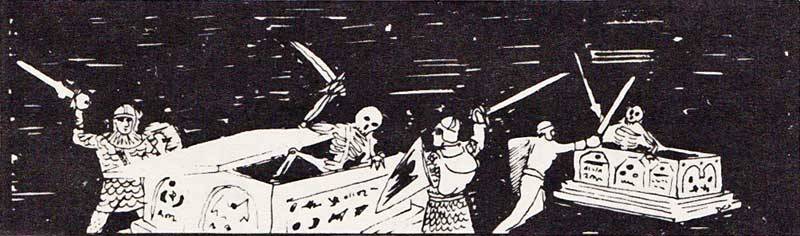
Sarcophagus Skeletons by David Sutherland. An illustration for Room N,
although with a bit of artistic license as there is only one sarcophagus with an animated skeleton


This is the second post in a series of notes for running The Ruined Tower of Zenopus using old school D&D rules. It continues from the first post here. This post focuses on a roster of monster stats for the dungeon rooms.

Page 5: Printer-Friendly dungeon map. Usable as-is with any ruleset.

Pages 4-13: Areas of the Dungeon. Here is a Roster of Monsters:

Room A. Goblins: MV 60, AC 6, HD 1-1, AT 1 weapon for 1d6. For 1-3 PCs: 3 goblins; 4-5 PCs: 5 goblins; 6+ PCs, 7-8 goblins

Room B. 4 skeletons: MV 120, AC 8, HD 1/2, AT 1 claws for 1d6

Room F. The veteran smuggler: MV 60, AC 5 (chain), F2, hp 11, AT 1 sword+1 for 1d6, Str 12, Int 10, Wis 9, Con 13, Dex 10, Cha 12

The thaumaturgist: MV 120, AC 9, MU4, hp 9, AT 1 spell or 1 dagger for 1d6, Str 9, Int 16, Wis 9, Con 10, Dex 11, Cha 12. Spells: Read Magic, Charm Person, Magic Missile, Protection from Good, Wizard Lock, Web

Room G. 2d4 giant rats: MV 120, AC 7, HD 1/2, hp 2, AT 1 bite for 1d3 + 5% chance of disease

Room J. 1 giant spider (Holmes manuscript): MV 60, AC 3, HD 1, hp 4, AT 1 bite for 1d6 + save vs. poison

1 enormous spider (1st edition rulebook): MV 20 (100 in web), AC 3, HD 6, hp 31, AT 1 bite for 1d8 + save vs. poison at -1

1 giant spider (2nd edition rulebook): MV 30 (120 in web), AC 4, HD 4+4, hp 21, AT 1 bite for 2d4 + save vs. poison

Spider attack rules: 

1st round: If the room is entered incautiously, roll a die to select a PC, and then roll for the spider's attack on them. On a hit, the PC is knocked down (the original does not indicate whether this causes damage; it could be interpreted as a standard d6 of damage), and may not return a blow. Continue with rounds 2-4 below. On a miss, the next round instead switches to normal combat.

2nd round: If there was a knockdown, the spider gets an attack on the PC, who gets no return attack. Others may join combat now and attack the spider. 

3rd round: Spider gets an attack on the PC, who may attack at -2 while getting up.

4th round and after: Normal attacks on both sides.

Room L. 1 monstrous sand crab: MV 60, AC 3, HD 2, AT 2 pinchers for 2d6 each

Room M. 4 smugglers: MV 120, AC 7, HD NH, hp 4, AT 1 cutlass for 1d6

Lemunda: MV 120, AC 9, F2, hp 11, AT 1 dagger for 1d6, Str 10, Int 14, Wis 12, Con 15, Dex 12, Cha 17

1 giant octopus: MV 120 (swimming), AC 7, HD 3, hp 16, AT 6 tentacles for 0 + drag underwater

Room N. Endless giant rats: see Room G

1 flying dagger: MV 0, AC 3, HD 1, hp special, AT 1 for 1d6; if hit, motionless for 3 rounds

1 sarcophagus skeleton: MV 120, AC 7, HD 1, hp 7, AT 1 scimitar for 1d6

Room P.  2 ghouls: MV 90, AC 6, HD 2, hp 11, 9, AT claw/claw/bite for 1d3 each & paralysis

Option: 1d6 cultists: MV 120, AC 9, HD NH, AT 1 scimitar for 1d6

1 ghoul; as above, but with 7 hp

Room RT. Endless giant rats: see Room G

Option1 monstrous rat: MV 180, AC 5, HD 1-1, hp 7, AT 1 bite/1 claws for 1d3+1 each

1d6 giant rats: see Room G

Room S. 1 giant constrictor snake: MV 100, AC 6, HD 2, hp 13, AT 1 bite for 1d6

Room S2. Ape: MV 120, AC7, HD 2, hp 9, AT 1 pummel for 1d6

Saturday, June 20, 2020

Scrum in Miniature: The Lost Art of Games Workshop's Holmes Basic

My fellow Scrum Club member Joe has started a series called the "Lost Art of D&D" on his blog Scrum in Miniature, and the second installment covers the replacement art by John Blanche and Fangorn that was used by Games Workshop in the first printing of Holmes Basic rulebook, first released in December 1977. The post goes through the rulebook and shows each replacement work contrasted with the original from the U.S. version (example above).

In a 2001 interview, Gary Gygax was asked about the UK version, and responded:

"Yes, I saw the work, and I approved. Ian [Livingstone] and Steve [Jackson of Games Workshop] convinced me that their audience didn't like the illustrations used in American versions of the game, so I gave them the okay to produce their own. I had a copy of the Basic Set rules, but it was lost when Lorraine Williams took over TSR..."


Lost Art of D&D No. 2: Games Workshop's Holmes Basic (1977)

After Games Workshop attained the license to print a co-branded edition of TSR's 1977 Dungeons & Dragons basic rules book, they set about putting their own stamp on it, designing a new cover and replacing a number of the illustrations they deemed too crudely drawn for their U.K. market.

Monday, April 13, 2020

Smaug vs the Sutherland Red Dragon


Left: Smaug by Tim Kirk (1975). Right: the cover of the Holmes Basic Set (July 1977). 
Click on the image for a larger view


David Sutherland painted a cover for the Holmes Basic Set that remains one of the most iconic early D&D illustrations. It literalized the title of Dungeons & Dragons, showing a dragon in a dungeon. The viewpoint is as if we are members of the party of adventurers who have just entered the chamber and disturbed the huge red dragon resting on its seemingly endless bed of gold and treasures.

This image has influenced the cover art of many successor sets ranging from later TSR D&D Basic Sets to the Pathfinder Beginner Box. Sutherland's take on the Red Dragon appeared in other D&D products of the era, including the Monster Manual and Monster Cards.

The 1975 Tolkien Calendar

Sutherland's dragon was in turn possibly influenced by an earlier image of red dragon on a pile of gold that was published about two years before Holmes Basic. This was a stunning depiction of Smaug by Tim Kirk that appeared in the 1975 Tolkien Calendar, which included works done as part of his MFA from Cal State. In particular, note the similar (but not identical) poses of the dragons, the head "whiskers" of the dragons, and the wide ventral neck scales. There are also similarities in the treasures embedded in the pile of gold, including urns, chests and embedded swords. There's even an arching shape over the head of each Dragon (vaulted ceiling for Smaug, entrance archway for the Sutherland Dragon).


Kirk's illustration in turn appears to be a modernization of Tolkien's own "Conversations with Smaug", which appears in the Hobbit itself. Note how Tolkien has placed skulls on the floor around the pile of gold and compare this with the skulls in Kirk's pile of gold:


Source: The One Ring

Additional Evidence: Pig-Faced Orcs

By the mid-70s, Tolkien's Middle-Earth books had grown extremely popular and the 1975 calendar was the first to feature art from an artist other than Tolkien himself. It's easy to imagine that a fantasy artist such as Sutherland would have encountered this calendar. But t
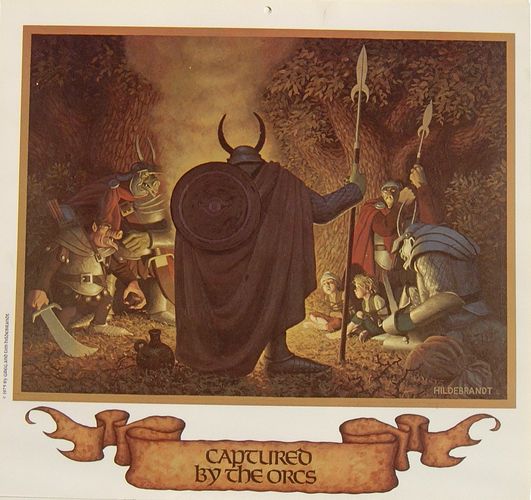
here is one other bit of evidence that Sutherland was familiar with the Tolkien Calendars. The 1976 Tolkien Calendar (which would have been published in mid-to-late 1975) included art by the Brothers Hildebrandt, including this image of very pig-faced orcs: 


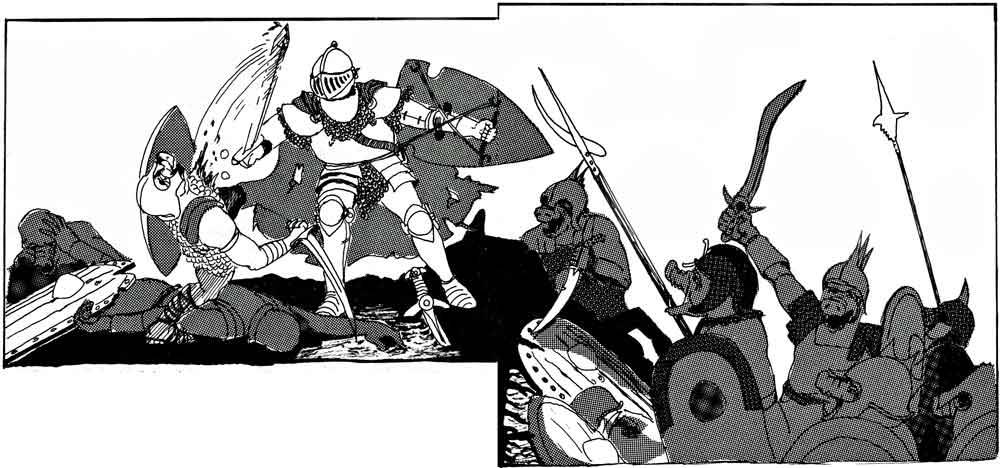
And Sutherland was the one who slightly thereafter introduced pig-faced orcs into D&D, via his illustrations in Swords & Spells (July 1976, per the Acaeum), Holmes Basic & the AD&D Monster Manual.


This illustration is spread across two pages in Swords & Spells. 
Source: OldSchoolFRP


See also:

Sunday, December 2, 2018

1977 Gen Con X Souvenir Program


Gen Con X Souvenir Program, 1977. Source: Gen Con Guru

The Holmes Basic Set debuted in the summer of 1977, with TSR selling it at Origins in July, and then at Gen Con X in August. In this year Gen Con was held at the Playboy Resort in Lake Geneva for the first and only time, a site that is now the Grand Geneva Resort where Gary Con has now been held for a number of years.

I'd seen the covers of the 1977 Souvenir Program before, for example at the Gen Con Guru, but Demos Sachlas (editor of the B1 and B4 fan sourcebooks) just sent me a few photos of the interior that he took of a display copy at Gary Con last March. Page 19 is an ad for the Basic Set, which is now the earliest ad for it that I've seen:


Basic Set advertisement from the Gen Con X Souvenir Program. Source: Demos Sachlas

This advertisement is similar to the first one that ran in Dragon magazine, the next month in issue #9. Of note, these ads use a black and white excerpt of the original artwork rather than a picture of the actual box set cover.


Differences between these two ads include:
-the earlier ad is two-tone black/red, like the rest of the program, later ad is just black
-the later ad adds the subtitle "Swords & Sorcery..."
-the later ad revises "dungeon geomorphs" to "full set of dungeon geomorphs"; "polyhedra dice" to "set of five polyhedra dice"; "revised D&D booklet" to "revised D&D rules book".
-the later ad adds "*T.M. Reg. App. For", although the earlier ad includes the asterisk to which this refers, so perhaps it was removed during the program book layout
-the later ad adds the price, $9.95 plus $1.00 postage and handling
-the later ad replaces the "Other Recent Releases from TSR" and Booth information with a mail-order form

The program also includes a hand-drawn maps of the "Lake Geneva Area", which Demos suggests are by David Sutherland:


Maps of the Lake Geneva Area by David Sutherland. Source: Demos Sachlas


Of particular note is the drawing of the lake monster confronting a galley in Geneva Lake (confusingly, the town is Lake Geneva, but the lake is properly Geneva Lake):


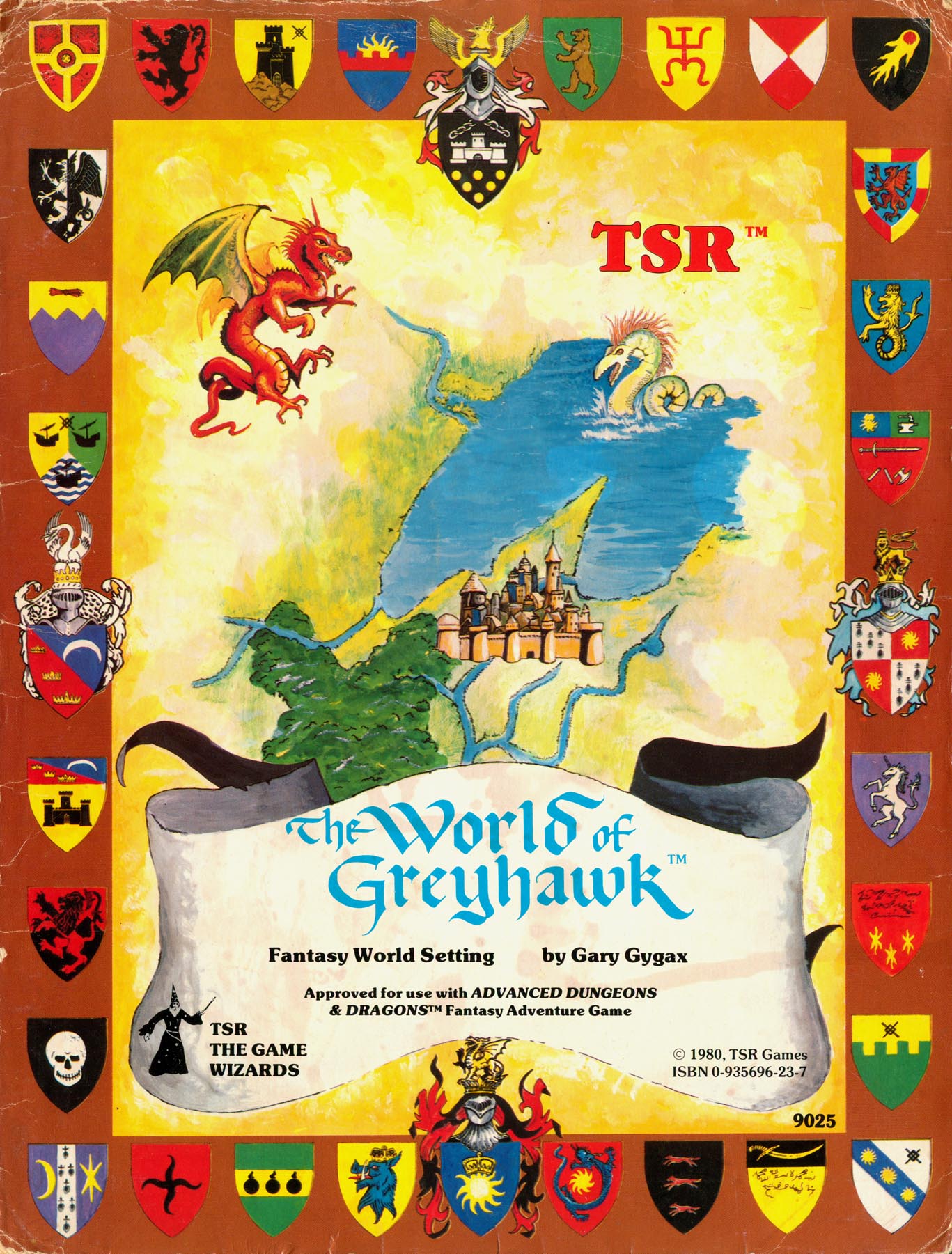
Compare this with his lake monster from the cover the World of Greyhawk Folio (1980):

Detail from the cover of the World of Greyhawk Folio (1980). Source: TSR Archive
See this post for another Lake Monster, attacking a Rhennee barge, by Sutherland from the interior of the Folio.

Perhaps surprisingly, the advertisement for Holmes Basic is on page 19, and not on the back cover of the program, page 32, which instead advertises another new TSR game, Warlocks & Warriors, designed by Gardner Fox:

Warlocks & Warriors ad, back cover of Gen Con X Souvenir Program (1977). Source: Gen Con Guru

The illustration here is also by David Sutherland, and also appears in the Warlocks & Warriors game instructions. The wizard wears a conical "stars & moons" hat, much like the one on the cover of Basic, and the warrior has a helm with an especially realistic-looking dragon:

Saturday, November 17, 2018

Elmore's take on the Sutherland Dragon


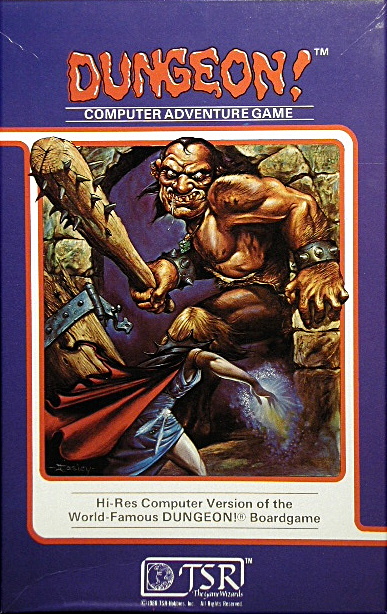
This illustration by Larry Elmore is from a fairly obscure product, the manual for the 1982 adaptation of TSR's boardgame DUNGEON! for the Apple II+. It's on the last page, and is the only illustration in the manual other than the cover, which shows a B&W version of the box cover art by Jeff Easley. It may have appeared in another TSR product, but a Google Image search didn't turn anything up.

While much smaller --- perhaps a Sub-adult? --- Easley's dragon clearly shares many details with David Sutherland's Red Dragon on the cover of the Holmes Basic Set (July 1977), particularly the head - triangular, heavy brow, cheek "whiskers". Also note the V-shaped scales down the ventral portion of the neck, the slightly curved spikes down the back, even the shapes of the scales. 


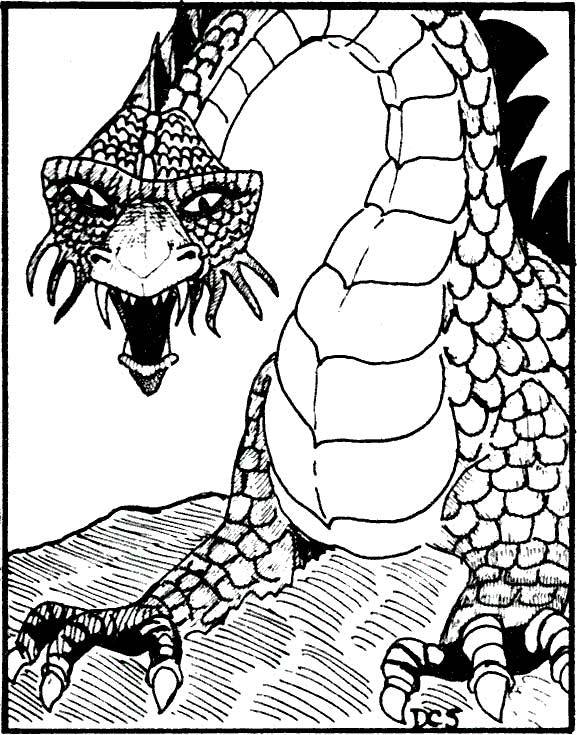
Sutherland drew a similar B&W version of this same Red Dragon for the monster entry in the AD&D Monster Manual (Dec 1977) ---


Which was redone in color by Jim Roslof for the AD&D Monster Cards (1981) ---


A Red Dragon does appear as one of the monsters in Dungeon!, so Elmore may have been using one of these as a guide in order keep the look consistent between TSR products.

If you'd like to see the entire game manual, it can be found here at the Museum of Computer Adventure Game History.


You can also watch a 10-minute play-through of the game here --- Dungeon! for the Apple II

It had graphics like this screenshot, showing a Superhero versus a jolly Purple Worm ---


Update: As pointed out by John L in the comments, here is Bill Willingham's take on a similarly styled dragon, from the Moldvay Basic Set rulebook (1981). 


Thursday, October 11, 2018

GAMMA WORLD IS HERE...

1978 promotional poster for Gamma World

FYI, just about forty years after they were originally released, the original Gamma World rules, now known as the first edition or 1E, are now available on Drive Thru RPG in both PDF ($10), Print-On-Demand ($20), or both ($22) ---

Gamma World 1E on Drive Thru RPG 
(link includes affiliate number)

Gamma World, by James Ward and Gary Jaquet, was first published in 1978 and was developed from Ward's earlier Metamorphosis Alpha RPG (1976). As the co-authors wrote in Dragon #18, "The creation of the boxed game of Gamma World was brought about when the need for a planet based version of Metamorphosis Alpha presented itself. The distances and possibilities presenting themselves on a planet were far more vast than those of a star ship. Also, through the course of playing MA, many new concepts were created and old ideas evolved into things far different from what was given" (from "GAMMA WORLD: First Report; Setting Up The Campaign" in the column From the Sorceror's Scroll in Dragon #18, Sep 1978).

The PDF is of the third printing from 1981, with a TSR Face Logo. Earlier printings had the Lizard Logo or the Wizard Logo (August 1978). I've checked the 2nd and 3rd printing against each other and didn't note any rules differences, just some slight differences to the logos, copyright info and product listings. I don't have access to a 1st printing, so I don't know whether any corrections were made from 1st to 2nd.

A Gamma World "Sneak Preview" appeared in Dragon #8, July 1977, the same month that Holmes Basic was first available at Origins 77. It was titled "Introduction to: Gamma World", and was an early draft of the Introduction that later appeared in the rulebook. It was attributed as an "Excerpt from "The Black Years" --- Hald Servin, 2562", with no further explanation. However, based on a further article "More Excerpts from the Journals
of Hald Sevrin" by Gary Jaquet in Dragon #19, it appears that he is "Hald Sevrin". 

In Dragon #15 (June 1978), an advertisement on page 18 announces two new TSR releases for Origins 78, Gamma World and the AD&D Players Handbook. This was repeated in Dragon #16 (July 1978), and the next two issues have, "This is Gamma World" advertisements that use the same artwork as the poster shown above, and specifically mention the poster as being available.

The back of the original Gamma World boxed set stated that "The GAMMA WORLD™ rules are also suitable for use with the ADVANCED DUNGEONS & DRAGONS rules." This compatibility can be seen by looking at a stat block from the "Monster & Treasure Listings" in the back of the Gamma World 1E rulebook ---

07. Yexil (2) HP: 42, 35; AC: 6, Move: 4/15; AT: bite does 3d6 damage, laser eye beam does 5d6 damage (25m range); MU: totally resistant to cold attacks.

They left HD out of these listings (similar to the OD&D M&TA listings, although those have a "To Hit AC9" score), but it can be found elsewhere in the write-up (10 in this case). It'd be trivial to just throw this at a (A)D&D party as an encounter. 

In 1979, the AD&D Dungeon Masters Guide included a section, "Mutants & Magic" (pg 113-114), on conducting cross-over campaigns between the two rulesets in either direction.

It took a few years, but the original rules were eventually supported by several products, including the sandbox module GW1 Legion of Gold (1981) by Gary Gygax, Luke Gygax and Paul Reiche III, the module GW2 Famine in Far-go (1982) by Michael Price, and a Referee's Screen with a mini-module, The Albuquerque Starport, also by Reiche. None of these are available on Drive Thru RPG yet, but hopefully will eventually appear. There was also a module in Dragon #52 (August 1981, Cavern of the Sub-Train, by the original co-author, Gary Jaquet.

I must note that they still haven't released Holmes Basic in PDF or POD....!!!

Update: I saw some pics on FB of the POD product. Since the file format puts the box cover on top, it results in a booklet with a color cover - a nice touch. The original booklet cover is the first page on the inside. The blue map from the box is also included in the interior, across two pages.

Wednesday, April 4, 2018

David Sutherland Day 2018


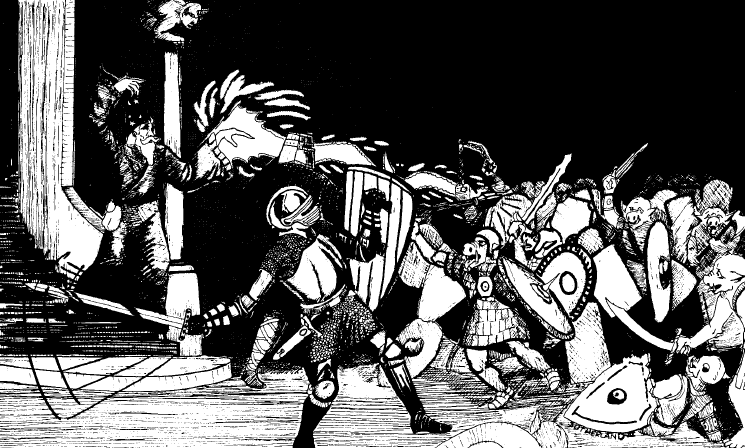
Sutherland's art from the title page of the Basic rulebook

2018 update:

It's once again David Sutherland Day so I've bumped this post (previously bumped last year). David would have been 69 today. Feel free to add a new comment below about his work.

Of note, there is now a Sutherland appreciation group on Facebook called:

The Scaly Sacrarium of Sutherland

And did you know that David Sutherland made his own customized lizard warriors that resemble his drawing from the Foreword of Holmes Basic? The one at the top of this blog? See this 2013 post on the Zenopus Archives for more on this:

DCSIII Customized Saurians

Original post from 2013

Today marks the birthday of my favorite TSR artist, the late David C. Sutherland III (aka DCSIII), who passed away too young (age 56) in 2005. I've designated April 4th as "David Sutherland Day". Dave's work defines the look of D&D in 1977, when his art graced the cover of the Holmes Basic Set and first AD&D hardback, The Monster Manual. His work also defined the look of Holmes Basic, being used for the both the cover, the title page (posted above) and foreword (the lizard rider that graces the title of my blog). He was also responsible for most of the artwork for the first Basic module, B1 In Search of the Unknown.

Tome of Treasures has a page with an extensive listing of his TSR credits.

In 2012 his Basic Set artwork was featured in a line of retro t-shirts from WOTC. And in 2013 his original painting was recovered from a crate at the WOTC offices.

Please post a comment on what your favorite work(s) of his.

Here are a few somewhat obscure pieces from Swords & Spells (1976) that are very much in the same style as the Holmes title page piece:


This illustration is spread across two pages in Swords & Spells. Source.


Friday, January 12, 2018

Gary Con X Games Scheduled


Update: I had to cancel my attendance at Gary Con due to attend the funeral of a relative, but I ran the same scenario later in the year in June at North Texas RPG Con.

Last week I was notified that my approved game for Gary Con X (March 8-11, 2018) has been scheduled (two sessions). Event sign-up starts tomorrow for the highest badge level (Diamond), with the other badges levels following on successive weeks until February 3rd for the Silver general admission badge, which is what I have. Last year I didn't even register for a badge until after that date and still found plenty of great games to play in.

I'll be running the Return to the Tower of Zenopus twice (see description below), once on Friday from 9AM-1PM in Forum AB, and once on Saturday at the same time and location. 

Forum AB is apparently part of the Forum Convention Center, which is being used for the first time at Gary Con, and is on the opposite side of the convention center from the rest of the games (but much closer to where many of the rooms are, including my room last year). There are 37 pages of games scheduled for this room, so that's about 370 games scheduled for this new location. See the pdf map of the venue, the Grand Geneva Resort, which was same location of Gen Con X back in August of 1977 and the Holmes Basic was the new TSR release of the summer.

Links of interest:
Gary Con website
Gary Con forums General Discussion
Badge Registration
Full Schedule of Events (searchable)
Grand Geneva Resort website
Gary Con Facebook Group (public)
OD&D Discussion thread
Dragonsfoot thread
Knights & Knaves Alehouse thread


* * * * *

Return to the Tower of Zenopus

Forty years ago adventurers first braved the dungeon under the ruined tower of the wizard Zenopus. Fearsome monsters were overcome and fabulous treasure recovered, but the doom of Zenopus was never revealed. The stairway leading down to the dangerous passages was eventually bricked over by order of Lady Lemunda, current ruler of prosperous Portown. However, recently your party uncovered a previously unknown means of entry. What secrets remain to be discovered in the old dungeons? Meet at the Green Dragon Inn and adventure as Boinger, Zereth, Murray or another character from J. Eric Holmes' stories (pre-generated characters will be provided). This adventure from the Zenopus Archives celebrates the 40th anniversary of the Holmes Basic D&D set.

Friday, February 24, 2017

Sample Dungeon in Gridmapper

Click here for a larger view
I recently became aware of a browser-based mapping tool called Gridmapper by Alex Schroeder. It looked easy & fun to use, so I tested it out by making a replica of the Sample Dungeon map (original by J. Eric Holmes, Basic rulebook version probably by David Sutherland. See them side-by-side in this post). Above is my current draft. 

Alex recently added the cave wall icons ("grotto"), which is essentially for this map, which mixes dungeon and cave walls. However, Gridmapper doesn't allow for water in the same square, or for partial water squares, hence the blockiness of the water areas. 

I added the thaumaturgist's tower, which is described in the text but not shown on the map.
Where icons were available, I've also added some notable features for various rooms; for fun I'll let you figure them out for yourself. 

(Just noticed I left the compass direction off the map)