This is the blog. Click here to go to the Zenopus Archives website.

Note: Many older posts on this blog are missing images, but can be viewed at the corresponding page in the Internet Archive

FEATURED POST

The Forgotten Smugglers' Cave: Index of Posts

An index of posts describing the Forgotten Smugglers' Cave, an adventure for Holmes Basic characters levels 2-4.                    ...

Showing posts with label Conan. Show all posts

Thursday, April 3, 2025

Gary Con 2025: Day 0


Gary Con XVII illustration by Chet Minton

In March, I attended Gary Con in Lake Geneva for the sixth time, and for a con report I'm going to make a short series of blog posts with highlights from each day.

The first is for Wednesday, March 19th, or "Day 0", when I traveled to Wisconsin, checked in to the hotel and picked up my badge, before the official start of the con the next day. Highlights included:


—Stopping at Renaissance Books in the Milwaukee Airport. The only used bookstore in an airport in the US, Renaissance always has a good selection of Appendix N and adjacent paperbacks in the sci-fi/fantasy section. I normally stop here on the way out, but this year I had time after arriving and before I was scheduled to get my rental car. 

Taking advantage of a "buy 3-get 1 free" for paperbacks, I picked up H. Rider Haggard's The People of the Mist (1894), ERB's Tarzan and the Leopard Men (1935), Alan Dean Foster's Splinter of the Mind's Eye (1978)(for a friend; I read this in the 90s); and Conan the Undaunted (1984), #19 in TSR's Endless Quest series and written by the late Jim Ward, a longtime Gary Con regular.


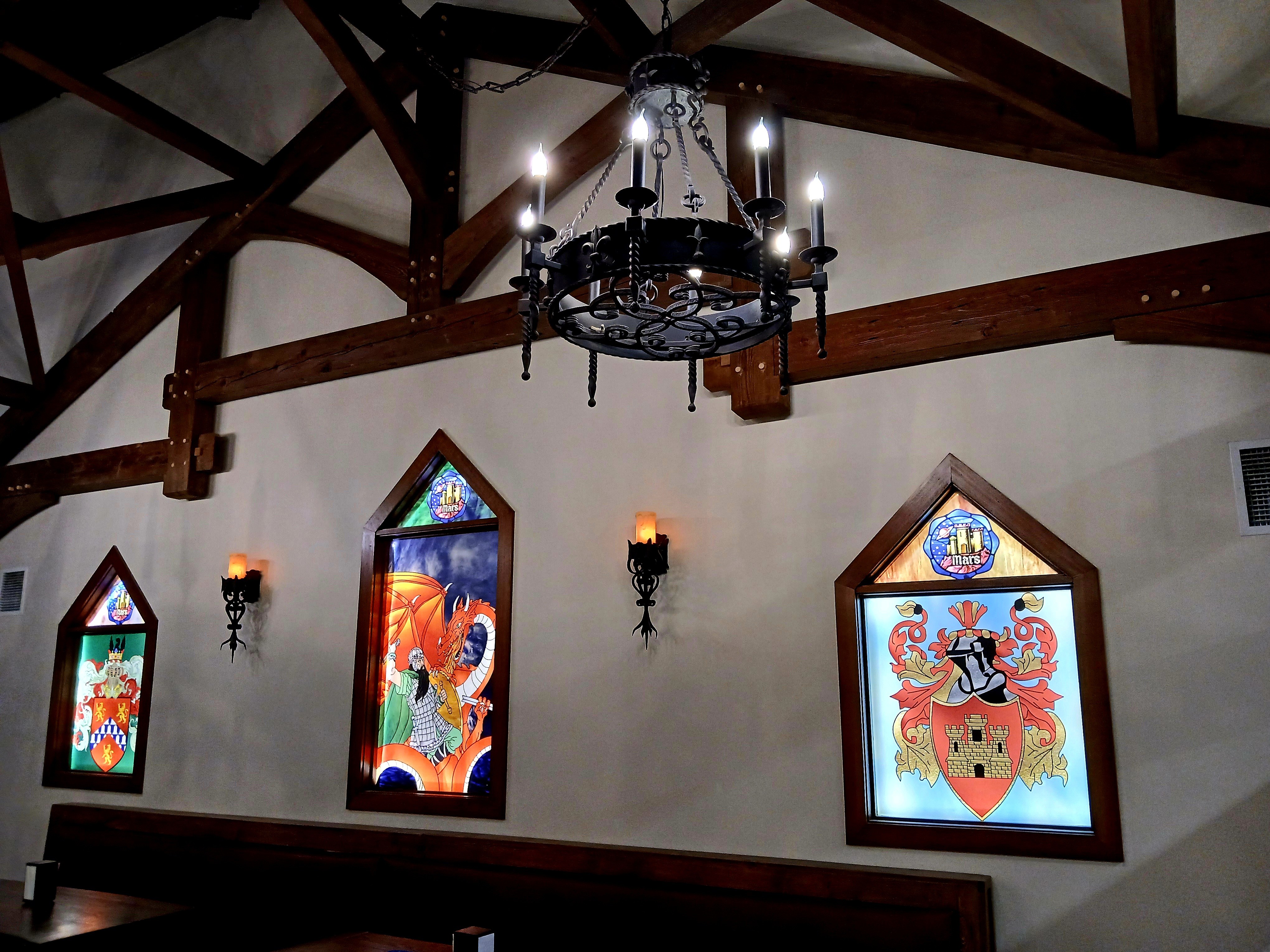
—Visiting Mars Cheese Castle, a humongous cheese shop in the shape of castle located in Kenosha, which I stopped at on the way to Lake Geneva. Coincidentally, this is not far from the University of Wisconsin Parkside, where Gen Con was held from 1978-1984, during the heyday of AD&D 1E. 

Mars has gone all-in on the medieval theme, which you can see in the photos:


The Mars brand cheese curd selection

—Having lunch at the diner inside Mars, where I had the "World's Best Fried Cheese Curd's", which did not disappoint, with Dang! butterscotch root beer, which I'd never heard of before but was excellent.


—Arriving at the Grand Geneva hotel, checking in and feeling like it was the day after last year's con. 


View from my room at the Grand

—Seeing the new D&D Pinball Machines in the lobby. There were a few units set up throughout the hotel for free play, and on another day I was able to try one for a few minutes.


—Meeting up with friends from back home also attending the con, and sharing pizza delivered from the venerable Next Door Pub, a favorite of TSR staff employees, and a pecan kringle from Mars for dessert.


The extensive Kringle stand at Mars, with a wide variety of flavors

—Super quick badge pickup. In an improvement from last year, they had many more check-in stations so that there was essentially no line by the time I arrived.


—Luke Gygax's annual Welcome Party, with free Spotted Cow on tap.

Next: Highlights from Day 1.

Monday, April 29, 2019

Thongor Fights the Pirates of Tarakus (1970)


We're going to need a bigger boat, mateys...

Yesterday's used bookstore find: Thongor Fights the Pirates of Tarakus, the sixth and last novel in Lin Carter's Thongor series. This series is Appendix N-adjacent, as Carter is called out in the list but only for his later Warrior at the World's End (1974).

Carter is probably best known for his pastiche work with L. Sprague de Camp on the Lancer/Ace editions of Conan, but he also edited seminal '70s fantasy series such as Ballantine Adult Fantasy and Flashing Swords, works that helped popularize the fantasy genre in the '60s & '70s. Years ago I read his very early (1969) book on Tolkien's work, A Look Behind the Lord of the Rings. 

Carter also helped get the Cthulhu Mythos into D&D by way of J. Eric Holmes; Holmes cited Carter's "H.P. Lovecraft: The Gods", in The Shuttered Room and Other Pieces (1959), as one of his sources for his “Lovecraftian Mythos in D&D” article in Dragon #12 in 1978. See my post The Cthulhu Mythos in D&D in the 1970s.

Thongor is a "Clonan", with the above cover specifically calling out Howard's character: "Sorcery and seafighting - and mortal peril for the mightiest warrior-hero CONAN". The author's note situates the series on "the Lost Continent of Lemuria" (drawing from Lemuria in popular culture), which is Carter's Hyborian Age analog.

The particular paperback I found is stated as the third printing, published by Berkely Medallion in 1976, with a fantastic cover by Vincent DiFate, different than the 1970 original.

I'm not sure when I'll get to reading this, but I'll try to update this post when I do. Possibly the pirates in this book will inspire some background details for the pirates in the sea cave in the Sample Dungeon.

See also "Ochre Jelly Inspiration?" which discusses a Carter & de Camp Conan story.

Sunday, February 19, 2017

Eastern Wizard Miniature

Photo from auction listing by Billy Galaxy Toys

Another painted Minifig mini from the J. Eric Holmes collection. This one is SS67 Eastern Wizard, from their Sword & Sorcery line. Note the "SS" stamp on the base.

Some of the figures from this line were inspired by the Conan stories. At first glance, this figure appears to have an unnatural "crab claw" hand, but I think he's actually holding a crescent shaped object. Anybody have any idea who he's supposed to represent, from Conan or another S&S story?

Wednesday, November 11, 2015

Part 53: "The Room Contains a Giant Snake"

Part 53 of a comparison of Holmes' manuscript with the published Basic Set rulebook. Turn to page 45 of your 'Blue Book' (page 44 for the 1st edition) and follow along...

The final part of the Sample Dungeon is the 3-part tower of the evil magic-user, who also frequents Room F where he is first described. In this part I'll cover Rooms S and S1, leaving S2 for the next post.


Room S - Spiral Staircase
  
This is the only part of this area actually shown on the map; the other two rooms (S1 and S2) are situated directly above it and are accessed by a staircase. Room S is part of the dungeon and is the only circular room in the dungeon. Does it date back to the time of Zenopus who excavated in his cellars or did the evil magic-user, who is trying "to take over the dungeons", dig it under his tower? On the published map, we can estimate that the thaumaturgist's tower is only about 300 feet from the ruins of Zenopus' tower. The roof of the room is 25 feet above, which is the same height as the entrance stairs at the start of the adventure, so this tower is either on the same hill as the ruins, or a nearby hill of similar height.

As you can see above, Room S on Holmes' original map is larger in relation to the other rooms of the dungeon. For example, Room S is larger than Room F. The published map puts it only about 40 feet across, but is should probably be more like 50 or 60 feet.

The room has four entrances/exits, including doors to the north and south, a secret door "opened by pressing a hidden catch" under the stairs and leading to a tunnel to Room F, and a trap door on the ceiling accessed by a spiral staircase going around the wall. The staircase is said to start at the north wall and make one full turn, which would place the trap door directly above the north door to the room. So the map only shows part of the staircase.

While the room can be accessed from other rooms in the dungeon, the evil wizard has a suitably hideous guardian for his tower - a giant snake. This is the only other thing in the room besides the staircase. 

Serpents of unusual size are fairly common in pulp fiction. Conan in particular encountered them on several times, including some associated with wizards. For example, in the Scarlet Citadel (1933), Conan is trapped with a giant snake in "the tunnels and dungeons wherein Tsotha [the wizard] performed horrible experiments with beings human, bestial, and, it was whispered, demoniac, tampering blasphemously with the naked basic elements of life itself".


Conan Chained by Frank Frazetta, used for the cover of Conan the Usurper (1967), a collection which includes The Scarlet Citadel
 

This being an introductory adventure, the snake here is not terribly difficult. Holmes gives it 2 HD, AC 6 (explicitly described as "leather and shield") and a move of 100 feet / turn. It would also have the default 1 attack for 1d6 damage. There are no giant snakes in the Holmes Basic Monster List, so this is another example of the "Giant Animals or Insects" from the Monster List in the manuscript, which was deleted by Gygax. 

There are no snakes in Chainmail, but OD&D Vol 2 mentions "snakes" in the description of "Insects or Small Animals", which are creatures with 1 hit point to 1 HD, AC 8. The entry for "Large Insects or Animals" covers "giant ants and prehistoric monsters" having 2 to 20 HD, so one might interpret this as covering giant snakes. OD&D Vol 3 lists Giants Snakes on Monster Level 3 (pg 10), suggesting about 3 HD, and on the Swimmer table. The extra descriptions of Aquatic Monsters on page 35 include Giant Snakes, but these have 6 HD.

The Greyhawk Supplement included Giant Snake in the list of "Attacks and Damage by Monster Type" (i.e., variable monster damage), but we don't see that information included here, of course, since Holmes didn't include that information in the Monster List - it was added by Gygax during editing.

Moldvay Basic and the AD&D Monster Manual each include a differing assortment of Giant Snakes, none of them close to the snake here. In those books, the lower HD snakes are poisonous, and the constrictors are much larger, having 5-6 HD.

As published, the only changes to this room are to add the snake's hit points (13) and change trap door to "trap doors". This seems to be a mistake since the first paragraph still refers to a single "trap door".

Rooom S1 - Ground Floor

This is the "ground floor of the magician's tower", and with S2 above, the only "rooms" that are part of a building in Portown rather than the dungeon. The description indicates there is a street to the north of the tower, which would be between this tower and the ruins of Zenopus. Another spiral staircase leads up to a trap door to the next floor. There's a brief description of the contents, all mudane: a fireplace (suggesting the tower has a chimney), cooking utensils and a few chairs. As you might guess, since it's all basically descriptive there are no changes to this room as published.

Continue on to Part 54: "An Ape in an Iron Cage" (Room S2 and the Coda)
or Go Back to Part 52: "No End to the Rats" (Room RT)
or Go Back to the Index: The Holmes Manuscript

Wednesday, January 11, 2012

Conan on the River of Doom

Battle of Zama, courtesy Google Images, illustrator not indicated

Previously I discussed Dr. Holmes' appreciation for the works of L. Sprague de Camp, particularly an obscure novel titled Solomon's Stone. Holmes not only a fan of de Camp - he also worked for him at one point as a contracted author! This was described in an article written by John Martin in 1995, titled "In the Burroughs Tradition: John Eric Holmes and the Mahars of Pellucidar", published in Paperback Parade #42. The article is based on an extensive interview that Martin conducted with Holmes, which naturally focused on his Pellucidar work (D&D receives the briefest of mentions). John Martin later included part of the original article in rewritten form in an Edgardemain internet article titled, "John Eric Holmes: Mahars of Pellucidar and Red Axe of Pellucidar". The original version has a bit more detail, and quotes Holmes directly, so I'll reproduced the relevant paragraphs here:

"Awhile back, he had a contract with L. Sprague de Camp to write a Conan novel "I wrote two-thirds of CONAN ON THE RIVER OF DOOM, and then they changed editors and the new editor said he didn't want a Conan book set in Africa and that project died, although I did get paid. The nice thing about dealing with L. Sprague de Camp," he said, "was that de Camp took the writer's side and wrote contracts in such a way that a write could keep the rights to his material, even if it was turned down by the publisher."

"He's thought of simply programming his computer to change Conan's name to something else and finish and submit the story elsewhere. But instead of that, "I thought of another way I wanted to come at it. I decided I wanted to do some other historical things about Africa with it and I wanted to start off with the battle of the Plains of Zama where Hannibal is defeated by Scipio Africanus, and have my hero be part of Hannibal's army that escapes into the interior of Africa, and ends up with a 'searching out of the river monsters' kind of quest," Holmes said."

Holmes' revision has never been published, and it's unclear whether it was ever finished.

I'm not sure what year his contract with de Camp would have been...sometime in the early '80s? Perhaps the Bantam Editions from 1978-1982, which L. Sprague de Camp was heavily involved with. The last of these was the novelization of the Conan the Barbarian in '82. Perhaps someone with more knowledge of when de Camp stopped editing Conan could provide some insight.

Holmes may have been drawn to the African locale based on his appreciation for Burrough's Tarzan stories. The Martin article also describes how as an eight-year old living in Hawaii, Holmes met Burroughs and had him sign a copy of Tarzan and the Leopard Men. And while on the subject of Africa and aquatic monsters, I'll also note that Holmes also wrote a fantasy supplement for Avalon Hill's Source of the Nile game, published in The Dragon #24, April 1979, where explorers in the game have a chance of finding a city of survivors of lost Atlantis who have a sacred pool inhabited by a "mosasaurus, a gigantic aquatic dinosaur which has miraculously survived the eons in the lost city".

John Martin also wrote a moving account of the memorial service for Dr. Holmes in 2010.