This is the blog. Click here to go to the Zenopus Archives website.

Note: Many older posts on this blog are missing images, but can be viewed at the corresponding page in the Internet Archive

FEATURED POST

The Forgotten Smugglers' Cave: Index of Posts

An index of posts describing the Forgotten Smugglers' Cave, an adventure for Holmes Basic characters levels 2-4.                    ...

Showing posts with label Wandering Monsters. Show all posts

Friday, November 4, 2022

The Forgotten Smugglers' Cave #13: Twisty Passages

This is an installment of a new dungeon adventure set in the Portown milieu, which I'm writing for Holmes Basic D&D. You can find the Introduction to the dungeon here: Area 1.

Each entry includes part of a "pointcrawl" map showing the area & any exits, which include links allowing you to navigate the dungeon:

Area 14
||
13. TWISTY PASSAGES
||
Area 11

13. TWISTY PASSAGES. This is a natural labyrinth of narrow, winding passages that is supernaturally challenging to navigate due to the effects of a dying smuggler's curse. This area can be entered from either the stream tunnel to the south (Area 11) or from the north (Area 14, to be described).

Movement. Due to the disorientation, movement in the Twisty Passages is handled differently than standard movement. Each turn, roll 2d6 and add the total number of turns the party has spent in the area (i.e., add 1 on the first turn; add 2 on the second turn, etc), and then consult the following table:

Encounters in the Twisty Passages (2d6 roll + turn number):

3-4. Nothing. The party wanders aimlessly.

5. An Item. A piece of equipment, showing signs of age and disrepair, is found on the floor of the tunnel (roll on the "Equipping the Adventurer" reference sheet; re-roll if the result doesn't make sense; e.g., a horse).

6-8. Cursed Doubloon. A double-sized platinum coin (worth 10 gp) lies on the tunnel floor. If any character handles it, note this, as they will suffer a penalty on a save made when leaving the area (see below).

9. Eerie Noise. The party hears one of the following noises echoing through the tunnels (roll 1d6): 1. Coins Jingling; 2. Scraping; 3. Thudding Footsteps; 4. Crunching & Cracking; 5-6. Ghostly Whispering. If the party moves towards the noise, there is a 3 in 6 chance that the next turn will be either #11-12 below (for noises 1-4) or #13-14 (for noises 5-6). 

10. Skeletal Remains. Human bones, scattered about, along with 1-2 items per #5 above. If a platinum doubloon is brought into the area, the bones will begin scraping themselves together, which after 1d4 rounds form into a partial skeleton (treat as a skeletal torso below in #11-12), and inexorably move towards the doubloon. 

11-12. Undead Smuggler. The animated remains of a smuggler, now cursed to search the tunnels endlessly for platinum doubloons. They will move inexorably towards and attack any character carrying a doubloon, but will depart if given all doubloons possessed by the party. (The ghost periodically steals the doubloons back and scatters them throughout the tunnels). 

Form (roll 1d6):

1. Skeletal Torso (DX 3, AC 9, HD 1/8, 1 hp, AT 1 claws for 1 point, turned as skeleton with a +2 on the roll), and wears/carries 1-2 items per #5 above. This is the upper half of a skeleton, and pulls itself across the floor with its arms.

2. Skeletal Legs (DX 12, AC 9, HD 1/8, 1 hp, AT 1 kick for 1 point, turned as skeletal torso). This is the lower half of a skeleton (pelvis and legs).

3. Skeleton (DX 12, AC 7, HD 1/2, 2 hp, AT 1 claws for 1d6). Carries 1-2 items per #5 above, and 0-2 (1d4-2) doubloons.

4. Skeletal Duelist (DX 15, AC 6, HD 1, 5 hp, AT 2 weapons; turned as zombie). Wears leather armor and wields sword & dagger (2 attacks/round), and has 0-3 (1d4-1) doubloons.

5. Zombie (DX 6, AC 7, HD 2, 9 hp, AT 1 claws for 1d8). Wears leather armor and a backpack with 1d4 items per #5 above, and has 0-3 (1d4-1) doubloons.

6. Big Zombie (DX 4, AC 5, HD 3, 14 hp, AT 2 bones for 1d6; turned as a ghoul). Wears chainmail and wields two large bones.

13-14. Mysterious Figure. Just visible down one tunnel stands the silhouette of a short figure. If approached, it withdraws into the darkness. If followed, it will lead them to the Ghost's Resting Place in the next turn (see below); otherwise, roll again as normal.

15-16. Ghostly Thief. A random party member must save versus spells or have a random piece of small equipment or treasure (preferentially a magic item) spirited away to #17-18 below.

17-18. Ghost's Resting Place. This area appears as #10 Skeletal Remains (see above). However, a narrow niche in one wall conceals a small hiding space (5' diameter, 5' height). This is difficult to find; treat as a secret door unless led here by the Mysterious Figure above. Inside the space, a skeleton sits against a locked chest holding roughly 1,000 platinum doubloons (value 10,000 gp), as well any items of characters that were stolen. Opening the chest will cause the ghost to materialize before the party. 

The Ghost. The characters hear a whisper that the ghost, Ness Sentra, was once the leader of the "importers" operating in these caves. They operated successful for decades, until she executed a heist of platinum doubloons from the wizard Zenopus. This proved her downfall, as her second-in-command, Mot Daxor, grew obsessed with the coins, and led a faction in mutiny against her. She slew Daxor in a duel but was backstabbed by one of his cronies. Mortally wounded, she fled here, and before dying swore that all who came for the treasure would be doomed to search for it forever.

The ghost is treated as an Reinvigorating Spirit, a new monster written up here. It will only restore a lost level once the curse has been lifted.

Reinvigorating Spirit (1): DX 9, AC 3, HD 4, 30 hp, AT 1 touch for 1d6

Lifting the Curse. The characters will sense that the curse can be lifted placing the remains of Sentra in her rightful place in a sarcophagi in the Crypt of the Arch Smugglers (Area 24), where Mot Daxor was instead entombed, and that the coins will then be theirs.

19+. An Exit. Roll the d12 again, on 1-6: exit to the south (Area 12); on 7-12: exit to the north (Area 14). When attempting to leave the area, each character must save versus spells, with a -1 on the roll for every 5 doubloons handled. On a failed save, the character will feel compelled to continue searching the caves for doubloons, and will lose one point of wisdom for each day spent outside the caves. This loss is permanent until the curse is lifted.

Chronologically on this blog, the previous post installment was Area 12 and the next posted installment will be Area 14.

Notes:

The name and description are inspired by the "maze of twisty little passages, all alike" in the original text adventure game, Adventure (aka Colossal Cave), which I played once on a memorable evening in the early '80s, and then more extensively in its cloned form in Infocom's Zork I on my home computer. (The pointcrawl map format that I am using for these drafts is also inspired by the hand-drawn maps that players would make for navigating these games). And then, obviously, having a pirate (Adventure) or thief (Zork) in the maze that steals stuff is also inspired by those games.

Friday, November 12, 2021

The Forgotten Smugglers' Cave: Random Encounters

A random encounter table for the The Forgotten Smugglers' Cave, which starts here.


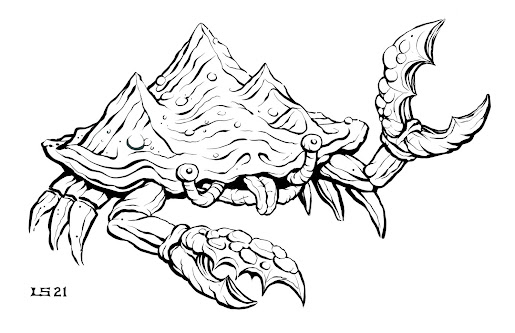
Illustration of a Large Rock Crab by Lore Suto


d12 Wandering Monsters and Other Encounters

When the players spend a turn searching, there is a 1 in 12 chance of an encounter per turn.

If an encounter occurs, roll d12 to determine which:

1. A large rock crab, camouflaged as a rock or stalagmite, strikes out at a random party member with previously hidden claws, surprising on 1-3 in 6. It will spend the next round drumming its claws on the rocky floor (during which time the characters can flee without being attacked), which cause 1d4 crabs to turn up in the next round (from a total colony of 2d4). They will continue this behavior (attacking alternately with drumming) until all crabs in the colony join in.

Large Rock Crab (2d4): DX 9, AC 5, HD 1/2, AT 2 claws for 1d4 each.

A full "new monster" entry for the rock crab can found here

2. A huge rock crab, camouflaged as a stalactite on the ceiling, drops on a random party member. This surprises on 1-5 in 6, and if the crab gains surprise, the drop is treated as an attack roll with a +4 to hit and doing the indicated damage; if a character is not surprised, they can automatically avoid the dropping crab. Once on the ground, the crab will spend the next round drumming its claws on the floor (see above), attracting the other 1d6 huge crabs in its group to drop to the ground and join in (there is only a 10% chance that any of the other are directly over another party member). 

Huge Rock Crab (1d6): DX 6, AC 3, HD 1, AT 2 claws for 1d6 each or drop for 1d8. 

3. A stalactite or chunk of rubble, disturbed by the group's movements, falls from above on a random party member. Treat as an attack by a huge rock crab above, but without further attacks.

4. pack of feral cats, descendants of smugglers' pets, begins circling the party just beyond their light source, meowing raucously for food. Providing food will quiet them. Otherwise, the noise will keep increasing until something else is attracted to the noise (roll again on the table), at which point it will suddenly cease.

5. A juvenile carrion crawler reaches down from a wall or ceiling in an attempt to paralyze a random party member. This is the spawn of the carrion crawler in Area #3; these are encountered alone, and there are only 8 in total throughout the cave system.

Juvenile Carrion Crawler (1): DX 15, AC 9, HD 1, AT 2 only (due to small size), D 0 + save vs poison at +4 or paralyzed.

6. The ghost of a peddler, who long ago provided the smugglers with goods, approaches. He is friendly and eager to sell goods to the party. He can procure any type ordinary equipment available at twice the cost of the rulebook prices. However, these items are actually brought forward in time from the past, and return there after one day.

7. An aggregation of aggroaches on the hunt scurries towards the party. See the full writeup of the aggroach here

Aggroach (variable): DX 10, AC 7, HD variable, AT 1 bite for 1 point.

Roll a d12 for size and numbers: 

1-6      =  2d6    least  (1 hp)
7-9      =  1d10  large  (HD 1/2)
10-11  =  1d6    huge  (HD 1)
12       =  1d4    giant  (HD 2)

8. A cloud of miasma settles in the area, sickening the party. Each must Save vs. Poison or make all die rolls at -1 for 3 turns.

9. A vampire bat, part of the colony in Area 6swoops in and attempts to bite a random party member. 

Vampire Bat (1): DX 18, AC 3 (9 while attached), HD 1/8 (1 hp), AT 1 bite for 1 point damage, attaches on a successful hit and then automatically drains 1 hp per round for two rounds, at which point it is full and will detach and fly away. 

10. A group of torches appears in the distance in the dark. Once in the light, they are revealed as floating torches. These are corpse lights, a type of minor undead formed from the spirits of smuggler lackeys who died in the caves.

Corpse Light (floating torch) (3d4): DX 10, AC 7, HD 1/8 (1 hp), AT 1 torch for 1 point of damage. Undead, turned as skeletons with a +2 on the roll.

11. A partial skeleton, just an upper torso, drags itself into view and begins inexorably crawling towards a member of party. On 1 in 4 it still wears a minor piece of jewelry worth 10d4 gp.

Partial Skeleton (1): DX 10, AC 7, HD 1/8 (1 hp), AT 1 claws for 1 point of damage. Undead, turned as skeletons with a +2 on the roll. 

12. Roll for surprise. On a 1 or 2, a random adventurer realizes that the wet rock they are standing on is actually a grey ooze, which has begun dissolving their boots. Otherwise, they  are merely standing near the ooze.

Gray Ooze (1): DX 3, AC 8, HD 3, AT 1 for 2d8.

Chronologically on this blog, this post was made after Area 10 and before Area 11.

Monday, February 3, 2020

Delta on the Monsters & Treasures of the Dungeon of Zenopus


As part of a continuing Subterrane Surveys series, Delta's D&D Hotspot has two posts up that look in detail at the monsters and treasures of the Dungeon of Zenopus, and the resultant experience point totals. The first one covers Holmes' original version as seen in the Holmes Manuscript, and the second one looks at the dungeon as published, which includes a number of changes made by Gygax.


Subterrane Surveys: Dungeon of Zenopus (per Holmes)

Today we're looking at the sample dungeon from the first-ever D&D Basic Set, edited by Eric Holmes (1979) -- what many of us now call the "Dungeon of Zenopus". This has been very influential over the years -- and just last week, our friend Zenopus Archives published a 5E conversion on DM's Guild.

Subterrane Surveys: Dungeon of Zenopus (per Gygax)

Today we're again looking at the sample dungeon in the first Basic D&D set (1979), the "Dungeon of Zenopus". Last time we looked at Eric Holmes' original unpublished draft. But after Holmes submitted that work, Gary Gygax took an editorial pass at it, changing many items on a line-by-line basis.

Monday, July 1, 2019

d12 Hauntings in the Dungeon of Zenopus


Detail from a Clarkson Stanfield illustration

"...but then neighbors and the night watchmen complained that ghostly blue lights appeared in the windows at night, that ghastly screams could be heard emanating from the tower at all hours, and goblin figures could be seen dancing on the tower roof in the moonlight". 
As told in the introduction to the Sample Dungeon, after the demise of Zenopus his tower was haunted by mysterious forces until it was destroyed by the town. While this stopped the above ground hauntings, it seems likely they would continue in the passages beneath. To this end, here I've written out 12 possible  hauntings that may visit a party exploring the dungeon. You might add a chance of one appearing when making a wandering monster check (e.g., a 1 on the d6 is a standard wandering monster, while a 2 is instead a haunting). The ones marked with a star should only appear once.

1*. An insane antiquarian (DX 10, AC 5, HD 0, hp 2, #AT 1 fists for 1 point) wearing an octopoid crown rushes the party, yelling for submission to the eight-armed sea queen, and pummeling whoever is closest. The antiquarian will (temporarily?) regain sanity if the crown is removed and they are brought out of the dungeon. The crown was found in an ancient chamber discovered when a cellar was excavated in Portown, and cannot be removed by the wearer themselves once worn (treat as a cursed ring of protection +2 that slowly drives the wearer mad).

2. A column of sickly green flame, 5' wide and 10' high, spouts from the floor (1-3 = ahead 10-100', 4-5 = behind, 6 = directly under party). All viewing it feel increasingly queasy (save versus spells each round or flee for 1d6 rounds). If touched or hit, the cold flame suddenly leaps on to the attacker and burns away vital forces (one point of Constitution per round; make a new save to break away). Once Con is exhausted, the victim's flesh withers, leaving an animated skeleton wearing their equipment. For survivors, Con is regained at the same rate. The column burns for 1d6 rounds after last touched. 


3*. An old skeleton (DX 6, AC 6, HD 1/8, hp 2, #AT 1 touch with green fire) wearing tattered blue robes totters unsteadily down the corridor. A cold green flame burns in its eye sockets. It feebly attempts to grab anyone approaching within 20 feet (the limit of its "sight"). If touched or hit, the green flame reacts as in #2 above. If the skeleton is destroyed the fire burns for 1d6 rounds. It wears a gold ring with an italicized "Z", value 50 gp. This is a former servant of Zenopus slain when the green flame engulfed the tower fifty years prior.

4. A ghostly blue light illuminates the corridor, slowly coalescing into a shape vaguely like a blue-robed figure. If the party lingers, the character with the highest Intelligence must save versus spells. If they save, the spirit will assault the next most intelligent character, and so forth. Failure results in a whispering in the mind urging the character to spend the night in the dungeon (save again to leave). Each night in the dungeon temporarily drains a point of Wisdom, until zero when they are under control of the spirit, which is that of a sinister wizard from the past, wishing to return to life (optionally, this is Zenopus himself).


Cover art for "L'Affaire Charles Dexter Ward"


5. A lone g
hastly scream is suddenly heard in the distance, but the direction is not clear, and it is not immediately repeated. Roll again for a chance of a wandering monster.

6. A shadowy goblin-sized figure (DX 18, AC 2, HD 1, hp 5, #AT 1 claws for 1d6) hangs from a wall at the edge of the party's light source. It hisses and dances away if the light advances. This is one of many small otherworldly familiars summoned by Zenopus to aid in his laboratory, and now trapped in our world. If a magic-user approaches alone and converses with the creature it may agree to serve as a familiar (make a reaction roll).


From "A Special Trick" by Mercer Mayer


7*. An armored zombie (DX 8, AC 5, HD 2, hp 8, #AT 1 claws every other round for 1d8) begins following the party. It does not attack unless attacked itself. An unsuccessful adventurer, it seeks the way back to town. It wears chainmail, a helmet and a leather backpack, which holds equipment and a note from one Griselda of Portown, dated months ago. If destroyed and the body returned to Griselda she will reward the party with 100 GP. If the party does not destroy the zombie, it will follow them out and return to her on its own.

8. A salty sea fog rolls across the floor and begins to fill the corridor or room. Each round it grows 1 foot higher, continuing no matter how far the party travels during this time, until it reaches the ceiling. Once, this occurs visibility is reduced to 1 foot (and all attacks are made at -2). After 1d6 turns, the mist will dissipate. 

9. A wind of fine sand picks up, gentle at first but but increasing in speed and particle size to a hail of pebbles and then a gale of rocks. All torches are extinguished in 1d6 rounds, and all who stay in place may take damage (roll an attack by 5 HD monster for 1d6 damage each round) before it subsides (2d6 rounds). The wind can be avoided by finding cover or going around a corner, as it only blows in a straight line.

10*. A ghostly crabber stalks the party from fifty feet behind; loud wet footsteps are heard. The ghost is covered in sucker marks and kelp (a victim the pirates fed to the giant octopus). If the party halts it stops and wordlessly points in the direction of the pirates (Cave M). If approached, it vanishes and reappears behind them. This keeps up until vengeance against the pirates is achieved, when it fades away, leaving a golden crab worth 1,000 gp.


11*. The shadow of each character begins to divide, forming a second one doubling the first. Each turn there is a 1 in 6 chance of noticing this; after 1d6 turns the shadows detach and attack the respective characters (if unnoticed, surprise is on 1-3 in 6). Each character fights their own shadow (AC 9, HD 1, hp equal to character, #AT 1 shadow weapon for 1d4). Extinguishing all light will delay the progression for an equal amount of time. 

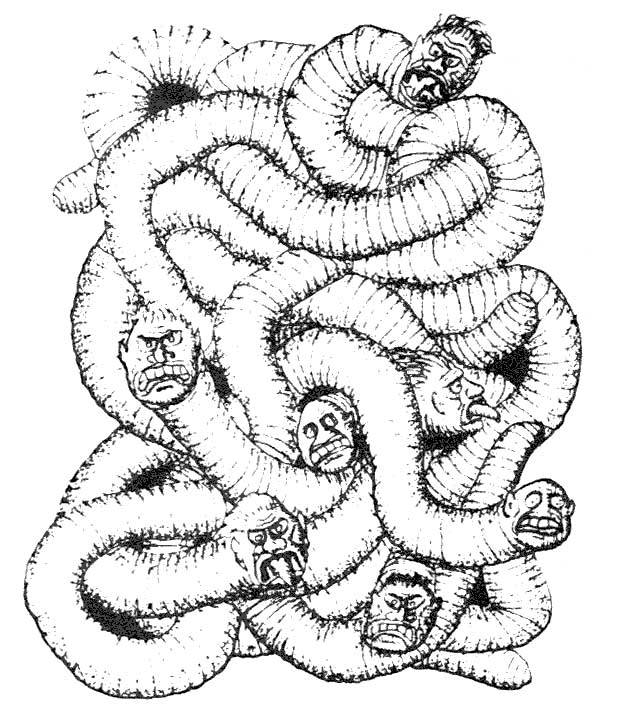
12*. The enormous bloated corpse of a former Portown bon vivant and charlatan slowly shuffles towards the party. It smells terrible, and mutters in a strange multi-voiced manner. It is not undead, but is instead animated from within by larvae (human-headed hellworms; see the Monster Manual for a description). If struck by any weapon it explodes in a shower of swamp gas (save vs poison or attack at -2) and larvae (2d4 total; AC 7, HD 1, hp 5, #AT 1 bite for 1d4+1), which surprise on 1-4 in 6. Hidden in the intestines of the corpse is a stolen blue diamond worth 500 GP, which caused their death when swallowed to hide the evidence.


Larvae by David C. Sutherland III


Sunday, February 14, 2016

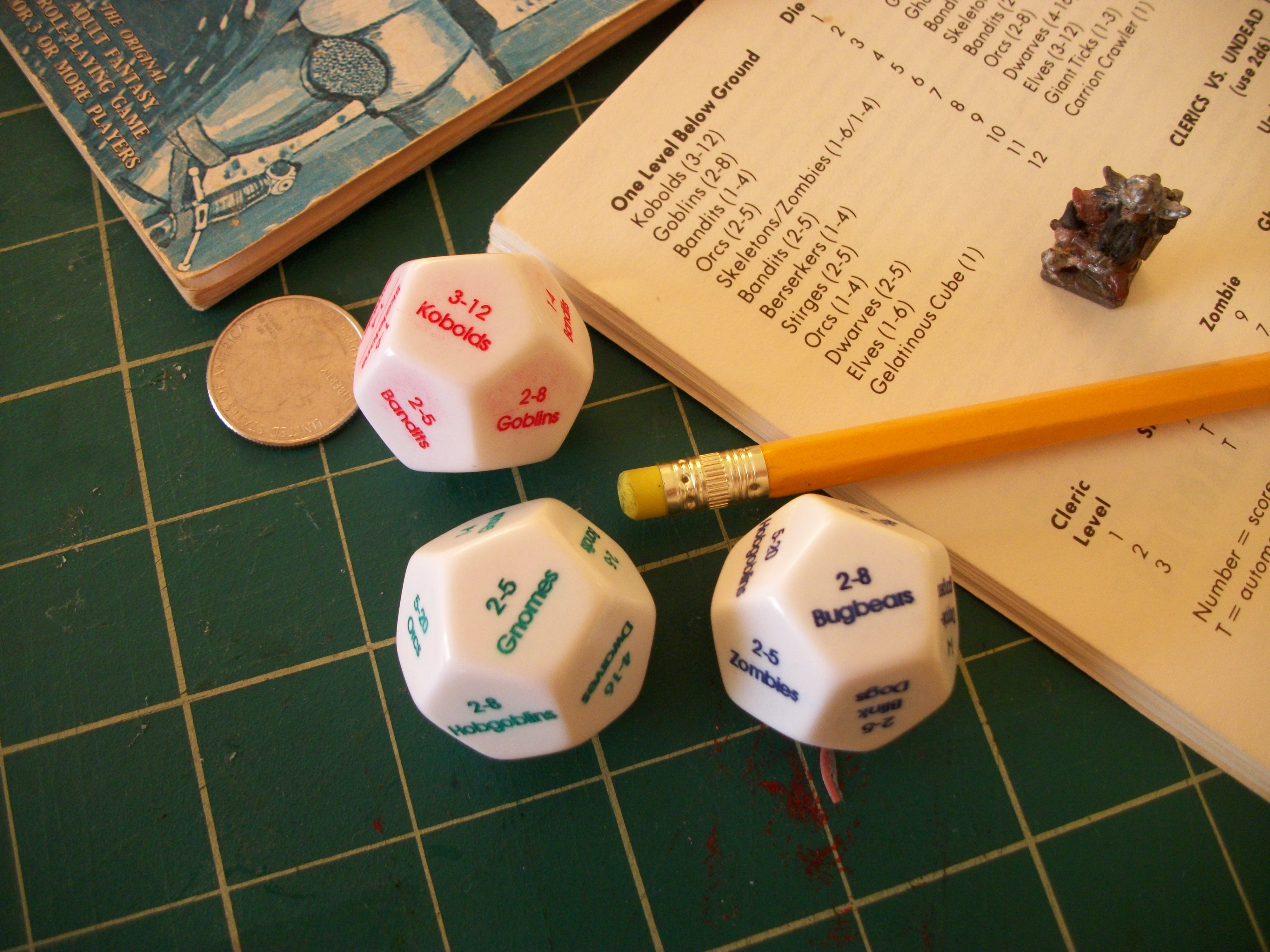
Wandering Monster Dice

"At the end of each three turns the Dungeon Master can roll a die to see if a wandering monster has come down the corridor. A roll of 6 means that something has come "strolling" along" - Holmes Basic rulebook
Eric Harshbarger, the Lego sculptor and game/puzzle designer who built a Lego mosaic of the Sutherland Dragon, has made Wandering Monster d12s based on the Holmes Basic encounter tables (3rd edition version). The post on his site is partially quoted below:

Wandering Monsters Die

This is probably the most specialized set of dice I've ever made, and it will appeal only to those who are as enamored with "old school" role-playing games as I am. The original Basic Dungeons & Dragons game had tables in it for "random encounters" or "wandering monsters". If something was encountered by an adventuring party, the dungeon master was supposed to roll a twelve sided die and refer to one of three tables (depending upon what "level" of the dungeon the party was on -- the rulebook only considered dungeons of depth down to level three).
Click here to read the rest of his post.

Click here to read about changes to the Level 1-3 Wandering Monster Tables from OD&D Vol III to Greyhawk to the three printings of Holmes Basic. 

Wednesday, November 27, 2013

Part 7: "Something Has Come Strolling Along"

Part 7 of a comparison of Holmes' manuscript with the published Basic Set rulebook. Turn to page 10 of your 'Blue Book' and follow along...

TRAPS, DOORS, SECRET DOORS, SURPRISES, WANDERING MONSTERS:
In the manuscript, the title of this section has "CLOSED DOORS" and "HIDDEN DOORS" for the second and third items. This was changed in the rulebook, but Holmes' original title survived into the Table of Contents of the first printing.

Traps: The only change to this paragraph in the published version was to append the final sentence with "...taking one or more 6-sided dice of damage". 

Doors: The first sentence was revised from "often locked" to "often stuck or locked".

Listen: No changes.

Secret Door: The published version of this paragraph adds a new sentence at the end, "Of course, the Dungeon Master will lessen these possibilities in lower levels of the dungeon".

Spiking Doors: No changes.

Surprise: No changes.

Wandering Monster: The first paragraph has no changes. The published version of the second paragraph adds a new sentence at the end, "Where a slash (/) appears between two monsters, roll again to see which of the two appears". This clarifies how to use of the Wandering Monster Table.

The published version has a long third paragraph that discusses adjusting the number of monsters encountered, but this is not present in this location in the manuscript. Instead, Holmes has some of this information later in two brief sentences following the Reaction Table:


Holmes got this information from pages 11-12 of Vol 3 of OD&D:

Number of Wandering Monsters Appearing: If the level beneath the surface roughIy corresponds with the level of the monster then the number of monsters will be based on a single creature, modified by type (that is Orcs and the like will be in groups) and the number of adventurers in the party. A party of from 1-3 wouId draw the basic number of monsters, 4-6 wouId bring about twice as many, and so on.

Holmes altered "basic number" to "one", presumably based on the first sentence that says "single creature". In the published paragraph, TSR changes this advice to suggest a number of monsters "roughly equal" to the strength of the party.

Level Beneath the Surface Table: This table, which is a revised version of the table on page 10 of Vol 3 of OD&D, is not present in the draft. Perhaps Holmes wasn't sure how to revise this, since the original table allowed for monsters of level 4 and above to be encountered on levels 1-3.

As a side note, the table (found in the published rulebook) has a nice mirror symmetry. 
The monsters that will be encountered on each level have the following ratios:
Level 1 --- 8:3:1 (i.e., 8 1st level monsters to 3 2nd level monsters to 1 3rd level monster)  
Level 2 --- 3:6:3
Level 3 --- 1:3:8

Wandering Monster Table: We've known for a long time that the WMT in the first print of the Basic rulebook was not Holmes' original. In Dragon #52, when reviewing the new Moldvay Basic Set, he wrote:

"The first Basic Set rulebook contained some irritating typographical errors. Someone at TSR rewrote the wandering monster table and put in a number of creatures that were not in my list of monster descriptions. But most of the errors were corrected for the second printing."

Holmes' original WMT is found in the manuscript, and tracks very closely to the tables from the Greyhawk Supplement, pg 64.


The only change that Holmes made to the Greyhawk Tables, which can be seen here, was to write out the level of the NPCs, rather than using level titles. He may have done this since the level titles above 3 do not appear in the Basic rules (of course, neither do stats for any of these higher levels). Here again we see Holmes using "order" instead of "level" for character level.

The secondary editor(s) at TSR seems to have revised the Greyhawk tables by drawing heavily on the Monster & Treasure Assortments, which included numbers of monsters for each type - something not found in the Greyhawk tables. However, this lead to monsters from the M&TA that are not in the Holmes rulebook being included in the 1st printing of the published rulebook. This table was revised again in the second and third printings as discussed in the post linked above showing the Greyhawk Tables.

Hostile-Friendly Reaction Table: This table is identical in the manuscript and published version, including introductory paragraph, and first sentence following it. As mentioned above, the second and third sentences following were moved to before the table and expanded. 

Holmes adapted this table from two places: OD&D, Vol 3, page 12 and the one in OD&D, Vol 1, page 12. The first source has the general format and content of the preceding and subsequent sentences, plus a smaller 3-entry table, and the second source has the more familiar 5-entry table.

Following this table, there is another paragraph covering pursuit. The only change here is to change the first instance of "(roll 1-3)" to "(roll 1-3 on a 6-sided die)". Holmes adapted this material from OD&D, Vol 3, page 12, although he simplified the material, including changing percentages to d6 rolls. 

Continue on to Part 8: "Successively Deeper Strata"
Or Go Back to
Part 6: "Fully Armored and Heavily Loaded"
Or Go Back to Start: The Holmes Manuscript 

Friday, October 18, 2013

Basic Level Monster Tables 1974-1978


Above is a graphic I jimmied up comparing the Monster Tables for Dungeon Levels 1-3 from OD&D Vol III (Jan '74), the Greyhawk Supplement (Feb '75), and the 1st three printings of Holmes Basic ('77-'78). I reoriented the tables for side-by-side comparison. I didn't have a scan of the 3rd print Holmes Table handy so I just annotated the changes. The Holmes table doesn't change again after the 3rd print. The obvious absence is the tables from the Monster & Treasure Assortment, Set 1, but with 100 entries for each level it wasn't practical to include it.

As you can see, the table from the 1st print Holmes has the same number of entries for each level as in Greyhawk, and preserves many of the monsters. The 1st level Holmes table actually includes every single monster from the 1st level of Greyhawk, with a few additions crammed in. The 2nd level of Holmes diverges more, and includes a few real oddities: Leprechauns, Troglodites [sic] and Piercers, monsters that appeared nowhere in an OD&D rulebook or Holmes itself. Leprechauns and Piercers made their debut in the Strategic Review #3 (Autumn '75), and Troglodytes in the convention version of Lost Caverns of Tsojconth ('76). As I mentioned yesterday, these monsters also appeared in the tables in the Monster & Treasure Assortments, so that may be the reason they ended up here. The 3rd level table preserves at least half of the corresponding Greyhawk level, and includes one more monster that debuted in the SR #3, Shriekers.

The tables in the 2nd print (Jan 78) of Holmes attempt to "fix" the tables for Basic by removing monsters not described in the monster list, and NPCs over 3rd level, also not described in Basic. Lower level NPCs were retained. One missing monster was overlooked (Gnolls), so in the 3rd print these were also changed - but they also went ahead and removed all of the classed characters. The changes are not especially imaginative and reduce the variety found in the tables, resulting in duplicating entries for bandits and orcs on Levels One and Two.

Ironically, the 2nd edition of the Holmes rulebook altered the Monster List, adding in a bunch of low level monsters from the Monster Manual, including many of the missing ones from these tables - Giant Rats, Giant Centipedes, Large/Huge/Giant Spiders, Gnolls, Troglodytes and Shriekers. But these monsters were never given their places back in the Wandering Monster Table.

Update #1 (2/2016): The 1st printing of OD&D Vol III had a slightly different list for Level 2. Entry 7 was Ghouls rather than Thouls, and entry 8 was Toads rather than Ghouls. This must be the source of the Giant Toads in the Level 2 lists in Greyhawk and the Holmes 1st printing.

Update #2: See also the Holmes Manuscript series Part 7, which shows that Holmes originally used the Greyhawk tables, and therefore TSR was responsible for the rest.

Thursday, October 17, 2013

Wandering Monster Table - 1st print

Click for larger view

Above is a scan of the Wandering Monster Table from the 1st print of the Holmes Basic rulebook, July 1977. This particular image is of the reference sheet from the back of the book. Thanks to Serian at the Acaeum for providing the scan several years ago at my request. The table is also found on page 10 of the rulebook.

A few years after the Basic Set Holmes wrote, “The first Basic Set rulebook contained some irritating typographical errors. Someone at TSR rewrote the wandering monster table and put in a number of creatures that were not in my list of monster descriptions. But most of the errors were corrected for the second printing” (pg 18, Dragon #52, 1981). 

The monsters not found in the MONSTER LIST in the rulebook include:
1st level: Centipede, Large Spider, Giant Rat
2nd level: Troglodite [sic], Giant Toad, Huge Spider, Gnoll, Leprechaun, Piercer
3rd level: Shrieker, Giant Snake, Giant Spider, Giant Weasel, Giant Lizard


Some of these monsters are found in the original tables from Vol III of OD&D and the Greyhawk supplement, and most can be found in the Monster & Treasure Assortment that was also included in the first three printings of the Basic Set. In addition, the "number appearing" are also mostly the same as those found in the M&TA set. These makes me think that the secondary TSR editor rewrote this table using the M&TA set. I have yet to see Holmes' original wandering monster tables from the manuscript, but hopefully they will be made available in the future for further comparison.

Why didn't Holmes include such low-level staples such as Giant Centipedes, Giant Rats and Huge/Giant Spiders in the Basic Rulebook? Possibly because these creatures never had a full write-up in OD&D. They are encompassed by the "Small" or "Large" Animals found in Vol 2 of OD&D, and some additional scattered stats appear in other places, but a full "monster entry" didn't appear until the Monster Manual. And then these entries were used as the basis for entries in the 2nd edition of the Holmes rulebook (Nov 78). Overall, Holmes included only a single "giant" animal - the "giant tick" in the MONSTER LIST, despite using a number of them in the Sample Dungeon - giant rats, giant spiders, giant crab, giant snake and large octopus. He may have thought that the full entries for these creatures was not a necessity.

The reason I requested the above scan is that in my personal copy of the first print, the table has been annotated (by a previous owner) to "fix" the undescribed monsters, in a unique way:


Click for larger view

The replacements include "Guinea Pig", "Chicken", "Map Devoerer", "Large Orc", "Purple Pig", Rabbit", "Hawk" and "Ants" (just Ants, not Giant Ants, which were not in the first print). 
As I once wrote on Dragonsfoot, "it's fun to imagine a party encountering 1-8 Hawks on the 2nd level underground. "Map Devoerer" sounds like an especially nasty critter - sort of a cross between and Intellect Devourer and a Rust Monster - as Gygax wrote in U&WA, "sure-fire fits for map-makers". Note that Holmes uses the term "guinea pig" on pg 38/39, although it's in reference to Players using their henchmen as experimental subjects to test Magic Items.

Monday, September 17, 2012

Where did all the NPC MUs go?

     Today James mentioned the decline in rival adventuring parties as foes in D&D. The earliest random tables (OD&D, Greyhawk, Monster & Treasure Assortments, Holmes Basic) included many NPCs in the random encounter tables for dungeons, though these were groups of magic-users, fighters, etc, all of the same level (e.g. Thaumaturgists). They may have been listed this way because it makes for a simpler table and an easier random encounter for the DM to stat, since they are all the same class/level. But my impression was always that these NPCs represented evil groups (cults?) operating in the dungeon rather than adventuring parties. However, either way it is interesting to note the decline in these encounters as D&D evolved in the 1970s. One theory I have with regard to magic-users is that this was due to Sleep spells being too difficult for low level parties to handle. 

     In the OD&D, Vol 3 (1974) Wandering Monster Tables, a 1st level dungeon should have encounters with Conjurers (Lvl 3 MU), Theurgists (Lvl 4), Thaumaturguists (Lvl 5), Magicians (Lvl 6) and Enchanters (Lvl 7) at frequencies of 3.2%, 3.2%, 1.6%, 1.6% and 1.6%, respectively. That's more than 11% of wandering monster encounters on a 1st level dungeon. Note these are encounters with a group of multiple spell casters. Given the usefulness of Sleep against the other wandering monsters found on that level, one would reasonably expect that at least one MU per group would have it memorized. Sleep should affect 2-16 1st level characters. All it takes is surprise or an initiative win by the MUs, plus a good roll on 2d8, to put most or all of a 1st level party to sleep instantly without save.

     In Greyhawk (1975) the chance of encountering wandering MUs on a level 1 dungeon drops slightly from almost 12% to just under 10%.

     In Set 1 of the Monster & Treasure Assortment (1976) the number drops severely - there's only a 3% chance of encountering a wandering MU on level 1.

     In the early printings of Holmes Basic (1977) the chance was higher, back up to about 6%. But by the 2nd edition of Holmes (1978), all NPCs were removed from the Wandering Monster tables (presumably because many of the higher level types listed were not described in the rulebook), bringing the chance to 0%.

    In the AD&D DMG (1979) there is a small chance of encountering MUs (max # is 3) on the 1st level of a dungeon - just over 2% using the Tables in Appendix C.

In Moldvay Basic (1981) there's also a 0% chance of wandering MUs on level 1 (pg 53).

     You can see the calculations for these numbers here.

     So there's a big drop in the chance of encountering wandering MUs in the dungeon as the rules evolved during the '70s. This makes it much less likely that low level PCs will get hit by a Sleep spell in the big games of the early 80s (AD&D, B/X). PCs still get their Sleep spell to use against the goblins, etc but no longer have to deal with the same spell being used against them.
One could argue that the Wandering Monster tables were nerfed!

     So if you really want to go old school, 1st level PCs should be encountering groups of rival magic-users on the 1st level dungeon more than 10% of the time. In OD&D, not all of these are immediately hostile given the Monster Reaction table, but on average 1/3 will be. Thus 3-4% of the random encounters will be with hostile higher level spellcasters, most of which should have at least one Sleep spell. Some may have Fireball as well...

(Portions of this post appeared previously in this OD&D Discussion thread).

Wednesday, February 29, 2012

Leap Day: Giant Toads in the Blue Book


by Dave Trampier, AD&D Players Handbook (1978)


For Leap Day I'll discuss the Giant Toads in the Holmes Basic Set. "What?", you say, "there aren't any Giant Toads in the Blue Book Monster List!" That's correct, but the original Wandering Monster Table in the 1st print rulebook (1977) did include 1-6 Giant Toads on the 2nd level. This table was revised in the 2nd print (May 1978) to remove monsters not appearing in the Monster List, including the Giant Toad. 

Furthermore, Giant Toads also appeared in the Monster & Treasure Assortment Levels 1-3 that was included in the Basic Set with each of the first three printings of the rulebook (1977, May 1978, Nov 1978).

     Here are the M&TA stats for the Giant Toad, which appear on each level:

     Lvl 1 #5. Giant Toads - (1-2) HP: 12, 8; #AT: 1; AL: 8; AC 7; ST/F 1-3; SA: None.
     Lvl 1 #79. Giant Toads - (1-2) HP: 9, 6; rest of the stats the same
     Lvl 2 #25. Giant Toads - (1-4): HP: 13, 8, 8, 8; rest of the stats the same
     Lvl 3 #8.  Giant Toads - (2-8): HP: 14, 11, 2 x10, 8, 2 x 6, 5; rest of the stats the same
     Lvl 3 #75.  Giant Toads - (2-8): HP: 13, 3 x 11, 10, 2 x 9; of the stats the same

MT&A uses a weird stat in place of HD: AL, or Attack Level, which is the "level of attack by monster as expressed by the monster's base number to score a hit on an unarmored opponent (armor class)". So it's a "to hit AC 9" or THAC9. By cross-referencing AL 8 with the Monster To-Hit Table, we find Giants Toads to have HD 2-3 (using OD&D or most Holmes printings) or 2+ to 3 (using the very last revision of the Holmes rulebook, which revised this table). The average HP of the 24 toads listed in the M&TA is 9.3, an average between 2 HD and 2+1 HD. We'll put them at 2+1 so they'll have an "AL 8" for all versions of the Blue Book.


Giant Toad by Jim Holloway


The history of Giant Toads in early D&D is complex, as with many of the "Giant" animals. In the LBBs, we see "Toads" (not listed as "Giant") in the Basic Animal Table in Vol 3. No stats are provided, but they are encompassed by the "Small Animals" (1 HD) or "Large Animals" (2 HD) described in Vol 2. 

In Greyhawk, "Giant Toad" first appears, both in the variable attack damage table (1 bite, 1-10/bite) and in the 2nd level Wandering Monster table. The GH WM tables appear to have been adapted for the 1st print Blue Book, explaining the reference to Giant Toads. 

In Blackmoor we finally get full stats for a Giant Toad as well as a lengthy description (for OD&D). Attacks/damage remain the same as in GH, but they are also given a "save vs poison" (not further explained). HD is 1-2, AC is 6, # Appearing is 3-30 and MV is 1/3/18 (apparently walking/swimming/leaping). The description indicates they are harmless unless attacked, found in any terrain, have "protective coloration" which is treated as invisible, can leap over 30' obstructions at 18" per turn and can make tongue attacks up to 15' that will draw opponents in. Giant Frogs are described separately, and are more vicious and dangerous. 

Next came the M&TA listing, which doesn't quite match Blackmoor (different HD, different AC, no special attacks indicated), so it may have a separate origin. 

In the Monster Manual, they are HD 2+4, AC 6, damage 2-8, and the tongue attack is dropped. They are also no longer harmless, eating anything rather than just insects. Furthermore, the poison ability is split off to a "Poisonous Toad", indistinguishable from the Giant Toad but slightly weaker (HD 2, AC 7, D 2-5). There's also completely new Ice Toad who are unexpectedly intelligent and have their own "weird language". 

Finally, in B/X, Giant Toads are pushed to the Expert Set, and have HD 2+2, AC 7, D 2-5, a tongue attack and camouflage (surprise on 1-3). Basically we are left with five-six different versions of the Giant Toads (OD&D/GH, BM, M&TA, MM (regular and poisonous) and B/X).

For a simple Blue Book version, we'll naturally use the M&TA stats, and pull in movement and damage from GH/BM (The M&TA is missing a damage stat, possibly because it was intended be used with static or variable damage; so we'll use the variable damage since Holmes does). There's no special attack or defenses in M&TA, so I've left out the poison, tongue attacks and camouflage (also missing from the Monster Manual version), but any of these could be added.

Giant Toad

Move: 30 feet/turn, 180 feet/turn leaping
Hit Dice: 2 + 1
Armor Class: 7
Treasure Type: nil
Attacks: 1
Damage: 1-10

These enormous albino amphibians can be found anywhere underground in groups of 2-8, hunting for prey primarily by scent due to their poor vision. Giant toads can leap up to 180 feet per turn, and up to 30 feet in the air, and can attack on the same round they leap. They eat practically anything, and will attack any humanoids except troglodytes. They are soothed by the scent of troglodytes, who raise them to use as guards and for hunting. Shriekers will also tolerate Giant Toads.


Giant Toad by David Sutherland from the Monster Manual (1977)