This is the blog. Click here to go to the Zenopus Archives website.

Note: Many older posts on this blog are missing images, but can be viewed at the corresponding page in the Internet Archive

FEATURED POST

The Forgotten Smugglers' Cave: Index of Posts

An index of posts describing the Forgotten Smugglers' Cave, an adventure for Holmes Basic characters levels 2-4.                    ...

Showing posts with label DMG. Show all posts

Saturday, October 19, 2024

A Return to Greyhawk!


"Behold Greyhawk" by Bruce Brenneise for the new DMG


A few days ago DMs Guild announced that Greyhawk is now available a campaign setting for community content:



This is because the newly revised 5E DMG, out November 11th, includes a 30-page chapter on detailing Greyhawk as a sample setting to show DMs how they can create their own settings. This will include a map of the City of Greyhawk and an updated version of Darlene's famous map of the setting:
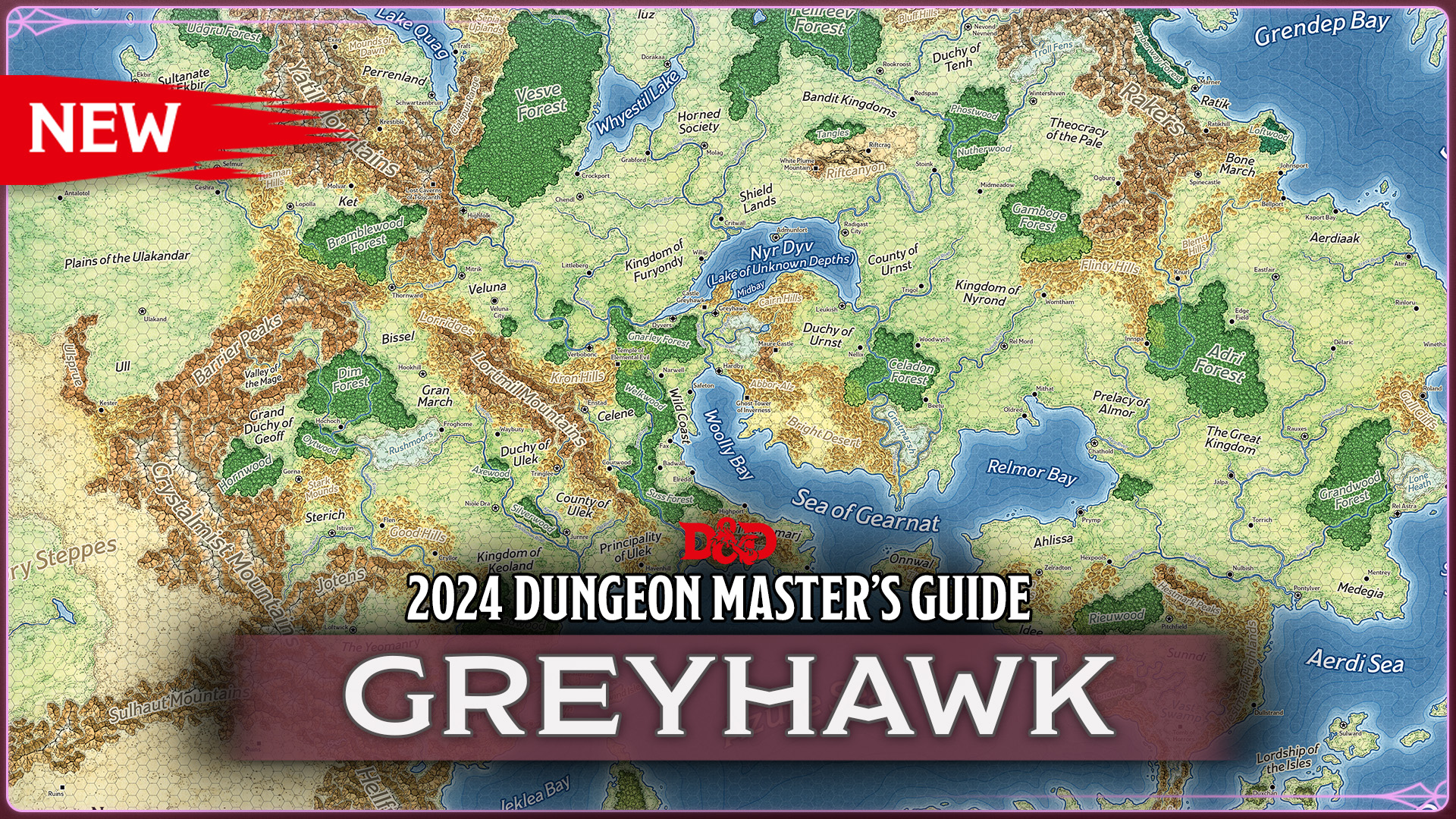


Harking back to the Sample Dungeons of yore, the DMG will also contain a chapter of Sample Adventures that are set in Greyhawk.

Watch here for an 18 minute interview with Chris Perkins and James Wyatt about thoughts behind using Greyhawk as a sample campaign setting in the new DMG.

While WOTC may not support this setting any further, allowing it to be added to DMs Guild opens it up to fans who wish to add more content to the setting (albeit only in 5E form).

I don't have any specific plans at the moment for creating Greyhawk content for DMsGuild, but I have updated the Ruined Tower of Zenopus conversion/expansion to tag it as Greyhawk (as opposed to just "nonspecific/any setting"), given that I have an appendix in it on using it with the Ghosts of Saltmarsh, which draws its mini-setting details from Greyhawk.

The new DMG is available for order on Amazon.


Friday, August 28, 2020

The Sea-Changed (New Monster)


Ariel's Song from the Tempest as illustrated by Virgil Finlay


A new monster for your Portown, Saltmarsh or other coastal D&D campaign, inspired by this thread on ODD74, 
which shows a photo of a skull undergoing a "sea change". As a bit of further explanation, the modern expression "sea change" originates in Shakespeare's The Tempest (click on the image above to enlarge it so you can read the full quote), which was memorably referenced by Gary Gygax in the Example of Play in the original AD&D Dungeon Masters Guide. I've taken it one step further by using it as the basis for a monster.

The Sea-changed

Move: 60 feet/turn
Hit Dice: 1 + 1
Armor Class: 5
Treasure Type: special
Alignment: lawful evil
Attacks: 1
Damage: 1d6

Sailors whisper that a corpse that comes to rest in the brine may undergo a mysterious and sinister transformation, rising again in a calcified skeletal form known as "the sea-changed". 

The sea-changed seek to spread their animating force to the living by touch of calciferous claws or an equally mineralized weapon or tool used during life such as a cutlass, harpoon or even anchor.

A hit with such will, in addition to inflicting damage, encrust the area of the wound with the sea-change unless a successful saving throw versus poison is made. Failure results results in the loss of one point of dexterity per day as the calcification spreads. Once dexterity reaches zero, the victim will be transformed into one of the sea-changed.

The spread can be kept at bay, but not cured, through daily application of vinegar. It is rumored among sailors that the merfolk know the secret of how to reverse the sea-change.

Each sea-changed has a 1 in 10 chance of having pearlescent eyes (roll on the gem table for value).

The sea-changed are subject to turning as zombies.

9/24 Update: Added an alignment, which I had inadvertently left out: Lawful Evil like mummies, wights, wraiths & spectres in Holmes. Thanks to Lore Suto on Twitter for pointing this out to me.

Thursday, April 20, 2017

Marked 20-sided Die


TSR's original dice set was included in Holmes Basic, Gamma World and sold separately

In the 1970s, rolling 1-20 wasn't as straightforward as today. The original dice set available from TSR included a white 20-sided dice, but it was numbered (and pre-inked) with 0-9 twice rather than 1-20. So these dice were actually d10s, and were most easily used to generate percentiles by rolling the same die twice in row or by rolling two different colored dice together. TSR even sold a separate white and pink set of Percentile Generators.

But since the beginning D&D has always needed d20s, for attacks and saving throws. The earliest D&D rulebooks don't explain how to use the 10-sided die to generate 1-20, but by the time of Holmes Basic, there was a recognized need to explain this, as the rulebook teaches two different ways to roll 1-20 with these dice. One is near the end of the book in the section "Using the Dice", which isn't in the Holmes manuscript, and so was added by TSR. This method uses a secondary "control" die to determine if the number is 1-10 or 11-20:

"For example: to generate 1-20, roll the 20-sided die and 6-sided die, and if the 6-sided die comes up 1-3 , the number shown on the 20-sider is 1-10 (1-0), and if the 6-sider comes up 4-6, add 10 to the 20-sided die and its numbers become 11-20 (1-0)".

The other method is described in the main part of the text in the section on Saving Throws (page 14). This was written by Holmes as it is found word-for-word in the manuscript:

"Numbers can be generated as follows: Mark one set of faces on a 20-sided die by coloring with a red permanent marker on one of each faces — 0, 1, 2, 3, etc. The marked faces will be considered to have a ten added to them — 1 = 11, 2 = 12, 3 = 13, etc. Unmarked
0 = 10, marked 0 = 20. This die will also be used to determine the results of combat from the combat table."

The picture at the top of this post (from an Ebay auction that indicated the dice were from a Basic set) shows an example of this: the owner has colored half of the faces of the 20-sider in a red color. The white faces represent 1-10, and the red faces represent 11-20. As I mentioned above these dice were pre-inked, so one couldn't just color the two sets of 0-9 with different colored crayons, the faces had to be marked to differentiate them.

This method is referenced again in the section "Combat Melee":

"The probability of a hit is converted into a random number of 1 to 20 (the specially marked die is recommended)" (page 18) and "A 20-sided die must be marked or colored so that
one set of sides 0-9 is different from the other set. Count 0 as a 10. The marked set is then read as if 10 had been added to the roll (11-20), treating 0 as 10 or 20. This die is used for all combat resolution" (page 19)

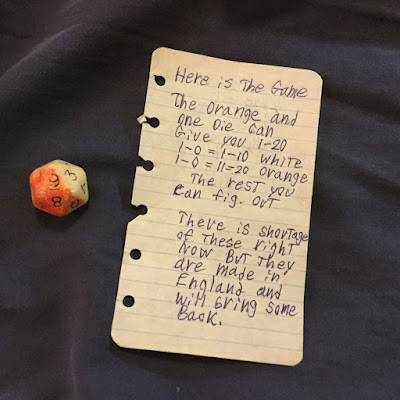
Holmes probably learned this marked die method from other gamers, as there are earlier examples of it. For example, below is an auction photo from last year, for an auction you may have heard about, an original woodgrain D&D set that sold for over $20,000. Included with the set in the auction was a 20-sided die and a note (with the date of ~1974 given by the auctioneer). In the note we see similar instructions, with the white half of the die being 1-10 and the orange half being 11-20.


In 1979, the 1st edition DMG still assumes use of these 20-sided d10s in the section "Dice", on page 10:

"If a d20 is used either 1-20 (assuming the use of a standard d20 which is numbered 0-9 twice without coloring one set of faces to indicate that those faces have 10 added to the number appearing) or 1-40 (assuming that one set of faces is colored) can be gotten by adding 0 if 1 or 2 is rolled on the d4 and 10 or 20 (depending on the die type) if a 3 or 4 is rolled"

The structure of this sentence is complicated, but Gygax is saying to use d4 control dice to turn 1-10 into 1-20 (for an unmarked die) or 1-20 into 1-40 (for a marked die).

This was a short-lived era as other manufacturers began cranking out dice. 

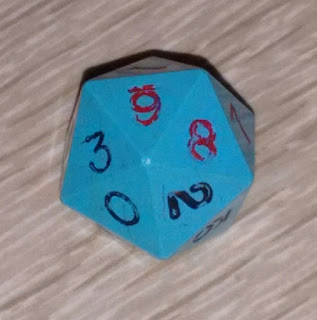
At some point (I don't have a date but will update this post if I find it), 20-sided dice that were not pre-inked appeared, which allowed for coloring the two sets of numbers with different colored crayons. You still had to remember which color was low (1-10) and which was high (11-20). I have a dice like this that I received in an auction a while back (I can't even remember what it came with):


I also don't know when the first 20-sided dice that was numbered 1-20 first appeared, but the standard d10 appeared around 1980, possibly debuting at Gen Con that year. 

In the last printing of the Holmes Basic rulebook, dated Dec 1979 but certainly from 1980 as it is the third version with that date, the section on "Using the Dice" was revised to refer to "the assortment of 4-, 6-, 8-, 10-, 12- and 20-sided dice" (page 46), and the portion about the control die no longer refers to 1-20. Holmes' instructions for making a marked d20 is still found in the section on Saving Throws, however.

The Acaeum reports that some sets of Holmes Basic include a set of six dice. I've never actually seen one of these sets. It does seem strange TSR would revise the rulebook to refer to the 10-sided die without actually including it. But I'd like to see it confirmed that a set shipped this way versus having dice added later. A complicating factor is that Holmes Basic set was sold up until at least 1986 (I have a catalog from then listing it), so some may have had 6-dice sets added to them at later date.

Certainly by the time of the Moldvay Basic set and Dragon Dice, both from 1981, we have the standard 1980s set of six dice, including both the 10-sided die and the 20-sided die numbered 1-20.

See also:
Veteran of the Dice Wars
TSR Ads in Boys Life 1977-1982

And Jon Peterson's articles on the history of dice in D&D: 
How Gaming Got Its Dice
The Origins of Dice Notation

Wednesday, December 14, 2016

Gygaxian Armor


AD&D Armor by David C. Sutherland III

The picture above should have been included in the 1E AD&D PHB or DMG. It illustrates the nine standard types of AD&D armor as described in those books, but appeared only in the relatively obscure AD&D Dungeon Masters Adventure Log, published in 1980.

Below are the corresponding descriptions from 1E AD&D Dungeon Masters Guide, page 27, plus a few notes from the shorter descriptions given on page 165. I've reordered them & included the encumbrance and move ratings from the table on page 27, and the armor classes and cost from the PHB. These use the unarmored AC 10 system that debuted in AD&D PHB, replacing the unarmored AC 9 system of OD&D.

Padded Armor (AC 8, MV 9", 10 lbs, 4 GP) is "heavily padded, quilted coat and an additional soft leather jerkin and leggings".

Leather Armor (AC 8, MV 12", 15 lbs, 5 GP) is "shaped cuir bouli (leather hardened by immersion in boiling oil) cuirass and shoulder pieces and softer shirt and leggings" (pg 27) and "includes boots and gauntlets" (pg 165).

Studded Leather (AC 7, MV 9", 20 lbs, 15 GP) is "leather armor to which have been fastened metal studding as additional protection, usually including an outer coat of fairly close-set studs (small plates)" (pg 27), and with "an extra layer of protection at shoulder area" (pg 165).

Ring Mail (AC 7, MV 9", 25 lbs, 30 GP) is "relatively soft leather armor over padding. To the long coat of leather are sewn metal rings. This makes the coat rather heavy and bulky".

Scale Mail (AC 6, MV 6", 40 lbs, 45 GP) is "armor similar to ring mail, but overlapping scales of metal are sewn to both coat and leggings—or a skirted coat is worn. As with chain, weight falls mainly on the wearer’s shoulders and waist".

Chain Mail (AC 5, MV 9", 30 lbs, 75 GP) is "padding plus interlocking mesh armor covering the upper and lower body. Vulnerable areas have multiple thicknesses. Weight falls upon the shoulders and waist of the wearer".

Splint Mail (AC 4, MV 6", 40 lbs, 80 GP) is "light chain, greaves, and a leather coat into which are laminated vertical pieces of plate with shoulder guards".

Banded Mail (AC 4, MV 9", 35 lbs, 90 GP) is "a layered armor with padding, light chain, and series of overlapping bands of armor in vulnerable areas. Weight is somewhat distributed".

Plate Mail (AC 3, MV 6", 40 lbs, 400 GP) is "light chain with pieces of plate — cuirass, shoulder pieces, elbow and knee guards, and greaves. Weight is well distributed".

Plate armor (AC 2, MV 9", 40 lbs, 2000 GP) is "a full suit of plate which is no more weighty and a bit less bulky, considering what is known as “field plate”" [This is an optional addition that Gygax mentions; it is not illustrated above. Rules for this were later expanded in Unearthed Arcana in 1985]

On page 165, Gygax refers the reader to Charles Ffoulkes' Armour and Weapons (1909), which thanks to the internet can be viewed here.

Original D&D and the Classic D&D successors only included Leather, Chain and Plate, so the additional armor types are typically associated with AD&D. However, many of them actually appeared all the way back in Chainmail Man-to-Man Melee Table:


The AD&D Monster Manual, which uses the original AC system (unarmored AC 9) gives us a few clues for adapting these armor types to OD&D.

Halflings: "The usual protection ... consists of padded or leather armor", with an AC of 7.
Wood Elf: "They usually wear studded leather or ring mail (AC 6)".
Gnomes: "...armored with leather armor which is ringed or well studded with metal and shield (armor class 5)".

Thus, if adapting these additional types to Holmes Basic or OD&D, we might use:

Padded Armor:  AC 7, MV 9", 10 GP
Leather Armor:  AC 7, MV 12", 15 GP
Studded Leather:  AC 6, MV 9", 20 GP
Ring Mail:  AC 6, MV 9", 20 GP
Scale Mail:  AC 5, MV 6", 25 GP 
Chain Mail:  AC 5, MV 9", 30 GP
Splint Mail:  AC 4, MV 6", 40 GP
Banded Mail:  AC 4, MV 9", 45 GP
Plate Mail:  AC 3, MV 6", 50 GP
Plate Armor:  AC 2, MV 9", 200 GP 

The AC & prices for Leather/Chain/Plate come from the original list in OD&D and Holmes Basic. In AD&D, there's little functional difference between Studded Leather and Ring, other than Ring being slightly heavier and costing twice as much, so I just left them as identical on this chart.

One practical use for this table in OD&D might be for adapting AD&D modules with these armor types. 

See also: The Monster Manual is a Holmes Supplement
 
(DMs Guild links include affilitate #)


Tuesday, May 26, 2015

"Two or Three Figures Fighting Side by Side"


Over on Jeff's Gameblog, he asks if we've been doing minis wrong, and quotes a portion of page 10 of the AD&D 1E DMG (1979) that talks about three squares/figures per 10' wide corridor (i.e. 1" squares that represent 3.3' rather than 5'). This reminded me this idea goes all the way back to OD&D, Vol 3 (1974), where we see:

"There can be places where 300 Hobgoblins dwell, but how many can come abreast down a typical passage in the dungeons? Allow perhaps 3 in a ten foot wide passage, and the balance will either be behind the front rank or fanning out to come upon the enemy by other routes" (page 12, underlining is found in the original text)

Holmes included an interpretation of this idea in the manuscript for Basic (1977), which Gygax left unchanged as published: 
"Characters can be attacked by more than one opponent at a time; the Dungeon Master should be guided by the actual placement of the figures on a paper sketch or on the table in deciding how many opponents can engage as melee starts, always keeping in mind the dimensions of the dungeon itself. One would not expect to get more than two or three figures fighting side by side in a ten foot corridor, for example" (page 20 of the published rulebook; I covered this text in Part 16 but didn't note the original source for this rule).

Holmes possibly went with "two or three" based on the weapon length limitations presented in Greyhawk (1975). For example, a battle axe "requires not less than 4' of space on each side of wielder" per the table on page 15. Update: Holmes may also have been influenced by the rule in Empire of the Petal Throne (1975) that Jeff discusses at the end of his post, which allows for 1-4 characters depending on weapon size.

Finally, in the Keep on the Borderlands (1980), which came out after the 1E DMG, Gary elaborates on the "two or three" rule:
"In a standard 10’ wide corridor, the most common arrangement is two adventurers, side by side, in each rank; however, three characters could occupy a single rank if all of their weapons were small (such as daggers and hand axes)" (page 5; this text is found in both the original version for Holmes, and the revised version for Moldvay Basic).

Moldvay Basic (1981) itself, however, simplifies the rule to "Different marching orders may be used when opening doors, searching rooms, fighting combat, and so forth. The most common marching order is to explore in a column of two-by-two though this may vary in corridors of different width" (pg B19).

Tuesday, September 16, 2014

Random Animal Table - 1E DMG


I recently rediscovered these random tables found in the 1E AD&D DMG on page 138,  presumably by Gygax. They are meant for the Bag of Tricks, so are often overlooked in the magic item section but could be used in any situation calling for a random animal. They are nicely ordered by HD and have the most important stats right there. Most of the animals are found in the Monster Manual, and having stats matching that source, but about a third of them are not, including weasel, skunk, owl, goat, ram, eagle and ostrich (several of these are found in giant form in the MM, but not normal form). For other opponents with 'stealth stats' in the DMG, see this thread on the Knights & Knaves Alehouse.

Here's an earlier version of this table from the Bag of Tricks entry in Greyhawk (1975). These are some of the earliest 'normal animal' stats for specific animals. The stats for the same animals found in both tables are similar, but with many minor changes.

Saturday, November 9, 2013

The Jim Lamb DMG

The Jim Lamb DMG. Source: Ebay Auction

Above is a screenshot from a recent auction of a 1st edition Dungeon Masters Guide, inscribed by Gary Gygax with: "2 August 1979 / This is the 1st copy of the DMG other than my own! for Jim Lamb Gatherer of the Mighty Brador! Gary Gygax"

Searching for the two names together, I found a column by Gygax on page 11 of Dragon #27, July 1979, titled "CANGAMES ’79 A brief report on the Canadian Gaming Convention at Ottawa, May 18-21, 1979", which relates that "Jim Lamb, one of the Cangames organizers, telephoned the motel, and after we had supper nearby, took me over to the convention site on the campus of the University of Ottawa". Possibly Gygax sent this copy to Lamb in return for his hospitality at the convention. Per the Acaeum, the DMG was first available to the public at Gen Con XII, August 16-19, 1979.
 
This putative "second copy" of the DMG was recently auctioned by Jim Lamb himself, and was bought by someone for an astounding $4500!

Thursday, February 9, 2012

Updated Covers for 1E AD&D Re-Release


     As reported on the Acaeum by Metamorphosis Sigma, WOTC has released updated covers for the 1E re-releases, which now say Advanced D&D (rather than just D&D) and correct the spelling of "Players" and "Masters" to remove apostrophes, as per the originals. I stitched the three thumbnails together so we could see them side by side.

     They are better than I expected. WOTC found a nice way to update the covers yet use part of the old art. I'd prefer less squiggles/curlicues but it's ok. The color scheme (brown background with yellow and red) reminds me of the World of Greyhawk boxset cover.

     I have 2+ copies of the originals of each of these manuals, so I'll let others have first chance at these new ones.  I'll only buy them to send a message of support for reprints if they don't sell out immediately.

Tuesday, February 7, 2012

Typical Monster Dexterities

Initiative in the Blue Book rules is determined by dexterity. Holmes suggests rolling a monster's dexterity on the spot if it is not known, and the Sample Dungeon does not include dexterity in the monster stats. However, in the first printing of the module B2 Keep on the Borderlands, Gary Gygax provided a dexterity score for most of the monsters. These can be used to extrapolate some typical monster dexterity scores as envisioned by Gygax:

Non-Humanoid (fastest to slowest):
Puma - DX 18
Adder - DX 15
Medusa - DX 14
Giant Centipede - DX 13
Spider, Large - DX 12
Gray Ooze - DX 11
Skeleton - DX 11
Owl Bear - DX 10
Stirge - DX 10
Huge Dog - DX 9
Fire Beetle - DX 9
Giant Rat - DX 8, 12 (l)
Wight - DX 7
Zombie - DX 6
Gelatinous Cube DX 5

Humanoid (smallest to largest):
Kobold - DX 13 (m), 10 (f), 12 (l)
Goblin - DX 11 (m), 10 (f), 13 (l)
Orc - DX 10 (m), 12 (f), 12 (l)
Hobgoblin - DX 10 (m), 12 (f), 15 (l)
Gnoll - DX 9 (m), 8 (f), 11 (l)
Lizardman - DX 10 (m), 9 (f)
Bugbear - DX 8 (m), 8 (f), 8 (l)
Ogre - DX 8
Minotaur - DX 12

Notes: (m) male, (f) female, (l) leader. 
Numbers represent predominate dexterity, rather than an average. 

A different way to generate a quick DX score is to divide the monster's Move score by 10. I was curious about how well this would match up with the DX stats from B2. So here are the same monsters using the movement in the Holmes rulebook converted to DX by this method:

Non-Humanoid (fastest to slowest):
Puma - not in Holmes Monster List; B2 doesn't give MV; Displacer Beast DX 15
Adder - not in Holmes Monster List; B2 doesn't give MV
Medusa - DX 9
Giant Centipede - DX 15
Spider, Large - DX 6 / 15 (web)
Gray Ooze - DX 1
Skeleton - DX 6
Owl Bear - DX 12
Stirge - DX 18
Huge Dog - not in Holmes Monster List; B2 doesn't give MV; War Dog DX 12 in MM
Fire Beetle - DX 12
Giant Rat - DX 12
Wight - DX 9
Zombie - DX 12
Gelatinous Cube DX 6

Humanoid (smallest to largest):
Kobold - DX 12
Goblin - DX 6
Orc - DX 9
Hobgoblin - DX 9
Gnoll - DX 9
Lizardman - DX 6 / 12 (water)
Bugbear - DX 9
Ogre - DX 9
Minotaur - DX 12

A few are similar, but most are quite different. So Gygax wasn't terribly influenced by the movement rates when determining the DX scores in B2. Some may have been randomly rolled, though others like the Puma were clearly selected, and humanoids seem to follow a trend of decreasing DX scores with increased size (except for the Minotaur). 


Originally posted here. 

Edit: And here are Gygax's typical Strength scores for humanoids, from the 1E DMG, pg 15:

Halfling - 8
Kobold - 9
Human, Gnome, Goblin - 10
Elf, Orc - 12
Dwarf - 14
Hobgoblin - 15
Gnoll - 16
Bugbear - 17
Ogre - 18
Trolls - 18+
Giant - 19 & up

2018 Update: 
There's a case to be made that Skeleton and Zombie Move stats should be reversed in Holmes Basic, so that Skeletons move at 12", Zombies at 6". This is the scores they have in the Monster Manual. If so, the B2 DX scores are a much closer fit to their MV scores.