This is the blog. Click here to go to the Zenopus Archives website.

Note: Many older posts on this blog are missing images, but can be viewed at the corresponding page in the Internet Archive

FEATURED POST

The Forgotten Smugglers' Cave: Index of Posts

An index of posts describing the Forgotten Smugglers' Cave, an adventure for Holmes Basic characters levels 2-4.                    ...

Showing posts with label Dice. Show all posts

Monday, March 13, 2023

Gary Con "Roll With Gary" Dice (2018)


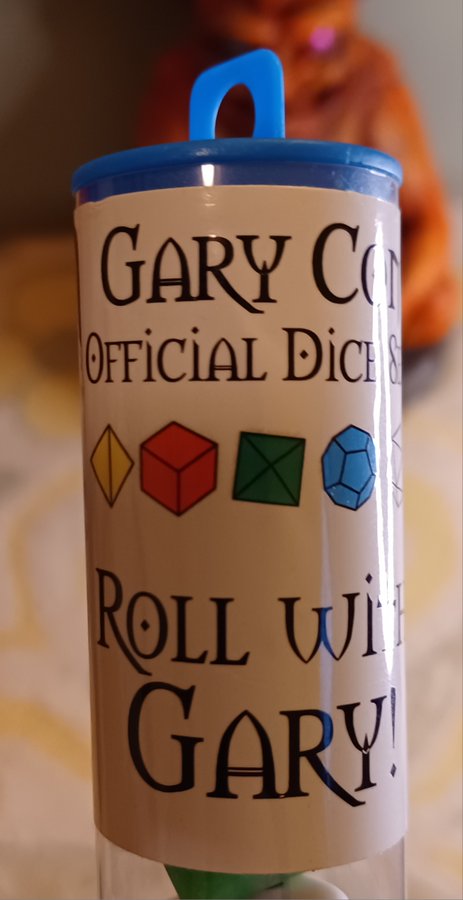
In 2018, Gary Con released a limited edition set of dice with colors matching the set packaged with Holmes Basic. These "Roll With Gary" dice were designed by Luke Gygax and produced by Black Oak Workshop.


The shapes and colors match those of the original set, including a yellow d4, orange d6, green d8, blue d12 and white 20-sided die. On each die, the highest number is replaced with the "GC" logo. The 20-sider is labeled 0-9 twice, just like the 20-sider in the original set, except that each "0" is replaced with a "GC". 


Wednesday, April 27, 2022

Dragon Dice Bag cross stitch kit (1982)


The above image, taken from a recent Ebay auction, shows the packaging for a 1982 DRAGON DICE BAG, a "Counted Cross Stitch Kit" from TSR subsidiary Greenfield Needlewomen, which includes some interesting hand-drawn line art showing the bag front and back, along with a set of polyhedral dice. The bag front includes a dragon and "D&D games", and the back says "May you always make your saving throw". Another image from the auction shows the pattern for stitching the dragon, which is green-colored, with a yellow-green belly:


I've seen other Greenfield D&D-tie-in cross stitch products before - for examples, see this post on Cyclopeatron - but I don't recall seeing this particular one, which has more rudimentary packaging than the others. Per Frank Mentzer on FB, this is because:

This was very early after our acquisition. We retooled their packaging; later ones all have a distinctive green theme. This has their art, not ours. (No it's not a Sutherland dragon. ;> )

This one is also interesting because it uses the "DRAGON DICE" trademark and logo (i.e., the same font) also featured on TSR's 1981 Dragon Dice, the packaging artwork for which was designed by Jim Roslof and can be seen in this post.


Advertisement for TSR's DRAGON DICE
(this was the first set of dice that I owned, in the same blue color)

You can read more about TSR's purchase of Greenfield Needlewomen in Jon Peterson's book Game Wizards, which briefly covers it in the chapters titled, "1982: Extravagance" and "1983: Splitting the Party". Based on quotes from Gary Gygax in TSR's in-house newsletter Random Events, TSR had designs on growing their business by entering the adjacent craft field; which isn't unreasonable because, as pointed out by T. Foster in the first comment in this post on Grognardia, at the time D&D was often sold in hobby shops alongside craft products. However, this particular company, based in Greenfield, Indiana, was purchased seemingly because it was owned by relatives of the Brian and Kevin Blume, and ended up being shuttered by TSR in 1983 after losing a large sum of money for the company.

A thank you to a post on the TSR Old School Gamers FB group for making me aware of this.

Saturday, November 27, 2021

TSR's 1976 "Lower Prices" Dice Ad (that shares text with Holmes Basic)


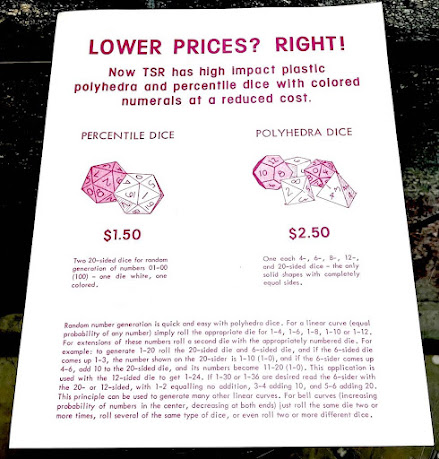
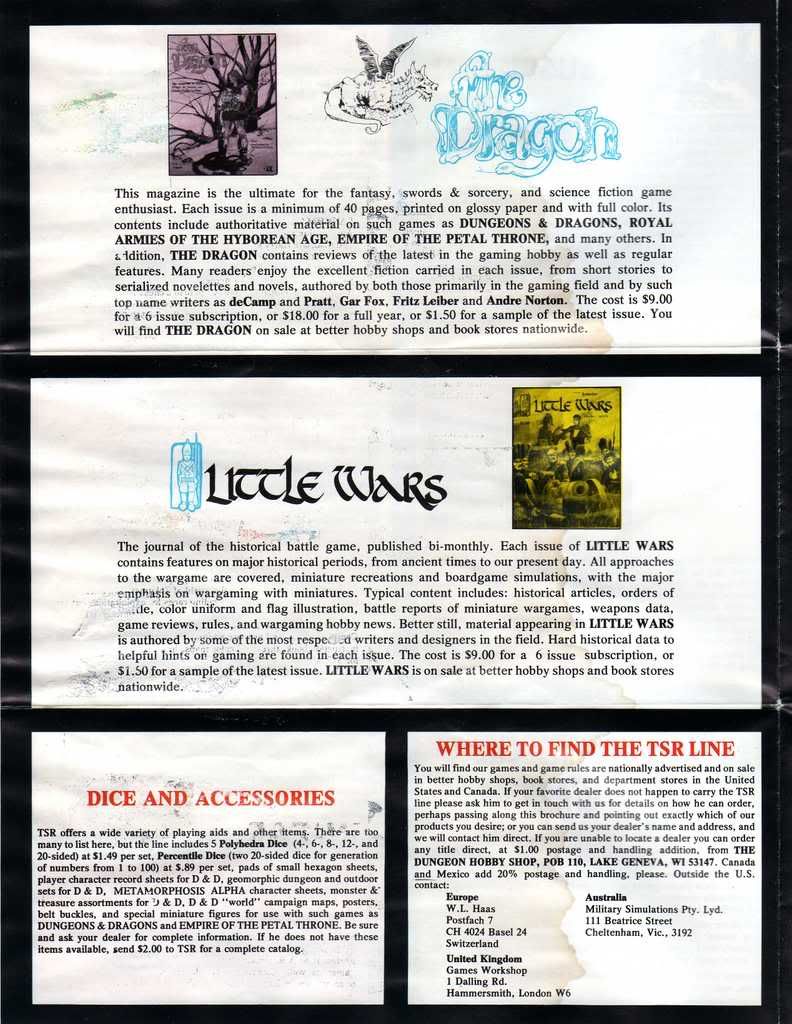
Over on Ebay, Jim Ward has been auctioning items accumulated from his career working at TSR, and among them I noted this early advertisement for dice from TSR that I don't recall seeing before. It appears to be from 1976, as the reverse side is an announcement for the new Metamorphosis Alpha RPG. TSR produced a number of these monochrome advertising sheets in the 1970s, some of which were also used as ads in magazines.

The lengthy explanatory text at the bottom of the page especially caught my attention because it's extremely similar to the "USING THE DICE" section found near the end of the Holmes Basic rulebook. Back in the last post of the Holmes Manuscript series, I presumed that this section originated with TSR, as it is not found in Holmes' manuscript.


Image originally posted in the Holmes Basic G+ Community (archived here)


The above image is from a 2nd or 3rd printing of the rulebook, but the "Using the Dice" text is the same in the 1st printing. Below is a transcription in which I've bolded the text that is the same as in the "Low Impact" Ad:

        Players need not be confused by the special dice
called for in DUNGEONS & DRAGONS. By using the
assortment of 4-, 6-, 8-, 12- and 20-sided dice, a wide
range of random possibilities can be easily handled.
        For a linear curve (equal probability of any
number), simply roll the appropriate die for 1-4, 1-6, 1 -
8, 1-10 , or 1-12. If some progression is called for,
determine and use the appropriate die (for instance, 2-
7 would call for a 6-sided die with a one spot addition).
For extensions of the base numbers, roll a second die
with the appropriately numbered die. For example: to
generate 1-20, roll the 20-sided die and 6-sided die,
and if the 6-sided die comes up 1-3 , the number shown
on the 20-sider is 1-10 (1-0), and if the 6-sider comes up
4-6, add 10 to the 20-sided die and its numbers become
11-20 (1-0). This application is used with the 12-sided
die to get 1-24. If 1-30 or 1-36 are desired, read the 6-
sider with the 20- or 12-sided die, with 1 -2 equalling no
addition, 3-4 adding 10, and 5-6 adding 20. This
principle can be used to generate many other linear
curves.
        For bell curves (increasing probability of numbers
in the center, decreasing at both ends), just roll the
same die two or more times, roll several of the same
type of dice, or even roll two or more different dice.

The introductory sentence has been replaced with two sentences, and one extra sentence covering modified ranges has been added, but otherwise the text is almost identical. From this we can see how another portion of the text of the Holmes Basic rulebook was constructed from some pre-existing text. I don't know whether this text is original to this ad, or if there is yet another source text from which it was taken. I assume the author here is Gygax based on the lengthier "Dice" section in the AD&D Dungeon Masters Guide.

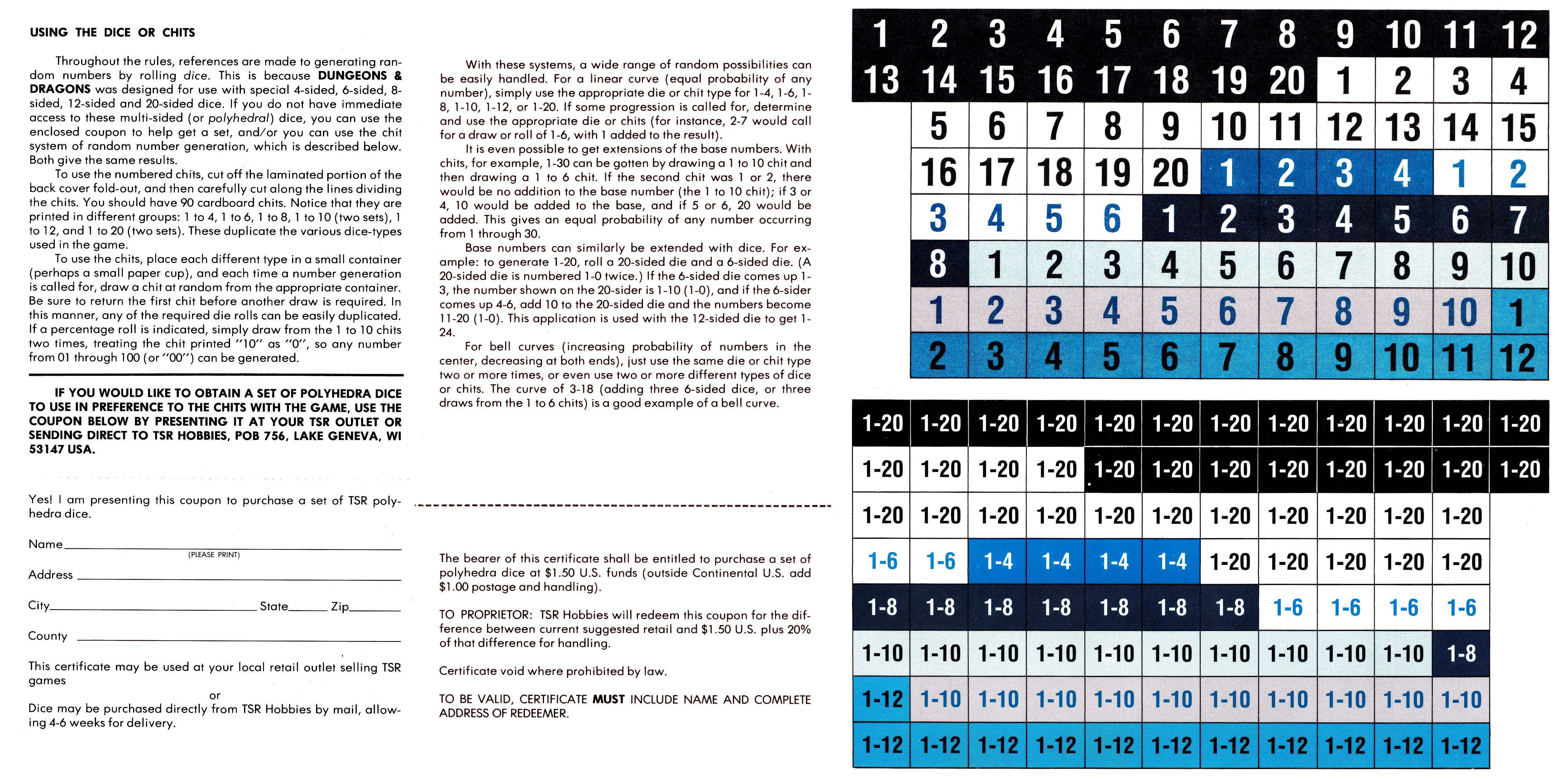
A later version of the "Using the Dice" text that is revised to include the chits can be seen in my recent post, Jim Ward on the Why of Chits.

See Also: 
Dice of the Gods (Creative Publications Dice Packaging)

Sunday, November 7, 2021

Jim Ward on the Why of Chits


The Chit Sheets, Front and Back.
Source: The Dice Collector

Later printings of the Holmes Basic D&D set came with an infamous sheet of chits, pictured above, in place of dice. I myself was one of those kids that received such a set, which only added to my confusion in understanding how the game was placed, despite the instruction sheet included for using the chits. It's long been rumored that the change was due to a dice shortage in face of D&D's popularity, and thus increased need for dice, but former TSR employee Jim Ward recently related (here on FB), how it was actually the result of management decisions by TSR during a time they were developing their own dice:


Young Jim Ward and the Dice Monster

© all rights reserved by James M. Ward 

“Young Jim Ward” was a history teacher in a small rural school when the call came in. I had just finished writing Gods, Demi-gods & Heroes, Deities & Demigods for AD&D, and Metamorphosis Alpha the first science fiction role-playing game. I told Gary Gygax that as soon as he could pay my teacher’s salary of 13,400 dollars I would move back to Elkhorn and join his company. In 1980 he was able to do that and I moved. 

“Young Jim Ward” started out in the sales department as the inventory controller. It was my job to order the boxes and parts for the games and especially the D&D box set. It was selling 100,000 units a month, steady as clock work. One of “young Jim Ward’s” jobs was to make sure the Hong Kong dice came in on time to fill the next batch of 100,000 boxes. It was a responsibility I took very seriously. 

It took exactly six months for 100,000 sets of poly dice to be made, ship from Hong Kong over the water, and be delivered to the boxer in Madison; Patch Press at the time. Naturally, being a careful person “young Jim Ward” ordered the dice two months early so that 100,000 boxes in December had their dice ordered 8 months out. So in May “young Jim Ward” was ordering dice for the December publication and everyone was fine with that. 

I’m proud to say there were some problems with getting things in on time before me. After “young Jim Ward” started, we were never late on getting product out. This included the day Patch Press printed 16 pages of the monster manual pages in the player handbook [sic*] and shipped the 100,000 to our warehouse. 

So one day “young Jim Ward” is doing his job and the vice presidents of the company have a meeting and decide it would be much more cost effective to make our own dice. I had no problem with the concept. I told them my dice schedule and young Jim Ward went back to work. Two months later, the Vice President in charge of getting the dice molds made comes into my office and says I can stop ordering Hong Kong dice. I became very alarmed and asked the question, do we have finished dice molds? His reply was no but he was sure we would have finished molds in a few short weeks. That was why I could stop ordering dice. “Young and diligent Jim Ward” didn’t want to stop ordering dice since there wasn’t a finished dice mold yet. He went to his Vice President and got permission to order the next month’s 100,000 dice. 

Weeks later the other Vice President comes storming into the sales office. “I thought I told you not to order dice,” he shouted. “Do we have a working dice mold?” I asked very meekly even though I wasn’t feeling meek. I had a job to do. “No we don’t, but that doesn’t matter, we will when we need the dice.” He stormed out of the office and I heard the lecture. I was told if a vice president of the company gave me an order I had to do it. I didn’t order the next month’s dice and it almost killed “young Jim Ward” with worry. 

For two months “young Jim Ward” got real sneaky and tracked the progress of the dice mold. On the day we were going to be late if we didn’t have Hong Kong dice “young Jim Ward” sent out a memo detailing the schedule and our need for 100,000 sets of dice. “Young Jim Ward” gave it to all of the vice presidents. An hour later the mold VP brought the memo back to my office and threw it in my face. “We will have dice when we need them. You are not to worry about this matter any more.”

Naturally, “young Jim Ward” started to worry even more. I asked my Vice President if I would send out memos every week (I wanted every day, but held myself in check) on the dice issue. He made me send out one a month. On the day when it would be too late to order dice to get them in December I sent out a memo detailing that fact. All the vice presidents got together and were assured we would have dice. “Young Jim Ward” was ordered not to send out any more memos on the dice. Raw blades of inventory agony transfixed “young Jim Ward’s” body as the weeks went by. Still sneaky, I knew exactly what condition the dice were in that were being made by the mold. I begged my VP to talk to Gary about the matter. He did and Gary went to the dice mold VP and asked to see what type of dice were being made by the new molds. That VP opened his desk to pull out several pieces of what looked like popcorn with numbers on them. Clearly they would not be used for the D&D box set. Gary went to me and told me to order dice and get them as soon as possible. He also told me never to listen to anyone who said not to order dice again. That dice VP got a written reprimand and I got a huge smile on my face. 

For three ugly months we used cardboard counters and a coupon for dice in our box sets. The only people happy about that were the prisoners in jail as they couldn’t get games with dice in them. From then on the dice VP didn’t like me at all and every time I was promoted into another position he would tell my supervisor what a trouble maker I was.


* It was the Dungeon Masters Guide that was misprinted with the pages of the Monster Manual, in what is designated the "Second Alpha" printing here on the Acaeum.

Saturday, August 28, 2021

Dice Dragon (New Monster)


TSR's Dragon Dice (1981). Art by Jim Roslof.
Detail of photo by Brian Stillman as found here


Dice Dragon

Move: 60 feet/turn, 240 feet/turn flying
Hit Dice: 1+1
Armor Class: 2
Treasure Type: Q
Alignment: neutral (75%)/chaotic good (25%)
Attacks: 1 bite
Damage: 1d6

These winged but legless micro-dragons, purple-and-blue with a yellow underbelly, are even smaller than their distant kin, the pseudo-dragons, but just as intelligent. Typically lairing in inaccessible crags or the tallest trees in the wilderness, dice dragons are occasionally found in association with thieves or gamblers, as they have an innate fondness for games of chance, particularly those involving dice, hence their common name. Indifferent to coins, they more eagerly wager for gems or precious stones, communicating via a raspy hiss and manipulating the dice with their tail, and storing their winnings in a small container, around which they coil while at rest.

Dice dragons defend themselves with their sharp bite or, thrice a day, a small puff of faerie fire, which does no damage but outlines one target in glowing light for 4d4 rounds (giving attackers a +2 to hit the target).

* * * * *

Notes: 

This new monster is inspired by the art on the packaging for the first set of polyhedra dice that I found after getting a Holmes Basic set with chits, TSR's Dragon Dice (1981), which was their first set of branded dice. My original set - which I still have some of - was pale blue as shown in the advertisement here in a 2012 retrospective on Grognardia. As can be seen there, the marketing promoted the plastic part of the packaging as a "reusable carrying case", hence the container portion of the write-up. 

This art is by Jim Roslof, who also did the cover the B2 Keep on the Borderlands; see here for a "bibliography" of his work on the Zenopus Archives site.

The "neutral/chaotic good" alignment is in accord with Holmes Basic, where some monsters - including all dragons - are written with a dual alignment, and some (like dwarves) are given percentages.

I chose to incorporate a "flame" breath weapon in line with the illustration, but used faerie fire to make it more interesting than just an ordinary flame, and because it seems fitting as it affects the roll of a die. It also helps differentiate it from other old school D&D mini-dragons:
  • The Pseudo-Dragon from the original Monster Manual, which appears as a miniature red dragon but can change color, and has a poison stinger instead of a breath weapon.
  • The Faerie Dragon from the Dragon #62 (and then the Monster Manual II), and breathes "euphoria gas".
  • The Pocket Dragon from the module M2 Maze of the Riddling Minotaur, which resembles a miniature green dragon and has a venomous bite.
All of the above have legs, but I also came across the amphiptere, which as used in heraldry is typically legless, but seems to have been written up in later systems as a miniature wyvern, for example there's a 5e version here.

I also kept in mind Pip the venomous "minidrag", who is winged and legless, from Alan Dean Foster's sci-fi Pip and Flinx series (1972 and on), which I started reading back in high school.

Update:

Based on further reports from adventurers collected by the Portown Sage, it is apparent that the Dice Dragon does not only breath faerie fire; rather, that is just one possible effect. Read more here:

Dice Dragon: Breath Weapon further research


Monday, February 24, 2020

Playing at the World on Identifying Dice of the 1970s


C. P. dice (front) versus Holmes Basic dice (back). Source: Playing at the World


Jon Peterson has a new video on YT up looking at the dice that were available for sale in the 1970s, and how to identify them:


It's a great video, rich with information, examples and period photos. There's an accompanying blog post with more photos and dice maps. See embedded link below.

In the video the Holmes Basic dice feature prominently as a starting point for Jon to look at the other less common dice of the '70s. I did not know that the Creative Publications dice set sold by TSR, seen here in their original packaging, can be distinguished from the later set shipped with Holmes Basic. The most prominent distinguishing feature is the color of the d6, pink in the CP set and orange-red in the Holmes set. I had previously attributed the color variations to lighting in photos.

Identifying the Dice of the 1970s

How can you recognize a polyhedral gaming die made in the 1970s? The video above gives my tips for collectors and researchers who want to roll old school. After the cut, I give a quick reference guide to identifying these dice.

Tuesday, April 23, 2019

Third Point of Singularity: Dice of Generations

Here's a great story by Mister Nizz on the Third Point of Singularity blog about his original set of low-impact D&D dice. From 2017, but I missed it the first time around:

The Dice of Generations

When it comes to geek "cred," you either have it or you don't have it. When I was a kid, there was no such thing as "geek cred".

Thursday, November 16, 2017

Dice of the Gods


POLYHEDRA DICE by CREATIVE PUBLICATIONS (photo source)


A suited man juggles five polyhedra dice - is this an early DM? No, more likely it is supposed to be a math teacher.

These photos were posted to the Acaeum recently (see this thread), and show a set of dice found with a OD&D White Box set. The dice themselves are the standard Polyhedra Dice sold by TSR in the '70s, which per Jon Peterson were sourced from a California company, Creative Publications. But the packaging they are in is something I've never seen before. The title, Polyhedra Dice, is identical to the title TSR used in their catalogs and product lists of the era (follow link to see an example). While the dice obscure some of the text, I can make out the letters "CREAT..." near the green 8-sider, indicating the original packaging was indeed supplied by Creative Publications, not TSR or another company.

Most of these dice that I've seen are ones from the Holmes Basic set (update: see below), where they came in small sealed bag without a paper insert. The set was also sold separately (see catalog link above), and I had assumed these were sold in the same form. But possibly at some point TSR re-sold sets with the original CP packaging, or possibly this set was ordered directly from CP.

The back of the insert begins with the following paragraph:

"To the ancient Greeks the five regular solids (tetrahedron - 4 faces, hexhedron - 6 faces, octahedron - 8 faces, dodecahedron - 12 faces, icosahedron - 20 faces) were known as the "dice of the gods". They were prized for their beauty and believed to have strange, cosmic meanings"

Following this is a list of suggestions for using the dice, which are mostly obscured by the dice themselves.

See also: 
The Marked 20-sided Die
TSR Percentile Dice in the '70s

Update: See Playing at the World on Identifying Dice of the 1970s. Note that the dice in this the CP sets are not exactly the same as those found in Holmes Basic. Most notably, the d6 in these Creative Publication sets is pink versus the orange-red of the d6 of the Holmes Basic sets. 

Friday, April 21, 2017

Gygax's Killer Die

As a follow-up to yesterday's post on the Marked 20-sided Die, here are some quotes from Gygax on his own Marked d20. Thanks to T. Foster at the Mystical Trash Heap blog for bringing this to my attention.

3/13/03
"Those low-impact d20s did get pretty round in short order--well short order in terms of gaming time. Rob Kuntz had one that would stand on a point now and again. I still have a couple that I use when playing OD&D as the DM. One with gray faces on 10 sides is a "killer" die that comes up on those faces a lot--the 11-20 range, of course! Can't find it now, but it's likely in a box of old dice somewhere in the basement here. I have a second one with red faces that's as good for the monsters' rolls, of course" (EnWorld Q&A post)

1/29/04
"As it happens I have quite a number of the old low-impact dice around here somewhere. The points on the d4 were very sharp but wore down quickly. Rob had a d20 that would stand on a worn point about one roll in 50 : )"

"Somewhere I lost my d20 with half the faces colored gray. It was my "killer die" that rolled an inordinate number of 20s, and the players really hated it : )" (EnWorld Q&A post)

Following this, T. Foster wrote: 
"I played with you in "Necropolis" at Glathricon (in Evansville, IN) in 1988 and am pretty sure I encountered your infamous 'killer' d20 -- it was white, numbered 0-9 twice, and rolled awfully well (for you, badly for us :) )."

2/6/04 - in response to T. Foster
"It was either my gray or red "killer die," undoubtedly. It has since sent a large number of adventurers to their doom when rolled on behalf of my OD&D game "Old Guard Kobolds." The ninth party of six or more 2nd level characters fell to them at JanCon last month" (EnWorld Q&A post)

(A few minor edits to Gary's comments to correct obvious typos)

Thursday, April 20, 2017

Marked 20-sided Die


TSR's original dice set was included in Holmes Basic, Gamma World and sold separately

In the 1970s, rolling 1-20 wasn't as straightforward as today. The original dice set available from TSR included a white 20-sided dice, but it was numbered (and pre-inked) with 0-9 twice rather than 1-20. So these dice were actually d10s, and were most easily used to generate percentiles by rolling the same die twice in row or by rolling two different colored dice together. TSR even sold a separate white and pink set of Percentile Generators.

But since the beginning D&D has always needed d20s, for attacks and saving throws. The earliest D&D rulebooks don't explain how to use the 10-sided die to generate 1-20, but by the time of Holmes Basic, there was a recognized need to explain this, as the rulebook teaches two different ways to roll 1-20 with these dice. One is near the end of the book in the section "Using the Dice", which isn't in the Holmes manuscript, and so was added by TSR. This method uses a secondary "control" die to determine if the number is 1-10 or 11-20:

"For example: to generate 1-20, roll the 20-sided die and 6-sided die, and if the 6-sided die comes up 1-3 , the number shown on the 20-sider is 1-10 (1-0), and if the 6-sider comes up 4-6, add 10 to the 20-sided die and its numbers become 11-20 (1-0)".

The other method is described in the main part of the text in the section on Saving Throws (page 14). This was written by Holmes as it is found word-for-word in the manuscript:

"Numbers can be generated as follows: Mark one set of faces on a 20-sided die by coloring with a red permanent marker on one of each faces — 0, 1, 2, 3, etc. The marked faces will be considered to have a ten added to them — 1 = 11, 2 = 12, 3 = 13, etc. Unmarked
0 = 10, marked 0 = 20. This die will also be used to determine the results of combat from the combat table."

The picture at the top of this post (from an Ebay auction that indicated the dice were from a Basic set) shows an example of this: the owner has colored half of the faces of the 20-sider in a red color. The white faces represent 1-10, and the red faces represent 11-20. As I mentioned above these dice were pre-inked, so one couldn't just color the two sets of 0-9 with different colored crayons, the faces had to be marked to differentiate them.

This method is referenced again in the section "Combat Melee":

"The probability of a hit is converted into a random number of 1 to 20 (the specially marked die is recommended)" (page 18) and "A 20-sided die must be marked or colored so that
one set of sides 0-9 is different from the other set. Count 0 as a 10. The marked set is then read as if 10 had been added to the roll (11-20), treating 0 as 10 or 20. This die is used for all combat resolution" (page 19)

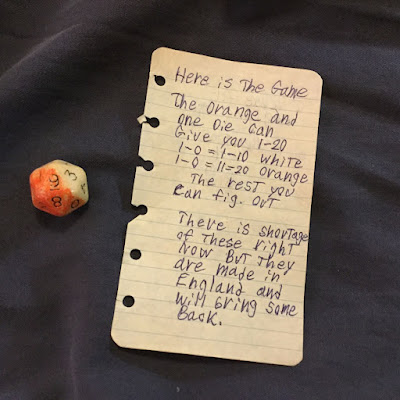
Holmes probably learned this marked die method from other gamers, as there are earlier examples of it. For example, below is an auction photo from last year, for an auction you may have heard about, an original woodgrain D&D set that sold for over $20,000. Included with the set in the auction was a 20-sided die and a note (with the date of ~1974 given by the auctioneer). In the note we see similar instructions, with the white half of the die being 1-10 and the orange half being 11-20.


In 1979, the 1st edition DMG still assumes use of these 20-sided d10s in the section "Dice", on page 10:

"If a d20 is used either 1-20 (assuming the use of a standard d20 which is numbered 0-9 twice without coloring one set of faces to indicate that those faces have 10 added to the number appearing) or 1-40 (assuming that one set of faces is colored) can be gotten by adding 0 if 1 or 2 is rolled on the d4 and 10 or 20 (depending on the die type) if a 3 or 4 is rolled"

The structure of this sentence is complicated, but Gygax is saying to use d4 control dice to turn 1-10 into 1-20 (for an unmarked die) or 1-20 into 1-40 (for a marked die).

This was a short-lived era as other manufacturers began cranking out dice. 

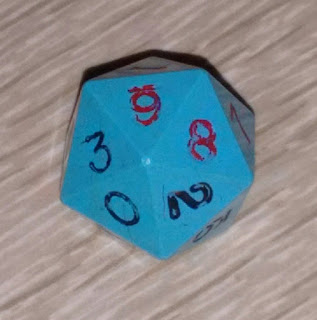
At some point (I don't have a date but will update this post if I find it), 20-sided dice that were not pre-inked appeared, which allowed for coloring the two sets of numbers with different colored crayons. You still had to remember which color was low (1-10) and which was high (11-20). I have a dice like this that I received in an auction a while back (I can't even remember what it came with):


I also don't know when the first 20-sided dice that was numbered 1-20 first appeared, but the standard d10 appeared around 1980, possibly debuting at Gen Con that year. 

In the last printing of the Holmes Basic rulebook, dated Dec 1979 but certainly from 1980 as it is the third version with that date, the section on "Using the Dice" was revised to refer to "the assortment of 4-, 6-, 8-, 10-, 12- and 20-sided dice" (page 46), and the portion about the control die no longer refers to 1-20. Holmes' instructions for making a marked d20 is still found in the section on Saving Throws, however.

The Acaeum reports that some sets of Holmes Basic include a set of six dice. I've never actually seen one of these sets. It does seem strange TSR would revise the rulebook to refer to the 10-sided die without actually including it. But I'd like to see it confirmed that a set shipped this way versus having dice added later. A complicating factor is that Holmes Basic set was sold up until at least 1986 (I have a catalog from then listing it), so some may have had 6-dice sets added to them at later date.

Certainly by the time of the Moldvay Basic set and Dragon Dice, both from 1981, we have the standard 1980s set of six dice, including both the 10-sided die and the 20-sided die numbered 1-20.

See also:
Veteran of the Dice Wars
TSR Ads in Boys Life 1977-1982

And Jon Peterson's articles on the history of dice in D&D: 
How Gaming Got Its Dice
The Origins of Dice Notation

Sunday, February 14, 2016

Wandering Monster Dice

"At the end of each three turns the Dungeon Master can roll a die to see if a wandering monster has come down the corridor. A roll of 6 means that something has come "strolling" along" - Holmes Basic rulebook
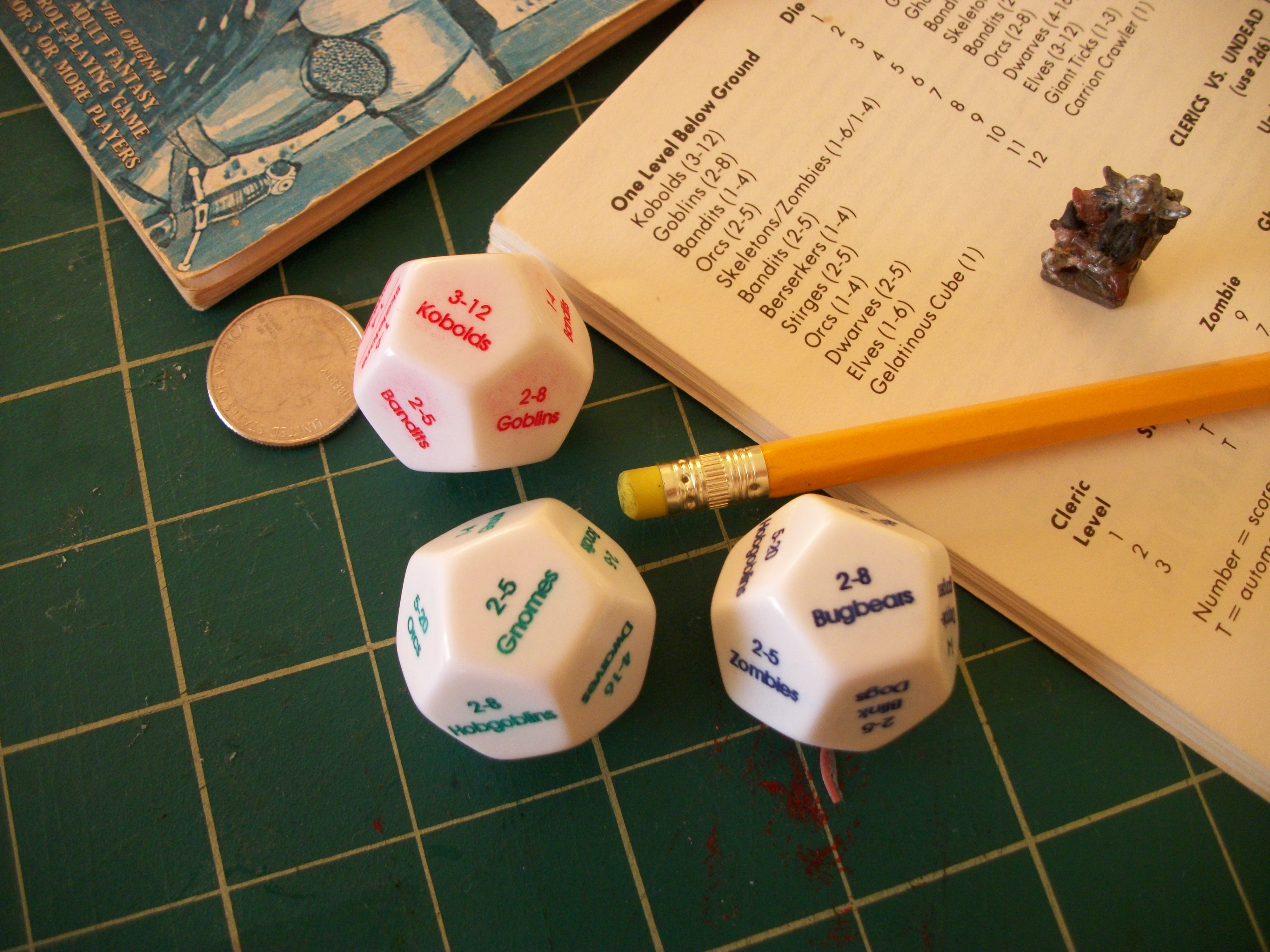
Eric Harshbarger, the Lego sculptor and game/puzzle designer who built a Lego mosaic of the Sutherland Dragon, has made Wandering Monster d12s based on the Holmes Basic encounter tables (3rd edition version). The post on his site is partially quoted below:

Wandering Monsters Die

This is probably the most specialized set of dice I've ever made, and it will appeal only to those who are as enamored with "old school" role-playing games as I am. The original Basic Dungeons & Dragons game had tables in it for "random encounters" or "wandering monsters". If something was encountered by an adventuring party, the dungeon master was supposed to roll a twelve sided die and refer to one of three tables (depending upon what "level" of the dungeon the party was on -- the rulebook only considered dungeons of depth down to level three).
Click here to read the rest of his post.

Click here to read about changes to the Level 1-3 Wandering Monster Tables from OD&D Vol III to Greyhawk to the three printings of Holmes Basic. 

Thursday, May 8, 2014

TSR Percentile Dice in the 1970s


This photo is courtesy of Will T. on G+, and shows the 1970s TSR 'Percentile Dice' (left) in comparison with the 'Polyhedra Dice' (right). Each set is still sealed in the original bag, verifying that the dice came pre-inked. The 20-sided dice are each marked from 0-9 twice, hence the two different colors, white and pink, for generating percentiles. Today these dice are commonly referred to as 'Low Impact' due to their rapid wearing when used.


Source: Wayne's Books


The Polyhedra set was included in Holmes Basic sets, until a shortage forced a temporary replacement with chits. The Percentile set was included in other TSR games including Top Secret and Boot Hill, as shown above in a photo from the Wayne's Books website.


Source: Tome of Treasures


TSR also sold each set separately as shown in this entry in an early catalog, 'Games for Imaginative People' from 1977/1978. The Polyhedra set is listed at $1.49 and the Percentile set at $0.89. The first three printings of the Holmes Basic rulebook also list these sets for the same prices in the product listing at the back of the book. Later printings still list the dice for sale but the prices have been removed. 


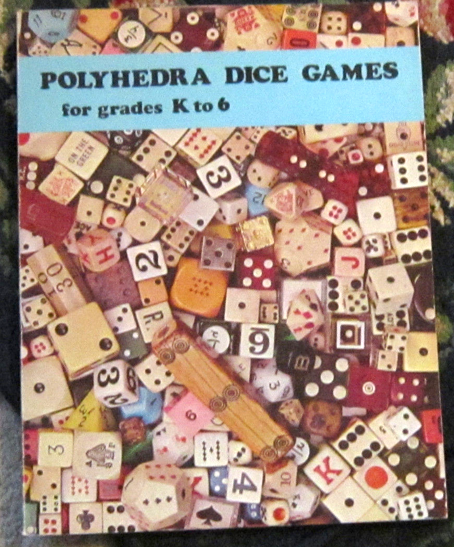
Jon Peterson, author of Playing At the World, discusses the history of TSR's early dice in his post, "How Gaming Got Its Dice". He mentions the company Creative Publications as the source of the Polyhedra dice, and presumably they supplied the Percentile set as well. Above is a book by Linda Silvey published by Creative Publications in 1978, showing their Polyhedra Dice set mixed in a sea of other dice (the image is from an Ebay auction).

Saturday, February 9, 2013

B/X Mud Brown and Pea Green Polyhedral Dice


In the early days my friend E.H. had the 1981 D&D Basic and Expert (B/X) sets, often knonw now as the Moldvay Basic and Marsh/Cook Expert Sets. I'll always remember the polyhedral dice from those sets, because they were so different than my pale blue Dragon Dice, which were the first set I'd purchased after starting with the notorious chits that came with my Holmes Basic Set. His Basic Set dice were pea soup green, and his Expert Set dice were mud brown, and each had a faint swirled pattern. On Tome of Treasures, a collecting site, I found a post with a picture of dice from a first print Expert Set that are exactly the same color as the brown ones I remember (see screenshot above). These dice came uninked, and the set also had a crayon for coloring them. There's been some discussion of the B/X dice on the Acaeum recently here. I haven't found a picture of the green dice yet.


Update: The "swirly-pea green" dice can be seen here on the Dice Collector's TSR dice page. Also, it looks like there may have been two slightly different versions of the brown dice, one with a more prominent swirl like I remember.

In those days we'd try to play D&D anywhere. Once we were in his dad's brown Subaru, with E.H. DMing in the front with the green/brown dice in a flat space on the dash. Unfortunately, the window was also open, and when his dad made a U-turn some of the dice went flying out into a busy intersection. We had to dodge traffic to try to recover them, and I don't think we found all of them.

Wednesday, April 11, 2012

Veteran of the Dice Wars

     Here's a nice picture of the "low impact" dice included with the Holmes Basic Set. On Flickr, found via Google Images. Good choice for the background:


     There's no ten-sided die in this set - they weren't available for sale until 1980. Instead, the white twenty-sider was numbered 0-9 twice, and was rolled with a control die (d6) to generate a d20 result (1-3 = 0-9; 4-6 = 11-20; per the instructions in the Holmes rulebook).

     Update: Note that these dice were all pre-inked by the manufacturer. If you look closely in the advertisements below you'll see that the dice already have ink on them.

     This set was included in the Holmes Basic Set starting with the 1st print (1977), and are shown (in black and white) in the photo on the bottom of the box with the Dungeon Geomorphs and the Monster & Treasure Assortment Set 1. The same photo showed up in color in a TSR catalog from 1977/1978 (a predecessor to the common "Gateway to Adventure" catalogs):


    The same set, which TSR called Polyhedra Dice, was also provided with Gamma World  boxed sets. TSR also sold the set separately ($1.49), as well as a set of two twenty-siders (one white, one pink) called Percentile Dice ($.89), as shown in the same catalog:


     In Nov 1978, TSR released the 2nd edition of the Holmes Basic Set, with the module B1 In Search of the Unknown replacing the Geomorphs and M&TA. The dice remained the same, as shown in this advertisement:
     At some point while they were selling this edition, the dice supply ran short and the infamous chits were introduced. Here's an advertisement showing the set with B1 and chits:

     In December 1979, the third edition was released, with B2 Keep on the Borderlands replacing B1. The sets still had chits in them, as shown in this ad, which is very similar to the one above:


     This is the version that I had as my first D&D set (which I got in 1982). The Acaeum also reports that some sets have been found with six dice, and the very last printing of the rule book refers to d10 with the other dice, so in 1980 they may have switched back to providing dice once they were available again.

     Which set did you have?

See also:
TSR Percentile Dice in the '70s
How Gaming Got Its Dice - article by Jon Peterson on Playing at the World

http://zenopusarchives.blogspot.com/2014/05/tsr-percentile-dice-1970s.html