This is the blog. Click here to go to the Zenopus Archives website.

Note: Many older posts on this blog are missing images, but can be viewed at the corresponding page in the Internet Archive

FEATURED POST

The Forgotten Smugglers' Cave: Index of Posts

An index of posts describing the Forgotten Smugglers' Cave, an adventure for Holmes Basic characters levels 2-4.                    ...

Showing posts with label ODnD. Show all posts

Wednesday, February 11, 2026

Gary Con 2025: Day 1 - Chainmail & Balrogs


The moathouse model for the Battle for the Moathouse 

Finding myself with a some rare free time, I dove back into my unfinished blog posts, and found this one covering my highlights from the first official day of Gary Con XVII, Thursday March 19th, 2025, where I played in two wargames and ran an RPG. Better late than never...

See the preceding post in this series here: Day 0

(1) For my first game in the morning, I played in the epic Battle for the Moathouse, a Chainmail scenario that recreates  a piece of Greyhawk history; specifically, the assault that creates the Ruined Moathouse in T1 The Village of Hommlet. This was refereed by the indefatigable Paul Stormberg, who organizes the entire Legends of Wargaming hall and game series every year.

Convention event listing description:

"Legends of Wargaming event! This Chainmail fantasy battle recreates one of the battles fought in the greater struggle against the Temple of Elemental Evil. After the Battle of Emridy Meadows and the Temple itself, a small force marched on the Moathouse, an outpost of Elemental Evil. Join the forces of weal and their righteous cause or serve Elemental Evil to crush the armies of good!"

I was on the side on the Forces of Woe (Elemental Evil), defending the Moathouse against the Forces of Weal. If I recall correctly at this late date, the game fairly faithfully recreated the course of the original events, with Weal doing pretty well storming the Moathouse. Woe was still in control of the Moathouse at the end of the allotted time, which I think was technically a win for us (i.e., surviving a certain number of rounds), but if the game had gone on just a little longer our leaders would have been forced to flee.

Photos:


The lineup for the Forces of Woe


The Forces of Weal advance on the Moathouse


Woe's Troll goes down on the battlefield


(2) In the afternoon I ran my Party of Balrogs OD&D scenario, the first of two games I was scheduled to run. This was second time running Party, the first being the year before at Gary Con 2024. That game had a great group of players, but they completed the scenario more quickly than I had anticipated, so I revised/added a few things to it for this year. 

Here's my convention blurb for the game:

"The 1974 D&D rules allowed for a character to be "virtually anything", even a balrog. This adventure takes this to 11 by having *all* of the PCs be balrogs! Ensorcelled to serve a wizard deep in a megadungeon, the spell is now broken. Can you get past the other guardians and make the wizard pay? This game by the Zenopus Archives celebrates 50 years of D&D. Balrog PCs provided."

I again had a great group of players, including one fellow who had played in some of my games previously. They undertook their mission with gusto and creative play and were successful in their mission. A thank you to all of them: Shawn (Stan the Goremonger), Lauren (Murdertina), Bryon (Billy the Balrog), Jeff N. (Pip), Matt (Thalroth), and Jeff W. (Ny Olog)

I'm running this scenario again this year at Gary Con 2026; the event page for it is here: Party of Balrogs GC 2026.

Unfortunately, I didn't take or receive any table photos for this game.

Michael Mornard, who played the original Balrog character in Greyhawk, happened to be GMing the next game I was scheduled to play (see below). To show my appreciation for originating the concept of Balrogs as PCs, I found him before his game and was able to introduce myself and buy him a beer to thank him for his inspiration.

(3) My evening game was Michael Mornard's Battle on the Ice, another Chainmail game, but historical rather than fantasy, based on the actual battle of the same name. This was played on the famous sand table in the Legends of Wargaming hall, with white coloring added to simulate the ice. I was part of the team on the side of Prince Nevsky, who won the actual battle, but unlike the real battle, we didn't fight on the actual ice, but rather tried to defend a position on an island, which probably contributed to our loss. However, our biggest mistake was separating our commander from his cavalry troops, without realizing this would render him much more vulnerable.

Convention Blurb: 

"Legends of Wargaming sand table event! This Chainmail historical scenario will be conducted on the Gary Con Sand Table. Refight the glorious battle of the Teutonic Knights vs. Prince Alexander Nevsky of Novgorod! The referee will be none other than Michael Mornard an early participant in LGTSA games and the playtesting of the Dungeons & Dragons game."

Photos:


Mike talking about the scenario prior to us placing our forces 


My team. I think Mike took this photo. I'm on the far right, wearing a Vecna tee.


The two opposing forces facing each other across the field


The other side advancing towards our island


Mike in action refereeing


Also in this series:

Gary Con 2025: Day 0

Gary Con 2025: Day 2 (forthcoming)

Previous Gary Con convention summaries:

Gary Con 2023 (unfinished): Day 0

Gary Con 2022: Day 1 --- Day 2 --- Days 3 and 4

Gary Con 2019 (unfinished): Day 1 --- Day 2 (part 1)

Saturday, December 21, 2024

The Mirkwood Tales RPG: the link between the original D&D rules and text-based computer games


Cover of Mirkwood Tales, 1977, by Eric S. Roberts


In May 1977, the all-text computer game Adventure, also known as Advent or Colossal Cave, "became the first computer game blockbuster", per the book 50 Years of Text Games by Aaron A. Reed (2023). Its popularity led to a whole genre of text-based adventure games that enjoyed popularity in the 80s, the best known being the Infocom games such as Zork, a close cousin of Adventure. While the start of Adventure approximates a real-world cave system, the game includes many fantasy elements, and it has long been known that the initial developer, Willie Crowther, was inspired by playing a D&D-type fantasy RPG.

Some of the earliest information came from Barry Gold, husband of Alarums & Excursions editor Lee Gold, in his article "Computers and Fantasy Gaming" from issue 30 of A&E, January 1978 (which I happen to have a physical copy of):
"As far as I know, Willie Crowther of Stanford University wrote the first fantasy simulation game. Don Woods added several features and expanded the dungeon to produce the current ADVENTURE game. Tim Anderson and Dave Lebling of MIT built on the Adventure game by using a more powerful computer language and including some ideas from D&D (Dave Lebling plays it). With help from two other users they came up with ZORK, sometimes called DUNGEON."

Later in the article, Gold adds follow-up information from Adventure co-designer Woods:

"ADVENT: Willie Crowther was at BBN (Bolt-Beranek and Newman - Massachusetts) when he wrote the original Adventure program. He was inspired by a Middle-Earth offshoot called Mirkwood Tales. Neither Willie nor Don appear to have drawn any ideas from the D&D rules in building Advent. Don Woods doesn't play any RPG games."

"The original program by Willie Crowther was much less complex than Don Wood's current version, and the dungeon was only about half its current size."

"Don Woods also provided a short genealogy of these games: war games, D&D, Mirkwood Tales, Adventures (original), Adventure (Don dropped the 's' from the name of his version), Zork."
From Gold's account, one might gather that this Mirkwood Tales was some kind of game situated between D&D and Adventure, but from this it's not really clear from this which it is closer to.

A 1996 Washington Post article by Katie Hafner and Matthew Lyon clarifies that Mirkwood Tales was a version of D&D set in Middle-Earth, in which Crowther played a thief sharing his first name:

"Dave Walden, who had been a programming ace working under Crowther at BBN, got his introduction to the game one night in 1975, when Eric Roberts, a student from a class he was teaching at Harvard, took him to a D&D session. Walden immediately rounded up a group of friends for continued sessions. Roberts created the Mirkwood Tales, an elaborate version of Dungeons and Dragons set in J.R.R. Tolkien's Middle Earth. The game stretched on for the better part of a year and was played mostly on Walden's living room floor. One of the regulars was Will Crowther. Where the dozen other players chose names like Zandar, Klarf or Groan for their characters, Crowther was simply Willie, a stealthy thief."

In 2012, the epilogue of the first edition of Playing at the World by Jon Peterson has a section "The First Virtual Worlds", which contains the first detailed description of the Mirkwood Tales rules, based on an unpublished 1977 manuscript written by Eric S. Roberts, the DM of the game (page 617). Peterson quotes from the Introduction and Acknowledgements section to demonstrate the "debt of Mirkwood Tales to Dungeons & Dragons", and then notes some of the significant differences in classes and combat from D&D, but concludes:
"Mirkwood Tales is a game of stratified progression, where characters accumulate experience points while adventuring and go up in level as they reach certain experience totals. It moreover relies on underworld exploration, combat and treasure to drive an engaging narrative. In all those respects, it very closely follows the precedent of Dungeons & Dragons" (page 617). 

Later in the section, Peterson reveals that Dave Lebling, one of the developers of Zork, also played in Roberts' Mirkwood Tales campaign (page 622).

(Note: The 2012 edition of Playing at the World is out of print, and is being republished in a two-volume edition; the first volume is already out but does not contain the above material).

Until this month, this was the most detail about The Mirkwood Tales RPG that was generally available. Now, however, Eric Roberts has made public a reformatted pdf of Mirkwood Tales, as announced recently on Renga in Blue by blogger Jason Dyer:


Head over there to find the link to the pdf, hosted on the Internet Archive, and much more in a deep dive back into Crowther's original version Adventure - before Woods added on to it - as viewed anew through the lens of the full Mirkwood Tales rules. Dyer has an ongoing project called All the Adventures, wirh the goal of playing and blogging "about every adventure game ever made in (nearly) chronological order" (!), and has previously played through the many variations of Adventure, and thus has great insight into the details of the game. 

Unlike Gold's early assertion, which appears to be based on communication with Woods rather than Crowther himself, after playing through Crowther's original version again, Dyer concludes that Adventure does draw upon several elements from The Mirkwood Tales:
"It isn’t like Crowther was trying to “adapt Dungeons and Dragons” entirely — this is not an RPG, and nearly every room has an analogue in the real cave — but there’s still clearly some flavor of Crowther’s world found in the campaign he participated in, with the treatment of magic, direct reference to the computer as the “eyes” of the player, and heavy emphasis on dwarves (if a bit more aggressive in this game)"
Of these, the element with the strongest ties to the original D&D rules is "the treatment of magic", which here refers to the identification of properties of magic items in the game. Dyer asked me about how magic items were identified in OD&D, and I pointed to the Example of Play in Vol 3, where a player tries on "old boots" to identify them as magical Elven boots:


Dyer notes that this concept, which is merely exemplary in OD&D, is expressly stated in The Mirkwood Tales rules:
"In addition to spells, magic appears in the Mirkwood Tales in the form of magical artifacts and equipment. More often than not, the magical effect of some object will not be clear from simple examination of the object, and it may require experimentation or searching for further clues to its nature" (The Mirkwood Tales, page 21, section "3.5.3 Magical Artifacts")

Adventure, in turn, requires the player to experiment to figure how out how to use magic such as items or words. The first magic item encountered in Adventure is the "the iconic three foot black rod with a rusty rod", which has two different properties in the game, and "the experience of fiddling with the rod — and finding two effects, both positive and negative — are similar to OD&D campaigns", per Dyer.

The Mirkwood Tales rules mostly rewrite the first volume of OD&D, Men & Magic, with some material from Vol 3, including a much longer Example of Play. The subject matter of Vol 2 is almost entirely missing; there are no lists of monsters or treasure. If I find time in the future I will take a closer look at how the Mirkwood Tales RPG rules differ from OD&D.

Sunday, December 1, 2024

Tower of Xenopus: Mazes & Minotaurs RPG adaptation by Tony Stroppa


In the comments to "Zenopus Built a Tower", Part 46 of the Holmes Manuscript series on this blog, reader Tony Stroppa wrote in about his adaptation of Holmes' Tower of Zenopus dungeon for the Mazes & Minotaurs RPG, a reimagining of OD&D as if it was inspired only by Greek mythology, and which can be found for free on DriveThruRPG. With Tony's permission, I'm sharing his comments here:

"I am running a game of "Mazes & Minotaurs", which is Mythic Greek inspired OSR game (instead of based on Tolkien and the Middle Ages). The setting is "Kriti" (Crete) during a quasi-mythical version of the Late Bronze Age. As an homage (plus, I am lazy) I repurposed and repackaged "The Tower of Zenopus" to be more Greek-sounding as "The Tower of Xenopus", and tied it into the myth of the Labyrinth of the Minotaur. The stone tower was a fortification built by a Mycenaean warlord, Xenopus ("Strange Foot") which is still standing. It is built on top of the earlier ruins of a Minoan temple on a mountaintop (a "peak sanctuary") in central Crete. Like many Minoan peak sanctuaries it was also a sacred burial cave, which dovetails nicely with parts of the original "Tower of Zenopus". The tunnels of the "dungeon" would have been carved out of the soft limestone rock common to Crete and filled with bones. (Minoans practiced primary and secondary burial, where remains would first be stripped of flesh, then re-interred en masse in ossuaries like jars, small caskets, etc. with several sets of remains in one container). Floors are limestone, all walls have extensive Minoan murals (dolphins, bulls, female goddess figures of Rhea/Cybele, etc.). Most doors have been removed to fit the archaic burial cave theme. Also, metal for hinges was scarce in the Late Bronze Age.

To adapt the map I flipped it over left-to-right but left it mostly unchanged. Above the initial entry stairs was a Mycenaean square stone tower fortification typical of the period (a ground floor and a roof accessed by a stairs). As the underground complex is on a mountain the underground river is the same. But the tunnel to the ocean is now instead a mystical passage to the Underworld. The pirates inside it are all changed to be "Telkines", mythical Greek "fish-children" (aka "Sons of Dagon" or off-brand Deep Ones). The goblins are changed to "Kobaloi". ("Kobalos" is linguistically related to "Kobold", which is itself linguistically related to "Goblin".) The ghouls become "Vrykolakes", a sorta-similar undead cannibal of Greek folklore. Giant rats and the Giant Spider are the same. Room S still has stairs up, these lead to another burial cave. The sorcerer inside is changed to be a Telkine water Elementalist with a Telkine guard.

Room S now also has stairs down, these lead to the Labyrinth of the Minotaur. At the middle of the maze are the remains of the Minotaur, slain by Theseus (and with the sword he used still in its ribs). At the entrance to the Labyrinth a "clue" (ball of thread) is tied off. This is what Theseus used to navigate the Labyrinth. It becomes clear the Labyrinth is not a real maze; although the path twisted and turned there are no branching paths or dead ends. (This is the classical Cretan labyrinth diagram.) It becomes clear the thread does not somehow mark off branches to aid in navigation, it simply measures distance to the middle of the Labyrinth. This is because it was intended all along the Greek (Hellene) sacrifices would be forced to travel a single path inwards to the centre where the Minotaur would be waiting to kill them. There would be no side passages, no dead ends. They would simply travel the path and it turned back and forth, becoming disheartened and confused, then die. Theseus, as he knew how far he would go, was forewarned by the thread running out. Thus when nearing the centre of the Labyrinth he was ready for a fight, unlike all the other sacrificial victims.

Thus, the classic "Tower of Zenopus" becomes the "Tower of Xenopus"!"


"Silver coin from Knossos displaying the 7-course "Classical" design to represent the Labyrinth, c. 400 BC." Source: Wikipedia page on the Labyrinth


Followup comment:

"It would be my pleasure! There are a couple of monsters that do not need adapting: the giant spider and crab, and the skeletons. The players are very into the quest; they have passed up every chance of looting even though there are glints of gold and valuables mixed within the bones in the ossuary vessels, a couple chests of silver in the boats on the shore of the vast underground ocean (the Gods warned them to not proceed further in that direction as it leads to the underworld, and it was not yet their time). As another "Greek" touch the rotating statue is of Poseidon, and the talking mask looks like the "death mask" of Agamemnon. In the central circular room are stairs leading up (into come caves on the mountainside) and a trap door leading down into the labyrinth.

The labyrinth is a classic "Cretan" one: circular with no branching paths with dead ends. One single path to the end. Clearly not the confusing maze they are expecting! The purpose of the labyrinth was to execute prisoners. So they wander the single path to the end where the Minotaur waited to end their lives. By that time they would be disoriented and demoralised, easy prey in the darkness. How Theseus prevailed was using a "clue", a ball of yarn. I could never figure out how that would help to navigate a maze unless it was really, really big! But if the path has no branches then a strand of twine can do one thing well: measure distance. Therefore Theseus would know exactly how far he'd gone and how close to the end. Instead of the Minotaur ambushing him as he stumbled along, confused, he would know to be armed and ready for a fight. A fight the Minotaur would not expect, the advantage would be his. In this case the PCs would follow the twine to the centre, there to face the Minotaur."

Second follow-up comment:

I decided to not do random encounters, although the Kobaloi (employed by the sorcerer as guards) are not doing a great job and could start patrolling. The sorcerer "boss" is a recurring NPC in my game, a woman. She's annoyed the Kobaloi are not doing their job!

Although like everyone I read Zenopus in the D&D Basic set, I never experienced it as a player or DM. It just has so many nice touches. And as mentioned it converts well to other fantasy systems.

As a GM's note, I thought the giant crab would give them a lot of trouble as their claws are very deadly in a low-HP system like Mazes & Minotaurs. But this turned out to not be the case. We are using the optional "Homeric" combat rules (critical hits) and the first shot with a sling stone nailed it in the eye and it spasmed, losing its turn. I determined it had been flipped on its back and needed a turn to right itself. (The actual result was the target fell down, which doesn't make sense for a squat 6-legged behemoth. Instead of ignoring the result I decided on something cinematic.) The PCs piled on and got several good hits in. By the time it stood back up the fight was practically over. It tried to disengage and they finished it off.

My commentary: This is a very creative adaptation of Holmes' Sample Dungeon and would be a great deal of fun to play through!

Wednesday, November 20, 2024

The Making of OD&D: Half-Price Sale on Amazon


The Making of Orginal D&D is currently on sale for $49.99 on Amazon, which is 50% off the cover price ($99). This is the lowest price I've seen for the book so far, which came out back in July. It says "Limited Time Deal", but there's no date indicated, so I don't when it ends. If you've been on the fence due to the price here's your chance. Find the table of contents  below.

Find it here: 

The Making of Original Dungeons & Dragons: 1970-1977


See also these earlier posts:

Early Greyhawk Lore in the 1973 D&D Draft

"The Making of Original D&D: 1970-1977": Out Today! 

"The Making of Original D&D: 1970-1977": Table of Contents

"The Making of Original D&D: 1970-1977": What Might the Precursors Be?

"How Dungeons & Dragons Started" (video about the book)

"The Making of Original D&D: 1970-1977": Everything we know about this upcoming WOTC book

Playing at the World revised edition out in July 

Wednesday, October 16, 2024

Making of OD&D: Discounted at Game Nerdz


If you haven't picked up the Making of Orginal D&D, it's available at Game Nerdz for $70.47 plus shipping (if you get your order up to $75 you'll get free shipping). This is almost $20 cheaper than the current Amazon price of $89.35. The page says there are currently 26 copies in stock. I've ordered from Game Nerdz a few times before without problem. 

Find it here: 

The Making of Original Dungeons & Dragons: 1970-1977 

(includes affiliate link)

See also these earlier posts about the book:

Early Greyhawk Lore in the 1973 D&D Draft

"The Making of Original D&D: 1970-1977": Out Today! 

"The Making of Original D&D: 1970-1977": Table of Contents

"The Making of Original D&D: 1970-1977": What Might the Precursors Be?

"How Dungeons & Dragons Started" (video about the book)

"The Making of Original D&D: 1970-1977": Everything we know about this upcoming WOTC book

Playing at the World revised edition out in July

Wednesday, October 9, 2024

Making of OD&D: Sale for Prime Members


FYI, right now Amazon is offering the Making of Orginal D&D book for $71.49, as a "Prime Big Deal" for Prime Member which is almost $30 off the cover price $99.99, and almost $20 off the "regular" sale price ($89.36). Unfortunately I just noticed this sale and it appears it ends in about 5 hours (the Big Deal Days are Oct 8-9).

Find it here: 

The Making of Original Dungeons & Dragons: 1970-1977


See also these earlier posts:

Early Greyhawk Lore in the 1973 D&D Draft

"The Making of Original D&D: 1970-1977": Out Today! 

"The Making of Original D&D: 1970-1977": Table of Contents

"The Making of Original D&D: 1970-1977": What Might the Precursors Be?

"How Dungeons & Dragons Started" (video about the book)

"The Making of Original D&D: 1970-1977": Everything we know about this upcoming WOTC book

Playing at the World revised edition out in July

Tuesday, June 18, 2024

"The Making of Original D&D: 1970-1977": Out Today!


Promo ad showing pages from the Greyhawk Supplement (1975)

Today is the day! As a reminder, today is the released date of highly anticipated book, The Making of Original Dungeons & Dragons: 1970-1977, a massive (almost 600 pages) tome reprinting the original D&D booklets & supplements; the original draft of D&D and a wealth of other related documents & correspondence. More details about the contents can be found in two of my earlier posts:

"The Making of Original D&D: 1970-1977": Table of Contents

"The Making of Original D&D: 1970-1977": What Might the Precursors Be?

If you haven't ordered the book yet, it can be found here on Amazon:

The Making of Original Dungeons & Dragons: 1970-1977

Recent Promos:

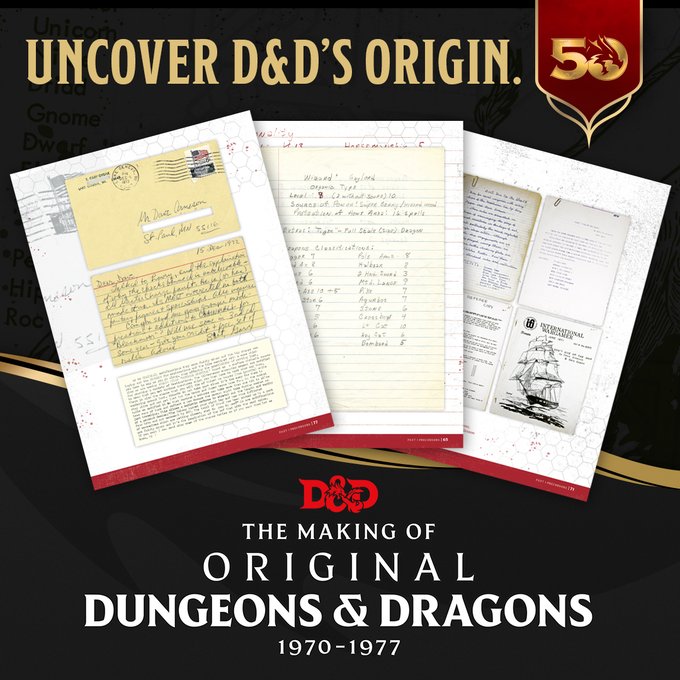
The official D&D account has posted several promo photos over the last few weeks, including the one at the top of this post. Here are two of the others:


Promo ad showing pages from Chainmail 2nd Edition


Promo ad showing correspondence between Gygax & Arneson


Monday, May 20, 2024

The Making of OD&D Book: What Might the D&D "Precursors" Be?


The Making of OD&D comes out in less than a month, and the approximately 600-page tome was revealed "in the flesh" last week on the official D&D account on Twitter, with the above photo of an advance copy captioned: "The Making of Original Dungeons & Dragons... it's BIG!" 

If you haven't ordered the book yet, it can be found on Amazon for $99, and with a price-drop guarantee:

The Making of Original Dungeons & Dragons: 1970-1977


Based on the Table of Contents that I re-posted at the beginning of this month, let's take a closer at what might be in the interesting section "Part 1: Precursors", which covers the ancient era before the first draft of D&D (1973). I don't have any particular insider knowledge, so these are simply my best educated guesses based on titles alone:

   Grayte Wourmes (page 10) 

   Fittingly for a game that includes "Dragons" in the title, the Precursor section starts with material that is clearly from a series of articles about Dragons that Gary Gygax wrote in 1969-1970 for the Diplomacy zine Thangorodrim (named after the mountains home to Morgorth's fortress Angband), describing White, Black, Green, Blue and Mottled (aka Purple Worm) Dragons.

   Maps of the Great Kingdom (page 18)

    The use of plural "Maps" suggests this will include at least two maps. One may be the original Great Kingdom map from Domesday Book #9 (1970/1971), which was previously reprinted on page 32 of Playing at the World (2012) by Jon Peterson. 

    Another may be a later one showing the territories of the Great Kingdom; one version of this map was uncovered by Dave Megarry in 2017; see my post from that year titled "Megarry's Copy of the Great Kingdom Map".

    Medieval Weaponry in the Encyclopedia Britannica (page 20)

    In 2014, Jon Peterson wrote in a post on his Playing at the World blog that, "Gygax did indeed rely heavily on the 1911 Encyclopedia Britannica for medieval information in the early 1970s for certain particulars, though that would be a story for another time". So it seems we are getting that story now. 

    I also note that on EnWorld in 2002, Gygax mentioned his "set of Eleventh Edition ENCYCLOPEDIA BRITANNICA that my most honored maternal grandfather bequeathed to me". The Eleventh Edition of EB has its own Wikipedia page.

   Chainmail's Fantasy Supplement (page 26)

    This is, obviously, the fantasy section that makes up about a quarter of the Chainmail miniatures rules. From the preview page that has been shown, the book will reprint the version from the 2nd Edition, published by Guidon Games in 1972.

    Gygax on Armor (page 46)
    
    This may be an article that Gygax wrote for Panzerfaust #43, April 1971, which Jon Peterson discussed on his blog in 2014.

    The Battle of the Brown Hills (page 50)

    This is a relatively well-known Chainmail scenario between the forces of Law and Chaos that Gygax wrote up for Wargamer's Newsletter #116, published in November 1971. These days you can play in it on a sand table as part of the Legends of Wargaming series run annually at Gary Con thanks to Paul Stormberg. This year it was run in the basement of 330 Center Street, where Gygax lived when he worked on the initial D&D rules.
    
    Arneson's "Medieval Braunstein" (page 54)

    In a 2014 post on the Playing at the World blog, Jon Peterson described a document with this same name "A surviving set of instructions for a 1970 medieval multiplayer game".
    
    Blackmoor Gazette and Rumermonger 2 (page 58)

    This is an issue of a campaign newsletter put out by Dave Arneson. The first issue can be seen here on the Playing at the World blog.
    
    "Points of Interest in Black Moor" (page 60)
    
    An article by Dave Arneson that originally ran in Domesday Book #13 (July 1972), and was later reprinted in the First Fantasy Campaign supplement published by Judges Guild.

    The Wizard Gaylord (page 64)
    
    Likely the same "surviving character sheet from the Blackmoor Campaign, that of Pete Gaylord's character the Wizard of the Wood (best known from the brief biography in First Fantasy Campaign)" that previously appeared on page 367 of the Playing at the World book (2012).

    Loch Gloomen (page 68)
    
    Blackmoor historian Dan Boggs described, in a 2014 post on his blog Hidden in Shadows, how in the spring of 1972, play in the Blackmoor campaign moved to an area known Loch Gloomen, or Lake Gloomy. Material from this era appears in a section titled "Loch Gloomen" in the First Fantasy Campaign. So this is likely some of the surviving original material from this era written by Arneson.

    Outdoor Survival (page 72)
    
    Excerpts from the rules of the board game Outdoor Survival, published by Avalon Hill, which was in the list of recommended Equipment in OD&D Vol 1 (Men & Magic) and heavily influenced the rules for Wilderness Exploration in Vol 3 (The Underworld and Wilderness Adventures).

    Gygax/Arneson Blackmoor Correspondence (page 76)

    Personal letters between Gary Gygax and Dave Arneson prior to the development of the first draft of D&D.

Wednesday, May 1, 2024

"The Making of Original D&D: 1970-1977": Table of Contents


Above is a screenshot of the Table of Contents for the forthcoming book, The Making of Original Dungeons & Dragons: 1970-1977, which I've written about previously. This was shown at a 50th Anniversary Panel at Gary Con in March, and later shared on D&D Beyond, and now can be seen on the Amazon order page, where the book is available for pre-order for $99, and with a price-drop guarantee:

The Making of Original Dungeons & Dragons: 1970-1977

There's over 576 pages of content in this book, and the page numbers confirm the previously reported but still-stunning news that the tome will include all or most of the original 1973 OD&D draft (pages 84-181), the three OD&D LBBs (pages 202-328), the Greyhawk supplement (pages 356-415), the Blackmoor supplement (pages 430-497), the Eldritch Wizardry supplement (pages 506-569), plus a slew of material from correspondence, drafts, player notes, and magazine articles.

For posterity (including future searchability), here is a text transcript of the contents, into which I've inserted some of the promotional images for the book in their appropriate places:

Table of Contents

Preface (page 4)
Foreword (page 6)

Pages 8 and 9

Part 1: Precursors (page 9) (Read more about what these documents are here)
    Grayte Wourmes (page 10)
    Maps of the Great Kingdom (page 18)
    Medieval Weaponry in the Encyclopedia Britannica (page 20)
    Chainmail's Fantasy Supplement (page 26)
    
Pages 28 and 29
    
    Gygax on Armor (page 46)
    The Battle of the Brown Hills (page 50)
    Arneson's "Medieval Braunstein" (page 54)
    Blackmoor Gazette and Rumermonger 2 (page 58)
    "Points of Interest in Black Moor" (page 60)
    The Wizard Gaylord (page 64)
    Loch Gloomen (page 68)
    Outdoor Survival (page 72)
    Gygax/Arneson Blackmoor Correspondence (page 76)

Part 2: The 1973 Draft of Dungeons & Dragons (page 79)
    Greyhawk and the Revised Great Kingdom Map (page 80)
    The First Draft of D&D (page 84)
    The Twin Cities Draft (page 182)
    The Mornard Fragments (page 188)
    The "Clean-Up Crew" (page 198)

Part 3: Original Dungeons & Dragons (page 201)
    Expanding the Rules (page 201)
    Draft Versus Published Version (page 202)
    The Brown Box and the White Box (page 202)

Pages 288 and 289

Part 4: Articles & Additions  (page 329)
    Monsters' Attacks and Damage (page 330)
    Greyhawk Player Maps (page 336)
    Gygax in Europa (page 338)
    The Strategic Review 1 (page 348)
    Greyhawk (page 356)

Pages 199, ?, and 414


    Excerpts from the Strategic Review (page 416)
    Blackmoor (page 430) 
    Additional Excerpts from the Strategic Review (page 498)
    Eldritch Wizardry (page 506)
    The Dragon (page 570)
    Gods, Demi-gods and Heroes (page 574)

Afterword: A Whole New Game (page 576)

While it remains jaw-dropping that WOTC is publishing a book of this nature, and the contents themselves are far beyond what anyone would have predicted, just for completeness sake I will note a few items that are apparently not included:

---The contents only list Chainmail's Fantasy Supplement, so it looks like it will not include the entirety of Chainmail, making it a bit less useful as a complete resource for OD&D, as running OD&D using Chainmail combat also requires the non-Fantasy portions. However, you can get a reprint of the complete Chainmail for less than $10 at DMs Guild, so it's easy to find this material.

---Gods, Demigods & Heroes is listed in the contents, but starts only two pages before the Afterward, so obviously this section is just a brief look at this supplement rather than the whole book.

---There's no mention of Holmes Basic in the contents; thus, if there's any coverage it will the be in Afterword ("A Whole New Game"). I haven't seen an exact page count for the book, so I don't know how long the Afterword is. Based on the originally announced title for the book, which included the dates "1970-1976", I wasn't expecting anything about Holmes Basic in it; but when the title was tweaked to "1970-1977", it seemed possible that it might get at least a page or two of its own, possibly discussing the Holmes Manuscript, which is based purely on OD&D. 

As noted above the book is over 575 pages as it is, so I'm not really surprised that there was indeed some limit to the expansiveness of the material that they could include.

See also these other posts:

The Making of OD&D Book: What Might the "Precursors" Be?

"How Dungeons & Dragons Started" (video about the book)

"The Making of Original D&D: 1970-1977": Everything we know about this upcoming WOTC book

Megarry's Copy of the Great Kingdom Map