This is the blog. Click here to go to the Zenopus Archives website.

Note: Many older posts on this blog are missing images, but can be viewed at the corresponding page in the Internet Archive

FEATURED POST

The Forgotten Smugglers' Cave: Index of Posts

An index of posts describing the Forgotten Smugglers' Cave, an adventure for Holmes Basic characters levels 2-4.                    ...

Showing posts with label Sample Dungeon. Show all posts

Sunday, February 16, 2025

Holmes Day 2025


J. Eric Holmes at his chalkboard game table, contemplating miniatures and notes.
Taken by Tony Bernard for the 1979 L.A. Times article, "Fantasy Life in a Game Without End";
a cropped version appears with the article. Scan of the original photo courtesy Bill Galaxy.


For fans of the Holmes Basic Set, today is notable as it marks the birthday of its editor, J. Eric Holmes. And this year he would have been 95 years old, although sadly we lost him in 2010 at the age of 80.

To mark the occasion, here are some Holmes-ian highlights from the last year:


February

For Leap Day 2024, I shared a new monster inspired by Holmes' Sample Dungeon: the Giant Zenopus.

March

At Gary Con 2024, I ran two games, one of which was a session of the Forgotten Smugglers' Cave, my Ruined Tower of Zenopus-adjacent dungeon. Later in the year I worked on preparing this for publication, although I haven't been able to finish it yet.

April

At our local Scrum Con 2024, I ran the Forgotten Smugglers' Cave again, and also an impromptu fill-in session of the original Ruined Tower of Zenopus sample dungeon, which is always a blast.


May

May saw the publication of 50 Years of D&D, which includes an article, "Doctor Holmes I Presume?' How a California Neurology Professor Penned the first Dungeons & Dragons Basic Set", co-written by Tony Rowe and yours truly. Read more about the book here: 50 Years of D&D.


June

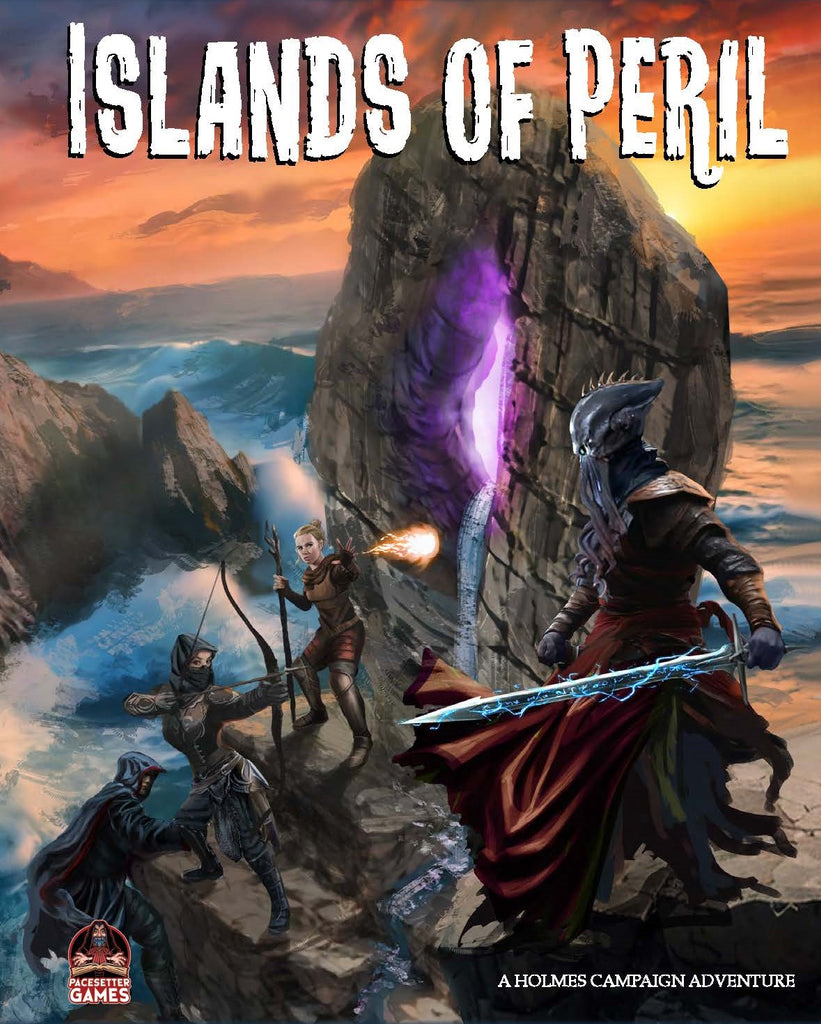
Pacesetter Games published the Islands of Peril, the latest adaptation of Holmes' original campaign maps and notes, to which I contributed a Foreword discussing the maps and notes on which it was based.


Wizkids promo photo. Source.

July

WizKids released a line of miniatures for the 50th anniversary of D&D, which included the Red Dragon, Blue Wizard and Green Knight from the cover of the Holmes Basic set. I have been somewhat frustrated with the availability of these figures, and haven't written a separate post about them on the blog, although I still might.


August 

I wrote about the return of the OSR zine Fight On #15, with an issue dedicated to Holmes, including an article by myself about how to Holmesify your OSR game.


September

I reviewed a Holmes Basic metal sign available from Ata-Boy via Amazon.


November

I wrote about the Coleman-Rider-Waite Deck tarot card The Tower, and its thematic similarities to the Tower of Zenopus.


December

I shared the "Tower of Xenopus", a writeup by Tony Stroppa of his adaptation of the Sample Dungeon for the Greek mythology-based Mazes & Minotaurs RPG.

January

Looking forward to Gary Con 2025, I wrote about the games I will be running, one of which is The Eye of Arzaz, Holmes' other sample dungeon from his 1981 book Fantasy Role-Playing Games.


Sunday, December 1, 2024

Tower of Xenopus: Mazes & Minotaurs RPG adaptation by Tony Stroppa


In the comments to "Zenopus Built a Tower", Part 46 of the Holmes Manuscript series on this blog, reader Tony Stroppa wrote in about his adaptation of Holmes' Tower of Zenopus dungeon for the Mazes & Minotaurs RPG, a reimagining of OD&D as if it was inspired only by Greek mythology, and which can be found for free on DriveThruRPG. With Tony's permission, I'm sharing his comments here:

"I am running a game of "Mazes & Minotaurs", which is Mythic Greek inspired OSR game (instead of based on Tolkien and the Middle Ages). The setting is "Kriti" (Crete) during a quasi-mythical version of the Late Bronze Age. As an homage (plus, I am lazy) I repurposed and repackaged "The Tower of Zenopus" to be more Greek-sounding as "The Tower of Xenopus", and tied it into the myth of the Labyrinth of the Minotaur. The stone tower was a fortification built by a Mycenaean warlord, Xenopus ("Strange Foot") which is still standing. It is built on top of the earlier ruins of a Minoan temple on a mountaintop (a "peak sanctuary") in central Crete. Like many Minoan peak sanctuaries it was also a sacred burial cave, which dovetails nicely with parts of the original "Tower of Zenopus". The tunnels of the "dungeon" would have been carved out of the soft limestone rock common to Crete and filled with bones. (Minoans practiced primary and secondary burial, where remains would first be stripped of flesh, then re-interred en masse in ossuaries like jars, small caskets, etc. with several sets of remains in one container). Floors are limestone, all walls have extensive Minoan murals (dolphins, bulls, female goddess figures of Rhea/Cybele, etc.). Most doors have been removed to fit the archaic burial cave theme. Also, metal for hinges was scarce in the Late Bronze Age.

To adapt the map I flipped it over left-to-right but left it mostly unchanged. Above the initial entry stairs was a Mycenaean square stone tower fortification typical of the period (a ground floor and a roof accessed by a stairs). As the underground complex is on a mountain the underground river is the same. But the tunnel to the ocean is now instead a mystical passage to the Underworld. The pirates inside it are all changed to be "Telkines", mythical Greek "fish-children" (aka "Sons of Dagon" or off-brand Deep Ones). The goblins are changed to "Kobaloi". ("Kobalos" is linguistically related to "Kobold", which is itself linguistically related to "Goblin".) The ghouls become "Vrykolakes", a sorta-similar undead cannibal of Greek folklore. Giant rats and the Giant Spider are the same. Room S still has stairs up, these lead to another burial cave. The sorcerer inside is changed to be a Telkine water Elementalist with a Telkine guard.

Room S now also has stairs down, these lead to the Labyrinth of the Minotaur. At the middle of the maze are the remains of the Minotaur, slain by Theseus (and with the sword he used still in its ribs). At the entrance to the Labyrinth a "clue" (ball of thread) is tied off. This is what Theseus used to navigate the Labyrinth. It becomes clear the Labyrinth is not a real maze; although the path twisted and turned there are no branching paths or dead ends. (This is the classical Cretan labyrinth diagram.) It becomes clear the thread does not somehow mark off branches to aid in navigation, it simply measures distance to the middle of the Labyrinth. This is because it was intended all along the Greek (Hellene) sacrifices would be forced to travel a single path inwards to the centre where the Minotaur would be waiting to kill them. There would be no side passages, no dead ends. They would simply travel the path and it turned back and forth, becoming disheartened and confused, then die. Theseus, as he knew how far he would go, was forewarned by the thread running out. Thus when nearing the centre of the Labyrinth he was ready for a fight, unlike all the other sacrificial victims.

Thus, the classic "Tower of Zenopus" becomes the "Tower of Xenopus"!"


"Silver coin from Knossos displaying the 7-course "Classical" design to represent the Labyrinth, c. 400 BC." Source: Wikipedia page on the Labyrinth


Followup comment:

"It would be my pleasure! There are a couple of monsters that do not need adapting: the giant spider and crab, and the skeletons. The players are very into the quest; they have passed up every chance of looting even though there are glints of gold and valuables mixed within the bones in the ossuary vessels, a couple chests of silver in the boats on the shore of the vast underground ocean (the Gods warned them to not proceed further in that direction as it leads to the underworld, and it was not yet their time). As another "Greek" touch the rotating statue is of Poseidon, and the talking mask looks like the "death mask" of Agamemnon. In the central circular room are stairs leading up (into come caves on the mountainside) and a trap door leading down into the labyrinth.

The labyrinth is a classic "Cretan" one: circular with no branching paths with dead ends. One single path to the end. Clearly not the confusing maze they are expecting! The purpose of the labyrinth was to execute prisoners. So they wander the single path to the end where the Minotaur waited to end their lives. By that time they would be disoriented and demoralised, easy prey in the darkness. How Theseus prevailed was using a "clue", a ball of yarn. I could never figure out how that would help to navigate a maze unless it was really, really big! But if the path has no branches then a strand of twine can do one thing well: measure distance. Therefore Theseus would know exactly how far he'd gone and how close to the end. Instead of the Minotaur ambushing him as he stumbled along, confused, he would know to be armed and ready for a fight. A fight the Minotaur would not expect, the advantage would be his. In this case the PCs would follow the twine to the centre, there to face the Minotaur."

Second follow-up comment:

I decided to not do random encounters, although the Kobaloi (employed by the sorcerer as guards) are not doing a great job and could start patrolling. The sorcerer "boss" is a recurring NPC in my game, a woman. She's annoyed the Kobaloi are not doing their job!

Although like everyone I read Zenopus in the D&D Basic set, I never experienced it as a player or DM. It just has so many nice touches. And as mentioned it converts well to other fantasy systems.

As a GM's note, I thought the giant crab would give them a lot of trouble as their claws are very deadly in a low-HP system like Mazes & Minotaurs. But this turned out to not be the case. We are using the optional "Homeric" combat rules (critical hits) and the first shot with a sling stone nailed it in the eye and it spasmed, losing its turn. I determined it had been flipped on its back and needed a turn to right itself. (The actual result was the target fell down, which doesn't make sense for a squat 6-legged behemoth. Instead of ignoring the result I decided on something cinematic.) The PCs piled on and got several good hits in. By the time it stood back up the fight was practically over. It tried to disengage and they finished it off.

My commentary: This is a very creative adaptation of Holmes' Sample Dungeon and would be a great deal of fun to play through!

Tuesday, November 26, 2024

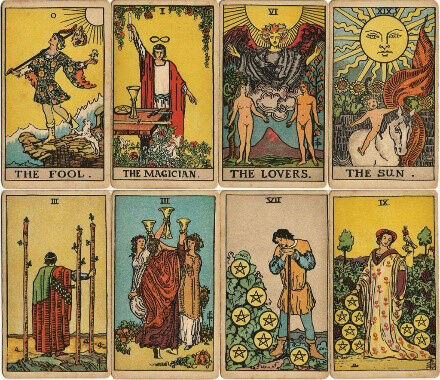
The Tower Card


"The Tower" card from the Rider-Waite-Smith Tarot deck

The recent miniseries Agatha All Along features the famous Rider-Waite-Smith Tarot deck, originally published by Rider in 1908, with sublime illustrations by Pamela Colman Smith and instructions by poet-mystic A. E. Waite, both members of the Hermetic Order of the Golden Dawn, a secret society devoted to occultism.


Pamela Colman Smith

A pivotal scene in one episode of the series employs the Major Arcana card The Tower (pictured above), which per Waite's instructions in the Pictoral Key to the Tarot represents: 

"Misery, distress, indigence, adversity, calamity, disgrace, deception, ruin. It is a card in particular of unforeseen catastrophe. Reversed: Negligence, absence, distribution, carelessness, distraction, apathy, nullity, vanity"

Note the emphasis on "unforeseen catastrophe", which is illustrated on the card by the lightning strike that knocks the crown and "wizards" from the tower and sets it afire. Per the Wikipedia page, Smith's design for this card is drawn from the card in the Tarot of Marseilles, which in turn had merged earlier concepts.


Rider-Waite-Smith cards at the Whitney

I've been a fan of Smith's illustrations since seeing the Rider deck on display in an exhibit of modernist art at the Whitney in NYC, where the Tower card jumped out at me, obviously, given my interest in the Tower of Zenopus. Seeing it again in the Agatha show reminded me of how well it resonates with the backstory of Holmes' sample dungeon, where the wizard and his tower are destroyed by unknown forces and a consuming fire, although here from beneath rather than above:

"Fifty years ago, on a cold wintry night, the wizard's tower was suddenly engulfed in green flame. Several of his human servants escaped the holocaust, saying their master had been destroyed by some powerful force he had unleashed in the depths of the tower"

I'm not suggesting that the Tower Card had any particular influence on Holmes' story, only that it has a similar theme, which also recalls ancient legends like the Tower of Babel or Zeus smiting the legendary doctor Asclepius with a bolt-from-the-blue for advancing his medical knowledge so far that he brought the dead back to life.

Holmes was a doctor and a scientist, but being a life-long fan of pulp and weird fiction, would have been familiar with the occultism as practiced around the turn of the 20th century. For example, he was a member of the Machen Society, devoted to the author Arthur Machen, who was friends with A. E. Waite and even briefly joined the Golden Dawn. In writing his own fantasy, Holmes occasionally employed the trappings of the occult. One Boinger and Zereth story, The Sorcerer's Jewel, features a medium, Misteera, who conducts seances, and another, In the Bag, even has the wizard Murray employ a tarot deck, albeit for solitaire rather than fortune telling; Boinger suggests that he "Play the knave on the Queen of Cups". 

However, in crafting the tale of Zenopus, Holmes was more likely directly inspired by the various doomed wizards in the Weird Fiction. In the Holmes Manuscript series, part 46, I went through the introduction to the Sample Dungeon and examined where Holmes may have taken inspiration from the works of H.P. Lovecraft, Clark Ashton Smith and Robert E. Howard.

Saturday, November 16, 2024

The Return of the Sample Dungeon


Cover of the 2024 DMG featuring Warduke, Skylla and Venger

Out this week is the latest version of the Dungeon Master's Guide, and in addition to bringing back Greyhawk as a sample setting, it also features the return of the Sample Dungeon. In this case, I don't mean the Tower of Zenopus, which goes only by the title "Sample Dungeon" in the Holmes Basic rulebook, but rather the general concept: an example of an adventure for new DMs to both run and base their own designs on.

This was a common feature in the DM section of D&D rulebooks throughout the 1970s and 80s, with OD&D, AD&D 1E and every version of Basic including one, and the dungeons while brief were strongly remembered due to their evocative details and because they were often the first adventure for new players. And decades later, these memories and shared experiences would promote a sense of community among the fan base for each rule set.

The idea started with the original D&D rules in 1974, which included a "Sample Map of Underworld Level" in Vol 3. This dungeon level by Gary Gygax lacked any real theme other providing examples, mostly of tricks and traps that could be used in designing a level. For the first Basic Set in 1977, J. Eric Holmes overhauled the example, creating a coherent first level for beginners complete with a brief backstory to provide a hook for exploring it, and concluding by inviting the DM to create additional levels.

Two years later, in the AD&D 1E DMG, Gygax followed Holmes' example with another dungeon level with a strong story behind it, colloquially known as the Ruined Monastery or the Dungeon of the Fire Opal. Unlike the Zenopus dungeon, only a few rooms of this level were fully detailed, presumably so the DM could complete the keying of the map, along with designing the unshown second level. It also advanced the use of this as a teaching tool by including an integrated Example of Play; i.e., it's set in the described dungeon rooms.

The next two iterations of Basic D&D continued the tradition of including a short dungeon written by the editor. Moldvay Basic (1981) had Tom Moldvay's Haunted Keep, which more tightly integrated the exemplary level into the dungeon design concepts presented in the DM section. The accompanying Cook-Marsh Expert rules from the same year also provided a Sample Wilderness which mentioned that a town, Luln, was a base for exploring the Haunted Keep, although the town was only briefly described. 

In Mentzer Basic (1983), Frank Mentzer expanded the introductory material by adding a solo adventure teaching the basics of play in the Players book, which was followed by a starting group adventure, Castle Mistamere, in the DMs book. One idea common to each of the above was that the dungeon was not complete, giving the new DM a base on which to practice adding their own ideas. The Mentzer Expert rules included the same Sample Wilderness from the previous set, but revised to include a new "Home Town", Threshold, along with a series of eighteen briefly described (single paragraphs) adventures for the DM to use with this setting.

In 1989, however, there was a big change: the revised DMG for AD&D 2E had no sample dungeon at all. The 1991 Rules Cyclopedia similarly lacked an adventure, although the complementary "Black Box" Basic Set from this time did include one, Escape from Zanzer Tem's Dungeon.

The DMGs from 3E (2000) and 3.5E (2003) brought back the sample dungeon by including a revised version of the Ruined Monastery dungeon from the original DMG. These include an updated map, partial level description (first three areas only) and an integrated Example of Play, but the background from the original is severely curtailed.

The 4E D&D DMG (2008) included a sample town (Fallcrest) and setting (Nentir Value) with an integrated sample dungeon called "Kobold Hall", which with 5 encounter areas literally follows the 5 Room Dungeon design model. (Thanks to Karla Adder on Twitter for the heads up on this.)

Jumping ahead to 5E, while the 2014 DMG included material on generating random dungeons (Appendix A), and a number of sample maps (Appendix C), including an updated version of the Fire Opal dungeon map from the 1979 DMG, as with 2E it lacked a true introductory adventure. 

But now with the new DMG, the concept is back in full force and with new innovations. Rather than just a single dungeon level, there are five (!) short adventures, each for a different level of characters, and with the suggestion that they can be run sequentially, particularly the first three. There is also a mix of adventure settings: towns, wilderness, small dungeons that rely on the maps by Dyson Logos found in an appendix, nautical, and other planes. In addition, the first four adventures are given locations in Greyhawk that are found in the setting material and maps elsewhere in the book. 

In my next post, I will look a little closer at these adventures and their locations in Greyhawk.

The new DMG is available for order on Amazon


Wednesday, September 14, 2022

Fear of a Black Dragon podcast: Tower of Zenopus


Fear of a Black Dragon is a long-running podcast covering FRPG adventures and settings, with a focus on both the old school and the modern. The latest episode is dedicated to none other than the Tower of Zenopus, aka the Sample Dungeon from the Holmes Basic rulebook. Find it here:


Fear of a Black Dragon: The Tower of Zenopus


I've listened to the episode & enjoyed it; they do a great job covering why the adventure has remained a fan favorite among old school D&D enthusiasts. The second half is directed to what elements to include in a sample adventure in a RPG rulebook, so may be of more general interest.

The Zenopus Archives itself gets a shout-out near the end of the show as "weirdly obsessively fascinating", which suggests I am doing something right thing here. In that vein, I left two comments on the page for the episode, and I will add a few more here:

  • The podcast mentions that Gygax toned down the spider in the dungeon in the 1978 version of the rulebook (which is the 2nd edition). While this is true, it happened only after an initial ratcheting up of the spider's lethality. In Holmes' manuscript, the giant spider has but a single HD, which was changed to 6 HD (!) for the first publication in July 1977. The revised version in 1978 scales this back to 4+4 HD, in line with the Monster Manual, which had come out in the intervening year. You can read about this in more detail in Part 49 of the Holmes Manuscript series. 

  • The podcast also mentions the dagger hidden in the abdomen of the spider. This is not in Holmes' manuscript, so was added to the published version, presumably by Gygax, who was fond of concealed treasures.

You can find other recordings of interest, mostly audio but a few video, on the Zenopus Archives site here.

Wednesday, November 25, 2020

M1 Blizzard Pass: Dungeon Design


Today, Grognardia has a retrospective on the module M1 Blizzard Pass by Zeb Cook.

This brought back some of my memories of this module, which was released in 1983. I remember buying it at Kay-Bee Toys in our local mall on the same day that my sister got the Smurf: Rescue in Gargamel's Castle game for our Colecovision.

I enjoyed the solo module, but what I really found fascinating was the "group adventure" at the end, which describes the dungeon, consisting of the single map shown above, in less than three full pages. Not only is it an interesting behind-the-scenes look at the solo adventure, but it is also a rare example of a TSR "mini-dungeon"; i.e., an adventure consisting of a single dungeon page with just a few pages of description. In the early days, we really only saw this kind of short adventure as a sample dungeon in a rulebook (e.g., Holmes Basic or Moldvay Basic). I think it reminded me of those because it was also in the back of the booklet. One reason I liked this kind of short adventure is that it was closer to the single map-page dungeons I was making myself at the time. Even the adventures published in Dragon magazine were usually longer than this, and had at least two different map pages. 

(Warning, below are some spoilers if you plan to ever play through the dungeon)

As is obvious from the name, the setting for Blizzard Pass is a snowy mountain pass, which immediately gives the dungeon a feel that differentiates from typical sample dungeons. A few of the elements tie into this icy setting, for example, the ogre guard at the beginning that hides in the snow and then hurls "snowballs" (balls of ice) at the party, and the Snow Apes, a new monster.

According to the ten types of Scenarios outlined in Moldvay Basic, the adventure is #8, Rescuing Prisoners - the same as the The Haunted Keep sample dungeon. 

The dungeon itself is more linear than the one in Holmes Basic, but this makes sense as it is a defensible lair. And it has some neat twists that make the linear design more interesting. Two of the paths criss-cross over each other, making the map more eye-catching (see above).

The map also makes good use of the dungeon features key shown on page B58, which was one of the ways that the Moldvay Basic rulebook advanced dungeon design over that of the dungeon of Holmes Basic, as I outlined here. It also has a clever and thematic compass rose that uses the head of troglodyte, one of the monsters in the dungeon.

In addition to the main entrance, there are two other exits from the dungeon. One of these is via a branch point that leads to a red-herring mini-labyrinth in a second part of the dungeon; the other is the requisite secret escape route for the evil cleric, which is a motif that Gygax also used several times (in that post, jump to the section "Evil Human Lair with Escape Route" near the bottom).

It has a few interesting features of verticality; parts of the dungeon are higher than others, which is something also seen in the Caves of Chaos. This allows for a chute that leads from one area to another, a trap that Gygax originally suggested all the way back in OD&D, Vol 3 (e.g., "mouths of chutes" and "a slide to a lower level"), but didn't turn up that often in published dungeons. This trap also involves a weird statue/idol, a motif seen repeatedly in early D&D adventures; there's one in each of the Holmes and Moldvay Sample Dungeons, and Gygax provided several examples in the "Trick and Traps: (Additions)" section of the Greyhawk Supplement.

There is also a vertical passage in the dungeon that can only be traversed by climbing; this allows a thief a chance to use their climb walls ability; the solo adventure itself is written for a thief character. This is shown via a cross-section inset on the map, and leads to the second section of the dungeon. This part is set off visually from the first by use of half-tone dots, labeled on the key as "Higher Area", and perhaps reinforcing that the temperature is different in this part of the cave system.

Plus, it's got pulpy weird toads and apes as the new monsters: the aforementioned Snow Ape and the hypnotic Rock Toad, also called a Cave Toad.

A Rock Toad as illustrated by Jim Holloway

I like this dungeon enough that I included it when I started an annual kids' campaign about five years ago. IIRC, this was the fourth adventure that they went through (Holmes Sample Dungeon -  Mentzer Sample Dungeon - Quest for the Silver Sword - Blizzard Pass).

If you'd like to see this mini-dungeon yourself, Blizzard Pass is available on DMs Guild (note: affiliate link), and it comes with all of the solo entries filled in within the appropriate text so you can actually play through it without the  invisible ink pen.

Read the Grognardia retrospective here:

Retrospective: Blizzard Pass

Yesterday's post about solo wargames reminded me of something that I had almost forgotten: that, in 1983, TSR published the first of two solo adventure modules for Dungeons & Dragons. Entitled Blizzard Pass and written by David Cook, this module is, in broad outline, not all that different from a Fighting Fantasy book like The Warlock of Firetop Mountain.

Thursday, November 12, 2020

The Ruined Tower of Zenopus: Updated!


Attention all: The Ruined Tower of Zenopus has been updated!

Today, I uploaded a revised version (designated Version 2.0) to DMs Guild. As with the last update, the updated pdf should be available to anyone who previously purchased the adventure. In fact, DMs Guild should have sent you a notification that the product has been updated.

Two pages have been added, bringing the total to 20 pages. The new pages are:

(1) A full-page illustration by J. Eric Holmes' son, Chris Holmes...!

I commissioned this fantastic new work from Chris (who has his own website here) and it depicts the octopus from Room M battling a party in one of the pirate rowboats. Here is a thumbnail sneak-peak; see the adventure for the full-sized illustration:


(2) A Printer-Friendly Dungeon Map. Back in May, I added two separate dungeon map files to the product, drawn using the application Gridmapper by Alex Schroeder. I have now revised the PDF itself to include a version of this DM's Map. I removed the black background and redid the lettering to improve legibility. Again, just a sneak peek here:


Find the updated adventure here:

The Ruined Tower of Zenopus on DMs Guild


Click here to read reviews of the RTOZ by various bloggers

Friday, July 24, 2020

A Chronology of D&D Sample Dungeons: The Haunted Keep by Tom Moldvay (1981)

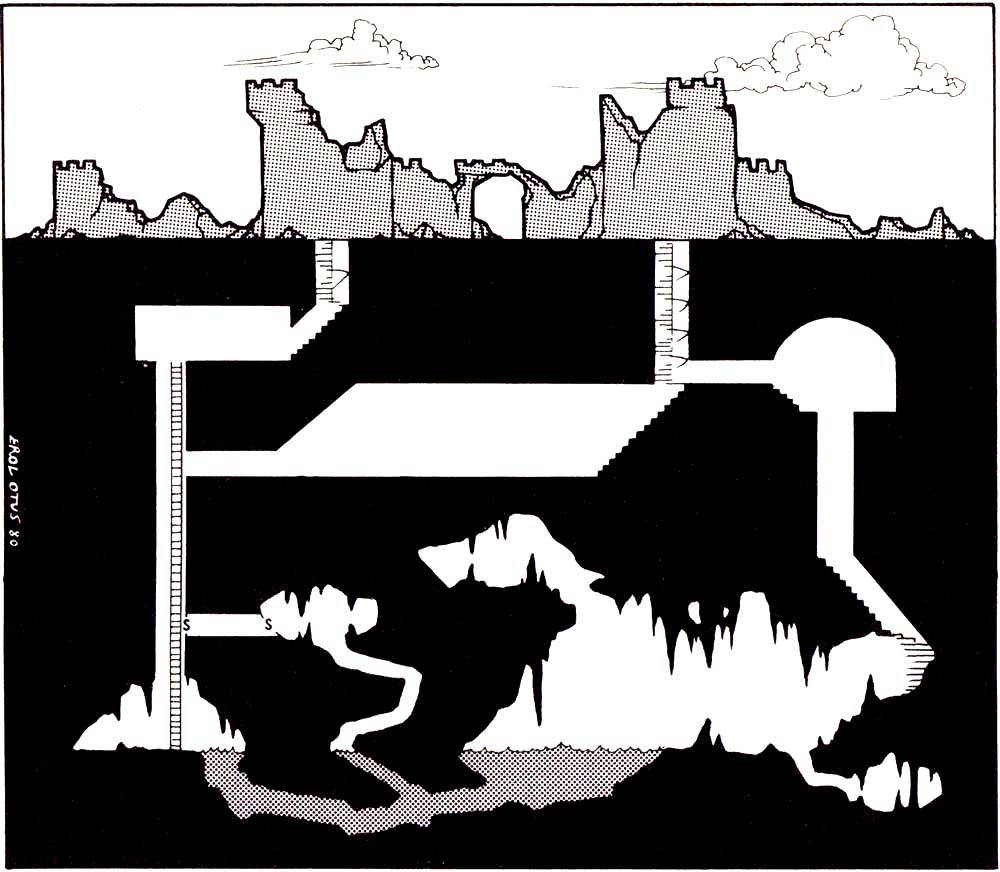
The Haunted Keep cross-section by Erol Otus. Source: Old School FRP tumblr

This is material I recently wrote for the Chronology of Sample Dungeons section of the Zenopus Archives site. Think of it as a first draft as I will likely revise/add to it over time.

The Haunted Keep is the sample dungeon from the 1981 revision of the D&D Basic rulebook, which was edited by Tom Moldvay. As with the Holmes Basic rulebook, the job of editor involved a significant amount of original writing, including an entire sample dungeon level. While the Zenopus Dungeon from Holmes Basic has no formal name other than "Sample Dungeon", Moldvay specifically refers to his scenario as "THE HAUNTED KEEP" (top left of page B55).

Holmes pioneered the inclusion of an introductory sample dungeon in the Basic rulebook, taking the sample level concept from OD&D Vol 3, which is essentially a collection of examples, mainly tricks and traps, and adding narrative cohesion and gearing it towards beginners. Moldvay takes his cues from Holmes' structure, similarly providing an evocative background in several concise paragraphs (page B55) followed by a single fully described dungeon level (page B56-B57), and with suggestions for expansion.

Moldvay's background echoes that of the Zenopus Dungeon in several respects. The occupants have mysteriously disappeared, leaving the structure housing the dungeon abandoned. The structure is said to be haunted; "[s]trange lights and sounds are often seen and heard in the ruins by the passing townspeople", which recalls the Zenopus Dungeon's bit about the neighbors complaining about ghostly lights and ghastly screams. The Haunted Keep is ruined like Zenopus' tower, although not to the same extent, and thus Moldvay's sample dungeon level is actually above ground in the only remaining floor of the East Tower.  Because the dungeon is named The Haunted Keep, it's not usually remembered that the sample level is actually of the East Tower of this structure (see map below), and there is a perhaps a trace of Holmes' ruined tower concept in Moldvay's likewise ruined tower. 

Moldvay advances the concept of an introductory sample dungeon in a number of significant ways. These changes suggest why Moldvay chose to write a new level rather than just revising Holmes' dungeon.

1. Providing "Boxed Text". Several of the paragraphs of the background are in quotes, with a suggestion that this could be read to players (pg B55); this seems to be a step in the evolution of TSR's "boxed text" that would shortly become standard in modules. The first modules for the revised Basic Set, such as B3 Palace of the Silver Princess (originally by Jean Wells alone, with Moldvay as a co-author on the revised version) and B4 The Lost City (by Moldvay) were among the first TSR modules to include boxed text.

2. Integration with Advice on Types of Scenarios. Moldvay provides a motivation for exploring the dungeon beyond simply looking for treasure. On page B51, he lists out ten different "Scenarios", of which the "Haunted Keep" is described as an example of #8, "Rescuing Prisoners".

3. Procedural Dungeon Construction. There is the significant addition of a "step-by-step" how-to section that shows how the dungeon was constructed (pages B55-B56), with the dungeon level being the example of the output. This guidance is integrated with Moldvay's instructions for stocking dungeons on pages B51-B52; both sections include steps A-F.

4. Dungeon Map Features. The dungeon map (pg B57) includes more room features than the Zenopus dungeon, and these correspond to a separate key of standard dungeon map features (pg B58).

Maps for the Haunted Keep from page B57. Source: Marks Roll Dice 

5. Location Map. There is a second map showing the outside structure of the dungeon below the dungeon map (shown above). This serves as a bit of a location map, showing a north-south road running through the gatehouse of the ruined keep, as well as suggestion another area for expansion: the West Tower. The introduction also indicates that the "interior of the gatehouse will be similar to the towers, though there will be fewer rooms", although the map does not shown a blank interior area where these rooms would be located in the Gate House.

6. Sample Cross-Section Integration. The sample cross-section (of B58) drawn by Erol Otus (shown at the top of the page) is linked to the sample dungeon level rather than being an unrelated cross-section like Skull Mountain in Holmes Basic. This cross-section shows second and third levels of the dungeon, corresponding to Moldvay's instructions for expanding the dungeon. These three levels match the three levels of Basic play, which refer to both character levels and dungeon levels. This was a design decision first implemented by Holmes, who included Wandering Monsters for the first three dungeon levels. Holmes had also intended for his rulebook to include a cross-section of a dungeon with just three levels, but TSR replaced this with the much more extensive Skull Mountain cross-section.

7. Tie-in to Examples of Play and Combat. The Example of Play (page B59) is also linked to the sample dungeon rather than having it be an unrelated example like in Holmes Basic. The Example starts at end of the first level of the dungeon at the entrance to the second level, and is thus able to continue the description of the dungeon a bit further. This Example of Play is also linked to the Example of Combat earlier in the book (B28), which continues directly from the Example of Play. 

8. More Advice on Expanding the Sample. for Holmes gave some brief suggestions for expanding the dungeon. Moldvay expands on this by giving more detailed instructions for what the DM should include when designing the 2nd and 3rd level of the dungeon (pg B55).

The extra material noted above does mean that the dungeon itself is greatly reduced in size from Holmes' example, with the first level of the Haunted Keep having just 9 rooms described in a little over half a column of text, as compared to Holmes' 15+ rooms described over 3 full pages. This provides less ready-to-go material for the DM, but this was perhaps less of a concern as the Basic Set now included a full module. When the Holmes Basic set debuted, it was packaged with Monster & Treasure Assortments, but these were replaced in 1978 with B1 In Search of the Unknown, and then again in early 1980 with B2 Keep on the Borderlands, which was then retained in revised format for the Moldvay Basic set.

Tuesday, May 26, 2020

A Dungeon Map is now included with the Ruined Tower of Zenopus on DMs Guild!


Screenshot of the new Dungeon Master's Map for The Ruined Tower of Zenopus


The Ruined Tower of Zenopus
now includes a map of the dungeon!


Yesterday I uploaded two separate dungeon map files to the Ruined Tower of Zenopus page on DMs Guild (as previously teased). These should be available for download by anyone who has already purchased the module, and for any new purchases. If you go to your account on DMs Guild there is a section near the top that says "Updated Files", which hopefully will show this product as updated on May 26th. 

This map is derived from the map I made in Gridmapper a few years ago and posted here.

The two maps are variations of the same map; the first is a Dungeon Master's Map, a preview of which is shown above, and the second is a Player's Map. In addition to being labeled differently, the Player's Map has the room letters removed, along with the secret doors and corridor between Rooms S and F.

Each map comes as a png file with a size of 8400 pixels by 8190 pixels, a large size that is optimized for use in Roll20, but is also printable. See the notes for each use below. Each file is a little over 4 MB. 

Each square on the map(s) is 10' wide, as in the original. A few corridors are not to scale due to the limitations of Gridmapper (or perhaps my lack of skill in using it). The secret corridor between Rooms S and F should only be 5' wide, and the rat tunnels should only be 3' wide (I noted the latter on the map). 

Using in Roll20:

-Create a New Game. The Zoom should be set to 100% by default, but set it to that if not.

-Click on the Page Toolbar icon. There should be a Page called "Start". Hover your mouse over it and a gear will appear to the left titled "Page Settings". Click and a "Page Settings" menu will open. Change the Settings as follows: 

-Under "Page Size", set the Width to 60 and the Height to 58.5. Under "Cell Width", change the size from 1 to 0.5. 

-Leave the Page Toolbar by clicking on the page called "Start". Now go to the toolbar on the left, and click on the "pin" icon (second from top). A menu will open. Change from Objects and Tokens to "Maps & Background". If you don't do this, your map will import as a token and the grid will not overlay the map.

-Again confirm Zoom is set to 100%. Drag the map file (the DM's or Player's Map) from your desktop (or folder) to the Roll20 Page workspace. This will import the map. In the workspace, drag the map until the upper left corner of the imported map is exactly aligned with the upper left corner of the workspace. This should line up the map exactly with four 5' squares inside each 10' square on the map.

-You can change the color of the grid in the Page Toolbar if you'd like the 5' squares to be darker or lighter (you can even set them to white so they are invisible).

-Note if you are using the Player's Map, you will need to add the Secret Passage between Rooms F and S if the PCs find it. This can be done either by drawing it on the map using the Roll20 drawing tools, or I think you can cut and paste the corridor from the DM's Map and import it into Roll20 and overlay it on the map in the appropriate spot.

Printing the Map: The map can be printed on a sheet of paper, but be warned that since the background is black and fills the negative space, it will use a lot of black ink or toner. The map file is only 75 dpi but is so large it should print at a fine resolution when shrunk to the sheet of a paper. I tested this and it printed fine using a "Shrink to Fit" setting, which was about 7% of the original size.

I hope to make a more printer-friendly option available in the future.

Product Link:
The Ruined Tower of Zenopus on DMs Guild


Click here to read reviews of the RTOZ by various bloggers

Friday, April 3, 2020

Don Turnbull on the Zenopus Sample Dungeon as "Coherent" dungeon design


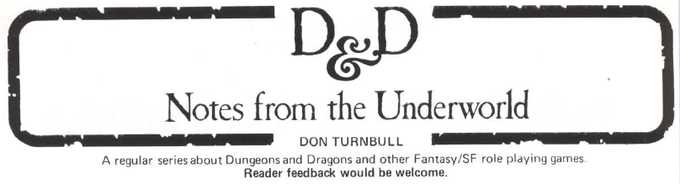
THE PHOENIX (later just PHOENIX) was "A British Board Wargamers Magazine" published by SimPubs, a UK affiliate of the company SPI, from 1976 until 1982 (36 issues total, which are available here on spigames.net). As Dungeons & Dragons ramped up popularity during the era of Holmes Basic, Don Turnbull wrote a semi-regular column for this magazine called "D&D: Notes from the Underworld" (likely a play on Dostoyevsky's Notes from the Underground). It started in issue #15 and ran for eight installments, with the last in issue #26 July/August 1980. An editor's note at the top of his first column indicates that his column will serve to introduce D&D to wargamers:
"I am pleased to welcome Don to these pages. Without much fear of contradiction I can say that he is one of the small band that first really brought boardgaming to our shores in the far off halcyon days of Poultron Press [an early name for SPI — Z]. His deep experience of the hobby is reflected in anything that he turns his hands to - D & D is no exception. It his hoped that his regular articles on this and other games of a similar nature will enable us all to appreciate what some amongst use are wont to call 'unreal wargames'! Note his comments on feedback — we are waiting!"
Don Turnbull (1937-2003) started his career in gaming by publishing a Diplomacy zine, Albion. He was an early D&D enthusiast in the UK, running an OD&D megadungeon named the Greenlands (after the street where he lived), a few sections of which were published in White Dwarf and Dragon magazines. He rose to prominence in RPG circles working for White Dwarf, writing reviews and editing the Fiend Factory column compiling new monsters by various contributors, which he later turned into the Fiend Folio (1981). He went on to run TSR UK, publishing Imagine, the UK analog of Dragon magazine, to which also contributed a regular column. During this period he co-wrote TSR's classic U1-3 series of modules with Dave J. Browne and oversaw the UK module series. He next worked with Gary Gygax in his ill-fated post-TSR company New Infinities Productions. He continued to run D&D games - set in Greyhawk's County of Urnst - for his friends until he passed away in 2003 at the age of 66.

A photo of Don at Games Day III (17 Dec 1977) with the new UK printing of the Holmes Basic set appeared in White Dwarf #5 (Feb/March '78): 


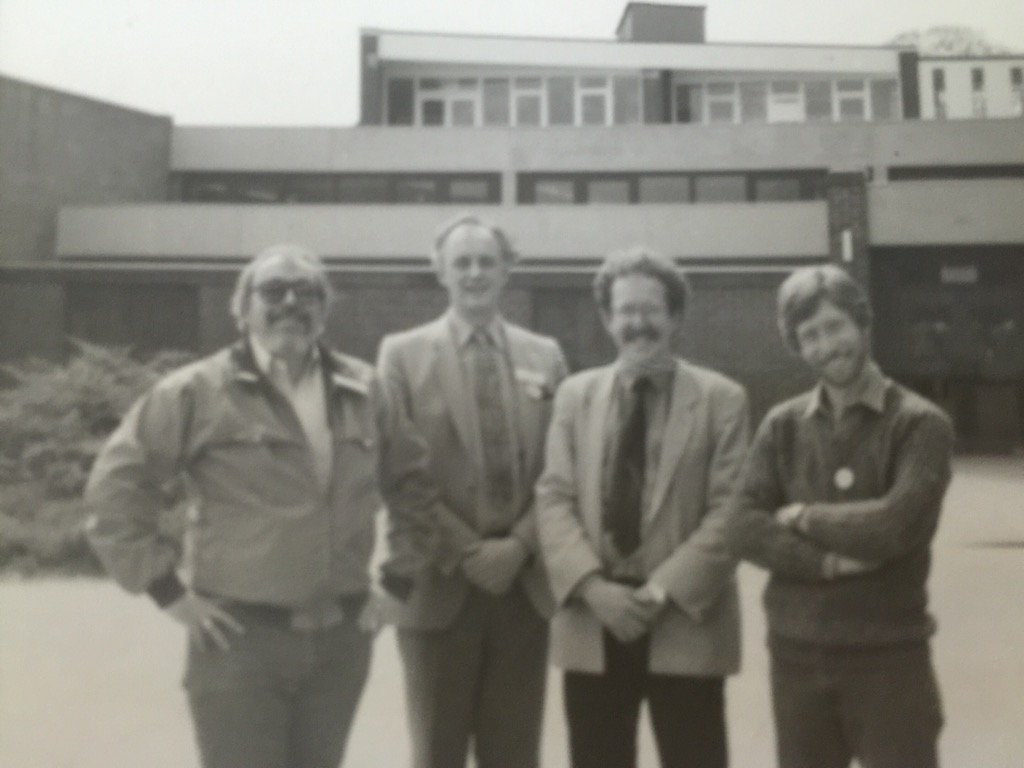
"Dubious characters handling dubious material! From left to right, Bill Howard, Don Turnbull, Tony Ball and Rob Thomasson". However, based on the below photo, I think Don is actually the one wearing the plaid tie.


In 2016, Ian Livingstone of Games Workshop posted on Twitter a photo of Gary Gygax, Turnbull, himself and Steve Jackson (the UK one) in 1979:


The second installment of his column for the Phoenix (in issue #16, Nov/Dec 1978), is devoted to dungeon design, including distinguishing what he describes as "incoherent" and "coherent" designs, and the strengths and weaknesses of each. As an example of "coherent" design he cites a certain dungeon very familiar to us:

"The coherent design requires much more initial work. First the DM must invent a rationale for the design — give the dungeon a history and provide reasons why it should be more or less as it is. The new edition of the TSR rules [the Holmes Basic set — Z] contains a good example — the cellars and tunnels beneath a sorceror's tower which, since the mysterious death of its architect, are rumored to contain fabulous treasure and unspeakable monsters. Such a rationale might be made available to the players, int he form of local legend perhaps, before their characters can penetrate the dungeon; or it might simply serve as the DM's private source of design ideas. 
Of course, the coherent style is far from convergent: there will almost certainly be elements of incoherence within it. In the TSR example, the sorceror's tower will have some areas of random or near-random occupancy — who can tell what monsters have made their lairs in its myriad passages and rooms? Was the death of the sorceror caused by an invading party of monsters in the first place? There is plenty of room for flexibility here. 
Once the 'history' has been devised, the design flows from it, and in my limited experience designing comes somewhat easier at this stage than in the incoherent style. In the TSR example, the sorceror would have had sleeping quarters, a study and/or laboratory, a trophy room perhaps, a library, some servants' quarters, a dungeon in which he used to incarcerate potential victims of his experiments etc. Some of his personal possessions (scrolls, magic books, artifacts) might have survived if they were carefully hidden. His faithful manservant may even still be doddering around wondering what has happened to his master but determined to keep the place tidy in readiness for his master's return. The trouble with coherent designs is that they tend to be limited in the physical sense. Even if the sorceror had created a large 'lair' it won't take long for a visiting party to ransack the place. If a designer is to create a setting large enough to keep his players occupied for a long series of adventures, he must thing bigger than this. Nor, in the end, will he be able to get by with a sorceror's tower here, an Orc stronghold there, a Dragon's nest in the interior of the hill, and Undead area below the local burial ground and the like. Sooner or later, in connecting all these parts to form a whole, he will come to the point at which the coherence drifts away — he may even come to a point at which his imagination refuses to conjure up another rationale."

There are interesting ideas here for expanding the Sample Dungeon, some of which I've touched on myself over the years:

-Invading monsters, still in the dungeon, presumably on a lower level "where Zenopus met his doom". Possibilities that come to my mind include Holmes' Dagonites (analogs of the Deep Ones), Ancient Builders, Lovecraft's Mi-Go (which I call Whisperers), D&D's Troglodytes, or some kind of Green Flame manifestation, which I used in the d12 Hauntings of the Zenopus Dungeon.

-Living quarters for Zenopus such as a bedroom, study, laboratory, trophy room (B1 In Search of the Unknown has one of these), library, servants' quarters, and/or prisoner dungeon. Some of these would more likely have been in his destroyed tower, but it does give some possible ideas for filling in some of the empty areas in the basement, or for a modified adventure set closer to the disappearance of Zenopus when the tower was still intact.

-A hidden cache of wizardly possessions. Along this line, when I've run the original I've placed an old "Storage Room" in the empty room south of Room J (the Spider's Lair), which I've been meaning to write up here for quite a while.

-A former servant of Zenopus still wandering about, waiting for his return; I especially like this one, although it is more logical with an adventure set closer to the disappearance of Zenopus before the tower was destroyed by the town. The intro to the dungeon mentions that some of his servants escaped the immolation of the tower and I used one as a source of a rumor in Portown rumors. I also placed a former creation of Zenopus as one of the wandering monsters in my 5e adaptation of the dungeon, and have former familiars (the "goblin figures") in the aforementioned d12 Hauntings.

Turnbull's later U series of adventures is  a logical extension of his idea of coherent dungeon design. And the haunted house in the first module, U1 The Sinister Secret of Saltmarsh certainly has some similarities with Holmes' Sample Dungeon, such as a missing "wizard" and an underground connection to sea caves harboring smugglers. Thus, the development of the U-series appears to have been influenced by Turnbull's earlier encounter with the Sample Dungeon in the Holmes Basic set and his view of it as a strong example of "Coherent" dungeon design.

Wednesday, March 11, 2020

The Ruined Tower of Zenopus goes Electrum!


The Ruined Tower of Zenopus hit Electrum Best Seller status on DMs Guild last week! I've updated the image on the product page to include the Electrum badge; this is shown above but won't show up on the actual purchased pdf.

It's currently on sale for $1.79 as part of the site-wide sale for DM's Day (March 4th, the anniversary of the passing of Gary Gygax), which runs through the 15th.

Again, a big thank you to everyone who has purchased it, plus an even bigger thank you to those who have taken the time to write out a review it, including:

Old School Tumblr
Erik Jensen via Twitter
Noah at the Hapless Henchmen
Joel at the Abominable Fancy 

And any others I'm forgetting at the moment!

If you have purchased and have a moment, it could use more Ratings and short Reviews on the DMs Guild site itself.

If you missed it, I was recently on the Wandering DMs chatting live about the Ruined Tower, and it is was recorded.

Product Link:
The Ruined Tower of Zenopus on DMs Guild