This is the blog. Click here to go to the Zenopus Archives website.

Note: Many older posts on this blog are missing images, but can be viewed at the corresponding page in the Internet Archive

FEATURED POST

The Forgotten Smugglers' Cave: Index of Posts

An index of posts describing the Forgotten Smugglers' Cave, an adventure for Holmes Basic characters levels 2-4.                    ...

Showing posts with label Otus. Show all posts

Wednesday, September 11, 2024

Playing at the World 2E: Price Drop


The first volume of the revised second edition has dropped to $23.33 on Amazon: 

Playing at the World, 2nd Edition, Volume 1: The Invention of D&D

This is down from a list price of $29.99 and an Amazon price of $27.85 in July just prior to release.

Read more about the book in my July post just prior to the release:

Reminder: The first volume of the revised Playing at the World is out in two days!

Sunday, July 28, 2024

Reminder: The first volume of the revised Playing at the World is out in two days!


As a reminder, in just two days (July 30th), the first volume of the revised edition of Jon Peterson's Playing at the World, subtitled The Invention of Dungeons & Dragons, arrives from MIT Press with an amazing cover by legendary TSR artist Erol OtusPer the publisher info, this volume "distills the story of how the wargaming clubs and fanzines circulating around the upper Midwest in the 1970s culminated in Gary Gygax and Dave Arneson’s seminal role-playing game, D&D". 

You can find it here on Amazon, currently priced at $27.85, and with a pre-order price guarantee:

Playing at the World, 2nd Edition, Volume 1: The Invention of D&D

It will be followed next year (April 8th) by Volume 2: The Three Pillars of Role-Playing Games, which is "a deeper dive into the history of the setting, system, and character of D&D", and appears to correspond to chapters 2-4 of the original edition, which were: 2: Setting - The Medieval Fantasy Genre; 3: System - The Rules of the Game; and 4: Character - Roles and Immersion. 

The pre-order page for Volume 2 can be found here:

Playing at the World, 2nd Edition, Volume 2: The Three Pillars of Role-Playing Games

See also my earlier post about the release here, and see the Erol Otus art without the text here


Thursday, March 14, 2024

Erol Otus cover illustration for Playing at the World 2E


Yesterday on FB, artist Erol Otus shared his original, unadorned illustration for the cover of the first volume of the revised of second edition of Playing at the World by Jon Peterson, due out this July. Per Erol's post, the illustration is meant to call "to mind monochromatic publications from the earlier days like “The Strategic Review” and Fanzines". 

Given the blue color, might I add the Holmes Basic rulebook to that list?

See my previous post for more info about the revised edition, which can be pre-ordered from Amazon here:

Playing at the World, 2nd Edition, Volume 1: The Invention of D&D

Monday, March 11, 2024

Playing at the World revised edition out in July

With a cover by Erol Otus!


Cover by Erol Otus...!


Playing at the World, Jon Peterson's 2012 groundbreaking history of the origin of RPGs, has been out of print for a number of years, with secondhand copies going for increasingly higher prices, but as I reported previously a revised second edition is coming later this year from MIT Press

The expanded book will now be split into two volumes, with the first one, Volume 1: The Invention of Dungeons & Dragons, coming out on July 30th of this year. Per the publisher info, this volume "distills the story of how the wargaming clubs and fanzines circulating around the upper Midwest in the 1970s culminated in Gary Gygax and Dave Arneson’s seminal role-playing game, D&D". 

The MIT Press and Amazon pre-order pages have now been updated with the cover art: a fantastic illustration by the legendary old school TSR artist Erol Otus (shown above)*. The first volume is now available for pre-order from Amazon for $29.95, and with a price guarantee:

Playing at the World, 2nd Edition, Volume 1: The Invention of D&D

I've pre-ordered it myself.

It will be followed later by Volume 2: The Three Pillars of Role-Playing Games, "a deeper dive into the history of the setting, system, and character of D&D". This appears to correspond to chapters 2-4 of the original edition, which were: 2: Setting - The Medieval Fantasy Genre; 3: System - The Rules of the Game; and 4: Character - Roles and Immersion. 

*Thanks for captainjapan on the OD&D74 forums for this news.

Friday, June 21, 2019

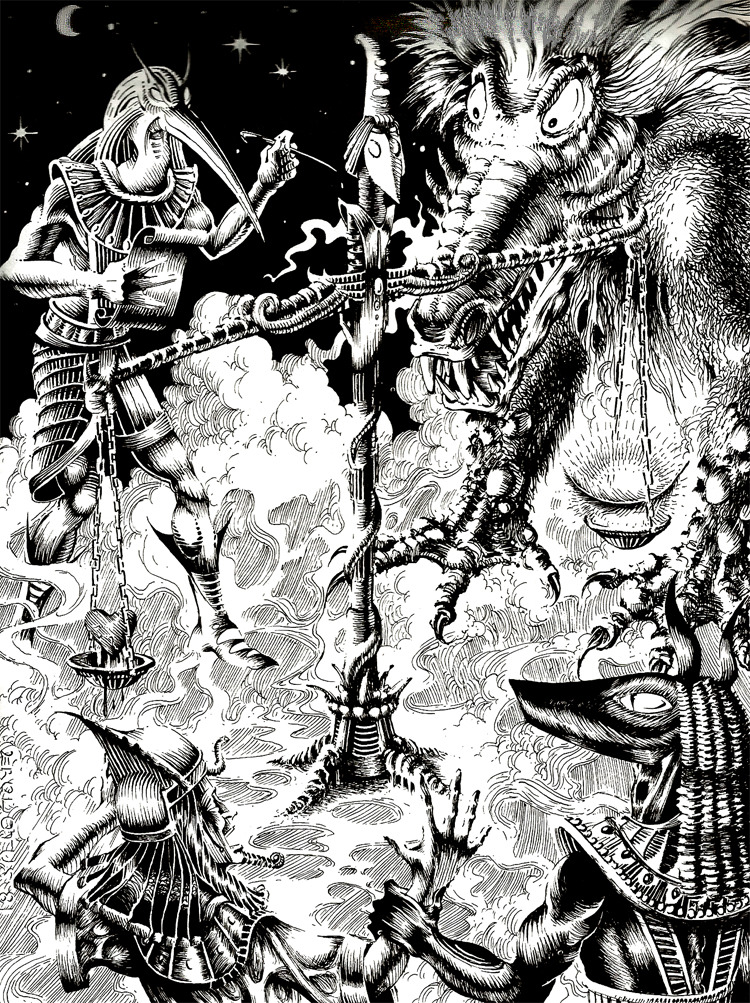
Obscure Art Friday: Weighing the Heart of the Dead by Erol Otus


Erol Otus, Weighing the Heart of the Dead. Image source


The above picture is a fantastic full-page illustration by Erol Otus from Deities & Demigods (later retitled Legends & Lore), the fourth AD&D hardcover released in 1980. A tour-de-force of TSR's bullpen of artists at the time, it includes the work of Darlene, Dee, Diesel, Jaquays, Otus, Rosolf, Sutherland and Trampier, and lesser known artists (Eymoth, Jeff Lanners), all together in a single tome. 

But this picture is not in the highly sought after first or second printings that include the Cthulhu & Melnibonean Mythos, and which get the most attention these days. It was only added to the third printing when the Cthulhu & Melnibonean Mythos were removed. Some clues to the change are that Otus' signature includes an "81", which is the year after the book was originally published, and that Jeff Dee illustrated the rest of the Egyptian Mythos.

I'm not sure why TSR added this picture; I thought maybe they needed to fill in a page but by my count those two Mythos total 16 pages, which was exactly the amount removed (reducing the page count from 144 to 128 pages). Perhaps TSR let Otus add it because they were removing his stunning work on the Cthulhu Mythos (which he drew all of), which was his major contribution to the book besides the cover, title page illustration, and a few Non-Human Deities.

I had the version with this picture when I was kid and always liked it; these days I only have the earlier version but at some point realized this picture was not in it. I posted about it a few years ago in the Holmes Basic Community on G+. Per our discussions there, the image is a bit confusingly placed, as it comes on page 43 at the end of the Chinese Mythos, whose last entry is "Yen-Wang-Yeh (judge of the dead)", but the image is clearly illustrating a scene from the Egyptian Mythos, which after removal of the Cthulhu Mythos is placed right after the Chinese Mythos. 

Thoth is pictured in the background, and Anubis  in the foreground, fulfilling his role as "collector of the souls for transportation to the house of the dead", per his entry in the Egyptian Mythos. Curiously, there does not seem to be any further description of the Judgement scene anywhere else in the Egyptian Mythos, including any description of the creature standing behind the scales.

I found the above scan at the Sharktanks tumblr, where they wrote: 
"The Egyptian rite of Judgement from TSR’s “Deities and Demigods” by Erol Otus, 1980.  Still the only artistic depiction of the rite I’ve seen outside of the original hieroglyphs. The Devourer of the Dead is a lot bigger in this version than in the ancient copies I’ve seen."
The Wikipedia entry for the Book of the Dead gives more information, including a picture showing the same entities:


"This detail scene, from the Papyrus of Hunefer (c. 1275 BCE), shows the scribe Hunefer's heart being weighed on the scale of Maat against the feather of truth, by the jackal-headed Anubis. The ibis-headed Thoth, scribe of the gods, records the result. If his heart equals exactly the weight of the feather, Hunefer is allowed to pass into the afterlife. If not, he is eaten by the waiting chimeric devouring creature Ammit composed of the deadly crocodile, lion, and hippopotamus. Vignettes such as these were a common illustration in Egyptian books of the dead."

Sunday, September 2, 2012

Monster Manual 1E artwork trivia


Chimeras - 1st print MM (left) vs 2nd print MM (right)

Over on the Acaeum, misterspock has documented several artwork changes that were made to the Monster Manual. The first is the Chimera; the original drawing by David C. Sutherland III (aka DCS III or just DCS) from the first print MM (Dec '77) is missing its wings, despite having an 18"/round flying move. The later drawing, also by DCS, from the 2nd print MM (May '78) has the wings added as well as other changes. Also altered were the Type III Demon and Nightmare.

An older post on Dragonsfoot by Paul Stormberg of the Collector's Trove provides some context for these changes:
"Dave (DCSIII) told me he didn't like some of the creatures he drew (Type III Demon, Chimera, Dinosaurs, and some others) as they had to be hastily done. DCS was a fast artist but it made his quality suffer. The Monster Manual was supposed to be done by Dave Trampier but he worked slowly and often quit and went home or to the local bar to blow off steam regardless of deadlines. Not so for DCS. He labored long into the night to get things done and sacrificed quality for speed when ordered to do so. Tramp was different, he was the golden boy for Gary and Gary did not push him on deadlines. Instead Dave was asked to pick up the slack.

When Dave got the Monster Manual blue lines from the printer he saw "this huge hole" in the document. There were no dinosaur illustrations, at all, just many blank pages. So that night Dave did all of the dinosaur drawings. He was supposed to be working on other things but crammed and speed drew things to pick up the slack. So a few pictures that had been hastily drawn by DCS, and that always bugged Dave were redrawn by him for later editions of the MM. It is the only book where he does this because it was never meant to be his project and the hastily drawn stuff bugged him so he just had to fix some things.

In the end, DCS was selected to be the Art Director for his work ethic and he slowly moved away from having time to create art. Ultimately he directed cartography at the company which you begin to see in fantastic maps like those in I6 Ravenloft."

Tom Wham is also listed in the credits, and contributed both classic "bestiary" drawings that blend well with the others (Beholder, Blink Dog, Herd Animal, Gynosphinx) as well as his signature cartoons (Giant Lynx, Mind Flayer, Giant Pike).

In addition to the altered artwork, later MM prints also added new art. Buried on the Acaeum's Monster Manual errata page is a list of the missing artwork in earlier printings:
First:  Ape (Gorilla), Centaur, Doppleganger, Dryad, Eye of the Deep, Fungi, Gar, Ghost, Hobgoblin, Intellect Devourer, Kobold, Men (Berserker), Merman, Mummy, Otyugh, Pegasus, Pixie, Purple Worm, Rat (Giant, Sumatran), Skeleton, Slug, Sprite
Second:  Ape (Gorilla), Eye of the Deep, Fungi, Otyugh, Rat (Giant, Sumatran)
Third:  Eye of the Deep, Fungi, Otyugh, Rat (Giant, Sumatran)
Fourth:  All pictures present.  Note that some monsters still do not have an accompanying illustration, but the Fourth print is as good as it gets.
[Note: the Ape (Gorilla) here should actually read Ape (Carnivorous)]

Most of these added illustrations are by DCS or Trampier, but the ones added to the fourth print are by Jean Wells (by herself or with DCS), whose name was also added to the credits on the title page.

Unpublished drawings also exist for several monsters that never received an illustration in the Monster Manual, including a Slithering Tracker and Giant Skunk by Bill Willingham, a Masher by Erol Otus, and an unattributed Shadow.

Update: Here's a screenshot of the DCS Chimera in the Blackmoor Supplement (Sep '75) that paleologos pointed out below:


Friday, March 2, 2012

Obscure Art Friday: Drow Captain by Erol Otus

Drow Captain by Erol Otus

     Following up from last week, this is another original drawing by Otus that was sold along with the Masher. Again, I grabbed the auction photo so the image is low-res. I looked into some of the old threads on the Acaeum, and it seems that the drawings were auctioned on Ebay in 2004, and were bought by the Burntwire Brothers. They later sold the Masher drawing, but still own the Drow Captain - you can it in their gallery here. This drawing came with a "detailed description page" by Kevin Hendryx for the artist to reference.

     According to the original auctioneer, "Believe it or not this stuff came from the estate of a 96 year old woman who lived in Lake Como, WI and once operated a resale shop in Sharon, WI".  The auctioneer speculated she got it from a dumpster, which wouldn't surprise me given what I've heard about TSR throwing out original art.

    As far as I know, the Drow Captain art was never published, but instead used for a Grenadier mini in the Action Art Set (8002), 1980. As indicated below in the insert, Gygax selected the figures to include in the set. He discussed here in his Q&A thread at Enworld in 2007: "About all I did was suggest what figure types I thought would be appealing to consumers, give vague discriptions of what some of the figures should look like. Then the miniature figuring people would consult with another person or persona at TSR that could help them--artists and model makers".

Drow Captain mini, Grenadier Action Art set Monsters 8002, image from the Lost Minis Wiki

Grenadier Action Art set Monsters 8002, insert, image from the Lost Minis Wiki
Grenadier Action Art set Monsters 8002, front cover, image from the Lost Minis Wiki

Friday, February 24, 2012

Obscure Art Friday: Masher by Erol Otus


     I'm going to start a weekly series called "Obscure Art Friday". First up is an image I've used for years as my avatar on the Acaeum & Dragonsfoot forums. It's small (low-res) and has a moire pattern in the background due to its source: I snagged the image long ago (2004?) from an auction of original Erol Otus drawings that was posted on the Acaeum. The seller was the Burntwire Brothers, who are long-standing Acaeum members with an impressive game room featuring their collection and much original artwork, which they shared in this thread. The Collector's Trove (who I believe purchased the Otus artwork) later indicated that the back of the drawing has "Monster Manuel" [sic], "Reduce 60%" and "Masher" written on it. This suggests the drawing was intended to illustrate the Masher entry in the 1E AD&D Monster Manual, which describes them in this way: "These worm-like fish move slowly along coral reefs, crushing and eating the coral growth...Mashers have a number of dorsal spines, 4' long, with poisonous secretions". The drawing fits this description accurately, showing an underwater worm with dorsal spines, mashing coral.

      The Masher originally appeared in the Blackmoor supplement, albeit with much less description: "Coral eaters, harmless unless frightened, if so is just like 20 hit dice Purple worm, with treasure". This is one of Steve Marsh's contributions that Gary elaborated on for the Monster Manual, which thanks Marsh "for devising the creatures for undersea encounters which originally appeared in BLACKMOOR." The masher is one of the most obscure monsters in the MM, often entirely forgotten due to being aquatic and lacking an illustration. The Monster Manual had artwork added to the first four printings (1977-1979), as detailed here, so this piece may have been intended for a further revision that never happened; the original MM never included any Otus pieces. The Masher would certainly gotten more attention over the years if it had a cool Otus illustration!

Tuesday, November 22, 2011

The Arduin Adventure vs. Holmes Basic

Logo from the cover of The Arduin Adventure rulebook
     
     The original Arduin trilogy of booklets ("Grimoires", 1977-78) were written by Dave Hargrave as supplements to the original D&D game. The Arduin Adventure, published in 1980 by Grimoire Games, was the first product to present Arduin as a stand-alone game, in an introductory format seemingly inspired by the Holmes Basic Set. According to Gygax, the Holmes Basic Set was selling 12,000 copies a month by mid-1980, so it was natural that other game designers would follow suit. Thus, The Arduin Adventure box set ($9.95) included a 64-page rulebook with all of the necessary rules, three character sheets, two sheets of magic item cards, and two 20-sided dice. The rulebook was also available separately ($7.95), with cover art by Greg Espinoza.

Photo of the contents of The Arduin Adventure box set from a current Ebay auction

     Much like Basic D&D distilled the original D&D rules, The Arduin Adventure simplifies the Arduin trilogy to six races (elf, dwarf, hobbitt, human, amazon and half orc), five classes (warrior, thief, priest, mage and forester), twelve statistics (dexterity, agility, strength, intelligence, ego, wisdom, charisma, hit points, armor class, mana and experience level), combat rules, four levels of spells for priests and mages, a short list of magic items, and about 30 monsters.

The Forgotten Tower as depicted on the back cover of The Arduin Adventure.
Artwork by Brad Schenck (Morno)

     The rulebook also contains a nine-page introductory scenario, The Forgotten Tower, set in a lost wizard's tower (rather than beneath a destroyed one as in the Holmes Sample Dungeon). It has 45 rooms including eight in the dungeon that are to be keyed by the DM (ala B1 In Search of the Unknown). A picture of the Forgotten Tower was included on the back cover of the rulebook, with art by Brad Schenck (Morno), known for his work on Wee Warriors products, such as the cover and maps for the first D&D module, Palace of Vampire Queen.

     The Arduin combat rules use Dexterity scores for initiative. This goes back to the first Arduin Grimoire and predates the use in the Holmes Basic Set. In The Arduin Adventure, the "Monster" section gives typical Dex scores for each creature, and a few monsters in The Forgotten Tower also have Dex scores listed.

Skorpadillo by Erol Otus, from The Howling Tower.
Scan grabbed from Jeff's Gameblog.

     One "Basic" level dungeon module was also published for Arduin: The Howling Tower (Arduin Dungeon #2, 1979), for character levels 1-4. All of the monsters in The Howling Tower are provided with Dex scores (example: Skorpadillo, "dext. 16"). Erol Otus (also a Holmes Basic artist for B2) provided the interior artwork for The Howling Tower (two quarter page illustrations, including the one above). 

See also:
Detailed review at RPGnet

Discussion thread at Original D&D Discussion

Monday, September 12, 2011

Obscure TSR art related to B1-B3

Dragonsfoot member paleologos recently made some interesting posts about obscure TSR art:

The original Trampier version of the B1 cover (published in Polyhedron #5)

A castle by Erol Otus (from Polyhedron #1) that resembles his picture of The Keep on the back of B2

Art from the French version of B3 by Darlene (I've never seen these pictures before)