This post is part of the Tales of Peril Book Club, indexed here.
The second short "scene" of the Maze of Peril is a few paragraphs of compact world-building that expands the setting outward from the Green Dragon to the surrounding town and the Underworld beneath it. I quoted most of this section in a 2012 post, The Underworld of Holmes. As I wrote there, the term "The Underworld" is straight out of Vol 3 of the Original Dungeons & Dragons rules, "The Underworld & Wilderness Adventures", being the original term used to refer to the vast multi-layer dungeons of the game.
The narrator tells us that Zereth and "every man in the [Green Dragon] tavern" knows the rumors of the treasure of the Underworld. Holmes uses a favorite turn of phrase, "fabulous treasures", which also appears in the introduction to the Basic rulebook ("The dungeons are filled with fearsome monsters, fabulous treasure and frightful perils") and the Sample Dungeon ("Whispered tales are told of fabulous treasure and unspeakable monsters in the underground passages").
The rumors draw all sorts of adventurers and other types to the "tiny town", indicating that it is special in the land in its relation to the Underworld. The name of the town, Caladan, is first given here, and is noteworthy in that it was previously used by Frank Herbert as the name of the homeworld of the Atreides in Dune. Chris Holmes said that his father was a fan of Herbert but didn't know of any other specific reason for its use.
The description of the Underworld, like the name, is very much in line with OD&D: "corridors of wealth, they were also tunnels of deadly peril" and "there must have been many layers of dungeons and underworlds laid down, one atop the other". But Holmes takes this concept further by giving a putative origin for these dungeons: they were built by a mysterious prehistoric race. This echoes the introduction to the Sample Dungeon, where "the reputed dungeons lie in close proximity to the foundations of the older, pre-human city". As I wrote previously, this theme is "reminiscent of the pre-human alien civilization described in Lovecraft's At the Mountains of Madness (1931), who built vast underground cities in remote locations". Holmes never reveals any more details about the mysterious builders, so on this blog I later took the idea one step further, positioning Lovecraft's creatures in that story as Holmes' architects of the Underworld, to create a "new" monster for Holmes Basic called the Ancient Builder. The write-up for this monster now appears in the recently released Blueholme Journeymanne rules as the "Old Ones" entry in the Monster List.
While the rumors of the Underworld are well known in Caladan, the entrances are not. The narrator indicates that Zereth has been looking for information about an entrance but has not been successful. One reason that the entrances are not well known is that "many of the rash adventurers who set forth for the secret entrances to the fabled Underworld were never heard from again". Again, this fits with the story's origins in actual OD&D games, where many first level parties perish on their first expedition below.
In the next scene, Zereth will finally succeed in learning of an entrance.
Showing posts with label Easter Eggs. Show all posts
Showing posts with label Easter Eggs. Show all posts
Friday, October 27, 2017

Friday, May 10, 2013
Holmes' Harryhausen Tribute
 | ||
|
Ray Harryhausen's special effects for the 1961 movie adaptation of Jules Verne's novel Mysterious Island include a spectacular battle with a stop-motion giant crab, which can be
watched in its entirety here on TCM. Now compare this with two other giant crabs appearing in the writings of J. Eric Holmes:
Room L in the Sample Dungeon in the Basic Set rulebook (1977):
"L — Another cave with the river running through it. There is phosphorescent fungus growing on the rocks, so anyone can see without lights. There are east and west entrances on both sides of the river to the sandy beach. The river is only 3-4 feet deep at the center of the channel and can be forded.
There is a giant crab concealed under the sand on the south beach. It will attack anything that moves on either beach. It runs 60 feet in 1 turn, in armor class 3 (plate mail), and takes 2 hit dice (8 hit points). It strikes with its giant claws one at a time as fast as a man" (pg 43)
Excerpt from "Dark Water", Chapter 2 of Maze of Peril (1986):
"The beach heaved and crumbled under Boinger's feet. The sand spilled away as a broad, blue carapace rose up on six armored legs. Boinger staggered backward as as great claw passed over his head. The great beast crashed over the startled little adventurer and up the beach, where the two mercenaries and the dwarf swung futilely as it went by. The claw scattered like an oversized nut cracker, swooped at Zereth who dropped flat on the sand, and backed Murray against the wall.
"Ooop!" cried the magician, swatting the crustacean across the eye-stalks with his staff.
The others rushed to attack the monster's rear, only to find that the tough armor turned their blows with ease.
"The joints," called Bardan, "go for the joints of his legs!"
Boinger swung two handed at a leg as the crab began to turn, had the satisfaction of feeling his blade bite deep into the limb, heard the exoskeleton crack as he twisted his sword loose. The creature stumbled as the adventurers attacked its other limbs. Finally, after several tries, the dwarf got a jab with his spear past the guarding claw and into the softer mouth parts just under the carapace. The brute collapsed, was rolled over, and the legs hacked off to keep it from righting itself.
"Thank you for the help, I guess," Murray mumbled as he got to his feet and brushed the wet sand from his robe. "I wish you could have been a little less forceful."
"Didn't have time to," the elf replied, and turned to walk down to the new boat.
"You know," said the halfling, poking the still twitching stumps of the giant crab with his sword, "this stuff would be really tasty steamed or roasted. Why don't we build a small fire and cook up a few legs?"
"Fire, you idiot?" cried the mage. "Do you want to bring every monsters in the place down upon us? We can't go around building fires all over the beach. You're not having a little picnic outing back home, you know. We're in the middle of enemy territory!"
"Well, I guess you're right," Boinger agreed reluctantly. "We haven't any melted butter, anway..." (pg 17)
The giant crab had appeared previously in OD&D, Vol 3, as part of the "Special Suggestions for Monsters for Naval Adventures" (pg 34-35). However, Holmes specifically references two key details from the Harryhausen sequence: hiding the sand, and eating the crab.
And for my tribute to Harryhausen, here's a full entry for the giant crab for Holmes Basic:
Giant Crab
Move: 60 feet/turn
Hit Dice: 2
Armor Class: 2
Treasure Type: nil
Alignment: nil
Attacks: 2
Damage: 2-12 each
Rumored to be originally created by the mad sorcerer Nemo, these enormous bright orange crustaceans now lurk everywhere near bodies of water in the underworld. They conceal their garish shells with sand, bursting forth to attack anything of smaller size that moves (surprise on 1-4 in 6). They attack twice per round, once with each of their black-tipped claws. They do not keep treasure but their tough shell can be fashioned into orange armor equivalent to plate mail +1 (AC 2) by an armorer of the highest skill for 1,000 gp. Reported to be delicious if cooked.
watched in its entirety here on TCM. Now compare this with two other giant crabs appearing in the writings of J. Eric Holmes:
Room L in the Sample Dungeon in the Basic Set rulebook (1977):
"L — Another cave with the river running through it. There is phosphorescent fungus growing on the rocks, so anyone can see without lights. There are east and west entrances on both sides of the river to the sandy beach. The river is only 3-4 feet deep at the center of the channel and can be forded.
There is a giant crab concealed under the sand on the south beach. It will attack anything that moves on either beach. It runs 60 feet in 1 turn, in armor class 3 (plate mail), and takes 2 hit dice (8 hit points). It strikes with its giant claws one at a time as fast as a man" (pg 43)
Excerpt from "Dark Water", Chapter 2 of Maze of Peril (1986):
"The beach heaved and crumbled under Boinger's feet. The sand spilled away as a broad, blue carapace rose up on six armored legs. Boinger staggered backward as as great claw passed over his head. The great beast crashed over the startled little adventurer and up the beach, where the two mercenaries and the dwarf swung futilely as it went by. The claw scattered like an oversized nut cracker, swooped at Zereth who dropped flat on the sand, and backed Murray against the wall.
"Ooop!" cried the magician, swatting the crustacean across the eye-stalks with his staff.
The others rushed to attack the monster's rear, only to find that the tough armor turned their blows with ease.
"The joints," called Bardan, "go for the joints of his legs!"
Boinger swung two handed at a leg as the crab began to turn, had the satisfaction of feeling his blade bite deep into the limb, heard the exoskeleton crack as he twisted his sword loose. The creature stumbled as the adventurers attacked its other limbs. Finally, after several tries, the dwarf got a jab with his spear past the guarding claw and into the softer mouth parts just under the carapace. The brute collapsed, was rolled over, and the legs hacked off to keep it from righting itself.
"Thank you for the help, I guess," Murray mumbled as he got to his feet and brushed the wet sand from his robe. "I wish you could have been a little less forceful."
"Didn't have time to," the elf replied, and turned to walk down to the new boat.
"You know," said the halfling, poking the still twitching stumps of the giant crab with his sword, "this stuff would be really tasty steamed or roasted. Why don't we build a small fire and cook up a few legs?"
"Fire, you idiot?" cried the mage. "Do you want to bring every monsters in the place down upon us? We can't go around building fires all over the beach. You're not having a little picnic outing back home, you know. We're in the middle of enemy territory!"
"Well, I guess you're right," Boinger agreed reluctantly. "We haven't any melted butter, anway..." (pg 17)
The giant crab had appeared previously in OD&D, Vol 3, as part of the "Special Suggestions for Monsters for Naval Adventures" (pg 34-35). However, Holmes specifically references two key details from the Harryhausen sequence: hiding the sand, and eating the crab.
And for my tribute to Harryhausen, here's a full entry for the giant crab for Holmes Basic:
Giant Crab
Move: 60 feet/turn
Hit Dice: 2
Armor Class: 2
Treasure Type: nil
Alignment: nil
Attacks: 2
Damage: 2-12 each
Rumored to be originally created by the mad sorcerer Nemo, these enormous bright orange crustaceans now lurk everywhere near bodies of water in the underworld. They conceal their garish shells with sand, bursting forth to attack anything of smaller size that moves (surprise on 1-4 in 6). They attack twice per round, once with each of their black-tipped claws. They do not keep treasure but their tough shell can be fashioned into orange armor equivalent to plate mail +1 (AC 2) by an armorer of the highest skill for 1,000 gp. Reported to be delicious if cooked.
Tuesday, March 19, 2013
Lemunda = Tiger Lily?


From J.M. Barrie's original Peter Pan novel (1911, courtesy Project Gutenberg):
"Marooners' Rock stood alone in the forbidding waters as if it were itself marooned.
The boat drew nearer. It was the pirate dinghy, with three figures in her, Smee and Starkey, and the third a captive, no other than Tiger Lily. Her hands and ankles were tied, and she knew what was to be her fate. She was to be left on the rock to perish, an end to one of her race more terrible than death by fire or torture, for is it not written in the book of the tribe that there is no path through water to the happy hunting-ground? Yet her face was impassive; she was the daughter of a chief, she must die as a chief's daughter, it is enough.
They had caught her boarding the pirate ship with a knife in her mouth. No watch was kept on the ship, it being Hook's boast that the wind of his name guarded the ship for a mile around. Now her fate would help to guard it also. One more wail would go the round in that wind by night.
In the gloom that they brought with them the two pirates did not see the rock till they crashed into it."
Compare with Lemunda in Room M (Sea Cave) in the Sample Dungeon:
"The [pirates'] prisoner is a girl, Lemunda the Lovely, whose father is a powerful lord in the city above. Lemunda is a good fighter in her own right and carries a concealed dagger in her girdle, but right now she is bound and gagged. She is lying in the bottom of the second boat, not the one occupied by the pirates. Her family would be very grateful to get her back."
It may just be a coincidence, but in each story the pirate's captive is the daughter of a chief/lord, is a warrior herself (proficient with knife or dagger), and is bound in a rowboat.
In Disney movie of Peter Pan (1953), Marooner's Rock becomes Skull Rock, and Tiger Lily is brought there by Hook and Smee to a location more like a sea cave. I came across the similarities between Lemunda and Tiger Lily, when reading about Skull Rock, which is one predecessor (among many) of the Great Stone Skull (aka Skull Mountain) in the Basic Rulebook.
For the full list of possible Holmes Basic Easter Eggs, see this post on OD&D Discussion.

 |
| Hook and Smee take Tiger Lily to Skull Rock |
Wednesday, January 16, 2013
The Giant Gila Monster
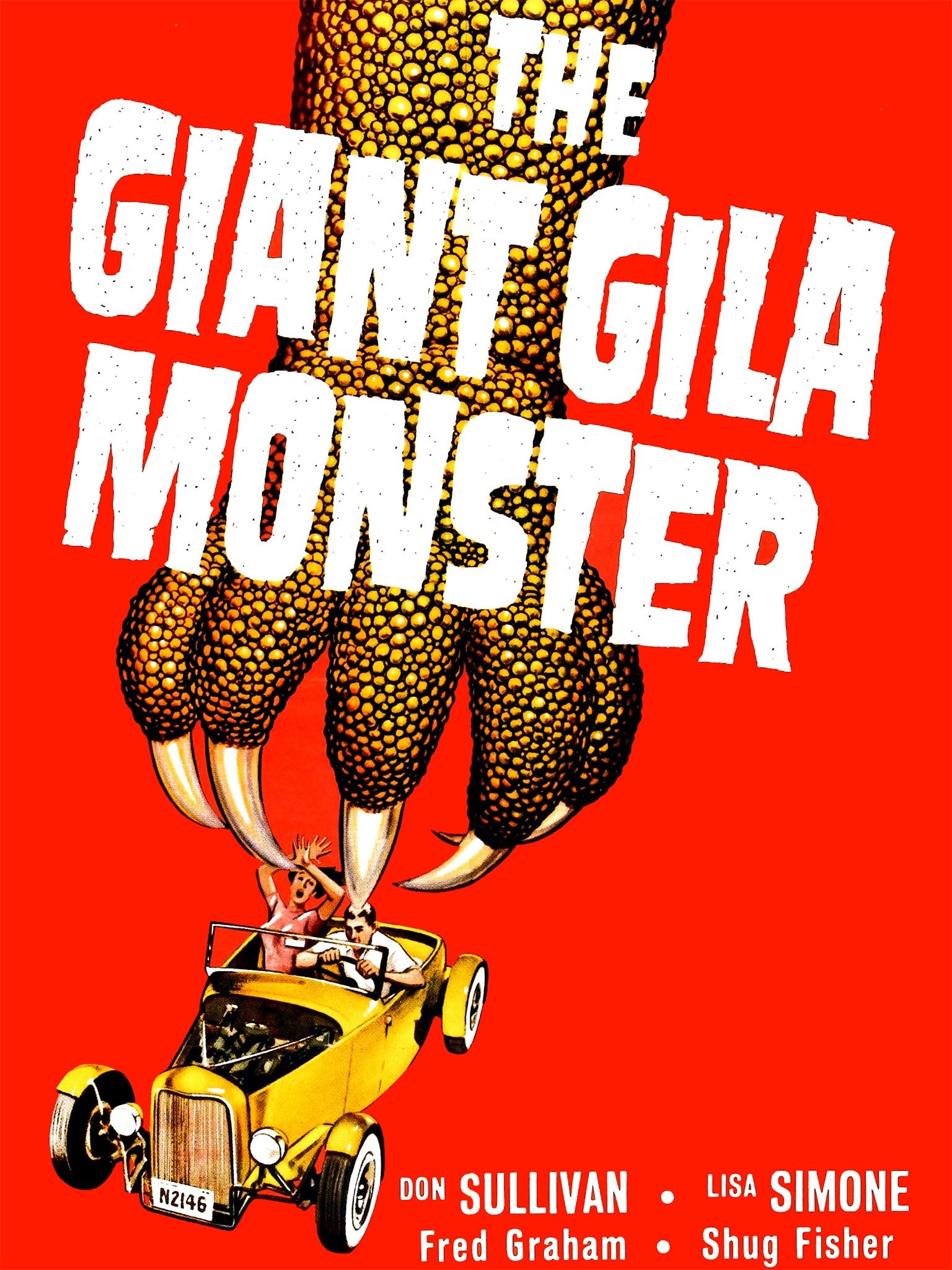 |
Poster for the 1959 film "The Giant Gila Monster" directed by Ray Kellogg |
Above is a poster for a 1950's monster movie, The Giant Gila Monster, which may have served as inspiration for Dr. Holmes for a D&D monster. I haven't seen the movie yet, but there's a MST3K version on Netflix which I've added to my queue.
On page 38 of Holmes' 1981 book Fantasy Role-Playing Games there's an untitled dungeon map which we have been calling the "Halls of the Lizard King" based on a key feature. It's just part of a dungeon level, and there's no corresponding text describing the dungeon, but the map itself provides descriptive names for many of the rooms and features. Notably there's a colossal cave housing a "Giant Gila Monster". According to the Wikipedia entry, the monster in the movie is about 70' long, and which is similar in size to the creature on the Holmes map. If the squares are 10' each as on another map in the book, the monster is at least 100' long:
On page 38 of Holmes' 1981 book Fantasy Role-Playing Games there's an untitled dungeon map which we have been calling the "Halls of the Lizard King" based on a key feature. It's just part of a dungeon level, and there's no corresponding text describing the dungeon, but the map itself provides descriptive names for many of the rooms and features. Notably there's a colossal cave housing a "Giant Gila Monster". According to the Wikipedia entry, the monster in the movie is about 70' long, and which is similar in size to the creature on the Holmes map. If the squares are 10' each as on another map in the book, the monster is at least 100' long:
 |
Detail of Holmes' map showing the 100'+ monster |
This map likely came from Holmes' own campaign. Since we unfortunately don't have any other information on his version of the monster, I've written up my own take on it for Holmes Basic. Hit Dice are extremely high since Purple Worms are 50' long and have 15 HD. The poison breath is inspired by an Apache legend, and the healing properties of their skin from Sonoran Indian legends.
Giant Gila Monster
Move: 30 feet/turn
Hit Dice: 20
Armor Class: 3
Treasure Type: see below
Alignment: neutral
Attacks: 1 bite
Damage: 3-18 points
Enormous burrow-dwelling predatory lizards, up to 100’ long when fully grown. Their breath is so foul that all creatures in a
thirty-foot radius must save versus
poison each round or take 1d6 points of damage. They are slow-moving but
bite quickly, and will grip their victim tightly, inflicting 3d6 points of
damage per round. Even worse, their salivary glands secrete a toxin that
requires a save versus poison each
round to avoid taking an additional 2d6 points of damage from pain. They do not hoard treasure but their hide is valuable (1d6 x 10,000 gp) for two reasons. The hide has regenerative properties; ingesting a portion will restore 1 extra hit point at the end of the day, and magic-users can use it to brew healing potions. Furthermore, the tough, beaded skin can also be used to make colorful armor equivalent to plate mail but light as leather armor.
Edit: Revised 1/17 to add properties of hide.
Edit: Revised 1/17 to add properties of hide.
Friday, November 23, 2012
JEH Easter Egg
 |
Detail of Sample Dungeon map, annotated |
This might be coincidental, but Room J is quite a ways out of sequence with Rooms H, I, K, L and M, so it is possible that it was deliberately placed above the Room E (empty room) and H. Below is the full map, annotated:

Monday, November 19, 2012
Kingsport as Portown
 |
Map of Marblehead, MA, inspiration for Lovecraft's Kingsport |
Previously, in "How Zenopus Met His Doom", I discussed similarities between Holmes' Sample Dungeon & Lovecraft's short story, The Festival, set in the fictional New England town of Kingsport. The geography of the Sample Dungeon and Portown also fits well with Marblehead, the real-world town on which Kingsport is based.
Holmes describes his wizard's tower as "on the low hills
overlooking Portown" and "close to the sea cliff west of the town, and
appropriately, next door to the graveyard". Marblehead has several
cemeteries in the hills overlooking the town, including near the sea to the west of
the town (which is on a peninsula so the sea is to both the east
and west of it). I have no idea whether Holmes himself was aware
of this, but he was familiar with books about the Cthulhu Mythos, as mentioned in his letter in The Dragon #16. Regardless, the similarities make the geography of Marblehead a useful model for a map of Portown.
In addition to The Festival, Lovecraft's fictional Kingsport is also the setting for two other Lovecraft stories: The Terrible Old Man (1921) and The Strange High House in the Mist (1931). Lovecraft scholar Joshi notes that this later tale is also inspired by two other New England locations (Magnolia; Mother Ann) having high sea cliffs, as well as "a passage in Dunsany's Chronicles of Rodriguez (1922) about the home of a wizard on the top of a crag" (Note by S. T. Joshi in The Dreams in the Witch House, pg 431). An excellent graphic adaptation of Strange High House can be read here.
Update - An 1872 map of Marblehead, showing the Waterside Cemetery to the west:
In addition to The Festival, Lovecraft's fictional Kingsport is also the setting for two other Lovecraft stories: The Terrible Old Man (1921) and The Strange High House in the Mist (1931). Lovecraft scholar Joshi notes that this later tale is also inspired by two other New England locations (Magnolia; Mother Ann) having high sea cliffs, as well as "a passage in Dunsany's Chronicles of Rodriguez (1922) about the home of a wizard on the top of a crag" (Note by S. T. Joshi in The Dreams in the Witch House, pg 431). An excellent graphic adaptation of Strange High House can be read here.
Update - An 1872 map of Marblehead, showing the Waterside Cemetery to the west:
 |
Marblehead, MA, 1872 map |
Wednesday, October 31, 2012
How Zenopus Met His Doom
 |
Tulzscha the Green Flame. Source. |
Earlier this year, in The Shadow over Portown, I speculated a connection between the wizard Zenopus and the Deep Ones of Lovecraft's Shadow over Innsmouth. Today, on Halloween, I'll discuss another Lovecraft story that possibly influenced Holmes' Sample Dungeon: The Festival (1925). (Warning: this post contains some spoilers if you haven't read the story. It's short if you want to read it first).
The intro of the Sample Dungeon sets up a mystery: what happened to Zenopus? We learn that on a cold night in winter his tower was "suddenly engulfed in green flame", but despite this several servants escaped and the tower stood until toppled by the authorities. The servants report that Zenopus was destroyed by some powerful force he unleashed in the depths of his tower. The end of the adventure refers to the "(undiscovered) deeper levels where Zenopus met his doom".
The "green flame" stands out as an interesting detail. It could be offhand, but knowing Holmes' fondess for Lovecraft, I searched and found that a monstrous green flame features prominently in The Festival. I hadn't read this before, but it was in one my Lovecraft compilations, and while reading it I noticed the setting reminded me a lot of Portown.
The story begins with the narrator traveling on a cold winter night (Yule) to the ancient sea town of Kingsport (fictional, but based on Marblehead, MA). Eventually his kin lead him to a hilltop church in the town, where he descends into underground passages:
"I knew we must have passed down through the mountain and beneath the earth of Kingsport itself, and I shivered that a town should be so aged and maggoty with subterraneous evil".
In a subterranean chamber, he witnesses his kin worshiping a pillar of green flame:
"...suddenly there spread out before me the boundless vista of an inner world - a vast fungous shore litten by a belching column of a sickish greenish flame and washed by a side oily river that flowed from abysses frightful and unsuspected to join the blackest gulfs of immemorial ocean" and "...what frightened me most was that flaming column; spouting volcanically from depths profound and inconceivable, casting no shadows as healthy flame should, and coating the nitrous stone with a nasty, venomous verdigris. For in all that seething combustion no warmth lay, but only the clamminess of death and corruption."
Lovecraft never names the green flame, but the Call of Cthulhu RPG calls it Tulzscha.
After witnessing further horrors, the narrator leaps into the underground river and is swept out into the harbor, to be rescued later. This is reminiscent of the river in the Sample Dungeon, which can sweep characters from one room to another and connects to the sea.
The famous final paragraph of The Festival even mentions dead wizards in a quote from the Necronomicon:
"The nethermost caverns...are not for the fathoming of eyes that see; for their marvels are strange and terrific. Cursed the ground where dead thoughts live new and oddly bodied, and evil the mind that is held by no head. Wisely did Ibn Schacabao say, that happy is the tomb where no wizard hath lain, and happy the town at night whose wizards are all ashes. For it is of old rumour that the soul of the devil-bought hastes not from his charnel clay, but fats and instructs the very worm that gnaws; till out of corruption horrid life springs, and the dull scavengers of earth wax crafty to vex it and swell monstrous to plague it. Great holes secretly are digged where earth's pores ought to suffice, and things have learnt to walk that ought to crawl."
The intro of the Sample Dungeon sets up a mystery: what happened to Zenopus? We learn that on a cold night in winter his tower was "suddenly engulfed in green flame", but despite this several servants escaped and the tower stood until toppled by the authorities. The servants report that Zenopus was destroyed by some powerful force he unleashed in the depths of his tower. The end of the adventure refers to the "(undiscovered) deeper levels where Zenopus met his doom".
The "green flame" stands out as an interesting detail. It could be offhand, but knowing Holmes' fondess for Lovecraft, I searched and found that a monstrous green flame features prominently in The Festival. I hadn't read this before, but it was in one my Lovecraft compilations, and while reading it I noticed the setting reminded me a lot of Portown.
The story begins with the narrator traveling on a cold winter night (Yule) to the ancient sea town of Kingsport (fictional, but based on Marblehead, MA). Eventually his kin lead him to a hilltop church in the town, where he descends into underground passages:
"I knew we must have passed down through the mountain and beneath the earth of Kingsport itself, and I shivered that a town should be so aged and maggoty with subterraneous evil".
In a subterranean chamber, he witnesses his kin worshiping a pillar of green flame:
"...suddenly there spread out before me the boundless vista of an inner world - a vast fungous shore litten by a belching column of a sickish greenish flame and washed by a side oily river that flowed from abysses frightful and unsuspected to join the blackest gulfs of immemorial ocean" and "...what frightened me most was that flaming column; spouting volcanically from depths profound and inconceivable, casting no shadows as healthy flame should, and coating the nitrous stone with a nasty, venomous verdigris. For in all that seething combustion no warmth lay, but only the clamminess of death and corruption."
Lovecraft never names the green flame, but the Call of Cthulhu RPG calls it Tulzscha.
After witnessing further horrors, the narrator leaps into the underground river and is swept out into the harbor, to be rescued later. This is reminiscent of the river in the Sample Dungeon, which can sweep characters from one room to another and connects to the sea.
The famous final paragraph of The Festival even mentions dead wizards in a quote from the Necronomicon:
"The nethermost caverns...are not for the fathoming of eyes that see; for their marvels are strange and terrific. Cursed the ground where dead thoughts live new and oddly bodied, and evil the mind that is held by no head. Wisely did Ibn Schacabao say, that happy is the tomb where no wizard hath lain, and happy the town at night whose wizards are all ashes. For it is of old rumour that the soul of the devil-bought hastes not from his charnel clay, but fats and instructs the very worm that gnaws; till out of corruption horrid life springs, and the dull scavengers of earth wax crafty to vex it and swell monstrous to plague it. Great holes secretly are digged where earth's pores ought to suffice, and things have learnt to walk that ought to crawl."
So The Festival and the Sample Dungeon share:
-a seaport town on a cold, wintry night
-a structure on a hill overlooking the town, with labyrinthine tunnels beneath
-a monstrous green flame spouting from the depths
-an underground river that connects to the sea
-references to dead wizards
These could merely be coincidence, but the shared detail of the green flame is certainly intriguing, and using the Festival as inspiration, we might speculate that Zenopus made contact with the green flame while excavating his cellars, but on that cold winter's night it claimed him and emanated up through his tower. But the green flame is cold and did not destroy his body, which remains in the depths and instructs the worms...
Happy All Hallow's Eve!
See also other posts on Holmes & Lovecraft:
The Underworld of Holmes
The Shadow over Portown
Dr. Holmes and the Cthulhu Mythos in Deities & Demigods
Dr. Holmes and the Cthulhu Mythos, part II
Dr. Holmes and the Cthulhu Mythos, part III
Kingsport as Portown
-a seaport town on a cold, wintry night
-a structure on a hill overlooking the town, with labyrinthine tunnels beneath
-a monstrous green flame spouting from the depths
-an underground river that connects to the sea
-references to dead wizards
These could merely be coincidence, but the shared detail of the green flame is certainly intriguing, and using the Festival as inspiration, we might speculate that Zenopus made contact with the green flame while excavating his cellars, but on that cold winter's night it claimed him and emanated up through his tower. But the green flame is cold and did not destroy his body, which remains in the depths and instructs the worms...
Happy All Hallow's Eve!
See also other posts on Holmes & Lovecraft:
The Underworld of Holmes
The Shadow over Portown
Dr. Holmes and the Cthulhu Mythos in Deities & Demigods
Dr. Holmes and the Cthulhu Mythos, part II
Dr. Holmes and the Cthulhu Mythos, part III
Kingsport as Portown
Thursday, March 8, 2012
The Brazen Head of Zenopus
 |
| Friar Bacon and the Brazen Head, 30 More Famous Stories Retold by James Baldwin |
I previously mentioned the talking mask in Room I of the Sample Dungeon as a possible example of a magical creation of Zenopus the Wizard (per the OD&D rules for magic item creation). Desert Scribe commented that he thought the mask a relic of the older pre-human city on which Portown is built. This is a possibility, as the room description doesn't give any other information on its origin. However, because the mask is described as being "bronze", I think it is version of the "Brazen Head" of medieval lore. These constructs were said to be made by wizards and could answer any question, and are sufficiently well known to have their own Wikipedia entry, which begins:
The most famous one was that said to be possessed by Roger Bacon (1214-1294), and which has appeared numerous times in literature, including John Bellairs' 1969 fantasy novel, "Face in the Frost", which was later reviewed by Gary Gygax in Dragon #22 (pg 15, Feb 1979) and included in the inspirational reading list in Appendix N of the AD&D Dungeon Master's Guide (Aug 1979). I haven't found any specific connections between Holmes and any of these books, but he read widely so I wouldn't be surprised if he was familiar with the brazen head.
One other possible clue is that the sundial that activates the talking mask is labeled in Roman numerals, which suggests a human rather than pre-human origin. Holmes' writings are peppered with references to ancient Earth cultures; for example, in his novel Maze of Peril the clerics cast spells in Latin.
One other possible clue is that the sundial that activates the talking mask is labeled in Roman numerals, which suggests a human rather than pre-human origin. Holmes' writings are peppered with references to ancient Earth cultures; for example, in his novel Maze of Peril the clerics cast spells in Latin.
 |
| The Honorable Historie of Friar Bacon and Friar Bungay, Robert Greene (1630 edition), title page woodcut |
Friday, January 13, 2012
de Camp's Great Stone Skull

Detail from King Conan #4 (1980), Marvel, art by John Buscema
Today we head back to the Blue Book, where the illustrated "Sample Cross Section of Levels" features a "Great Stone Skull" on "Stone Mountain", known colloquially as "Skull Mountain". A "Great Stone Skull" also appears in the Conan story “Shadows in the Skull” by L. Sprague de Camp and Lin Carter. This story is most easily found in the book Conan of Aquilonia (1977), a compilation of four Conan stories, but was first published as the featured story in the February 1975 issue of Fantastic magazine. This places the story’s first publication before that of the Holmes Basic Set in mid-1977.
This late story (completely non-Howard) recounts King Conan's search for the sorcerer Thoth-Amon in a region far to the south of Zembabwei. Traveling south with son Conn on flying dragons, they spot a strange rock formation:
"Following his son's indication, Conan peered through the haze and saw a curious thing. This was a mountain of chalk white stone, the lower slope of which had been rudely carved into the shape of an immense grinning death's head.
Conan's barbarian heritage of superstition rose within him, bringing a gasp of awe to his lips and a prickling of premonition to his skin. The Great Stone Skull, whereof Rimush [royal soothsayer of Zembabwei] had spoken!
Conan's blazing blue eyes stabbed through the murk. Ahead a flat, barren strip of dead earth stretched to the foot of the cliff. There, the black arch of a portal yawned. Its lintel was carved like the fanged upper jaw of a skull. From the upper works peered two round ports, like the eye sockets of a skull. It was an eerie thing to see" (pg 145-146).
The Great Stone Skull of the Blue Book is an entrance to a dungeon leading to an underground city ("The Domed City"). Likewise, the Great Stone Skull of the Conan story turns out to be the entrance to a dwelling of "prehuman serpent-folk", former rulers of the world, and the last allies of Thoth-Amon.
This story was later illustrated in King Conan #4 (Marvel, Dec 1980; see detail above). While it remains to be shown conclusively whether the details of the Sample Cross Section illustration originate with Dr. Holmes or someone else at TSR (e.g., the artist, probably DCSIII), there is a feature similar to "The Pit" in Holmes' later novel Maze of Peril: an open hole leading straight down into the Underworld. Furthermore, Holmes was a fan of Conan: he wrote in his 1980 Psychology Today article that his "players have wandered ... through worlds created by ... Robert E. Howard".

Update: In 2014, we learned that the Skull Mountain drawing is by Tom Wham, and is not present in the Holmes Manuscript. Thus, it would seem that any influence de Camp's "Great Stone Skull" on this drawing would have come solely through Wham and not Holmes.
Subscribe to:
Posts (Atom)