This is the blog. Click here to go to the Zenopus Archives website.

Note: Many older posts on this blog are missing images, but can be viewed at the corresponding page in the Internet Archive

FEATURED POST

The Forgotten Smugglers' Cave: Index of Posts

An index of posts describing the Forgotten Smugglers' Cave, an adventure for Holmes Basic characters levels 2-4.                    ...

Showing posts with label B/X. Show all posts

Tuesday, April 28, 2026

Moldvay Basic finally available in Print on Demand


Great news: The "B" of "B/X", the rulebook of the 1981 D&D Basic Set, commonly known as the Moldvay Basic, is finally available in print-on-demand (POD) from DrivethruRPG, 13 years after it originally appeared in PDF, and three years after its partner "X" (the Expert Set rulebook) POD was released. 

Find it here:

Moldvay Basic rulebook on DrivethruRPG

(all links to DrivethruRPG include my affiliate number)

The B/X ruleset has become extremely popular in recent years as the source of rules for the Old School Essentials retroclone, but now you can get an official reprint of the original. 

While this site is primarily devoted to the Holmes Basic set, I am also a big fan of the Moldvay Basic rulebook, which took Holmes' pioneering work as a base and developed it further. And I love the Sample Dungeon, The Haunted Keep, which I've written about here.


The module that was included in the Moldvay Basic Set, the 1981 revision of Gary Gygax's B2 The Keep on the Borderlands, is already available in POD, so together these products constitute the printed contents of the 1981 Basic Set (no dice and crayon, of course).

Find it here: 

B2 The Keep on the Borderlands on DrivethruRPG

While this is great news for availability of this particular rule set, the Holmes Basic rulebook frustratingly remains completely unavailable, either in PDF or print, for unknown reasons. The newly available Moldvay Basic POD means that they are still releasing/updating the available products, so this does give a bit of hope. Perhaps they are saving it for the 100th anniversary in 2077?

See also these previous posts on the Zenopus Archives related to Moldvay Basic:

Original Known World Campaign Documents (2022)

Chronology of D&D Sample Dungeons: The Haunted Keep by Tom Moldvay (1981) (2020)

M1 Blizzard Pass: Dungeon Design (2020)

Zargon Beckons (2015)

Ur-Known World (2015)

Expert Set rulebook: PDF notes (2013)

Ancient Treasures from the Cellars (D&D PDFs) (2013)

B/X Mud Brown and Pea Green Polyhedral Dice (2013)

Wednesday, May 29, 2024

Gygaxian Monster Paralysis: Permanent?


Letter from Gygax to an fan (1989)


A not uncommon question about the rules in Holmes Basic is: "How long does the paralysis inflicted by Carrion Crawlers, Gelatinous Cubes or Ghouls last?"

This is asked because, in the Holmes rulebook, an attack by each of these monsters inflicts paralysis unless a saving throw is made, but none of the respective entries indicate how long the victim remains immobilized. One might assume that it wears off at some point after an encounter is over, or one might turn to the Wand of Paralyzation, which in Holmes has a duration of 6 turns for a failed save. Other than that, there's no specific guidance.

The lack of durations reflects the OD&D source material that Holmes relied on when editing the manuscript for the Basic rulebook. Carrion Crawlers and Gelatinous Cubes were introduced in the Greyhawk supplement, but neither specifies any duration for the paralysis they inflict. Ghouls were introduced earlier, in Vol 2 (Monsters & Treasure), where it says, "As stated in CHAINMAIL for Wights, Ghouls paralize any normal figure they touch, excluding Elves" (page 9). In Chainmail, the entry for "Wights (and Ghouls)" does make clear that their paralysis lasts for "one complete turn" of that game (page 33, 2nd edition), and while it is clear that Holmes did consult those rules for some aspects of Basic (such as the Parrying rule), for whatever reason he did not include this information, and neither did Gygax when he revised the manuscript before publication.

If Gygax eventually recognized that the omission of durations for paralysis in OD&D and Holmes Basic was an oversight, he had an opportunity to correct that in the AD&D Monster Manual, which came out about 6 months after Holmes and revised most of the existing D&D monsters. But he did this for only one of the three, the Gelatinous Cube, which now paralyzes for 5-20 (5d4) rounds. Notably, this duration also corresponds to the revised duration for the Wand of Paralyzation given in the AD&D Dungeon Masters Guide, published a few years later in 1979.

The Monster Manual still lacks durations for the Carrion Crawler and Ghoul as well as a number of new sources of paralysis: the breath weapon of Silver Dragons, the touch of Ghasts, the tentacles of the Giant Portuguese Man-O-War, and the secretions of the Slithering Tracker. 

Why the seeming reluctance to add durations for monster paralysis? Later TSR products varied quite a bit in attempting to fill in the "missing" durations (look below for a list), which suggested that it was simply an oversight that was only slowly corrected. But was there another reason?

A recently uncovered 1989 letter from Gygax to a fan in Ecuador, posted on FB (see the image up above), sheds some light on his original view of paralysis. Unexpectedly, Gygax writes: 

"Paralysis might be permanent. I finally gave in and said 5-20 minutes, but... I like it better as permanent until removed by something. You choose."

As an AD&D round corresponds to one minute, the 5-20 minutes noted here corresponds exactly to the 5-20 rounds that newly appears for the Gelatinous Cube in the Monster Manual, and for the wand in the Dungeon Masters Guide.

Thus, Gygax's comment surprisingly suggests that the reason he didn't include a duration for monster paralysis in early D&D products was because he viewed such paralysis as "permanent until removed by something"...! 

His "something" is vague and not further explained in the letter. One possibility would simply be the same thing that restores hit points in OD&D: a return to base for complete rest. Per OD&D Vol 3: "On the first day of complete rest no hit points will be regained, but every other day thereafter one hit point will be regained until the character is completely healed. This can take a long time" (page 35). Others include those given in later rulesets: the second iteration of the Basic rulebook (Moldvay Basic) in 1981 newly allowed for Cure Light Wounds or Healing Potions to remove paralysis, and for AD&D, Lenard Lakofka created a new 3rd level cleric spell, Remove Paralysis, that appeared in Dragon #58 (February 1982) and then was compiled in Unearthed Arcana in 1985. 

While "permanent" paralysis may seem harsh, if viewed in the context of a game also replete with "save or die" poisons, "save or permanent paralyzation" fits in as a permanent consequence that is not quite as bad as death.

* * * * *

As an addendum, with regard to Carrion Crawler & Ghoul paralysis, later TSR D&D products gave a variety of answers to this:

---In T1 The Village of Hommlet (1979) by Gygax, ghoul paralysis is given a duration of 3-12 (3d4) turns.

---In Dragon #37 (May 1980), the Sage Advice column written by Jean Wells answered the question, "How long does the paralysis caused by a carrion crawler, ghast or ghoul last?" with "I have always assumed it to be 24 hours. However, since the duration of the paralysis is not clearly defined in any of the books, I suggest that each DM decide the duration in his particular campaign" (page 12). I note that a duration of a full day is much closer to the "permanent until removed by something" suggested by Gygax than any of the other suggested durations listed here.

---In Dragon #39, a followup Sage Advice column clarifies the above: "According to Lawrence Schick, Vice-President for Production and Design at TSR Hobbies, the paralyzation caused by carrion crawlers is of the same duration as that caused by ghouls— 3-12 turns. Paralyzation caused by a ghast takes twice as long—6-24 turns—to wear off". This duration for ghouls is the same as given in T1.

---In Moldvay Basic (1981), the paralyzation of Carrion Crawlers, Gelatinous Cubes, Ghouls and new Thouls is standardized as a shorter 2-8 (2d4) turns.

---In Polyhedron #2 (Autumn 1981), in the Dispel Confusion column, Gary Gygax answered the question, "How long does (or should) paralysis caused by a carrion crawler last? And what, if any, are the effects of multiple hits by this creature?", with: 

"Paralysis from creatures lasts as long as paralysis from a wand: 5d4 (5-20) rounds (DMG page 136). Multiple hits from a carrion crawler (or any other paralyzing creature) forces multiple saving throws on the part of the victim; when any one is failed, the other hits have no further effect on the paralysis (damages still apply if given, such as by a ghoul or ghast)." 

This is the only published source that really matches Gygax's later letter in giving a generalized 5d4 rounds for paralysis. 

---In TSR's Monster Cards (1982), part of the AD&D line, Ghoul and Carrion Crawler paralysis are instead each given a duration of 2d6 turns. These cards include revised entries from the Monster Manual, so are often viewed as "official" revisions for AD&D.

---In the AD&D 2E Monstrous Manual (1989), we see a different duration for each monster: Carrion Crawler, 2d6 turns; Gelatinous Cube, 5d4 rounds; Ghoul, 1d6+2 rounds; and the Ghast, 1d6+4 rounds.

Friday, May 12, 2023

Was the Holmes Basic Rulebook Sold Separately?


Source: Tome of Treasures


There have been a few discussions on Dragonsfoot lately, including this one, about whether the early D&D Basic and Expert rulebooks were sold separately from the boxed sets, which spurred me to post some pictures that show, for Holmes Basic and B/X (Moldvay Basic and Cook-Marsh Expert), that the answer is yes.

For example, above is a section from a 1978 TSR Catalog hawking the "BASIC SET of DUNGEONS & DRAGONS", "complete in a full color bookshelf-sized box", for $9.95...but also the rulebook "only" for an even $5. (Incidentally, I'd love a better scan of this catalog entry if anyone has or can make one that is higher resolution and/or not water-stained).

As reported by Jon Peterson back in 2021, the almost $5 price difference actually played a pivotal role in Dave Arneson's lawsuit against TSR, as "Arneson learned that he was not being paid his expected 5% royalty on the $10 cover price of the whole Basic Set, but instead only on the copy of the Basic D&D rulebook that shipped in the box, which then sold separately for $5". Read Jon's article for the full story.


Here's another piece of ephemera, also from 1978, again showing the availability of each item separately. It's the first page of an Order Blank - an order form - for the Dungeon Hobby Shop from April 1978, which shows the boxed set and separate rulebook available for the same prices, and also provides the TSR Stock Numbers - 1001 for the boxed set, and 2001 for the rulebook. These are the same numbers printed on the products starting with the 2nd printing, dated Jan 1978.


Source: image from Ebay auction

Four years later, and the 1982 Dungeon Hobby Shop catalog has both products still available for sale, but at a deep discount because they have been superseded by the revised Moldvay Basic set. The boxed set now has a product code of T1001, a $10 original price (5 cents higher than above), a $6 sale price, and is described as "Original DUNGEONS & DRAGONS Basic Set. Contains all the rules need to play D&D game adventures". The rulebook has a product code of T2001, a $5 original price, a $2.50 sale price, and is described as "D&D Booklet (Original). The original booklet found in the D&D Basic Set. This product is no longer in print!".

(Incidentally, 1982 is when I received my Holmes Basic Set. Did my parents get it for me because it was on sale?)


Image Source: Battlegrip.com


Here are two pages from one version of the 1981 TSR Gateway to Adventure catalog which show the separate entries for the B/X boxed sets (stock numbers 1011 and 1012) and the stand alone rulebooks (stock numbers 2014 and 2015).

And these stand-alone rulebooks weren't only available for mail order purchase. As T. Foster reports on Dragonsfoot (here): "I can confirm that I purchased the 1981 Expert rulebook as a standalone for $6 at a Waldenbooks store" and "I also purchased the Holmes Basic book as a standalone at a Toys R Us store sometime around 1986 - no idea why they still had it on the shelf when it had been officially out of print for ~5 years..."

The next iteration of Basic, aka Mentzer Basic, arrived in 1983 and changed the rulebook more radically, splitting the material between two booklets, one for Players and one for DMs. This change meant that the rulebooks needed to be sold together, so TSR didn't offer a stand-alone rulebook for this iteration of Basic.


Friday, January 28, 2022

Piazza Thread: Original Known World Campaign Documents


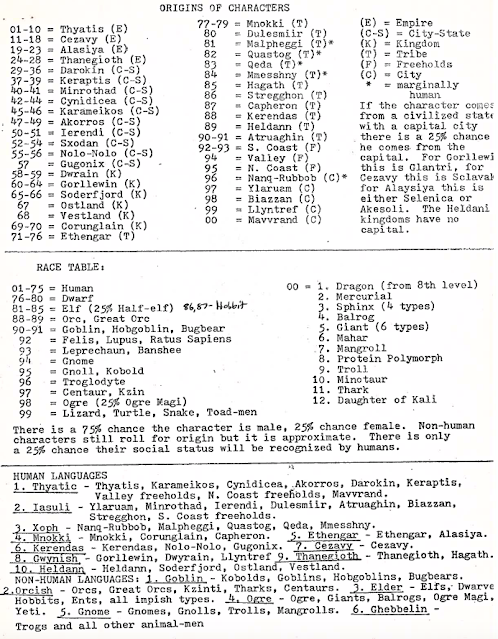
Sample Page from the Original Known World documents - "Origins of Characters".
Note the extensive list of non-human races available for play including
Felis Sapiens, Toad-Men, Balrogs, Protein Polymorphs and Tharks...!

Over on the Piazza, a great forum dedicated to the various and sundry D&D settings, member TraverseTravis has posted scans of a sheaf of documents from the Original Known World D&D campaign of Lawrence Schick and the late Tom Moldvay before they started working for TSR. This is the original material which Moldvay and others drew on for developing the published Known World campaign setting - later Mystara - as it initially appears in the 1981 D&D Expert Rulebook and the module X1 Isle of Dread. 

Portions of this material surfaced back in 2015, which I described in post on this blog called "Ur-Known World"; from there you can find a link to an interview with Schick on Black Gate.

The new set of documents was saved by one of the original members of the group, Bill Wilkerson (thanked as a playtester in Moldvay's module B4 The Lost City), who provided them to TraverseTravis for scanning. Shannon Appecline compiled the scans into a single document organized by subject according to OD&D Vol I-III.

Find links for downloading them in the first post here:

Bill Wilkerson's Original Known World documents


I've been contributing to the Piazza thread with comments on how the "New Monsters" from the Original Known World were later used by Moldvay and Schick in various TSR publications such as the Fiend Folio, X1 Isle of Dread and X2 Castle Amber.

A big thanks to TraverseTravis and Shannon Appelcline for their efforts in making this material available to the public!


Wednesday, November 25, 2020

M1 Blizzard Pass: Dungeon Design


Today, Grognardia has a retrospective on the module M1 Blizzard Pass by Zeb Cook.

This brought back some of my memories of this module, which was released in 1983. I remember buying it at Kay-Bee Toys in our local mall on the same day that my sister got the Smurf: Rescue in Gargamel's Castle game for our Colecovision.

I enjoyed the solo module, but what I really found fascinating was the "group adventure" at the end, which describes the dungeon, consisting of the single map shown above, in less than three full pages. Not only is it an interesting behind-the-scenes look at the solo adventure, but it is also a rare example of a TSR "mini-dungeon"; i.e., an adventure consisting of a single dungeon page with just a few pages of description. In the early days, we really only saw this kind of short adventure as a sample dungeon in a rulebook (e.g., Holmes Basic or Moldvay Basic). I think it reminded me of those because it was also in the back of the booklet. One reason I liked this kind of short adventure is that it was closer to the single map-page dungeons I was making myself at the time. Even the adventures published in Dragon magazine were usually longer than this, and had at least two different map pages. 

(Warning, below are some spoilers if you plan to ever play through the dungeon)

As is obvious from the name, the setting for Blizzard Pass is a snowy mountain pass, which immediately gives the dungeon a feel that differentiates from typical sample dungeons. A few of the elements tie into this icy setting, for example, the ogre guard at the beginning that hides in the snow and then hurls "snowballs" (balls of ice) at the party, and the Snow Apes, a new monster.

According to the ten types of Scenarios outlined in Moldvay Basic, the adventure is #8, Rescuing Prisoners - the same as the The Haunted Keep sample dungeon. 

The dungeon itself is more linear than the one in Holmes Basic, but this makes sense as it is a defensible lair. And it has some neat twists that make the linear design more interesting. Two of the paths criss-cross over each other, making the map more eye-catching (see above).

The map also makes good use of the dungeon features key shown on page B58, which was one of the ways that the Moldvay Basic rulebook advanced dungeon design over that of the dungeon of Holmes Basic, as I outlined here. It also has a clever and thematic compass rose that uses the head of troglodyte, one of the monsters in the dungeon.

In addition to the main entrance, there are two other exits from the dungeon. One of these is via a branch point that leads to a red-herring mini-labyrinth in a second part of the dungeon; the other is the requisite secret escape route for the evil cleric, which is a motif that Gygax also used several times (in that post, jump to the section "Evil Human Lair with Escape Route" near the bottom).

It has a few interesting features of verticality; parts of the dungeon are higher than others, which is something also seen in the Caves of Chaos. This allows for a chute that leads from one area to another, a trap that Gygax originally suggested all the way back in OD&D, Vol 3 (e.g., "mouths of chutes" and "a slide to a lower level"), but didn't turn up that often in published dungeons. This trap also involves a weird statue/idol, a motif seen repeatedly in early D&D adventures; there's one in each of the Holmes and Moldvay Sample Dungeons, and Gygax provided several examples in the "Trick and Traps: (Additions)" section of the Greyhawk Supplement.

There is also a vertical passage in the dungeon that can only be traversed by climbing; this allows a thief a chance to use their climb walls ability; the solo adventure itself is written for a thief character. This is shown via a cross-section inset on the map, and leads to the second section of the dungeon. This part is set off visually from the first by use of half-tone dots, labeled on the key as "Higher Area", and perhaps reinforcing that the temperature is different in this part of the cave system.

Plus, it's got pulpy weird toads and apes as the new monsters: the aforementioned Snow Ape and the hypnotic Rock Toad, also called a Cave Toad.

A Rock Toad as illustrated by Jim Holloway

I like this dungeon enough that I included it when I started an annual kids' campaign about five years ago. IIRC, this was the fourth adventure that they went through (Holmes Sample Dungeon -  Mentzer Sample Dungeon - Quest for the Silver Sword - Blizzard Pass).

If you'd like to see this mini-dungeon yourself, Blizzard Pass is available on DMs Guild (note: affiliate link), and it comes with all of the solo entries filled in within the appropriate text so you can actually play through it without the  invisible ink pen.

Read the Grognardia retrospective here:

Retrospective: Blizzard Pass

Yesterday's post about solo wargames reminded me of something that I had almost forgotten: that, in 1983, TSR published the first of two solo adventure modules for Dungeons & Dragons. Entitled Blizzard Pass and written by David Cook, this module is, in broad outline, not all that different from a Fighting Fantasy book like The Warlock of Firetop Mountain.

Friday, July 24, 2020

A Chronology of D&D Sample Dungeons: The Haunted Keep by Tom Moldvay (1981)

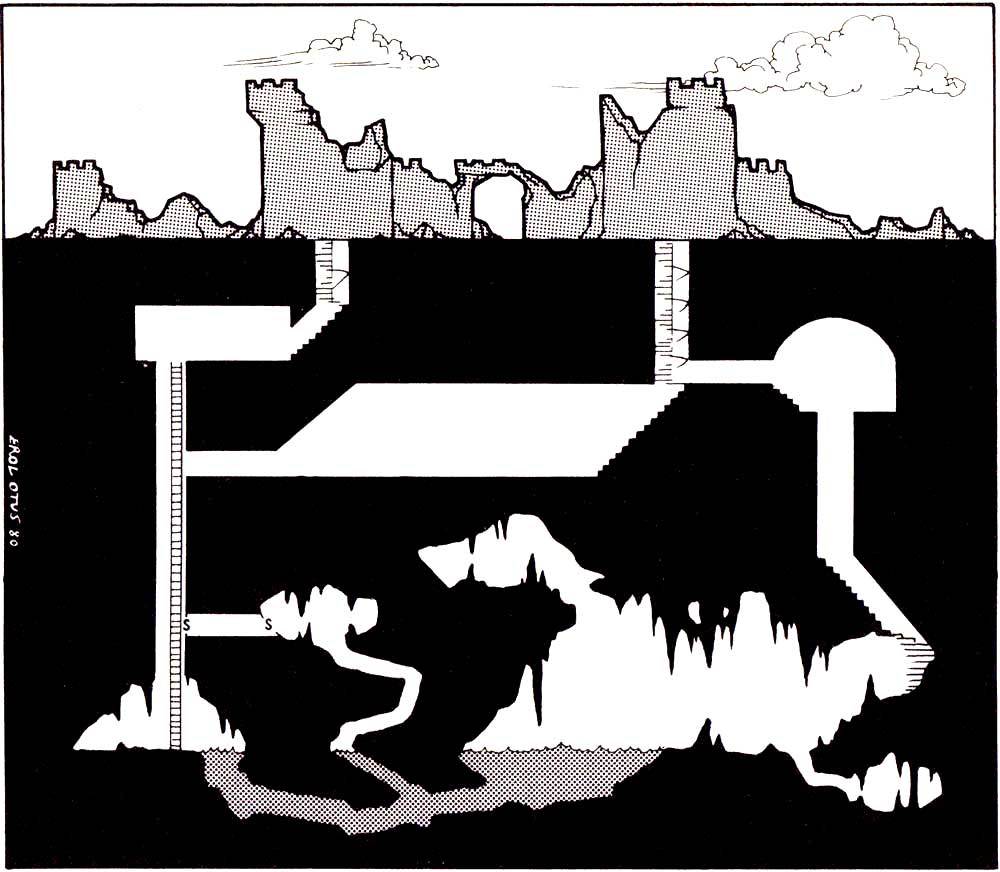
The Haunted Keep cross-section by Erol Otus. Source: Old School FRP tumblr

This is material I recently wrote for the Chronology of Sample Dungeons section of the Zenopus Archives site. Think of it as a first draft as I will likely revise/add to it over time.

The Haunted Keep is the sample dungeon from the 1981 revision of the D&D Basic rulebook, which was edited by Tom Moldvay. As with the Holmes Basic rulebook, the job of editor involved a significant amount of original writing, including an entire sample dungeon level. While the Zenopus Dungeon from Holmes Basic has no formal name other than "Sample Dungeon", Moldvay specifically refers to his scenario as "THE HAUNTED KEEP" (top left of page B55).

Holmes pioneered the inclusion of an introductory sample dungeon in the Basic rulebook, taking the sample level concept from OD&D Vol 3, which is essentially a collection of examples, mainly tricks and traps, and adding narrative cohesion and gearing it towards beginners. Moldvay takes his cues from Holmes' structure, similarly providing an evocative background in several concise paragraphs (page B55) followed by a single fully described dungeon level (page B56-B57), and with suggestions for expansion.

Moldvay's background echoes that of the Zenopus Dungeon in several respects. The occupants have mysteriously disappeared, leaving the structure housing the dungeon abandoned. The structure is said to be haunted; "[s]trange lights and sounds are often seen and heard in the ruins by the passing townspeople", which recalls the Zenopus Dungeon's bit about the neighbors complaining about ghostly lights and ghastly screams. The Haunted Keep is ruined like Zenopus' tower, although not to the same extent, and thus Moldvay's sample dungeon level is actually above ground in the only remaining floor of the East Tower.  Because the dungeon is named The Haunted Keep, it's not usually remembered that the sample level is actually of the East Tower of this structure (see map below), and there is a perhaps a trace of Holmes' ruined tower concept in Moldvay's likewise ruined tower. 

Moldvay advances the concept of an introductory sample dungeon in a number of significant ways. These changes suggest why Moldvay chose to write a new level rather than just revising Holmes' dungeon.

1. Providing "Boxed Text". Several of the paragraphs of the background are in quotes, with a suggestion that this could be read to players (pg B55); this seems to be a step in the evolution of TSR's "boxed text" that would shortly become standard in modules. The first modules for the revised Basic Set, such as B3 Palace of the Silver Princess (originally by Jean Wells alone, with Moldvay as a co-author on the revised version) and B4 The Lost City (by Moldvay) were among the first TSR modules to include boxed text.

2. Integration with Advice on Types of Scenarios. Moldvay provides a motivation for exploring the dungeon beyond simply looking for treasure. On page B51, he lists out ten different "Scenarios", of which the "Haunted Keep" is described as an example of #8, "Rescuing Prisoners".

3. Procedural Dungeon Construction. There is the significant addition of a "step-by-step" how-to section that shows how the dungeon was constructed (pages B55-B56), with the dungeon level being the example of the output. This guidance is integrated with Moldvay's instructions for stocking dungeons on pages B51-B52; both sections include steps A-F.

4. Dungeon Map Features. The dungeon map (pg B57) includes more room features than the Zenopus dungeon, and these correspond to a separate key of standard dungeon map features (pg B58).

Maps for the Haunted Keep from page B57. Source: Marks Roll Dice 

5. Location Map. There is a second map showing the outside structure of the dungeon below the dungeon map (shown above). This serves as a bit of a location map, showing a north-south road running through the gatehouse of the ruined keep, as well as suggestion another area for expansion: the West Tower. The introduction also indicates that the "interior of the gatehouse will be similar to the towers, though there will be fewer rooms", although the map does not shown a blank interior area where these rooms would be located in the Gate House.

6. Sample Cross-Section Integration. The sample cross-section (of B58) drawn by Erol Otus (shown at the top of the page) is linked to the sample dungeon level rather than being an unrelated cross-section like Skull Mountain in Holmes Basic. This cross-section shows second and third levels of the dungeon, corresponding to Moldvay's instructions for expanding the dungeon. These three levels match the three levels of Basic play, which refer to both character levels and dungeon levels. This was a design decision first implemented by Holmes, who included Wandering Monsters for the first three dungeon levels. Holmes had also intended for his rulebook to include a cross-section of a dungeon with just three levels, but TSR replaced this with the much more extensive Skull Mountain cross-section.

7. Tie-in to Examples of Play and Combat. The Example of Play (page B59) is also linked to the sample dungeon rather than having it be an unrelated example like in Holmes Basic. The Example starts at end of the first level of the dungeon at the entrance to the second level, and is thus able to continue the description of the dungeon a bit further. This Example of Play is also linked to the Example of Combat earlier in the book (B28), which continues directly from the Example of Play. 

8. More Advice on Expanding the Sample. for Holmes gave some brief suggestions for expanding the dungeon. Moldvay expands on this by giving more detailed instructions for what the DM should include when designing the 2nd and 3rd level of the dungeon (pg B55).

The extra material noted above does mean that the dungeon itself is greatly reduced in size from Holmes' example, with the first level of the Haunted Keep having just 9 rooms described in a little over half a column of text, as compared to Holmes' 15+ rooms described over 3 full pages. This provides less ready-to-go material for the DM, but this was perhaps less of a concern as the Basic Set now included a full module. When the Holmes Basic set debuted, it was packaged with Monster & Treasure Assortments, but these were replaced in 1978 with B1 In Search of the Unknown, and then again in early 1980 with B2 Keep on the Borderlands, which was then retained in revised format for the Moldvay Basic set.

Tuesday, October 27, 2015

Goblin +1


One idea I've mulled over is a shorthand system for notating stronger/weaker variations of monsters. Similar to magic items, it would simply follow monster's name with a plus or minus: Goblin +1, Goblin +2, Goblin -1, etc.

The modifier would be applied to the monster stats. In OD&D, humanoid leaders generally have an entire hit die or more than the standard version. So I would apply a modifier to the hit dice rather than just hit points, as well as bonuses to AC and damage.

For example, an Orc +1 would get an extra HD, which includes the corresponding increase in to-hit and saves, as well as +1 to damage and AC.

Orc (HD 1, AC 7, AT: 1 x 1d6)
Orc +1 (HD 2, AC 6, AT: 1 x 1d6+1)
Orc +2 (HD 3, AC 5, AT: 1 x 1d6+2)

For humanoids with less than 1 HD, I would convert the hit dice to nearest die and then add the modifier (for bonuses), or drop the hit dice to the next die (for penalties). For example, a goblin has HD 1-1, which is equivalent to a d6 hit dice. Thus:

Goblin (HD 1-1, AC 6, AT: 1 x 1d6)
Goblin +1 (HD 2d6, AC 5, AT: 1 x 1d6+1)
Goblin -1 (HD 1/2 (1d4), AC 7: AT: 1 x 1d6-1)

As it turns out a system of this nature, but with a different shorthand, was outlined in the D&D Rules Cyclopedia nearly twenty-five years ago. See this post on the The Disoriented Ranger blog for an excerpt of the rules from that volume. It's a little different in that the modifier is applied to hit points per hit dice, similar to a CON bonus. I think this works better for higher HD monsters. With low HD monsters, a one or two point change in hit points won't make a noticeable difference in the staying power of the monster in combat.

One could take this idea further and apply a bell curve roll (e.g. 3d6) to a group of monsters to determine which members are the leaders. Using the B/X stat modifiers, for example:

3: Monster -3
4-5: Monster -2
6-8: Monster -1
9-12: Monster 
13-15: Monster +1
16-17: Monster +2
18: Monster +3

Update:
On further thought, rather than rolling for a group, it'd be simpler to just give guidelines:
For every ~20 monsters, one will be +3, two will be +2, and three will be +1. 

Thursday, March 12, 2015

Zargon Beckons


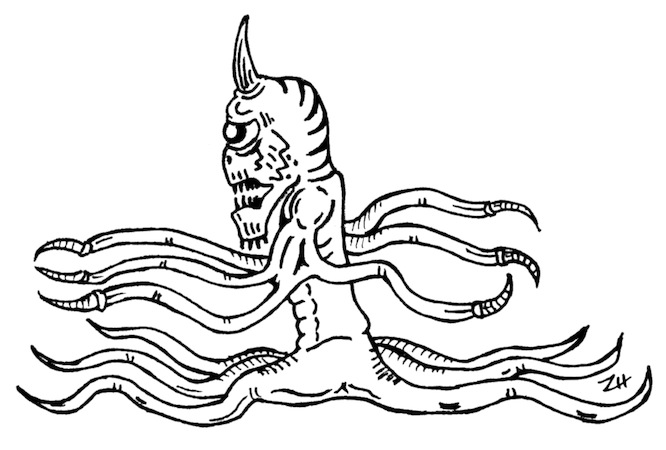
Over on Dragonsfoot, paleologos has proposed an extensive 'campaign sourcebook' to supplement the module B4 The Lost City (1982) by Tom Moldvay. The compilation will include retrospectives, background material and expansions (he did this before for B1, which you can find via this page). He is soliciting authors for various topics; see the proposed table of contents. He is also asking for artwork contributions, which inspired me to sketch the above monstrosity. Furthermore, he's started a thread on Holmes Basic section of the OD&D Discussion board to discuss any possible connections with the Holmes rules. This was one of the earliest B/X modules and there is the possibility that is was originally written for the earlier Basic set, like B3 Palace of the Silver Princess (as confirmed by Frank Mentzer).

Sunday, February 8, 2015

Ur-Known World


A portion of one of the maps, annotated based on the notes


Over on Black Gate, there's a fascinating post by Lawrence Schick, a former TSR employee who among other work wrote the classic module S2 White Plume Mountain, and edited the original Dungeon Masters Guide, both released in 1979. The post is called 'The "Known World" D&D Setting: A Secret History" and it recounts the origins of B/X's Known World campaign setting, later known as Mystara. The setting was first published by TSR in the module X1 Isle of Dread by David "Zeb" Cook and Tom Moldvay, which was included in the original Expert Set (1981). But the published setting drew one earlier campaign materials developed by Schick and Moldvay, who was his pre-TSR collaborator. Head over to Black Gate to the read article and see four pages of the original material, including two pages of notes and two pages of the map. 

The map I posted is a portion of one of those maps, with annotations in red that I added based on the notes. You can see the original positions of some well-known locations such as Glantri, Darokin and Ylaruam.

You can see how the picture-in-hex style of the published map of the Known World was influenced by the original.

* * * * *

Here are some things I love about the pre-TSR Known World: 

Created for OD&D!

Weird fiction influences are much more pronounced.  

Schick: "Moldvay did most of the initial culture write-ups, whereas I created the leading non-player characters in each homeland; I was also the Name Guy and came up with most of the location names, drawing on Dunsany, Vance, and Clark Ashton Smith for inspiration."

Schick: "...in every land there would be hidden cults that worshiped Lovecraftian Elder Gods."

Shoggoth in the list of languages.

Malpheggi and Quastog tribes being footnoted as "marginally human".

Kzinti, Tharks and Mahars among the non-human races.

Giganthropithici (Giant Ape-Men?) among the races that speak Ogre.

"Keraptis" appears on the list of city names...this was also the name of the wizard in Schick's White Plume Mountain.

"Tentrumtoom...K88 (ruined city & pyramid dungeon)" - precursor of B4 The Lost City? There's also a city of Cynidicea but it appears to a be living city.


Update: According to Bruce Heard in the Mystara Reborn group on FB, he didn't know about this original Known World even when he was working for TSR on the Gazetteer series (thanks to Havard for pointing this out on DF). This is useful to know because it limits the publications that would have been inspired by the original Known World campaign to products originating from Moldvay/Schick/Cook. So any new material appearing in the Gazetteers would not be from the original campaign.

See also:
OD&D Discussion thread
Piazza Discussion thread
DF Discussion thread 

2022 Update: 
Many more documents related to this campaign were recently uncovered. See this thread on the Piazza.

Sunday, February 10, 2013

Expert Set rulebook pdf notes


I ended up buying the new pdf of the Expert Set rulebook, which you can find here on DriveThruRPG

A few notes:

(1) The scan quality is great, the text is completely OCR'd and searchable, and the pdf is fully indexed with bookmarks. Front and back covers, including insides are all included, important since there's a table of contents inside the front and an index inside the back. Pages are mostly scanned straight, though a few are slightly off, which you can see in the screenshot of the Gnome Lair:


GNOME LAIR - location from the Sample Wilderness in the Expert Set rulebook


(2) It's a 1st printing of the rulebook according to the Acaeum. The distinguishing feature on the front cover is the lack of a white circle around the "2" on the upper left front cover. I hadn't seen the interior of a 1st printing before, but a quick comparison to a later printing didn't reveal any major text differences in the rules. I do note that the title page of the 1st printing has Gygax & Arneson's name on it, but for some reason their name is missing from the hard copy later printing that I have.

The corresponding Moldvay pdf from dndclassics is not a 1st printing, as it has a white circle around the "1" on the front cover. Apparently the Wizards are not paying attention to the printings at this level of granularity. It will be interesting to see what printing of the Holmes rulebook we end up with - most likely the 2nd or 3rd printing.

(3) Here's the neatest part of the pdf: It's 88 pages rather than the 68 pages as you'd expect (64 page rulebook plus covers). That's because it has several bonus items from the Expert Set at the end: a 16 page TSR product catalog, a 2-page RPGA membership form, and a 2-page TSR survey. The catalog is a real treasure if you haven't seen it before: a 1981 Gateway to Adventure TSR product catalog (see the cover here). There are several versions of this catalog, and this one happens to be the one that shows the Holmes Basic rulebook cover next to a listing for the new Expert Set rulebook. So now I have a better scan of the picture of this, which I've replaced in my previous post. However, I also noted that the catalog shows the Moldvay Box Set on another page along with the Expert Set. So perhaps the B/X box cover design was finished at the time of this catalog but not the rulebook cover design.


Update: Ten years later, they've added a Print-on-Demand (POD) option for this. Find it here:

Saturday, February 9, 2013

B/X Mud Brown and Pea Green Polyhedral Dice


In the early days my friend E.H. had the 1981 D&D Basic and Expert (B/X) sets, often knonw now as the Moldvay Basic and Marsh/Cook Expert Sets. I'll always remember the polyhedral dice from those sets, because they were so different than my pale blue Dragon Dice, which were the first set I'd purchased after starting with the notorious chits that came with my Holmes Basic Set. His Basic Set dice were pea soup green, and his Expert Set dice were mud brown, and each had a faint swirled pattern. On Tome of Treasures, a collecting site, I found a post with a picture of dice from a first print Expert Set that are exactly the same color as the brown ones I remember (see screenshot above). These dice came uninked, and the set also had a crayon for coloring them. There's been some discussion of the B/X dice on the Acaeum recently here. I haven't found a picture of the green dice yet.


Update: The "swirly-pea green" dice can be seen here on the Dice Collector's TSR dice page. Also, it looks like there may have been two slightly different versions of the brown dice, one with a more prominent swirl like I remember.

In those days we'd try to play D&D anywhere. Once we were in his dad's brown Subaru, with E.H. DMing in the front with the green/brown dice in a flat space on the dash. Unfortunately, the window was also open, and when his dad made a U-turn some of the dice went flying out into a busy intersection. We had to dodge traffic to try to recover them, and I don't think we found all of them.

Tuesday, February 5, 2013

B/X Expert Set for use with Holmes Basic


Screen shot from the bonus catalog at the end of the new Expert Set rulebook pdf

The D&D Expert Set rulebook by Cook/Marsh is now available on pdf at dndclassic.com. It was designed to accompany Moldvay Basic, together forming what is commonly called B/X now, but it contains a section in the beginning on using it with the previous (Holmes) Basic Set. So in one sense it's the official Expert Set for Holmes Basic.

As I wrote on the Rules Expansion page on the ZA site: 

In Dragon #35, Gygax also revealed that "Design is now hard at work on the second boxed D&D game, the Expert Set. It will take players through at least 12th level of experience, tie in the best of the “Original” material, and actually add some new classes, spells, magic, monsters and so on." In context, this appeared to be an Expert Set that would complement the Holmes Basic Set. A late 1980 Gateway to Adventure catalog shows the Holmes Basic set side-by-side with an unpictured but soon-to-be-released Expert Set. However, when the Expert Set finally arrived in 1981 it was accompanied by an entirely new Basic Set that replaced the Holmes Basic set (although TSR continued to have the original in stock through the Mail Order Hobby Shop until at least 1986). To aid owners of the original Basic set who did not wish to buy a new set, the Cook/Marsh rulebook contained a section on page X4 titled "Using D&D Expert with an early edition of D&D Basic" which began "If your copy of the D&D Basic rules has a blue cover with a picture of a dragon on it, then this section is for you". This section then provides a summary of the "new material found in the 2nd edition of D&D Basic.

See also the previous post, Holmes Expert Set from TSR catalog.

Update: I ended up buying the new pdf of the Expert Set rulebook. See a future post for some notes.

Tuesday, January 22, 2013

Ancient Treasures from the Cellars (D&D pdfs)


The whispered rumors were true; the Wizards have been excavating in their cellars in search of ancient treasures. OneBookShelf (RPGnow/DriveThruRPG) was preparing its website to re-issue the D&D backcatalog in pdf form. Today, they are available through a dedicated storefront called dndclassics.com with the tagline "Every Edition Available Again!"


Here are my notes and a roundup of news related to this:
-Eighty PDFs are currently available from a range of lines (Moldvay Basic, AD&D, etc). Francisa on the K&KA forums posted the following message from customer support : "Our initial release includes over 80 titles, though we plan to release smaller batches of additional titles on a rolling basis after that. Needless to say the final catalog will be extensive." They are releasing them as they become available from the Wizards. James Raggi reports the following from them: "All second edition and prior titles have been re-mastered with better quality scans and re-bookmarked. Scanning equipment has improved considerably over the last decade, and it was time to replace the scans created under the ESD program with all new scans."

-B1 In Search of the Unknown is free for download this week. Get it here. The normal list price is $5.50. It's the brown-colored Moldvay revision from 1981 rather than the original monochrome version for Holmes Basic. Quality is excellent, and fully text searchable (yes!). Badmike reports that the pdf is fully printable.

-Moldvay Basic is available on authorized pdf for the first time ever. It's $4.99, and currently the hottest product on the site. I haven't bought it yet, but I plan to. It will be nice to have a text searchable version. No Expert, as of yet but it's coming on Feb 5th (see updates below).

-Good news: if you purchased a pdf from them in the past, and there's a new version, you can download the new one for free. I checked my account and was able to download the new version of B6 Veiled Society, which I'd purchased previously. It's a completely new scan, much better than the old one. They even scanned the map on the inside of the folder as one large page rather than two separate pages in the old pdf.

-No Holmes Basic products yet. Hopefully we'll at least see the Holmes Basic rulebook. They'll probably also release the original B1 since it has a different cover that makes it easily distinguishable. I'd like to see the original B2 for Holmes Basic (with DX scores for monsters) as well. No OD&D yet, either but I'm 100% certain we'll see those.

-Each product has an excellent "Product History" page written by RPG historian Shannon Appelcline. Here's some quotes from the page for B1: "The story of "Search" begins with the first Dungeons & Dragons Basic Set (1977), which was a reorganization of the rules from the original 3-book Dungeons & Dragons (1974) and Supplement I: Greyhawk (1975) produced by J. Eric Holmes. Following the publication of the Basic Set, TSR was looking for better introductory material to support it.

Enter TSR Games & Rule Editor Mike Carr, who saw the need for an introductory adventure that really taught GMs how to create and stock a dungeon. He offered to write such a product for TSR, who accepted. "In Search of the Unknown" was thus an introductory module for the introductory rule set - making it the ultimate introduction to the game."


-Deities & Demigods is available, but buyer beware: judging by the preview pdf, the new  scan is unfortunately of the fourth printing, without the Cthulhu or Melnibonean Mythos. The fourth printing was an oddity in that Holmes is still thanked for his help on the Cthulhu Mythos, and Chaosium is thanked for permission (pg 4), but these Mythos had been removed. If you look at the table of contents, it's the revised edition with only 128 pages.

-There's a GeekDad column on Wired about the new pdfs: "The PDFs are made from fresh scans of these old products. "We've rescanned everything," Schuh said. "It's the highest quality you can get out there." (I'd generally concur: The scans are good quality, and best of all, the PDFs are searchable. For example, you can search 1980's Q1: Queen of the Demonweb Pits for all instances of the word "Lolth" or "spider ship," which could come in handy during game play. I did see a few errors in the reproduction of multi-part gatefold-style maps, but hopefully these glitches will be resolved.)"

"The company also plans on releasing "conversion notes" so the older gaming products available on dndclassics.com can be played with newer editions of D&D, including the latest revamp of the rules, what is being called "D&D Next," now in development and scheduled to be released sometime in 2014."

-Some "Basic 4th Edition" products are available for free as well, including H1 Keep on the Shadowfell, for levels 1-3, which is 145 pages long (!) and includes 4E Quickstart Rules and lots of large maps for play (not sure how well these will print out). Also Khyber's Harvest, a 36-page adventure for 2nd level characters.

Updates:
-According to this Examiner interview, the next pdfs will come on Feb 5th, and will include among others the AD&D MMII, DSG, WSG, D&D Expert rulebook and the module DA2. And OD&D is on the way: "We are opening with around 80 titles covering all of the editions, well, maybe not the earliest Chainmail or Original Edition yet, but that will come."

Monday, February 27, 2012

Visit Holmeston and see the Haunted Keep


Dave at There's Dungeons Down Under alerted me to a new adventure called "Shadow of the Haunted Keep" that contains a tribute to Holmes. The adventure is 48 pages and is available from RPGnow for $1.99, and is for "the Dark Dungeon 2nd Edition Game" (also by the author, and available for free here) or "or any Old School Renaissance fantasy game you prefer". The adventure provides simple dual DD2E/OSR stats.  The author is Jaap de Goode and the publisher is Sangreal Games, based in The Netherlands. The dungeon portion is a version of the Haunted Keep sample dungeon from the Moldvay Basic rulebook, and there's a town, Holmeston, "named after the honorable late herr doctor Holmes, who first built a settlement here (the blue house)". There's a 7-page preview at RPGnow.

Saturday, September 17, 2011

Holmes Expert Set from TSR catalog


In a previous post on Rules Expansions, I mentioned a late 1980 Gateway to Adventure catalog that shows the Holmes Basic Set side-by-side with an unpictured but soon-to-be-released Expert Set. A screenshot of this is above, taken from a scan of a page posted by TheMilford at the Tome of Treasures in 2009. As you can see, it's actually just the booklets that are advertised rather the whole sets. (If anyone has this catalog, please let me know if there is another entry for the sets).

While the listing shows the cover of the Blue Book, it is given the product code 2014, which was used for the Moldvay Basic Set rulebook. Most likely the new rulebooks were in production but not ready for photography at the time this catalog was prepared. The same page also shows the first print of B2 (written for Holmes) rather than the revised B/X version, and also has an unpictured listing for the module B3 (the first module for Moldvay), "the newest of the instructional settings for the D&D Basic Set".

Still, if you saw this catalog in 1980 you would probably have assumed that the forthcoming Expert Set was going to be a companion to the existing Holmes Basic Set, rather than the significant revision with new cover artwork that eventually appeared in 1981. Earlier in the year (Dragon #35, March 1980), Gygax had revealed that "Design is now hard at work on the second boxed D&D game, the Expert Set. It will take players through at least 12th level of experience, tie in the best of the “Original” material, and actually add some new classes, spells, magic, monsters and so on." In context, this appeared to be an Expert Set that would complement the Holmes Basic Set. The above catalog entry is the closest TSR got to advertising this mythical Holmes Expert Set.

Further thoughts:

Does anyone remember seeing this catalog at the time? Later copies of the Gateway to Adventure Catalog with the same cover, including the one I have from a Moldvay Set I found at a Goodwill in the mid-80s, replace the above entries with the B/X Sets. The copy from the Tome of Treasures site was found with a first print Cook/Marsh Expert Set.