This is the blog. Click here to go to the Zenopus Archives website.

Note: Many older posts on this blog are missing images, but can be viewed at the corresponding page in the Internet Archive

FEATURED POST

The Forgotten Smugglers' Cave: Index of Posts

An index of posts describing the Forgotten Smugglers' Cave, an adventure for Holmes Basic characters levels 2-4.                    ...

Showing posts sorted by relevance for query Castle Greyhawk. Sort by date Show all posts

Wednesday, March 4, 2015

Visualizing Castle Greyhawk

In memory of Gary Gygax (July 27, 1938 – March 4, 2008), here is a glimpse of Castle Greyhawk using his words & some relevant pictures.


Walled City[1]


"To the east of the busy walled city of Greyhawk the land is forsaken, overgrown with thorns and thistles. Oozing marsh creeps slowly down. The copses are huddles of weird, bloated trees. The wiry grass seems to grasp at the feet of any who dare to tread upon it. In the center of this unwholesome place, on a rock-boned prominence, hulks the ruin of the grim Greyhawk Castle..."[2]


Castle
[3]


"The fallen west gate of Greyhawk Castle was at hand, and through this mouldering portal the party passed. In a few moments they had entered the great central keep, heaved open an inner door, and carefully proceeded down a set of winding stone steps---steps worn with age and slippery with dampness. They had entered the dungeons."[2]


Castle Courtyard with Keep[4]


"... Old Greyhawk Castle was 13 levels deep. 

The first level was a simple maze of rooms and corridors..."[5]


One version of Castle Greyhawk Level 1[6]


"The second level had two unusual items, a nixie pool and a fountain of [endless] snakes.

The third featured a torture chamber and many small cells and prison rooms..."[5]


Castle Greyhawk Level 3[6]


"The fourth was a level of crypts and undead. 

The fifth was centered around a strange font of black fire and gargoyles. 

The sixth was a repeating maze with dozens of wild hogs (3 dice) in inconvenient spots, naturally backed up by appropriate numbers of wereboars. 

The seventh was centered around a circular labyrinth and a street of masses of ogres. 

The eighth through tenth levels were caves and caverns featuring trolls, giant insects, and a transporter nexus with an evil wizard (with a number of tough associates) guarding it. 

The eleventh level was the home of the most powerful wizard in the castle. He had balrogs as servants. The remainder of the level was populated by Martian white apes, except the sub-passage system underneath the corridors which was full of poisonous critters with no treasure. 

Level twelve was filled with dragons. 

The bottom level, number thirteen, contained an inescapable slide which took the players “clear through to China”, from whence they had to return via “Outdoor Adventure”.

It was quite possible to journey downward to the bottom level by an insidious series of slanting passages which began on the second level, but the likelihood of following such a route unknowingly didn’t become too great until the seventh or eighth level

Side levels included a barracks with orcs, hobgoblins, and gnolls continually warring with each other, a museum, a huge arena, an underground lake, a giant’s home, and a garden of fungi."[5]

Notes:

[1] Art (uncredited) from Outdoor Geomorphs Set One: Walled City by Gary Gygax (TSR, 1977). The sample encounters from this set reference City of Greyhawk locations, so the art is possibly a picture of the city. 

[2] Excerpts from The Expedition into the Black Reservoir by Gary Gygax (El Conquistador, 1975).

[3] "Bodenburg Castle was used as the original model for the ruined upper works of Greyhawk Castle. Gygax had one in his basement at 330 Center Street" - caption for historical display by Paul Stormberg at Gary Con VI. Photo is by Allan Grohe (grodog).

[4] Siege at Bodenburg Map Inset. Source: The Army Men Homepage.


[5] Excerpt from "How to Set Up Your Dungeons & Dragons Campaign" by Gary Gygax (Europa #6-8, April 1975) & "'Greyhawk' had a fountain on its second level which issued endless numbers of snakes" (Greyhawk, 1975).

[6] Two Levels of the Real Castle Greyhawk by Random Wizard (2013). See also Gygax Castle Greyhawk Map thread at the Knights & Knaves Alehouse. These were maps that Gary was using to run the Castle at conventions in the last decade of his life. Please note that these maps, while appearing old, may not be the original maps for these levels; notably, the first dungeon level of the published Castle Zagyg uses a different map.

Friday, September 8, 2023

Gygax's Yggsburgh (2005) available once again


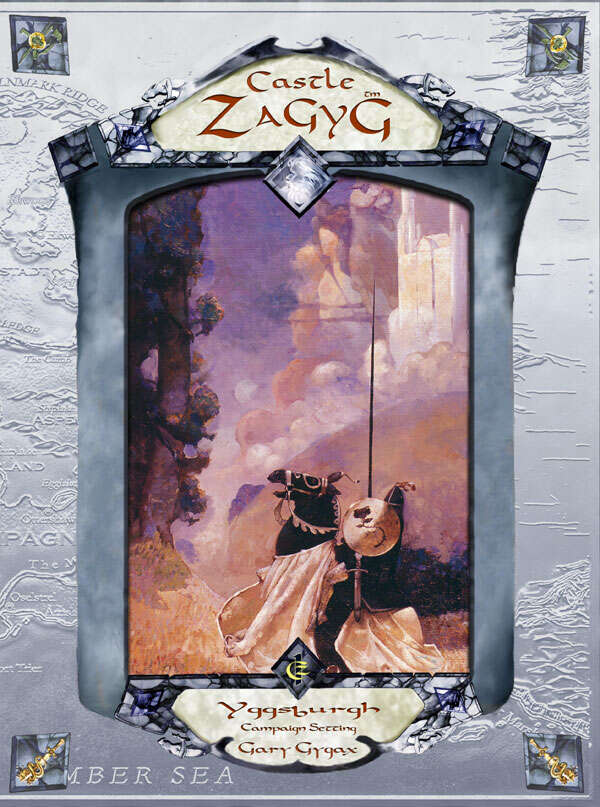
The front cover of Yggsburgh,
with an illustration by Jeffrey Catherine Jones


If you haven't heard, Gary Gygax's Yggsburgh sandbox campaign setting, originally released in 2005 and withdrawn from sales after he passed away in 2008, is once again available for purchase from Troll Lord Games, following an agreement with the Gygax estate. You can pre-order the hardcover from the TLG site for $65, which also includes an immediate download of the PDF, or you can buy the PDF alone from DrivethruRPG for $19.99:


Yggsburgh Print (pre-order) + PDF 

Yggsburgh PDF only


For those unfamiliar with it, Yggsburgh is a re-casting of Gygax's long-delayed City of Greyhawk project, intended as a setting for exploring the Castle Greyhawk dungeons, here re-christened Castle Zagyg.  

Back in May of 1980, shortly before the initial publication of the World of Greyhawk campaign setting, Gary Gygax discussed future releases for the setting in issue 37 of The Dragon, where in his regular column "From the Sorcerer's Scroll", under the title "Greyhawk: The Shape of the World", he estimated that "The City of Greyhawk might make a 1981 publication date, certainly 1982, and about the same time the series which will eventually represent the whole of the Dungeons of Castle Greyhawk will begin". Sadly, neither title ever appeared under Gygax's byline, and became the most infamous of TSR vaporware. 

Decades later, in the early 2000s, Gygax finally started a new project to publish this material, this time under the aegis of TLG's Castles & Crusades RPG. However, only Yggsburgh and the first portion of the Castle Zagyg, titled the Upper Works (2007), were finished and released before Gygax passed away, and the license to publish them was withdrawn.

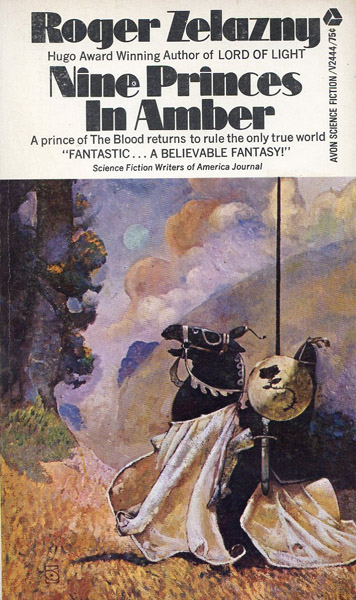
Yggsburgh is a sprawling 256-page hardcover book, with cover art by the great Jeffrey Catherine Jones, repurposed from the 1972 Avon paperback edition of Nine Princes of Amber by Roger Zelazny. This was the first novel in the Amber series, which was included by Gygax in Appendix N in the AD&D Dungeon Masters Guide in 1979. Originally, the entire series of Castle Zagyg books was slated to feature covers with Jones' classic work from the 1970s.


The book itself is also accompanied by an 8-page hexmap, drafted by Darlene in a style similar to her original maps for the World of Greyhawk, which was tipped into the back cover in the 2005 publication. This depicts an area 50 hexes east-west and 34 hexes north-south, at 1 mile per hex, for a total area of 1,700 square miles:


Players Version of the Yggsburgh Hex Map by Darlene

Rather than just being a high-level gazetteer, Yggsburgh is a big sandbox, which I'd compare to Lenard Lakofka's AD&D module L1 The Secret of Bone Hill. There's a city with 93 described areas, including the famous Green Dragon Inn, and an area map with 48 described locations, and including a number of fully detailed small dungeons, which is often overlooked: 

  • Thieves' Underground (13 rooms)
  • River King's Tomb (19 rooms)
  • The Cursed Mine (14 rooms)
  • The Gnome Burrows (25 rooms)
  • The Unholy Ringstones (25 encounter areas)

These could easily be extracted and run as one-shots or dropped in other settings. 

Castle Zagyg and Rob Kuntz's Dark Chateau (2005) are also two of the intended locations in the sandbox, so there is the potential for larger dungeons, although this does make the campaign setting incomplete on its own if you intend to use those.

I've had the original hardback for many years, and it's probably my favorite late-era Gygax product. While I haven't run anything from it yet, I will pick it up every now and then and read a bit. It's sort of a glorious sprawling mess like the original AD&D DMG, but in campaign setting form.

Sunday, March 6, 2022

Gygax's "City on the Edge" Greyhawk Adventure


Detail of the World of Greyhawk map by Darlene, showing Veluna west to Zeif
(click on the image for a larger view)

Nearly two decades ago, Gary Gygax wrote the following in a pair of posts on EnWorld:

"...A couple of years back a group from Tennessee visited, and I designed an adventure for them that would indeed take them from Greyhawk all the way west of Zeif, looking for a haunted city there. After eight hours they'd not made it much further than Rel Mord*, so that was the end of the adventure. Pity..."

"...It was indeed a shame thy chaps didn't return as they promised when they left. They brought their own PCs of around 8th level, but one lost a couple of levels to some wights, so they stopped in Rel Mord to have the clerics there restore them.

BTW, I suspect that they didn't come back because their van caught fire and was totally destroyed on the way home. They did save their dice..."

(Obvious typos corrected for readability)
*Likely this was actually Lopolla, as Rel Mord is east of Greyhawk; see below

These comments suggested that Gygax did something rare in his post-TSR years: returned to the actual World of Greyhawk campaign world for an adventure, and not just Castle Greyhawk, which he ran multiple times at conventions and at least one home campaign.As he wrote on EnWorld in 2005: "No, seldom if ever do i run O/AD&D game sessions on the WoG. Once the setting passed from my hands I lost interest in it." And for this game, he didn't just run one of his many older adventures, but actually created a new adventure that further developed the setting, by placing a new adventure location in Zeif. Despite the significance of this, it passed without much notice and has been mostly forgotten for the last two decades.

However, this past week Gene Weigel, who blogs here, found that he had saved an earlier post by Gygax from July 2001, made to another forum since deleted, perhaps lejendary.com. In it, Gygax reveals more about the details of what must be this same adventure, including the mysterious name of the haunted city, The City on the Edge, which predates Zeif itself:

"Most of the group was having a bit of cool refreshment--soda, beer, and a few of those lemon ice drinks with vodka. Four beers or whatever over as many hours is pretty well a wash...room trip or two.

I tried to move things along as much as possible while keeping with requisite roleplay and wandering encounters. The party was traveling west from Veluna City to discover "The City on the Edge" in far-distant Zeif. They had acquired a map, and the 12th level paladin in the group determined to find this lost city, purge it of its evil. A tall order, as I explained it was there when the Bakluni came to Oerik, and it was quickly shunned way back then!

The upshot is that they made Lopolla as noted, traveling with a band of dervishes randomly encountered, most fortuitously for them and me as DM. With the assistance of the Rhennee they made Thornward by river, then trekked over the Penwilds (the hills below the Bramblewood Forest--those further west and south at the foot of the Barrier Peaks being the Pennor Hills/Pennors.

The barrow with the super-specter was in the Bramblewood. Thereafter the party made it to the river hamlet the dervishes knew of, purchased dugout canoes, and went down the Tuflik to Lopolla.

Sadly, it was then near 11 PM and we had to quit--about half-way to the place where the shunned City of the Edge lies on the shore of the Dramidj.

Gary"

(Obvious typos corrected for readability)

You can trace the journey from Veluna to Lopolla that he describes here on the World of Greyhawk map excerpt that I placed at the top of this post.

The materials that Gygax created for this adventure are not completely lost to time. In a reply to a post Gene made in the Gary Con FB group, Paul Stormberg, Creative Director of the Gygax Archive revealed:

"I did indeed run across the materials for this campaign with maps for Lopolla, the Plains of the Paynims, and details on the City on the Edge and its strange ruler and inhabitants."

So with luck perhaps we will one day learn more about the mysterious City on the Edge, such as why it has its name. Is it merely because it is on the edge of the world (i.e., the Greyhawk map), or is it something more sinister, like the edge of another plane of existence?

Besides just sounding like a fascinating adventure, this work is significant in that it is some of the last development work that Gygax ever did for the World of Greyhawk. To this short list we might add the pseudo-Greyhawk Yggsburgh region for Castle Zagyg.

* * * * *

Gary Gygax's World of Greyhawk boxed set (1983), which includes Darlene's maps, is available as a pdf from DMs Guild here (affiliate link included).

Friday, August 10, 2012

Where on the Great Kingdom map was "The Weird Enclave of Blackmoor"?

One of my earliest impressions of the Holmes Basic Set, from before I even understood any of the rules, comes from the memorable Foreword by Gary Gygax, which was reprinted from the original Dungeons & Dragons set and begins:

"ONCE UPON A TIME, long, long ago there was a little group known as the Castle and Crusade Society. Their fantasy rules were published, and to this writer's knowledge, brought about much of the current interest in fantasy wargaming. For a time the group grew and prospered, and Dave Arneson decided to begin a medieval fantasy campaign game for his active Twin Cities club. From the map of the "land" of the "Great Kingdom" and environs — the territory of C & C Society — Dave located a nice bog wherein to nest the weird enclave of "Blackmoor," a spot between the "Giant Kingdom" and the fearsome "Egg of Coot."

Dr. Holmes, the editor of the Basic Set, was wise to include this section as it is a marvel of evocative campaign names: Castle & Crusade Society, Great Kingdom, Blackmoor, the Egg of Coot. It made me immediately want to learn more about these locations, see that map of the "land", and of course play a game where I could visit those places.

[Jan 2014 update: The Holmes manuscript doesn't include this Foreword, so its inclusion was most likely added by Gygax/TSR]

Now, many years later, I can finally see the original Great Kingdom map, thanks to Playing at the World by Jon Peterson, a fantastic new book that traces the origins of D&D. This book includes a reprint of the original map, drawn by Gary Gygax and published in an article in Domesday Book #9 (late 1970 or early 1971):


Great Kingdom map by Gary Gygax, Domesday Book #9 (1970/1), reprinted in Playing at the World (2012).

     
This map bears some striking similarities to the later World of Greyhawk map (1980), particularly the Sea of Dust in the lower left corner, surrounded by mountain ranges and the Dry Steppes directly to the north, and the centrally located Lake of Unknown Depths (Nir Dyv). Unfortunately, the map does not show the location of Greyhawk, Blackmoor or any of the names from the Foreword - these locations were added later by Gygax and Arneson. However, in First Fantasy Campaign (Judges Guild, 1977), Dave Arneson provides an hand-drawn map of Blackmoor that may provide some clues:


In First Fantasy Campaign, Arneson writes, "In starting my campaign, I reserved a small area out of the center of the Great Kingdom map of the IFW's Castle & Crusade Society (a now extinct Medievals group" (pg 11). Assuming that his map of the enclave of Blackmoor is an inset near the center of the Great Kingdom map, we can fit the two together. If the "Great Ocean" of the Blackmoor map is the western edge of the "Great Bay" of the Great Kingdom map, the other details of the Blackmoor map could be placed as follows:


Annotated map showing speculative locations of Blackmoor and Greyhawk


I've also tentatively placed Greyhawk in a position similar to that of the World of Greyhawk map: just south of a peninsula stretching into the Lake (see the picture below). This annotated map might work well for a OD&D campaign set in Greyhawk or Blackmoor. See this OD&D Discussion thread for more ideas for such a campaign.


And finally here's some info on the original Greyhawk Campaign map from Gygax's letter A&E#15 (Oct 76). Note that the map referred to here is not necessarily the Great Kingdom one from 1970/71 printed above; Gygax may have made another version(s) before 1976.

"The game world is a parallel earth, but the continents are somewhat different. Most of our campaign activity takes place on what corresponds to North America, on the eastern half of the continent. The "Blackmoor" lands lie far up on the northeast coast. "Greyhawk" is in the central portion. There are a few other independently run campaigns located on this map. There are also some other dungeons related to the "Greyhawk" campaign located at some distance from the free city of Greyhawk. Players in our campaign may freely play in "Blackmoor", but to get there they must adventure cross country. With one or two other campaigns, we do not allow any cross-campaign play other than this, for these is too great a disparity of DMing. The territory within 500 or so miles of our main dungeon is mapped out at 5 miles to the hex. Territory within 50 miles of Greyhawk city is mapped more closely, and monster locations are indicated. The entire world is mapped out in rough form, with notes regarding typical encounters in given areas as well as particular special places, for hardy souls who wish to go forth to seek their fortunes."

See also these follow-up posts:

Saturday, August 31, 2024

Early Greyhawk Lore in the 1973 D&D Draft


Cover of the 1973 draft, previously posted on Playing at the World,
and now included in MODD

The Making of Original D&D: 1970-1977 (hereafter MODD) has been out for a few months now; if you haven't picked up a copy yet, find it here. You can read more about the book and find a table of contents in my previous posts, which are linked down below.

The longest section of "new" material in the book is the long-awaited The First Draft of D&D, as it is termed in MODD, which sheds light on the early development of the game, now in its 50th year. This document is alternately known as either the 1973 Draft or Guidon D&D, based on the "Forward" [sic], which Gygax signs as an editor for Guidon Games, and with a date of 1 July 1973, months before the November date of the revised Forward in the published rules.

Beyond the rules themselves, the draft also contains some "lore" (as the kids call it) from Gygax's early Greyhawk campaign, which is the subject of this post. These tidbits provide some insight as to what had already rapidly developed in the campaign in the months since February of 1973, when Arneson first ran his game for Gygax and Kuntz.

The list sticks to direct mentions of the Greyhawk campaign, and includes page numbers from the draft itself and MODD for reference. The notes include whether the made it into the published rulebook in revised form, but some of it did not.

THE LAND OF THE GREAT KINGDOM

On page ii of the draft (page 87 of MODD), in the "Forward" [sic], Gygax writes:

"From the map of the "land" of the Great Kingdom" and its environs, Dave [Arneson], Dave located the wierd [sic] enclave of "Blackmoor", just below the terrible "Egg of Coot".

This material made it into the published book in slightly revised and expanded form, reading:

"From the map of the "land" of the "Great Kingdom" and environs -- the territory of the C & C Society -- Dave located a nice bog wherein to nest the wierd [sic] enclave of "Blackmoor", a spot between the '''Great Kingdom" and the fearsome "Egg of Coot".

This text refers to the "Great Kindgom" map(s) that I've written about previously. The description of Blackmoor's location was changed as published, but remains accurate as it is both "below" (south) the Egg of Coot, and also between it and the Great Kingdom.

In 1977, the published version was also included in Holmes Basic with slight revisions, as "Foreword from the Original Edition".

NON-REAL PLAYERS

On page 11 of the draft (page 101 of MODD), in the section "NON-REAL PLAYERS" (an unintentionally hilarious term which later became "NON-PLAYER CHARACTERS"):

"In the "Greyhawk Castle" campaign most players have 1-4 men (or elves or dwarves) and quite a few have orcs, ogres, etc". The monster-types, however, with the exception of orcs, cannot serve in the underworld, but they will man castles or lurk in dungeons built under players' own stronghold".

Many years later, Gygax recalled the use of orcs in theses early games, particularly by Rob Kuntz's character Robilar, in an Up On a Soapbox column called "The First Orc Hero" in Dragon (Oct 2003); see this thread.

This material was removed from this section in Vol 1 as published, although Vol 3 has a section titled "Men-At-Arms" that indicates that Chaotic characters may employ Orcs and provides costs for such. No specific reference to the Greyhawk campaign remains, however.

EXAMPLE OF A MULTI-LEVEL DUNGEON

On page 32 of the 1973 draft (page 126 of MODD), in the section on the "UNDERWORLD", subsection "Levels", Gygax provides an example of a dungeon by describing his own creation:

"Consider "Greyhawk Castle" for example: It has over ten levels down (as it is still being played exact information cannot be given), and on some levels are items like an underground lake, a bowling alley for 30' giants, and enormous caverns filled with weirdly shaped and colored fungi"

This text, in expanded form, made it into the published version, Vol 3, page 4, section the "UNDERWORLD":

""Greyhawk Castle", for example, has over a dozen levels in succession downwards, more than that number branching from these, and not less than two new levels under construction at any given time. These levels contain such things as a museum from another age, an underground lake, a series of caverns filled with giant fungi, a bowling alley for 20' high Giants, an arena of evil, crypts, and so on."

Thus, from 1973 to 1974, the descripton of the dungeon grew: 10 levels becomes 12, and the three named features become six. The bowling giants are changed from 30 feet to 20, possibly to match the tallest Giants in Vol 2, and the fungi in the caverns change from "weirdly shaped and colored" to "giant".

The three added features ("museum of another age", the "arena of evil", and "crypts") were possibly either created or discovered by players, and thus revealable, after the time of the 1973 draft. Note that the original text expressly states Gary's concern with revealing secrets to the players of an ongoing campaign.

EXAMPLE OF A CAMPAIGN WORLD

On page 34 of draft, in the section "UPPER WORLD", Gygax describes part of his campaign world:

"In the Greyhawk game the world is somewhat like the real one, and players who are incautious can get transported thousands of miles away. Then, adventuring across a parallel world's India they might meet living gods with eight arms, learn the "rope trick", how to walk over beds of glowing coals, and so on. The mythology of each land can supply the referee with a basis for their surroundings."

Gygax's use of Earth for portions of his campaign suggests why Gods, Demigods & Heroes (1976), and then Deities & Demigods (1980), leaned so heavily into real world mythology. This text also reveals the origin of the spell Rope Trick, which was introduced in the Greyhawk supplement (1975).

This text disappeared completely from the published book, but in 1975 in Alarums & Excursions #15, Gygax made a similar reveal with respect to Greyhawk:

"The game world is a parallel earth, but the continents are somewhat different. Most of our campaign activity takes place on what corresponds to North America, on the eastern half of the continent. The "Blackmoor" lands lie far up on the northeast coast. "Greyhawk" is in the central portion. There are a few other independently run campaigns located on this map. There are also some other dungeons related to the "Greyhawk" campaign located at some distance from the free city of Greyhawk. Players in our campaign may freely play in "Blackmoor", but to get there they must adventure cross country. With one or two other campaigns, we do not allow any cross-campaign play other than this, for these is too great a disparity of DMing. The territory within 500 or so miles of our main dungeon is mapped out at 5 miles to the hex. Territory within 50 miles of Greyhawk city is mapped more closely, and monster locations are indicated. The entire world is mapped out in rough form, with notes regarding typical encounters in given areas as well as particular special places, for hardy souls who wish to go forth to seek their fortunes."

This also shows that the existence of Arneson's Blackmoor in the Great Kingdom/Greyhawk, mentioned in the "Forward" (see above) was still in effect in Gygax's campaign world in 1975.

* * * * 

In summary, these references to Greyhawk in the first draft show that by July of 1973, the Greyhawk campaign had a central dungeon with over ten levels and a variety of unusual features, characters commonly employing multiple henchmen/hirelings including orcs and other monsters, and a campaign world leaning heavily on the real world for details of the broader world.

See also these earlier posts:

"The Making of Original D&D: 1970-1977": Out Today! 

"The Making of Original D&D: 1970-1977": Table of Contents

"The Making of Original D&D: 1970-1977": What Might the Precursors Be?

"How Dungeons & Dragons Started" (video about the book)

"The Making of Original D&D: 1970-1977": Everything we know about this upcoming WOTC book

Playing at the World revised edition out in July


Monday, December 11, 2017

Gygax's Dungeon Level from Hall of Many Panes


The "Dungeon Delving" map from Hall of Many Pane


I recently found a cheap second-hand copy of the Hall of Many Panes boxed set, a mega-adventure written by Gary Gygax and published by Troll Lord Games in 2005, with dual stats for 3.5E D&D and the Lejendary Adventures (LA) RPG. The Hall was playtested by Gary back in 2002 using LA, his preferred system in his last decade. I was subscribed to his Gygax-Games email list back then and remember his regular play-test reports.

This is my first time owning the final product, so I'd never seen the "Dungeon Delving" Map that was one of the "Many Panes" (Pane 8 / Rose). In the text, Gary describes it at as a "dungeon of the days of yore". Once a party enters via the pane, they are stuck on the level and must explore it thoroughly until they figure out how to leave again.

The published map is a bit of an oddity, as the cartographer seems to have taken a scan of Gary's original map (whatever the source may be), made a negative image out of it, and then drew right over that digitally. The graph from the original paper can be seen in white, as well as many of Gary's notes - some written over completely, some written over partially, and some not written over at all, like the pool in Room 9. The cartographer must have had some trouble following the original notations because, as T. Foster has pointed out, the final map has a number of discrepancies between it and the text of the module.

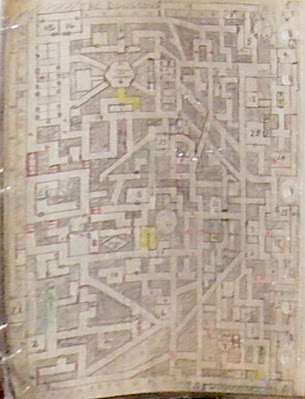
The design is interesting because it's a rare published example in Gary's early style of dungeons, as glimpsed in the tips in OD&D Vol 3, TSR's Dungeon Geomorphs and the unpublished levels of Castle Greyhawk (CG). In the '00s, Gary kept the original castle notes in a binder that he would use to run it at conventions, under OD&D rules, and a few of the levels were photographed by players of these games. The two most well-known images are of Levels 1 and 3, which I've included below for comparison (see also Visualizing Castle Greyhawk). On the whole, "Dungeon Delving" is closest in style to CG Level 3:


Castle Greyhawk Level 3 ("binder" version)


Below is a list of elements in "Dungeon Delving" that are found in Gygax's other dungeons. Note this list contains spoilers if you think you might ever play through Hall of Many Panes.

Diagonal Passages: In "Dungeon Delving" the central START area is an octagonal room similar in design to the hexagonal room in the northern half of Level 3 (see above). In each, a door leads out to a diagonal passage in four directions: NW, NE, SW, SE - essentially an X-shape with a room at the intersection.

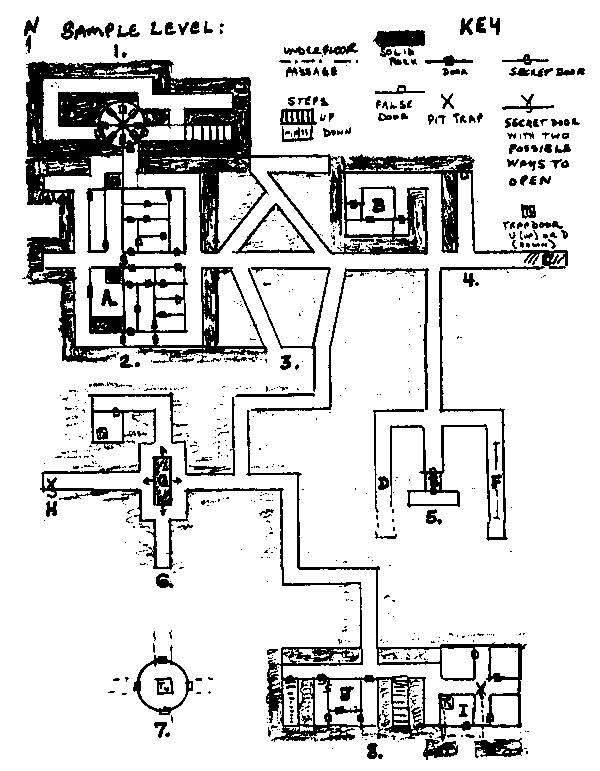
Gary's use of diagonal passages was first illustrated way back in the "Sample Level" in OD&D Vol 3; see Area 3 in the image further down this page. The note for this explained, "This area simply illustrates the use of slanting passages to help prevent players from accurately mapping a level (exact deviation from cardinal points is difficult for them to ascertain)."

His "Solo Dungeon Adventures" article in Strategic Review #1 (Spring 1975) is a close relative of these early dungeons, and was later reprinted as Appendix A: Random Dungeon Generation in the Dungeon Masters Guide. In this, Table III: Side Passages includes an entry that the "passage "X's" (if present passage is horizontal or vertical it forms a fifth passage into the "x")".

Diagonal passages and even a few "X-shaped" rooms can also be found in the Dungeon Geomorphs, originally published in 1976-1977, for example in Geomorph A from Set 1:


Geomorph A from Dungeon Geomorphs Set 1: Basic Dungeon (1976)


Room-Labyrinths: A prominent feature of the early dungeons are the maze-like series of empty rooms, which Gygax terms a "room-labyrinth" in OD&D Vol 3. Area 2 of the "Sample Level" illustrates this (see below), with the note stating, "This is a simple room-labyrinth, generally leading nowhere, but "[Room] A would be a room containing a monster and treasure". The section on "Distribution of Monsters and Treasures" further explains, "As a general rule there will be far more uninhabited space on a level than there will be space occupied by monsters, human or otherwise" (page 6). The random distribution instructions that follow give each room a 1-2 in 6 chance of having a monster, which means that on average 33% of the rooms will be occupied. 

The Dungeon Geomorphs are also chock-full of the room-labyrinths (see above). The original notes for the Dungeon Geomorphs restricted this even further: "Approximately 25% of the rooms and large spaces should contain monsters, treasures and other notable items. For every five such rooms there should be approximately one trap. Slanting passages, teleportation areas, slides and the like should be added sparingly thereafter -- one or two such items per level is a fair guideline".


Detail of the map from S1 Tomb of Horrors


Some other less filled-in Gygax dungeons have isolated room-labyrinths. The infamous Tomb of Horrors has a small room-labyrinth south of Area 8. One section of this leads to a false door concealing a spear trap (more on those below), and the other is a series of secret doors (Area 9) leading to the next area of the dungeon (Area 10). His last publication, Castle Zagyg, also has a room-labyrinth (Area 103) consisting of over 30 10' by 10' rooms with 50 (!) different doors, part of the defenses of his beloved Old Guard Kobolds.


Castle Greyhawk Level 1 ("binder" version)


Transporters: "Dungeon Delving" has three different two-way transporters; A1 & A2 are corridor/stair transporters, and B1/2 & B2/1 and B3/4 & B4/3 are two sets of room transporters. The L-shaped A1 & A2 transporters are in a style similar to those on the Level 1 CG map as pointed out by T. Foster here. 

Back in the Tricks and Traps section of OD&D Vol 3, the list of suggestions by Gygax include "Intra-level teleportation area, so that a player will be transported to a similar (or dissimilar area on the same level, possibly activated by touching some items (such as a gem, door, or the like)". The "Sample Level" in OD&D Vol 3 also includes two different examples of transporters, one a two-way room-based transporter, the other a one-way corridor transporter, although neither is explicitly "intra-level". See areas E and F below. 

Likewise, in the original notes for the Dungeon Geomorphs he suggests "putting in areas where those who entered are teleported to a similar spot elsewhere". Tomb of Horrors also has a number of teleporters.


The original version of the OD&D Vol 3 "Sample Level"


Pits: In "Dungeon Delving", the pits are marked with X's and are generally at intersections of corridors, similar to the example in the OD&D "Sample Level". See above, the "X" near Room I. The note for this states,  "Note the pit (X) at the four-way intersection containing a secret door on its south surface" (pg 5). The use of X's to marked covered pits became standard in D&D modules, at least for a time, for example the infamous pit in the Kobold lair in the Caves of Chaos.

The text for "Dungeon Delving" indicates that its pits are of three types, all 10' deep: an unboxed X to indicate an open pit, a boxed X to indicate a covered pit, and a boxed X with a cross-bar to indicate a covered pit with spikes at the bottom. I don't actually note any of the third type on the map itself, which suggests one of the mapping errors noted above.

Arrow/Spear Traps: An "A" on the "Dungeon Delving" map indicates an arrow trap that fires three arrows from the dungeon wall when the square is stepped on. Area 14 also has a more interesting variant on this. 

There are no arrow traps in the OD&D Sample Level, but the sample encounters for the Dungeon Geomorphs Set 1 have one that fires when a door is opened. Arrow and spear traps are part of the line-up in the Trick/Trap Table in "Solo Dungeon Adventures", and are part of the standard line-up in the trap tables in the Dungeon Masters Guide, including Appendix A: Random Dungeon Generation Tables and Appendix G: Traps. Tomb of Horrors has a number of door-triggered spear traps.

Cage Traps: A "C" on the map indicates a "cage trap" where "spike-ended bars fall from the ceiling above to enclose the exit(s) from the place". There are two of these, each opened differently. In the south, one side must be levered a foot off the floor to cause the bars to raise. In the north, a trapped lever near the cage must be pulled to raise it.

OD&D Vol 3 mentions a "return passage blocked by bars", although no other details are given. Appendix G: Traps in the Dungeon Masters Guide includes "Passage, blocked by falling bars". Most famously, the Moat House dungeon in the Village of Hommlet has a hidden grate that will fall to block the exit when a false door is pulled open; it can be raised by use of a hidden winch.

Sloping Passages: Along the NE edge of "Dungeon Delving" is a passage that "slopes up going north 300 feet, so as to bring those traversing it back to the normal level of surrounding dungeon without noticing the incline. Going south the slope is downwards, so as to require the flight of steps up to regain the level of the dungeon proper". This means that if approached from the north, the steps will appear to lead up a level, and if approached from the south, the steps will appear to lead down a level. This is straight out of OD&D Vol 3, which suggests, "Steps which lead to a slanting passage, so the player may actually stay on the same level..." The reverse is also suggested in the Sample Level, where "D" indicates a passage to a lower level with such a gentle slope that "even dwarves won't recognize it".

Carved Face: Area 14 also has a "huge leering face chiseled into the stone wall", reminiscent of other Gygaxian carved faces, including the "great bas-relief face" in the Tricks and Traps list of the Greyhawk Supplement, and of course the Face of the Great Green Devil in the Tomb of Horrors.

Weird Statues: In Dungeon Delving, the START area also has nine statues, a number that reminds me of the infamous room in CG with nine statues - actually imprisoned demigods, later freed by Robilar. The statues here do not similarly house prisoners, but are important to solving the dungeon level. The use of weird statues was suggested in several of the "Trick and Traps: (Additions)" found in the Greyhawk Supplement.

Evil Human Lair with Escape Route: Room 17 of "Dungeon Delving" is called the "Jolly Priest" and is home to an evil priest masquerading as good, ala the "jovial priest" in the Keep on the Borderlands. The description includes his plans for escape via a secret door and nearby passages, which is another design element Gygax often included in his dungeons. 

In the note for Area 8 of the OD&D Sample Level, "The western portion contains the room of some evil man [Room J], complete with two secret doors for handy escape". Likewise, the evil priest in the Caves of Chaos has a secret escape door from his chamber in Area K. And in the evocative yet incomplete DMG Sample Dungeon, the Wandering Monster Table indicates an evil cleric lairs in Areas 35-37, which contain two concealed doors - presumably an escape route.

See also: Gygax's Playtest Reports for the "Dungeon Delving" Level from HoMP

Monday, September 26, 2011

Green Dragon Inn, pt II


As a follow up to last week's post on the Green Dragon Inn mentioned in the Blue Book, I spent a little time looking in to the publication history of the Green Dragon in Greyhawk, which I'd read was owned at one point by Robilar, PC of Rob Kuntz.

As it turns out there is far less material on Greyhawk's Green Dragon than I had thought. While it apparently goes back to 1972 in the original Greyhawk campaign, it barely made it into print by TSR. This Dragonsfoot thread indicates that the first print reference to this Green Dragon was in the Official AD&D Coloring Album from 1979. I have a copy of this, so I pulled it out to see what it said:

"Here at the Green Dragon, a busy inn in a town on the shores of the Lake of Unknown Depths, a group of adventurers have met to plan a daring expedition in search of a fabulous treasure. They sit at an outside table, quaffing amber ale and charting their course to wealth beyond belief ... The innkeeper, his wife and the stableboy are all busy caring for the wants of the adventurers, for they known the party will soon set forth on their quest  - possibly to return loaded with bright gold!"

That's about it, other than the accompanying picture (see above) by Greg Irons, who illustrated the entire album in fantastic detail. See more pictures from it here.

I found a "Green Dragon Tavern" in Dragon #37 (May 1980), but it's actually yet another one, found in a town in the module The Pit of the Oracle by Stephen Sullivan. What's ironic is that this same issue has a Sorcerer's Scroll column where Gygax states that "The City of Greyhawk might make a 1981 publication date, certainly 1982, and about the same time  the series which will eventually represent the whole of the Dungeons of Castle Greyhawk will begin" and further provides information on Robilar (and other Greyhawk notables), but without mention of the Green Dragon.

I also have Artifact of Evil (1986, TSR), which is a Gord the Rogue novel by Gygax, where the Green Dragon is the location of a brief meeting between Gord and his druid friend, Curly Greenleaf. The "Green Dragon Inn" is described as "a place frequented by foreigners, mercenaries, tough adventurers, and others of less savory aspect" (pg 35). There's another appearance in Night Arrant, a later Gord novel published after Gygax left TSR that I don't have a copy of.

So it appears that most of what is now known about the original Greyhawk Green Dragon is from much more recent interviews and columns. Holmes' Green Dragon was first mentioned in the Blue Book, which was published in the Fall 1977. While it is possible he heard of the Greyhawk Green Dragon directly from Gygax or others at TSR, it is more likely a separate creation with a name inspired by Tolkien's Green Dragon in the Shire.

Wednesday, January 22, 2014

The Land of the Great Kingdom and Environs

If you haven't seen it yet, check out the video by Jon Peterson (author of Playing at the World) highlighting some awesome pre-D&D treasures from his collection:

"History of D&D in 12 Treasures"

Item #5 is a map, labeled in the video as "Great Kingdom Map, Gary Gygax, 1971, Territories of the Great Kingdom". In the accompanying post he further describes it as  "showing Blackmoor and other Castle & Crusade Society holdings". In the video Jon gives us several glimpses of the map that show a number of familiar kingdom names from the published World of Greyhawk, 1980.


An earlier version of this map, originally published in Domesday Book #9, appeared in Jon's book in 2012. This map has some geographical features named but is mostly missing the names of kingdoms. However, at the time I noticed that Dave Arneson's hand drawn map of Blackmoor from the First Fantasy Campaign (1977) matched a portion of the Great Kingdom Map. Combining the information from the two, I posted ("The Weird Enclave of Blackmoor") an annotated map with speculative locations of Blackmoor and Greyhawk:


Now, thanks to the glimpses of the "new" map that Jon has shown us in his video, I see that I was basically correct in the locations for Blackmoor, the Egg of Coot, the Duchy of Ten and The Great Kingdom, each of which is named in this map.

While the outlines and geographical features of the "new" Great Kingdom map are not identical to the previous one, they are close enough to roughly transpose the kingdom names back on to the mostly blank original map: 


Observations:

-Obviously, many changes were made when this world was later adapted as the World of Greyhawk in 1980, but it is striking how many familiar names appear in familiar locations. 

-Perunland is between the mountains to the northwest of Nir Dyv lake, as with Perrenland in the published Greyhawk map. 

-A Paynim Kingdom is further to the northwest, south of the Far Ocean. In the published Greyhawk this becomes the Plains of the Paynims, south of the Dramidj Ocean.

-The Hold of Iron Hand, north of the Paynim Kingdom on the Great Kingdom map, likely became the Hold of Stonefist. In published Greyhawk it is not anywhere near the Paynims, instead being at the western base of a northwestern peninsula in the same position relative to the Barbarian Kingdoms. Gygax seems to have split the northern areas of his Great Kingdom map, putting the the Hold and the Barbarian kingdoms on a great peninsula to the northeast, and leaving Perrenland, the Paynims and Blackmoor in the northwest.

-A Grand Duchy of Urnst is to the immediate southeast of Nir Dyv lake, as in the published World of Greyhawk. A Kingdom of Catmelun is to the southwest of this, possibly where the Kingdom of Nyrond is in the published version.

-A Grand Duchy of Geoff is to the west near the mountains, as in published Greyhawk.

-Where the City of Greyhawk should be, there's C. of Yerocundy [sp?] and to the west, a Kingdom of Faraz. There is the possibility that these two were combined to form the Kingdom of Furyondy, which in published Greyhawk is to the west of the lake like Faraz.

Interestingly, Andre Norton's 1978 Greyhawk novel, Quag Keep, uses similar but not identical names for two kingdoms:
 
"We shall have Yerocunby and Faraaz facing us at the border. But then the river will lead us straight into the mountains" (Chapter 6). 

-A Duchy of Maritz [sp?] also appears as an island on the Great Kingdom map. 

Quag Keep further mentions:

"In addition he saw a dozen of these silver, halfmoon circles coined in Faraaz, and two of the mother-of-pearl discs incised with the fierce head of a sea-serpent which came from the island Duchy of Maritiz" (Chapter 3)

This warrants a closer look at the geography mentioned in Quag Keep versus the Great Kingdom map. Andre Norton consulted with Gygax in writing Quag Keep so she possibly saw an earlier version of Greyhawk using these names.

-Neron March (possibly "Nekon") might possibly be a predecessor of "Gran March".

-In the comments Jon mentions Walworth north of the lake and that In published Greyhawk The Shield Lands appear in the same location and are ruled by the Earl of Walworth. In the video, Jon mentions that Gygax was named the Earl of Walworth in Domesday Book #2, and Walworth represents his holdings in the game (and is also the name of the county that Lake Geneva is in, in Wisconsin).

-I left out material from the map in the video that I couldn't read, and several small areas around Blackmoor that don't seem to correspond to anything significant: March Slove, County of Celate and County of Stabilny. 

-The title of this post references the Foreword to the original D&D Set, also reprinted in Holmes Basic:

"From the map of the "land" of the "Great Kingdom" and environs - the territory of the C&C Society - Dave located a nice bog where to nest the weird enclave of "Blackmoor", a spot between the "Great Kingdom" and the fearsome "Egg of Coot"".