This is the blog. Click here to go to the Zenopus Archives website.

Note: Many older posts on this blog are missing images, but can be viewed at the corresponding page in the Internet Archive

FEATURED POST

The Forgotten Smugglers' Cave: Index of Posts

An index of posts describing the Forgotten Smugglers' Cave, an adventure for Holmes Basic characters levels 2-4.                    ...

Tuesday, February 27, 2018

Warlock influenced Chivalry & Sorcery


A new thread on Dragonsfoot asking about Chevalier led to a reply linking a 2013 post on the Castelli & Chimere blog that I vaguely remember. Chevalier is the original, unpublished version of Chivalry & Sorcery that is an original D&D variant rather than a stand-alone game. The story goes that Ed Simbalist and Wilf Backhaus brought this manuscript to Gen Con with the idea of selling it to TSR, but ended up instead selling it to FGU, where it was published with further revision as Chivalry & Sorcery in 1977. A very limited reprint of the Chevalier manuscript was made by the authors in 1999, from which a few scans are shown on the C&C blog, including the "Forward" shown above, the title of which reproduces the font and mispelling found in Men & Magic (Vol 1 of OD&D).

What I didn't notice previously was the role of Warlock - the 1975 OD&D variant from Caltech - in the development of Chevalier. I've written previously about Warlock and its influence on Holmes Basic; for a general overview see the post "WARLOCK or how to play D&D without playing D&D?" and for other articles mentioning it click the Warlock label at the bottom of this post.

Ed Simbalist writes not only that "Warlock gave further ideas. And Petal Throne presented the concept of an integrated world" but also that "CHEVALIER is not intended to be a replacement for Dungeons and Dragons. Indeed, to play CHEVALIER, one requries at least the three D&D volumes and the Greyhawk Supplement. The other supplements make playing even more complete. If one throws in Warlock for good measure, the picture becomes complete. However, CHEVALIER changed a good many of the rules and, and the prospective player is forewarned to read very, very carefully."

The Introduction to the original Warlock made a similar statement that it is "not intended to replace D&D, nor is it intended in any way to interfere with it". Both games went on to develop their own complete systems, with C&S in 1977 and the Complete Warlock books in 1978-1980.

Furthermore, I can see some specific influences of Warlock in the scans posted on the posted scans in that blog article.

The Elf advancement table is formatted similarly to the one in Warlock and the Fatigue dice are pretty close to the Hit Dice for Elves in the original 1975 Warlock rules.

The M-U spell list includes not just spells from OD&D but also ones original to Warlock.
From the portion shown:
1st level: Match, Silence (as a 1st level spell), Sound Amplification, Telescope
2nd level: Awaken (one of the Holmes A&E stories has this on a scroll), Create Sound, Detect Experience [Group], Detect Evil/Good (as separate 2nd level spells), Freeze Water, Hallucination, Measure Distance, Measure Volume

3rd level: Ball Lightning, Cone Cold, Continual Darkness, Dark Cone, Detect Clairvoyance, Detect Clairaudience, Detect Teleport, Heat Cone, Illusion I, Light Beam

I don't have the 1st edition of Chivalry & Sorcery for further comparison, but I imagine much of this was changed by the time it saw print in 1977. Even so, it's clear that Warlock provided a template for Simbalist and Backhaus in assembling their own D&D variant, an important step in developing the game that eventually led to C&S.

See also: 

Saturday, February 17, 2018

Holmes Basic at DunDraCon 2018


This weekend is the 42nd DunDraCon, the long running convention in the San Francisco area. For the second year in a row, a DM is running Beyond the Door to Monster Mountain, a Holmes Basic mini-scenario available on the Zenopus Archives site. The scenario is being run twice, once at 10 AM and once at 2 PM, and is family/kid-friendly. See the convention listings here. 

The DM also started a thread about the game on ODD74, where he wrote:

"I will be running this great module with a few added encounters back to back Sunday Feb 18th at DunDraCon here on the left coast. The module by Zach is loads of fun for kids and adults alike and I run it in the room (along with my [wife's] help) with a horde of kids and young at heart in the children's room at the convention. Last year I had just as many adults as kids but it was a hoot. I hope to see some of you there as we celebrate 40 years of Holmes!

Based on attendance this time, if there are slots open, I will allow players to participate in both sessions. Maybe even leveling up!"

For those interested in the history of Dundracon, their website has a great pdf archive of past Dundracon programs going back to Dundracon III, President's Day weekend, 1978.
Here's the cover from the program for DunDraCon IV, 1979 (the cover has a typo which was hand-corrected):


Wednesday, February 7, 2018

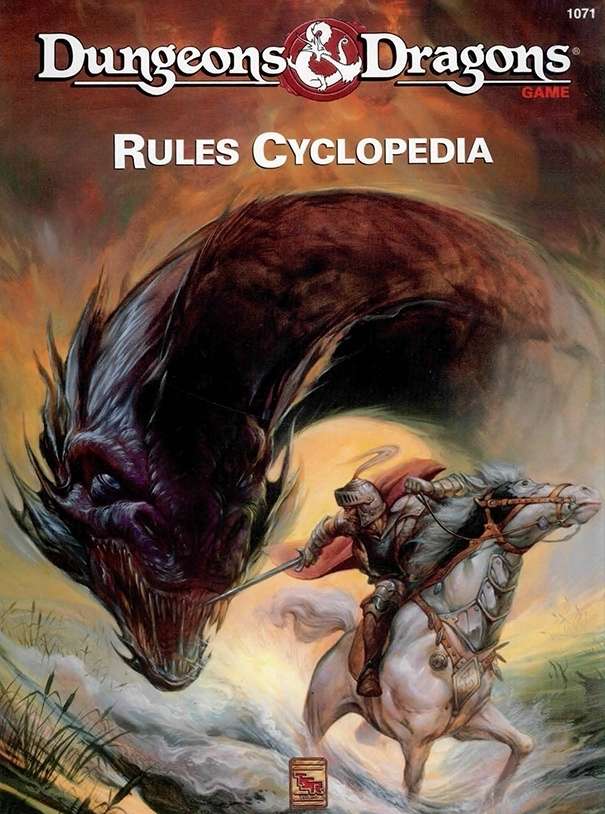
Rules Cyclopedia now available in print


The Rules Cyclopedia is now available in print-on-demand!

RPGnow link: Rules Cyclopedia 
DriveThruRPG link: Rules Cyclopedia 

The links include this blog's affiliate #, which gives a store credit of 5% of the price.

Published in 1991 by TSR, the Rules Cyclopedia was the culmination of the Basic/Classic line developed from J. Eric Holmes' work in 1977. Holmes is thanked in the Acknowledgements, along with the many other editors and authors who worked on the line, as the "Cyclopedia has also been drawn from the works and benefitted from the input of the following people". 

The Cyclopedia incorporates the entire 36 character levels developed in the BECMI (Basic-Expert-Companion-Masters-Immortals) line by Frank Mentzer as well as some rules from the Gazetteer series into a single hardcover rulebook of approximately 300 pages. The price of original copies has steadily risen to near $100 in recent years, so the print-on-demand option is welcome for those that wish affordable copies for actual use in play.

The rules remain highly compatible with the Original D&D line, so this book could easily be used as an expansion to Holmes Basic if you wish to have 36 character levels. The major difference is the ability scores, which use the bell-curve of bonuses developed by Tom Moldvay in the 1981 Basic rulebook revision. The "Full-Size Preview" link (shown above) on the page shows off a few of the early pages, including the Table of Contents if you want to see the scope of the material in the book.

While this is great news from a legacy point-of-view, I'll use this moment to point out that they still don't have a Holmes Basic pdf or print-on-demand available. It's a gaping maw in their catalog!

Tuesday, January 30, 2018

Into the Borderlands for Pre-Order


The new project from Goodman Games, Into the Borderlands, is now available for pre-order, per an announcement on their site a few days ago. This compilation includes reprints of the Holmes Basic versions of the modules B1 In Search of the Unknown and B2 The Keep on the Borderlands, along with the later B/X versions and new 5E conversions, plus other material. 

The format is hardcover and in a standard 8.5 by 11 inch size, as opposed to their oversized Metamorphosis Alpha and Judges Guild books. A whopping 384 pages, some of that due to 5E stat bloat as they admit in the FAQ. $49.99, and there will also be a PDF option eventually.

One interesting detail is that this is labeled "Original Adventures Reincarnated #1" on the order page and in the upper left corner of the book - see the yellow banner and the circled 1. This implies there will be further projects in this series.

Direct link to pre-order page

Tuesday, January 16, 2018

Maze of Peril Ch 1, Scene 4: "Tromping Through the Wilderness"

This post is part of the Tales of Peril Book Club, indexed here.

This is the first scene in the novel that takes place outside of the Green Dragon. The story skips ahead past "three days of tromping through the wilderness", as Zereth puts it, and shows how the party finally locates the entrance to the Underworld that Murray has heard of. As Holmes wrote in the Basic rulebook, "Many gamesters start with a trip across country to get to the entrance to the dungeon" (Personally, I'd love if we all started using the term "gamesters" more often).

The scene begins in a forest clearing on a cold, misty morning, where the party has resumed their so-far fruitless search. In addition to Boinger, Zereth, Bardan, and Murray, the party includes two "hired men-at-arms" (see descriptions below), horses and a pack mule carrying tools, including a shovel (a tool not found in the OD&D/Holmes equipment lists, but which we could add). These additions are the results of the planning at the Green Dragon in the previous scene, where "horse power" and "mercenary men-at-arms" were discussed, among other topics. Holmes' first-ever published D&D article described his rules for generating such men-at-arms; see "Warrior-for-Hire", which appeared Alarums & Excursions in early 1976. Also, in the introduction to the Zenopus dungeon in the Basic rulebook, Holmes recommends that a small party employ "one or more men-at-arms". 

Here we see Murray in action for the first time; at the Green Dragon he was an unseen observer. The first impression is of a prickly personality. Murray grumbles about the weather, snaps at his companions, and grunts an angry reply at Zereth when teased.

The party works together well to find the entrance. Murray identifies the clearing to search, a man-at-arms finds a stone of interest, Boinger locates a stone slab under the soil, the men-at-arms clear a ten-foot-square area off this slab, Bardan identifies a hollow beneath the stone, and finally Zereth finds a door in the slab.

We learn that Boinger wears sandals in town "to protect his feet from the grime and much of the town roads", but not in the forest where he likes to feel the leaves under his bare toes. Barefoot, he works "his way through the brush", feeling "a change in the consistency of the ground underfoot", which he describes as "hard and smooth just under the dirt". This speaks to an otherwise undescribed ability for halflings in D&D: detection by foot. I'm giving this skill to all halflings from now on.

Bardan identifies a hollow space under the granite, in line with the standard dwarven abilities given in OD&D Vol 1, which include noting "slanting passages, traps, shifting walls and new construction in underground settings". There's a similar dwarf-elf 1-2 in the Example of Play in the Holmes Basic rulebook, where the dwarf says, "There's a hollow space under the floor here somewhere", and then the elf is sent to check for a trap door.

Zereth examines the slab intently, as if performing a standard D&D check for secret doors, but he also has a "faint blue glow" emanating from his palms. It's unclear whether he has cast a spell (Knock or some sort of Detection?) or if this is just Holmes' way of describing the innate elvish ability to find secret doors (which in OD&D is twice as often as humans). In the first scene of this chapter we saw a similar blue glow emanate from Zereth's hand when he heated Boinger's drink to demonstrate his magical powers.

While Zereth searches Boinger and Bardan whisper wagers on which disturbed earthworm will re-bury itself first; this is a nice moment showing the camaraderie between the two.

Eventually Zereth touches an "individual depression" and the stone splits and opens to reveal a ten-foot hole, exposing a stone stair leading down. An entrance to the Underworld, as promised by the chapter title, "Entrances".

The scene ends with Murray urging everyone to "prepare for the descent". In the next scene, the party will finally enter the legendary Underworld.

Descriptions:

Murray: Wears a blue robe, which is the same color as the wizard on the cover of the Holmes Basic set. He has a four foot long staff that he keeps in a "duffle" while riding his horse.

Men-At-Arms: Both are brawny, at least one is tall, and one is named Olaf. More on that name later.

Boinger: As noted above, he wears sandals in town or on roads, but goes barefoot in the forest.

Friday, January 12, 2018

Gary Con X Games Scheduled


Update: I had to cancel my attendance at Gary Con due to attend the funeral of a relative, but I ran the same scenario later in the year in June at North Texas RPG Con.

Last week I was notified that my approved game for Gary Con X (March 8-11, 2018) has been scheduled (two sessions). Event sign-up starts tomorrow for the highest badge level (Diamond), with the other badges levels following on successive weeks until February 3rd for the Silver general admission badge, which is what I have. Last year I didn't even register for a badge until after that date and still found plenty of great games to play in.

I'll be running the Return to the Tower of Zenopus twice (see description below), once on Friday from 9AM-1PM in Forum AB, and once on Saturday at the same time and location. 

Forum AB is apparently part of the Forum Convention Center, which is being used for the first time at Gary Con, and is on the opposite side of the convention center from the rest of the games (but much closer to where many of the rooms are, including my room last year). There are 37 pages of games scheduled for this room, so that's about 370 games scheduled for this new location. See the pdf map of the venue, the Grand Geneva Resort, which was same location of Gen Con X back in August of 1977 and the Holmes Basic was the new TSR release of the summer.

Links of interest:
Gary Con website
Gary Con forums General Discussion
Badge Registration
Full Schedule of Events (searchable)
Grand Geneva Resort website
Gary Con Facebook Group (public)
OD&D Discussion thread
Dragonsfoot thread
Knights & Knaves Alehouse thread


* * * * *

Return to the Tower of Zenopus

Forty years ago adventurers first braved the dungeon under the ruined tower of the wizard Zenopus. Fearsome monsters were overcome and fabulous treasure recovered, but the doom of Zenopus was never revealed. The stairway leading down to the dangerous passages was eventually bricked over by order of Lady Lemunda, current ruler of prosperous Portown. However, recently your party uncovered a previously unknown means of entry. What secrets remain to be discovered in the old dungeons? Meet at the Green Dragon Inn and adventure as Boinger, Zereth, Murray or another character from J. Eric Holmes' stories (pre-generated characters will be provided). This adventure from the Zenopus Archives celebrates the 40th anniversary of the Holmes Basic D&D set.

Wednesday, December 27, 2017

Return of the Fantasy Trip


"At the beginning of my career, long before GURPS, I created a roleplaying game called The Fantasy Trip. For decades, the rights have been held by Metagaming, a publisher which is no longer in operation. I'm very pleased to announce that I have regained the eight TFT releases that I wrote myself: Melee, Wizard, Death Test, Death Test 2, Advanced Melee, Advanced Wizard, In the Labyrinth, and Tollenkar's Lair.

This is just an initial announcement, to invite you to celebrate with me a day that has been a long time coming!

I have no idea yet about release schedules. I will probably have to answer most questions with "I don't know yet" - but feel free to use the button below to go to the forum discussion of this post, and try me . . . or just share memories of the game!" (links added by myself)

In his 1981 book Fantasy Role-Playing Games, J. Eric Holmes reviewed the first two releases of this system, Melee and Wizard (pictured above), writing that the combat rules, "may be too slow for some players, but they have an air of authenticity which is lacking in the simpler combat systems" (pg 114).

Holmes further notes that, "I have used the "roll less than your dexterity (strength)" system in the practice game earlier in this book". This refers to the sample RPG system that Holmes provides in the book to show how the games work, along with an adventure for it, the Dungeon of Arzaz. While Melee used the 3d6 roll for combat, Holmes instead uses it for a system of "feats" - i.e., "feats of strength", "feats of dexterity" etc, that is more like an ability score check of later D&D. (Holmes uses a Chainmail-like 2d6 roll for combat)

You can read more about "Holmes' Other Game" in a thread from 2009 on ODD74. 

I've also written before about the appearance of the 3d6-roll-under-stat check in early D&D, which actually predates Melee as an isolated mechanic, but not as a generalized system.

As to myself, I've never owned or read Melee, Wizard or the Fantasy Trip, so I will be looking forward to any reissues of the original material that Steve Jackson puts out. Per his post here, a Kickstarter for a reissue of Melee may be the first project.