This is the blog. Click
here to go to the Zenopus Archives website.
Note: Many older posts on this blog are missing images, but can be viewed at the corresponding page in the Internet Archive
FEATURED POST
The Forgotten Smugglers' Cave: Index of Posts
An index of posts describing the Forgotten Smugglers' Cave, an adventure for Holmes Basic characters levels 2-4. ...
Monday, April 6, 2020
Holmes Portrait by David Crawford
A fantastic portrait of Dr. Holmes in an imagined study drawn by fan David Crawford!
David posted it to the Holmes Basic Facebook group last week and gave me permission to share it here. He wrote: "A little sketch in tribute to J. Eric Holmes, depicted here as a wizard (Zenopus himself?!?) in study."
Holmes studies a tome on his desk, while before him "is the ruined tower of ZENOPUS in the crystal ball". Behind him, a skull sits on one shelf of a large bookcase filled with books.
It really captures his likeness, and the black ink line art is reminiscent of David Sutherland's work in the late '70s. I can imagine this piece appearing with Holmes bio in the Basic rulebook.
Thank you, David, for making this.
Friday, April 3, 2020
Don Turnbull on the Zenopus Sample Dungeon as "Coherent" dungeon design
THE PHOENIX (later just PHOENIX) was "A British Board Wargamers Magazine" published by SimPubs, a UK affiliate of the company SPI, from 1976 until 1982 (36 issues total, which are available here on spigames.net). As Dungeons & Dragons ramped up popularity during the era of Holmes Basic, Don Turnbull wrote a semi-regular column for this magazine called "D&D: Notes from the Underworld" (likely a play on Dostoyevsky's Notes from the Underground). It started in issue #15 and ran for eight installments, with the last in issue #26 July/August 1980. An editor's note at the top of his first column indicates that his column will serve to introduce D&D to wargamers:
"I am pleased to welcome Don to these pages. Without much fear of contradiction I can say that he is one of the small band that first really brought boardgaming to our shores in the far off halcyon days of Poultron Press [an early name for SPI — Z]. His deep experience of the hobby is reflected in anything that he turns his hands to - D & D is no exception. It his hoped that his regular articles on this and other games of a similar nature will enable us all to appreciate what some amongst use are wont to call 'unreal wargames'! Note his comments on feedback — we are waiting!"
Don Turnbull (1937-2003) started his career in gaming by publishing a Diplomacy zine, Albion. He was an early D&D enthusiast in the UK, running an OD&D megadungeon named the Greenlands (after the street where he lived), a few sections of which were published in White Dwarf and Dragon magazines. He rose to prominence in RPG circles working for White Dwarf, writing reviews and editing the Fiend Factory column compiling new monsters by various contributors, which he later turned into the Fiend Folio (1981). He went on to run TSR UK, publishing Imagine, the UK analog of Dragon magazine, to which also contributed a regular column. During this period he co-wrote TSR's classic U1-3 series of modules with Dave J. Browne and oversaw the UK module series. He next worked with Gary Gygax in his ill-fated post-TSR company New Infinities Productions. He continued to run D&D games - set in Greyhawk's County of Urnst - for his friends until he passed away in 2003 at the age of 66.
A photo of Don at Games Day III (17 Dec 1977) with the new UK printing of the Holmes Basic set appeared in White Dwarf #5 (Feb/March '78):
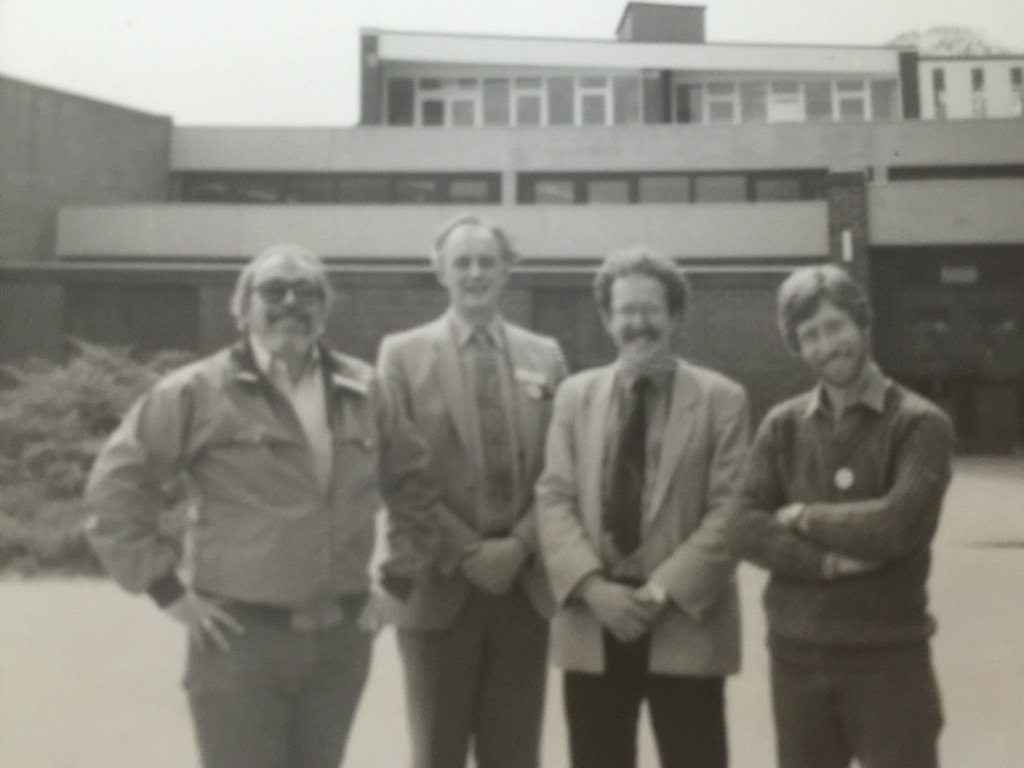
In 2016, Ian Livingstone of Games Workshop posted on Twitter a photo of Gary Gygax, Turnbull, himself and Steve Jackson (the UK one) in 1979:
The second installment of his column for the Phoenix (in issue #16, Nov/Dec 1978), is devoted to dungeon design, including distinguishing what he describes as "incoherent" and "coherent" designs, and the strengths and weaknesses of each. As an example of "coherent" design he cites a certain dungeon very familiar to us:
"The coherent design requires much more initial work. First the DM must invent a rationale for the design — give the dungeon a history and provide reasons why it should be more or less as it is. The new edition of the TSR rules [the Holmes Basic set — Z] contains a good example — the cellars and tunnels beneath a sorceror's tower which, since the mysterious death of its architect, are rumored to contain fabulous treasure and unspeakable monsters. Such a rationale might be made available to the players, int he form of local legend perhaps, before their characters can penetrate the dungeon; or it might simply serve as the DM's private source of design ideas.
Of course, the coherent style is far from convergent: there will almost certainly be elements of incoherence within it. In the TSR example, the sorceror's tower will have some areas of random or near-random occupancy — who can tell what monsters have made their lairs in its myriad passages and rooms? Was the death of the sorceror caused by an invading party of monsters in the first place? There is plenty of room for flexibility here.
Once the 'history' has been devised, the design flows from it, and in my limited experience designing comes somewhat easier at this stage than in the incoherent style. In the TSR example, the sorceror would have had sleeping quarters, a study and/or laboratory, a trophy room perhaps, a library, some servants' quarters, a dungeon in which he used to incarcerate potential victims of his experiments etc. Some of his personal possessions (scrolls, magic books, artifacts) might have survived if they were carefully hidden. His faithful manservant may even still be doddering around wondering what has happened to his master but determined to keep the place tidy in readiness for his master's return. The trouble with coherent designs is that they tend to be limited in the physical sense. Even if the sorceror had created a large 'lair' it won't take long for a visiting party to ransack the place. If a designer is to create a setting large enough to keep his players occupied for a long series of adventures, he must thing bigger than this. Nor, in the end, will he be able to get by with a sorceror's tower here, an Orc stronghold there, a Dragon's nest in the interior of the hill, and Undead area below the local burial ground and the like. Sooner or later, in connecting all these parts to form a whole, he will come to the point at which the coherence drifts away — he may even come to a point at which his imagination refuses to conjure up another rationale."
There are interesting ideas here for expanding the Sample Dungeon, some of which I've touched on myself over the years:
-Invading monsters, still in the dungeon, presumably on a lower level "where Zenopus met his doom". Possibilities that come to my mind include Holmes' Dagonites (analogs of the Deep Ones), Ancient Builders, Lovecraft's Mi-Go (which I call Whisperers), D&D's Troglodytes, or some kind of Green Flame manifestation, which I used in the d12 Hauntings of the Zenopus Dungeon.
-Living quarters for Zenopus such as a bedroom, study, laboratory, trophy room (B1 In Search of the Unknown has one of these), library, servants' quarters, and/or prisoner dungeon. Some of these would more likely have been in his destroyed tower, but it does give some possible ideas for filling in some of the empty areas in the basement, or for a modified adventure set closer to the disappearance of Zenopus when the tower was still intact.
-A hidden cache of wizardly possessions. Along this line, when I've run the original I've placed an old "Storage Room" in the empty room south of Room J (the Spider's Lair), which I've been meaning to write up here for quite a while.
-A former servant of Zenopus still wandering about, waiting for his return; I especially like this one, although it is more logical with an adventure set closer to the disappearance of Zenopus before the tower was destroyed by the town. The intro to the dungeon mentions that some of his servants escaped the immolation of the tower and I used one as a source of a rumor in Portown rumors. I also placed a former creation of Zenopus as one of the wandering monsters in my 5e adaptation of the dungeon, and have former familiars (the "goblin figures") in the aforementioned d12 Hauntings.
Turnbull's later U series of adventures is a logical extension of his idea of coherent dungeon design. And the haunted house in the first module, U1 The Sinister Secret of Saltmarsh certainly has some similarities with Holmes' Sample Dungeon, such as a missing "wizard" and an underground connection to sea caves harboring smugglers. Thus, the development of the U-series appears to have been influenced by Turnbull's earlier encounter with the Sample Dungeon in the Holmes Basic set and his view of it as a strong example of "Coherent" dungeon design.
Labels:
Sample Dungeon,
TSR UK,
Turnbull,
White Dwarf
Wednesday, April 1, 2020
Holmes Ref: Equipment Sheet
Here is a new reference sheet for Holmes Ref, an expanded Equipment List:
EQUIPMENT REFERENCE SHEET (single-sheet pdf)
This is something I started working on a while back, put aside, and just came back to last week and finished.
If you are not familiar with Holmes Ref, it's my slowly-accumulating series of reference sheets for Holmes Basic referees. The full set of Holmes Ref sheets & compilations can be found here.
Notes on the Equipment Sheet:
-It's written up like a catalog or menu that adventurers might actually read in game. The equipment is divided up by shop to provide a bit more of a generic town setting if you wish to roleplaying purchasing equipment, either before character creation or later during play.
-Each list is also numbered so it can be used to roll for random items, for instance to generate mundane items found in a dungeon, for example on the corpse of an unlucky adventurer...
-Sources include the Holmes Basic equipment list, the OD&D list (which is the same except for including some larger ships and lacking Tinderbox) and the Keep in the Holmes Basic module B2 The Keep on the Borderlands. The Specialist section of OD&D, Vol 3, provides the names for the Armorer, Smith and Sage and B2 provides the names for the Provisioner, Chapel, and Loan Bank as well as prices for the Inn & Tavern and Loan Bank.
-The weapon shop list preserves the original Chainmail weapon classes in order (1-12), which generally correspond to length.
-The general store list ("The Provisioner") includes an equipment pack ("Basic Explorer Pack") as number #11 that includes each of items #1-10 for 35 GP. For a quick start, just have your character grab this pack plus armor and weapons.
Thursday, March 26, 2020
Gary Con XII Goes Virtual!
Gary Con XII has gone virtual due to COVID-19!
It starts today, March 26th and runs through Sunday March 29th.
Tabletop Events has a completely separate site for Virtual Gary Con, and badges are free to all, even if you weren't signed up for the physical con. There are over 650 events on the schedule (mostly RPG, but also including seminars and other group events), and at least 230 of those still have seats available. And you can still sign up for games. The Gary Con Facebook Group is probably the most active site to check in to see what's going on during the con.
Before last weekend, I had never played on-line, let alone GM'd a game, so I didn't feel comfortable signing up to run one of my previously scheduled games for VGC. But I am signed up to play in a bunch of games using a variety of formats (Roll20, Astral Tabletop, Zoom, Discord, Google Hangouts, Skype), so I am using this as opportunity to learn so I will be able run a game this way in the future.
Last Saturday night I played in a game in Roll20 for the first time. This was run by Scott of my local group, playtesting a game for Virtual Gary Con, "Scooby Doo and the Ghost of Vault 74", a Scooby/Fallout mashup run using Savage Worlds rules. I played Scoob himself. I had to learn a lot of Roll20 technical details, but overall I found it worked very well and enjoyed the session. Scott put a lot of effort into making a fun map for us to interact with. We used the audio/video in the game rather than a separate program, which worked well enough for me. The screenshot below is the welcome screen (from post-session, I didn't think to capture a shot during the game and I wouldn't want to spoil any of it anyway).
See you at the con!
Thursday, March 19, 2020
The Ruined Tower of Zenopus Adaptation by An Abominable Fancy
Joel Priddy over at An Abominable Fancy has a great series of posts on his adaptation of The Ruined Tower of Zenopus to his own game world!
Here is an excerpt:
"Portown becomes Bandar Arzoo, an outpost of Parsas, the pseudo-Persia of my campaign. Built on the ruins of an ancient city, the base of most of the buildings are large blocks of milky-white rock, fitted without mortar, remnants from the ruin. The town's master is a badly-mutilated Rakshasa in magical disguise, bidding his time being devilishly charming and enjoying what luxuries his position affords until he is sufficiently recovered to cause some real trouble.
The Green Dragon Inn becomes Tennin Ad-ham, which serves a spiked wine called The Mother of All Evils.
Zenopus' tower is called Tabah, the ruin, by those who don't recall the story of Zenopus, and the Thaumaturgist's tower is Beda-At, the new tower."
Here are links to the six parts; the last also has links back to all of them:
Nutshell Review & Prep Notes Part One: Room A
Part Two: Rooms B-E
Part Three: Rooms F & G
Part Four: Rooms H-M
Part Five: Rooms N-S3
Part Six: Wandering Monsters
Thank you, Joel!
Product Link:
The Ruined Tower of Zenopus on DMs Guild
Monday, March 16, 2020
In Search of the Brazen Head of Scrum Con
![]() | |
|
In seems incredible that Scrum Con 2020 was only two-and-half-weeks ago, in those halcyon pre-pandemic days.
In my Post-Op report I said I would write more about the game I ran, which was a session of In Search of the Brazen Head of Zenopus. The con program listing is shown above, with great Brazen Head art by John of the of the 1000 Foot General. It was scheduled to be at Table 14 in the Spring Room, but the game was actually ran in the upstairs Fenton room at the Civic Center; see the "dungeon map" of the site in this post.
This scenario is a sequel to the original Zenopus dungeon, set forty years later and using Holmes' characters from the Maze of Peril as pre-gens.
IIRC, this was the fifth time that I have run this scenario. The four earlier occasions were: an initial playtest with my Local Group; a first con run at North Texas RPG Con in 2018 (with Chris Holmes playing!; pictures by players are here (Allan G.) and here (Noah G.)), and two sessions last year at Gary Con X; the first of which is written up here. I was supposed to run it again at Gary Con this year but the physical event has been canceled. I'd like to run it as part of Virtual Gary Con (badges and seats in available games are free to all!) but I have no experience with on-line games. I will play in at least one game at VGC in order to start gaining some experience in that milieu.
For Scrum Con, the game had a full table of players; with all of the pre-gens in play: Boinger, Zereth, Murray, Lady Hortensa, Sir Geoffrey, Brother Ambrose, Bardan, Olaf & Haldor (played together), Maximillian the Centaur and Sunna. I think this has happened only once before, in the first game I ran at Gary Con last year.
|
I'd like to share a full run-down of the game, but I'm still keeping the details secret to preserve certain surprises. So that will have to wait until some point in the future, perhaps after I publish it in some form.
I will say the Scrum Con group played their characters strategically. David H., playing Boinger, made an extremely innovative use of a found magic item, which made for a very memorable encounter. This group was also the first group to enter a certain part of the dungeon, so it was fun to get to playtest that area for the first time. Here is another photo of the game, different from the one I posted in my earlier post:
|
If you would like to see more photos of the con, there are over 400 (!) here in a post on the blog Scrum in Miniature, written by our prime motivator, Joe.
Wednesday, March 11, 2020
The Ruined Tower of Zenopus goes Electrum!
The Ruined Tower of Zenopus hit Electrum Best Seller status on DMs Guild last week! I've updated the image on the product page to include the Electrum badge; this is shown above but won't show up on the actual purchased pdf.
It's currently on sale for $1.79 as part of the site-wide sale for DM's Day (March 4th, the anniversary of the passing of Gary Gygax), which runs through the 15th.
Again, a big thank you to everyone who has purchased it, plus an even bigger thank you to those who have taken the time to write out a review it, including:
Old School Tumblr
Erik Jensen via Twitter
Noah at the Hapless Henchmen
Joel at the Abominable Fancy
And any others I'm forgetting at the moment!
If you have purchased and have a moment, it could use more Ratings and short Reviews on the DMs Guild site itself.
If you missed it, I was recently on the Wandering DMs chatting live about the Ruined Tower, and it is was recorded.
Product Link:
The Ruined Tower of Zenopus on DMs Guild
Subscribe to:
Posts (Atom)