This is the blog. Click here to go to the Zenopus Archives website.

Note: Many older posts on this blog are missing images, but can be viewed at the corresponding page in the Internet Archive

FEATURED POST

The Forgotten Smugglers' Cave: Index of Posts

An index of posts describing the Forgotten Smugglers' Cave, an adventure for Holmes Basic characters levels 2-4.                    ...

Showing posts with label Trampier. Show all posts

Wednesday, September 18, 2024

Art & Arcana on sale again - get the original Tomb of Horrors


Today I notice that the Art & Arcana Special Edition - which includes a reprint of the original version of Tomb of Horrors resembling an OD&D supplement - is back in stock and on sale and at an even lower listed price than before, $61.61 (albeit there's no extra coupon). That's lower than the pre-order price I paid when it came out ($63.50). Find it here:


Art & Arcana Special Edition


One thing I forgot to mention last time that is of interest to readers of this blog is that the book includes a drawing by Chris Holmes of a displacer beast from the 70s, drawn for the Basic rulebook manuscript (which appears courtesy of Billy Galaxy).

Update: I was asked about the content of the posters in this set. I took a look at my set and found:

  • AD&D Player's Handbook cover (1978) by Dave Trampier (16 x 10")
  • DM Screen cover (1979) by Dave Trampier (18 x 14")
  • Keep on the Borderlands cover (1980) by Jim Roslof (8 x 10")
  • AD&D Fiend Folio cover (1981) by Emmanuel (16 x 10")
  • World of Greyhawk box cover (1983) by Jeff Easley (8 x 10")
  • Swords of Deceit module cover (1986) by Keith Parkinson (8 x 10")
  • AD&D 2E PHB interior (PCs with slain tiny dragon)(1989) by Larry Elmore (8 x10")
  • Forge of Fury module cover (2000) by Todd Lockwood (16 x 10")
  • "Promotional painting for D&D 30th Anniversary (2004) by Todd Lockwood (16 x 10")
  • Storm King's Thunder interior painting (2016) by Chris Rahn (24 x 16")

Earlier post (from April):

The Special Edition of the D&D artbook Art & Arcana is currently selling for $69.99 on Amazon, plus when I look at the page I'm also seeing a coupon for $23.33, making the total only $46.66. If you can get it for this, it's a great deal for a set that has a list price of $125. 

The real hidden gem of the set is a reprint of the original OD&D tournament version of Tomb of Horrors, in a digest format resembling the LBBs. FWIW, the page says only 10 copies are left in stock.


Art & Arcana Special Edition


See also my earlier posts:

Locations for the Tomb of Horrors on the Great Kingdom Map

Delta's D&D Hotspot: Tomb of Ra-Hotep


Earlier Update (from April):

Amazon is no longer has the coupon available, but the book is still available new for $69.99 (follow the link above).

Sunday, December 4, 2022

Gary Con 2022: Days 3 and 4


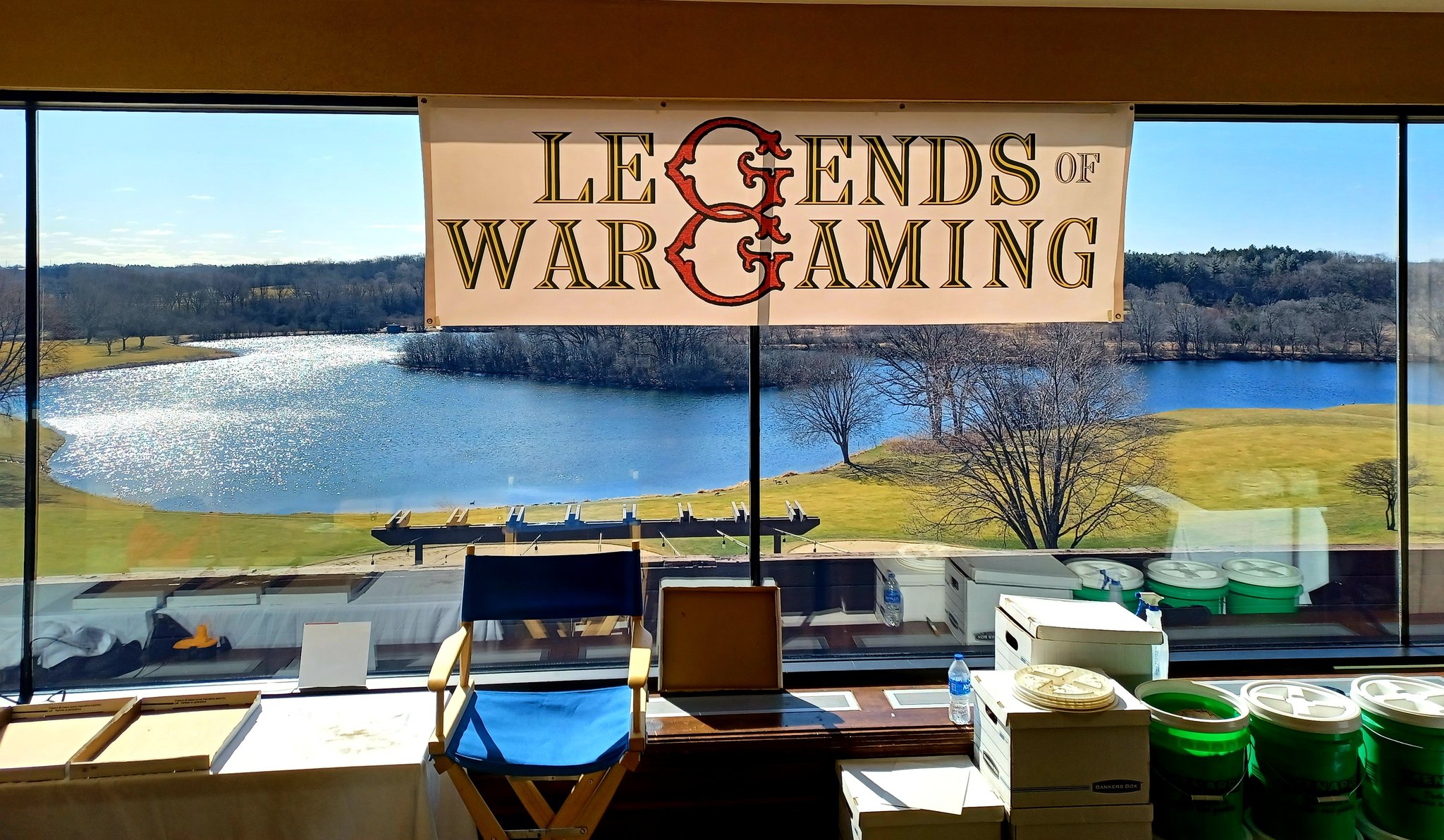
The view from the window of the Legends of Wargaming hall on Sunday morning. That's not Lake Geneva, but rather a small lake on the grounds of the hotel.

This post covers the gaming highlights of my third and fourth days at Gary Con XIV, Saturday the 25th and Sunday the 26th (of March 2022). If you missed them, the reports for first two days can be found here and here. [I wrote most of this post shortly after those, but didn't finish it until early December 2022]

Saturday

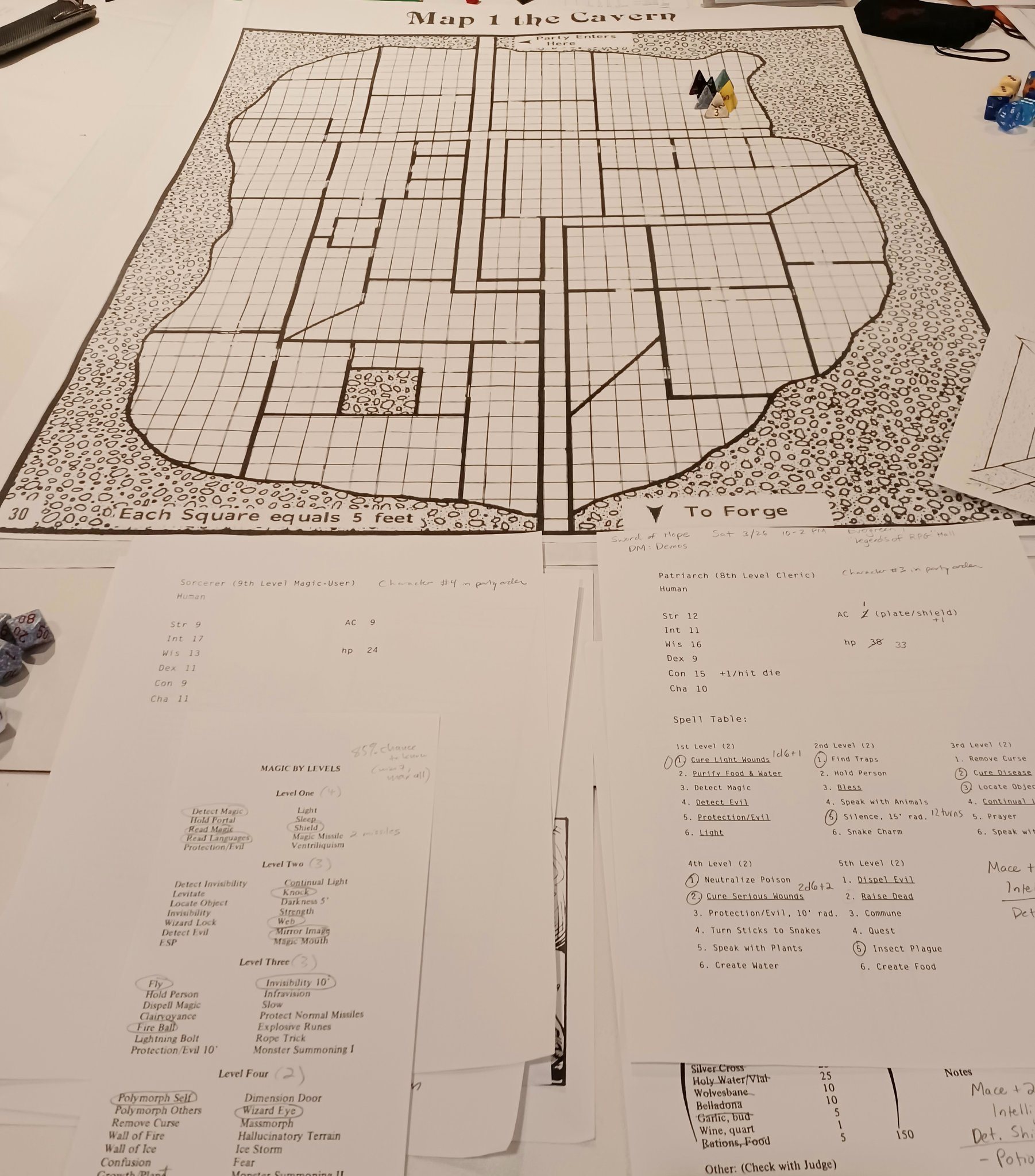
On Saturday morning Demos of the OSR Grimoire continued running the OD&D tournament written by Dave Emigh for Winter War in 1977. On Thursday he had run the first round of the tournament, The Tower of Ullison, which I also played in and covered in my post about the first day of the con. The second round is titled The Sword of Hope, and like the first, was later published as a module by Judges Guild, and which Demos reviewed here on Dragonsfoot; unfortunately, the third round of the tournament was never published. 


I was the only returning player from the first round, but familiarity with it wasn't necessary for this round, and the new players took to the scenario with gusto. There were six pre-gens, and five players, so I ran two characters, a magic-user and a cleric. The first part of the dungeon, which is pictured above, looks quite ordinary, but includes an interesting design feature that makes for fun tournament play: while we quickly found an exit in the south part of the dungeon, we couldn't open it until we had backtracked through the rooms to find and solve several puzzles. Beyond it lay the conclusion of the scenario. 

In the afternoon I ate lunch while watching a screening of a rough cut of The Dreams in Gary's Basement, a forthcoming documentary about Gary Gygax, hosted by the director Pat Kilbane. I backed the kickstarter for this project, and enjoyed watching this cut, which included about 40 minutes of mostly finished footage followed by some shorter excerpts. A few highlights for me were seeing video footage of Gygax talking outside an early Gen Con; a photo of David Sutherland I hadn't seen before; and animations of Sutherland's Dragon from the cover of Holmes Basic (!) and of Trampier's Demon Idol from the cover of the PHB. Afterwards, Kilbane hosted a Q&A, where he explained that progress on the film has been slow because he has been doing the editing himself to make sure it's done properly within the available budget. Later in the hall, Larry from Follow Me and Die! introduced me to Pat, and we had a pleasant chat where I learned that he is a gamer who started with Holmes Basic and still plays and designs RPGs.

In the evening I ran my second game of the convention, a session of In Search of the Brazen Head of Zenopus, which I'd run previously at the most recent in-person Gary Con in 2019, and at other cons. By my count this was the sixth time running it. Surprisingly, I had two players return from 2019; apparently, in the intervening years they'd completely forgotten they had played it in before! The game was fun, and Demos was able to join in near the end to take over Murray after another player had to leave. Unfortunately, I don't have any pictures from this game; when I'm DMing I'm often too pre-occupied to remember to take any myself.


Rare image of the wizard Zenopus conversing with other wizards

Afterwards, we relaxed in one of the halls, chatting with Griff of the Secrets of Blackmoor documentary and blog, who took the above photo of me. Still later, I joined my friend Rich of the Circle of Dar Janix at the hotel bar where he was hanging out with the Troll Lords

Sunday


Douglas Waltman's large-scale reproduction of the Knights of Camelot board


I didn't register for any games on Sunday morning as my flight out from Milwaukee was midday, and it's a 45-minute drive to the airport. Instead, after eating breakfast I hung out in the Legends of Wargaming for a few hours, watching Demos play TSR's Knights of Camelot refereed by Douglas Waltman. For this game, Waltman constructed a jaw-dropping large-scale reproduction of the original board, over 7 feet long, including a painstaking recreation of the beautiful map work by Darlene, but in relief. Completing the upgrade was an tremendous set of painted Mirliton miniatures representing each of the knights that appear in the game. More photos that I took of the setup can be seen here on Twitter.


Line-up of Mirliton knights for Knights of Camelot.


Renaissance Books store front in the Milwaukeee airport


Finally, one of my post-Gary Con traditions is stopping in Renaissance Books, the used bookstore housed in the the Milwaukee airport, which is apparently the only used bookstore currently in an airport in the US. In the past I discovered that it has a great selection of vintage sci-fi & fantasy paperbacks, including a lot falling under the Appendix N umbrella, and this time I picked out two Robert E. Howard compilations published by Zebra in the 1970s, Worms of the Earth, which is a Bran Mak Morn compilation, and the Second Book of Robert E. Howard, a compilation of various stories

When I was paying for my books, the owner saw my Gary Con hat and mentioned that he had written for Dragon Magazine in the 1980s. He introduced himself as Michael Lowry, and specifically mentioned an article on gemstones; which turns out to be "The Many Facets of Gems" in issue #83. He also wrote The Tarot of Many Things for issue #77, a variant of the Deck of Many Things. I suggested that he should come to Gary Con in the future, but he indicated that his focus is on sci-fi conventions these days.

* * * * * 

That's it for my Gary Con 2022 write-up. Looking forward to 2023, and since I'm finishing up this report in December, I can report that I've already got my ticket for Gary Con 2023 and am planning on running two games, a re-run of Expedition to Skull Stack Crater (which I ran for the first time in 2022) and the new Forgotten Smugglers' Cave

[I wrote most of this article in April 2022, but didn't finish it until December 2022]

Sunday, January 16, 2022

Demon Idol Review


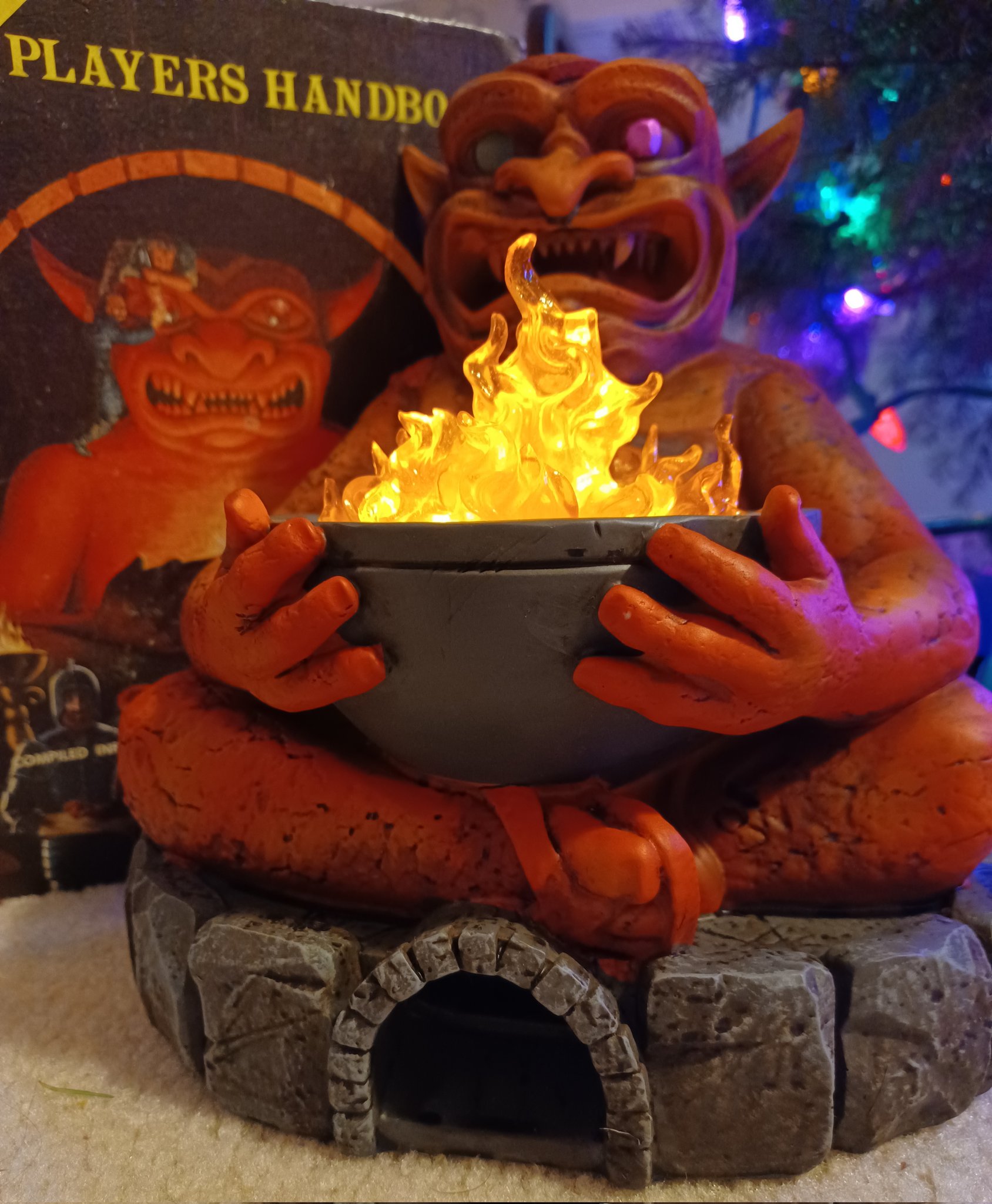
A Happy New Year from my original and new Demon Idols!

That's my original Players Handbook, which I received for my birthday in 1983 along with a Pac-Man watch. I still remember reading it in bed that night, captivated by all the new options not found in my Holmes Basic rulebook, like Half-Orcs!

The statue is a new Xmas present; a licensed "D&D Dice Tower" available from Gamestop.

Here's a quick review of the new demon idol tower:

Construction: Probably the biggest dice tower you'll ever own, being 10 inches tall, 8.5 inches wide, and 7 inches deep. It feels sturdy, weighing a bit under 4 lbs. The "aged" color and texture are well done. 

DesignThe nicest feature is the fire, which lights up via a switch on the bottom. It requires 3 button cell batteries (1.5 LR44), which are included.

It's not a perfect recreation of Dave Trampier's original art; notably, the horns have been turned into ears, giving it a more goblin-y feel. The statue's feet are not visible in the original; here, they are wearing sandals that somewhat comically resemble flip-flops. 

Note that the statue is missing one jeweled eye in a nod to the PHB cover. I feel like a bit of an opportunity was missed here to have two removable eyes.

For a more faithful and creepier design, see the version available from Otherworld Miniatures.

Functionality: The top of the head comes off, revealing a chute into which you drop your die, which shoots out the dungeon archway in the front. It works well; my first roll sent the dice flying about 3 feet across the kitchen floor.

And it could easily serve as a gigantic dungeon prop. The archway is big enough to slide a mini into, and there are some flat spaces on the pedastal and statue in which a mini could stand.

Friday, August 20, 2021

The Holmes Basic Set Cover Art: Exhibited!


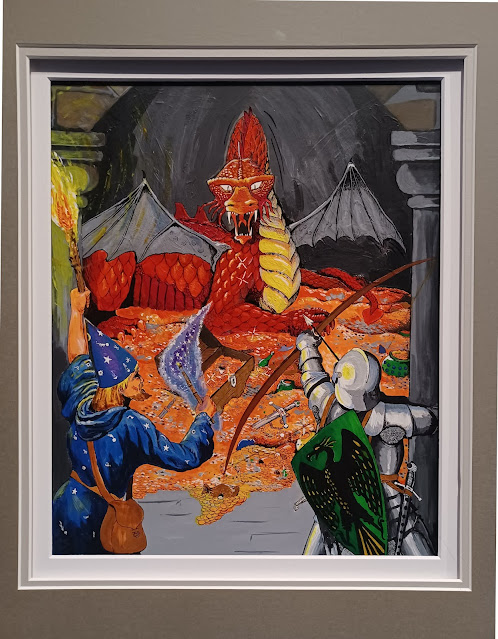
"The Sutherland Dragon" on display, photo by myself


About two weeks ago, while on vacation, I saw a cryptic post on FB implying that the original Holmes Basic Set cover art  which I often refer to as "The Sutherland Dragon", after the artist  was on display in public ... somewhere. After a bit of searching, I confirmed that it was indeed being exhibited, as part of the show Enchanted: A History of Fantasy Illustration at the Norman Rockwell Museum in the town of Stockbridge in western Massachusetts. I hadn't heard of the show until that moment, but at the time I just happened to be within reasonable driving distance of the museum, and would not be as close again for some time, so a quick decision was made to take a previously unplanned side trip to the museum!

A Painting Rediscovered

Not all original D&D art still exists, but I've known for a while that Sutherland's painting does, because back in 2013 Steve Winter reported on Twitter that it had been found, like the Lost Ark of the Covenant, "in a crate in WotC's warehouse". Steve provided a photo, observing that the "detail is amazing", which showed that the art had slipped inside its framing while in storage:


(As an aside, I joined Twitter for the first time just so I could comment on Steve's tweet, which eventually led to regular usage, and I recently passed 700 followers).

At the time, Steve also wrote on his blog Howling Tower about the find, which he coincidentally posted on Holmes' date of birth.

I also have a vague recollection of hearing later that it was now hanging up at the WOTC offices. I've played in several games with Steve at NTRPG Con and Gary Con over the years since (Gamma World, for example), so I may have asked him about it at one point.

Update: I was reminded on Twitter that on page 394 of Art & Arcana (2018), there is a small inset showing a WOTC employee holding the Sutherland Dragon with the caption: "Wizards employee Curt Gould poses in front of the beast with a red dragon of his own — the original Dave Sutherland basic box painting that he discovered in a Wizards of the Coast warehouse in 2013". The painting is in the same frame as the current exhibit. This may have been the source of my vague recollection mentioned in the paragraph above.

The Exhibit Curator on Sutherland's Illustration

The Enchanted exhibit opened in mid-June, after which the museum held a virtual symposium, which included a keynote talk (archived here on Google) by the exhibition curator, Jesse Kowalski, who at one point shows Sutherland's art (at ~41:00) and says that "it is probably the painting I was most thrilled to have in the exhibit", and that "I believe it is the first time on view to the public. It's on loan from Wizards of the Coast", and while "...it's not the best painting, however, it's such an iconic work that started a whole generation of kids in the basement rolling dice".

Visiting the Museum

After driving several hours we arrived in Stockbridge, where Rockwell had lived, and then at the museum, which is in a beautiful leafy setting with picnic tables and sculptures, which currently includes a complimentary exhibit of contemporary fantasy sculpture, titled Land of Enchantment: A Fantastical Outdoor Sculpture ExhibitionIn addition to the museum proper, which counts George Lucas and Steven Spielberg as donors, Rockwell's actual studio is also on the grounds, having been moved there from another location in town. 

Update: Thanks to a user on reddit, I've learned that Stockbridge is also famous as the setting of Arlo Guthrie's song Alice's Restaurant.

Seeing The Sutherland Dragon

After paying our entry fee and applying my sticker, I zipped through the rooms of the exhibit until I found what I was there for, which was hung next to another classic from the same era, David Trampier's Pseudo-dragon from the AD&D Monster Manual:


It was stunning to finally see the Sutherland Dragon in the person. 
The colors in the original are *much* brighter than the published image on the box cover, and many details are more apparent, such as the colorful, glinting gems stuck in the crevices between the dragon's belly scales, like Smaug in the Hobbit. I'll make a follow-up post with a few closer photos of details of the painting, so here I'll just talk about some overall impressions of the painting as it is on display in the exhibition.

The painting, which the wall text indicates is "acrylic on board", has been re-framed since 2013, and now includes triple matting (see the picture at the top of this blog). I imagine this was done by Wizards of the Coast, who the wall text indicates are still the owners. The catalog for the exhibit (see below for more on this) lists the size as 24 5/8" x 22", which I believe refers to the entire framing, or perhaps just the painted board inside. The new matting is more aggressive than in the earlier frame, limiting the visible portion of the painting to about 10" by 12", which is just a bit larger than the original box cover, which is about 9" by 11". I can guess why this was done, as it has the effect of focusing the presentation on the action of the scene: the wizard and warrior confronting the looming red dragon. And it also emphasizes that Sutherland was painting something just a bit larger in scale than what was needed for the product as published. 

Unfortunately, WOTC's new matting covers up some significant details from Sutherland's original painting. Like other TSR boxed games from this era, the cover art was printed not just on the top of the box lid, but also wraps around to the sides. In the case of the Holmes Basic Set, the left, top and right sides each show the blocks of dungeon walls, which were all part of Sutherland's painting. Since this is an exhibition focusing on illustration, I would have preferred to see the entire painting, along with discussion of how Sutherland arranged a composition that was intended for a wrap-around box top. 

The matting also shifts the "visible portion" of the painting downward from the published box cover, which covers up most of a significant detail that is visible at the top of the published box cover: the archway that connects the top of the columns and frames the dragon. As a positive, this shift keeps uncovered most of what was shown on the bottom box edge, allowing for an fuller unobstructed view of the two adventurers, which I enjoyed seeing.
 
For a visualization of what the entire painting might look like if the current matting was removed, here is a mock-up of the original art posted on the Xeveninti blog back in 2010. It was made by scanning the entirety of the original box (cover and all four sides), editing these together, and editing out the graphics:


I hope I don't sound too negative here; this was simply an observation I made while viewing the painting and thinking about it. My overall experience at the museum was terrific, I was thrilled to see the painting in person, and it is wonderful that it has been preserved ("it belongs in a museum!") and has been made available for public showing by WOTC.

Exhibition Catalog

I bought a copy of this at the gift shop, and you can purchase it online here. It's nicely done, edited by the curator of the exhibit, and lavishly filled with color images from the exhibit, plus other images not in the exhibit. There's an 11-page section called "Gaming", which includes a ~1/3-page image of the Sutherland painting — I, of course, wish they made this one full page like some of the other illustrations in the book — and a really nice large scan of Trampier's Pseudo-dragon, as well as other gaming art, including an Elmore and an Easley that were also in the show.

Thy Deadline

If you want to see the exhibit in person in Stockbridge, get there by October 31st of this year!

Update: Mike S. on FB found info here on where the show will later move to:

  • May 20 to September 5, 2022: Hunter Museum of American Art in Chattanooga, TN
  • September 23, 2022 to January 8, 2023: Flint Institute of Art in Flint, MI

Future Posts

I plan to make a few follow-up posts with some closer shots of the Sutherland Dragon, and also a few of the other artworks in the exhibition, including Trampier's Pseudo-Dragon. I'll update this section with the links once they are up.

See also:

Smaug versus the Sutherland Dragon

David Sutherland Day

Sutherland Dragon in Lego

Dragon+ 5 Wallpaper inspired by Sutherland Dragon

Saturday, June 20, 2020

Scrum in Miniature: The Lost Art of Games Workshop's Holmes Basic

My fellow Scrum Club member Joe has started a series called the "Lost Art of D&D" on his blog Scrum in Miniature, and the second installment covers the replacement art by John Blanche and Fangorn that was used by Games Workshop in the first printing of Holmes Basic rulebook, first released in December 1977. The post goes through the rulebook and shows each replacement work contrasted with the original from the U.S. version (example above).

In a 2001 interview, Gary Gygax was asked about the UK version, and responded:

"Yes, I saw the work, and I approved. Ian [Livingstone] and Steve [Jackson of Games Workshop] convinced me that their audience didn't like the illustrations used in American versions of the game, so I gave them the okay to produce their own. I had a copy of the Basic Set rules, but it was lost when Lorraine Williams took over TSR..."


Lost Art of D&D No. 2: Games Workshop's Holmes Basic (1977)

After Games Workshop attained the license to print a co-branded edition of TSR's 1977 Dungeons & Dragons basic rules book, they set about putting their own stamp on it, designing a new cover and replacing a number of the illustrations they deemed too crudely drawn for their U.K. market.

Thursday, October 11, 2018

GAMMA WORLD IS HERE...

1978 promotional poster for Gamma World

FYI, just about forty years after they were originally released, the original Gamma World rules, now known as the first edition or 1E, are now available on Drive Thru RPG in both PDF ($10), Print-On-Demand ($20), or both ($22) ---

Gamma World 1E on Drive Thru RPG 
(link includes affiliate number)

Gamma World, by James Ward and Gary Jaquet, was first published in 1978 and was developed from Ward's earlier Metamorphosis Alpha RPG (1976). As the co-authors wrote in Dragon #18, "The creation of the boxed game of Gamma World was brought about when the need for a planet based version of Metamorphosis Alpha presented itself. The distances and possibilities presenting themselves on a planet were far more vast than those of a star ship. Also, through the course of playing MA, many new concepts were created and old ideas evolved into things far different from what was given" (from "GAMMA WORLD: First Report; Setting Up The Campaign" in the column From the Sorceror's Scroll in Dragon #18, Sep 1978).

The PDF is of the third printing from 1981, with a TSR Face Logo. Earlier printings had the Lizard Logo or the Wizard Logo (August 1978). I've checked the 2nd and 3rd printing against each other and didn't note any rules differences, just some slight differences to the logos, copyright info and product listings. I don't have access to a 1st printing, so I don't know whether any corrections were made from 1st to 2nd.

A Gamma World "Sneak Preview" appeared in Dragon #8, July 1977, the same month that Holmes Basic was first available at Origins 77. It was titled "Introduction to: Gamma World", and was an early draft of the Introduction that later appeared in the rulebook. It was attributed as an "Excerpt from "The Black Years" --- Hald Servin, 2562", with no further explanation. However, based on a further article "More Excerpts from the Journals
of Hald Sevrin" by Gary Jaquet in Dragon #19, it appears that he is "Hald Sevrin". 

In Dragon #15 (June 1978), an advertisement on page 18 announces two new TSR releases for Origins 78, Gamma World and the AD&D Players Handbook. This was repeated in Dragon #16 (July 1978), and the next two issues have, "This is Gamma World" advertisements that use the same artwork as the poster shown above, and specifically mention the poster as being available.

The back of the original Gamma World boxed set stated that "The GAMMA WORLD™ rules are also suitable for use with the ADVANCED DUNGEONS & DRAGONS rules." This compatibility can be seen by looking at a stat block from the "Monster & Treasure Listings" in the back of the Gamma World 1E rulebook ---

07. Yexil (2) HP: 42, 35; AC: 6, Move: 4/15; AT: bite does 3d6 damage, laser eye beam does 5d6 damage (25m range); MU: totally resistant to cold attacks.

They left HD out of these listings (similar to the OD&D M&TA listings, although those have a "To Hit AC9" score), but it can be found elsewhere in the write-up (10 in this case). It'd be trivial to just throw this at a (A)D&D party as an encounter. 

In 1979, the AD&D Dungeon Masters Guide included a section, "Mutants & Magic" (pg 113-114), on conducting cross-over campaigns between the two rulesets in either direction.

It took a few years, but the original rules were eventually supported by several products, including the sandbox module GW1 Legion of Gold (1981) by Gary Gygax, Luke Gygax and Paul Reiche III, the module GW2 Famine in Far-go (1982) by Michael Price, and a Referee's Screen with a mini-module, The Albuquerque Starport, also by Reiche. None of these are available on Drive Thru RPG yet, but hopefully will eventually appear. There was also a module in Dragon #52 (August 1981, Cavern of the Sub-Train, by the original co-author, Gary Jaquet.

I must note that they still haven't released Holmes Basic in PDF or POD....!!!

Update: I saw some pics on FB of the POD product. Since the file format puts the box cover on top, it results in a booklet with a color cover - a nice touch. The original booklet cover is the first page on the inside. The blue map from the box is also included in the interior, across two pages.

Wednesday, November 30, 2016

Monochrome D2 Print-On-Demand


Tuesday's new batch of print-on-demand D&D from WOTC finally includes a '70s classic: the 1978 original monochrome version of D2 Shrine of the Kuo-Toa, part of Gary Gygax's timeless D1-D2-D3 'drow' trilogy.

According to the printing info at the Acaeum, the pdf (which i had previously bought) is of the 5th printing of the module, although I'm not aware of any content differences in the printings of D2. However, there are significant differences in art and content as compared to the later D1-2 compilation, as detailed here.

The front and back cover art in the original are both by David Sutherland. The back cover is rarely seen as it was not included in the D1-2 compilation, and is a great composition depicting an encounter with a rust monster, still looking very much like the Chinese toy that inspired it:


Interior art is by Dave Trampier (DAT) and Sutherland (DCS)
DAT:  Umber Hulk encounter (pg 3), Kuo-Toa barge encounter (pg 6), Kuo-Toa 'fingerling' pool (pg 10-11), adventurers resting (pg 13)
DCS: Roper battle (pg 4), Svirfneblin encounter (pg 7), Kuo-Toa throne (pg 9)
Kuo-Toa for monster entry (pg 13), Svirfneblin/Kuo-Toa battle (pg 15), Svirfneblin for monster entry (pg 16).

See also my previous post about the D&D print-on-demand.

(Note: links include affilitate number that gives me 5% credit if you make a purchase)

Wednesday, July 8, 2015

AD&D 1E Players Handbook PDF

"I can fit my entire spell book in one of these thumb drives"

Yesterday the original AD&D Players Handbook was given new virtual life, being made available as a pdf download from dndclassics.com (a special section of drivethrurpg / rpgnow). It's currently priced at $9.99. One the product page there's a nice historical essay by Shannon Appelcline who has written similar essays for most of the other 1E products. I bought the pdf today so I'll share some quick impressions.

The AD&D PHB was perhaps the third D&D product I ever owned, after the Holmes Basic Set and the Monster Manual (I may have received a module or two at the same time as the MM). It was a birthday present (along with a Pac Man watch!) and can still remember reading it in bed that evening, fascinated with the new material not mentioned in Basic like half-orc PCs. So I'm happy that it is back 'in print' and thus easily available for players to access. It's also great to have the full text available electronically for quick search and copy.  

 A few minor quibbles. The pdf is of the 'Premium Reprint' released in 2012 with reset text rather than a scan of one of the original hardcopies. Thus it has the cropped/redesigned cover art from the reprint rather than Trampier's glorious original painting spread across the front and back covers. It is also missing the TSR product list found in the back of the original, which is replaced by an ad for the Gygax Memorial Project. The interior art (by Trampier and Sutherland) is also darker than in the original, resulting in some loss, the worst probably being Trampier's finely shaded Magic Mouth on page 108, which looks murky in the pdf (See here for a 2012 side-by-side photo of this art in the original and reprint, by Brendan of necropraxis.com).

The reprint introduced a few new errors in the text, likely resulting from uncorrected OCR errors. These are included in the new pdf as reported here on DF. If you are interested in getting these corrected, try leaving a comment in the review section on dndclassics.com.

Furthermore, the original print version had a number of errors in the text, which were detailed in Dragon #35. See this Acaeum page for a list. Only a few of these were ever corrected in print. The new pdf version includes the corrections that were made in print back in the '80s as noted on the Acaeum page, but does not correct the others. Thus the new pdf still has some clear errors, such as the Dex table on page 11 with half-orcs having max 14 Dex, while the Table on Page 15 has the corrected '17'.

I believe this is the first of the 1E AD&D Reprints to be released electronically, so hopefully we'll see the rest shortly. And where's that Holmes Basic pdf?

Wednesday, June 4, 2014

Dave Trampier - Basic D&D Artist


TSR promotional poster circa 1978; photo from a recent Ebay auction by the Collector's Trove

One of TSR's finest artists, Dave Trampier, passed away this past March. He was perhaps best known for the demon idol artwork on the cover of the original Player's Handbook (seen above in a poster from the era), and the long-running Dragon magazine comic strip, Wormy. It was also reported by the owner of the store Castle Perilous Games & Books that Trampier was planning on attending an upcoming game convention, after a long absence.

Here I'll take a look at Dave's work for the first Basic Set. Dave had three pieces of art in the rulebook. Two were in the first edition; one was added to the 2nd edition.


The first is an illustration of the spell Web on page 16, signed 'D.A. Trampier'. This picture is one that helps to show the 'dungeon' setting of the game. It's not clear who the villain is here, but the wizard certainly looks menacing. He wears a 'stars & moon's cap like the wizard on the cover of the rulebook, and carries an interesting three-prong staff.


The second is an illustration in the combat section of the rules on pg 18. I always associated this with Bruno the Battler's combat with a big goblin on page 21, but the details don't match: the creature here actually looks like a minotaur with a battle axe. The background here is abstract, perhaps meant to be a stone wall underground. I don't see Dave's signature, so illustration may have been cropped from his original art.


This thoughtful manticore, signed 'DAT', was added to the Monster List section of the 2nd edition of the rulebook in Nov 1978. Perhaps it was originally intended for the Monster Manual (which came out in late 1977) but wasn't completed in time? My original rulebook was pretty trashed, missing pages from the beginning and end, so I cut out this picture and turned it into a refrigerator magnet I keep with my Halloween decorations. 


In the same year a similar manticore, in a lair surrounded by treasure, also by Trampier appeared on the cover of the Monster & Treasure Assortment, Set 3, Levels 7-9. The original was tinged blue on the cover but the black & white original later appeared in the combined set in 1980.

Dave Trampier's original art that became the cover of the module B1

Trampier's work also formed the basis of the cover of the original cover of the module B1 In Search of Unknown, which in 1978 was the first module to be included in the Basic Set. The cover art on the published module is signed "DIS & DAT", indicating it is the combined work of David C. Sutherland (aka DCS) and Trampier. Dave's original version of this artwork was later shown in an early issue of Polyhedron (#5, 1982), thanks to the editor Frank Mentzer, who was given access to TSR's old art files. See a comparison with published art in this DF thread by paleologos.


Trampier didn't contribute any other work to B1 (all of the interior illustrations are by Sutherland), but he did do the cover and all interior illustrations for another introductory module of the era, T1 The Village of Hommlet (1978) This module was for the same levels as Basic D&D, 1-3, but was marketed as an introduction for AD&D rather than Basic. Above is Dave's cover art for the original version of this module, showing a montage of encounters from the ruined moathouse.


Finally, Trampier also illustrated this awesome "You'll Be Amazed" advertisement from the fall of 1978 for the D&D Basic Set and the Dungeon! boardgame, which I wrote about here. Note that it contains yet another Manticore.

Friday, October 11, 2013

You'll Be Amazed

Click for Larger View

"You’ll Be Amazed" TSR ad for the Dungeon boardgame and the D&D Basic Set. From the first issue of Asimov’s SF Adventure Magazine, Fall 1978. Dungeon artwork by Dave Trampier. 

"THE SWORD AND SORCERY GAME OF ROLE PLAYING FOR THREE OR MORE ADULTS

THE BASIC SET CONTAINS EVERYTHING YOU NEED TO BEGIN PLAYING THE GREATEST FANTASY GAME EVER!"

Here are some notes I wrote about this ad previously on OD&D Discussion:


I looked through Dragon magazines from 77 and 78 and didn't see this ad.

Although it appeared in a Fall 1978 magazine, it was probably created earlier, due to: 


(1) Having a Lizard Logo; the July 1978 Dragon (#16) has Gamma World/Players Handbook ad with Lizard Logo; the August 1978 (#17) has full-page PH ad with Wizard Logo
 

(2) "T.M. REG. APP. FOR"; according to the Acaeum, the 3rd print Basic set rulebook (May 1978) still had the Lizard Logo but was missing the 'TM applied for' notice. The next printing of the rulebook (2nd edition) in Nov 78 had Wizard Logo.
 

It's also interesting that DUNGEON! is promoted as a solo game. Never saw that anywhere else.

Wednesday, November 7, 2012

More Holmes Basic T-Shirts


The Wizards merchandise website now has more old school t-shirt designs, including this one called "Red Dragon Cover" with the Holmes Box cover, minus the logo and product number. (Here's my previous post on the first shirt design). Confusingly, the website is still calling this a pre-sale, and the linked FAQ says that it ended 11/5, but the shopping cart still seems to be functioning. I haven't placed an order, but the price of each shirt is still $25, plus $1.25 tax, and the shipping calculator is giving me a quote of $9.45, for a total of almost $36 for a single shirt. It appears that additional shirts can be added to an order for about $2.

Another design shows a composite of monsters by Dave Trampier, incluiding his warrior vs minotaur (orc?) from the Holmes rulebook:


Sunday, September 2, 2012

Monster Manual 1E artwork trivia


Chimeras - 1st print MM (left) vs 2nd print MM (right)

Over on the Acaeum, misterspock has documented several artwork changes that were made to the Monster Manual. The first is the Chimera; the original drawing by David C. Sutherland III (aka DCS III or just DCS) from the first print MM (Dec '77) is missing its wings, despite having an 18"/round flying move. The later drawing, also by DCS, from the 2nd print MM (May '78) has the wings added as well as other changes. Also altered were the Type III Demon and Nightmare.

An older post on Dragonsfoot by Paul Stormberg of the Collector's Trove provides some context for these changes:
"Dave (DCSIII) told me he didn't like some of the creatures he drew (Type III Demon, Chimera, Dinosaurs, and some others) as they had to be hastily done. DCS was a fast artist but it made his quality suffer. The Monster Manual was supposed to be done by Dave Trampier but he worked slowly and often quit and went home or to the local bar to blow off steam regardless of deadlines. Not so for DCS. He labored long into the night to get things done and sacrificed quality for speed when ordered to do so. Tramp was different, he was the golden boy for Gary and Gary did not push him on deadlines. Instead Dave was asked to pick up the slack.

When Dave got the Monster Manual blue lines from the printer he saw "this huge hole" in the document. There were no dinosaur illustrations, at all, just many blank pages. So that night Dave did all of the dinosaur drawings. He was supposed to be working on other things but crammed and speed drew things to pick up the slack. So a few pictures that had been hastily drawn by DCS, and that always bugged Dave were redrawn by him for later editions of the MM. It is the only book where he does this because it was never meant to be his project and the hastily drawn stuff bugged him so he just had to fix some things.

In the end, DCS was selected to be the Art Director for his work ethic and he slowly moved away from having time to create art. Ultimately he directed cartography at the company which you begin to see in fantastic maps like those in I6 Ravenloft."

Tom Wham is also listed in the credits, and contributed both classic "bestiary" drawings that blend well with the others (Beholder, Blink Dog, Herd Animal, Gynosphinx) as well as his signature cartoons (Giant Lynx, Mind Flayer, Giant Pike).

In addition to the altered artwork, later MM prints also added new art. Buried on the Acaeum's Monster Manual errata page is a list of the missing artwork in earlier printings:
First:  Ape (Gorilla), Centaur, Doppleganger, Dryad, Eye of the Deep, Fungi, Gar, Ghost, Hobgoblin, Intellect Devourer, Kobold, Men (Berserker), Merman, Mummy, Otyugh, Pegasus, Pixie, Purple Worm, Rat (Giant, Sumatran), Skeleton, Slug, Sprite
Second:  Ape (Gorilla), Eye of the Deep, Fungi, Otyugh, Rat (Giant, Sumatran)
Third:  Eye of the Deep, Fungi, Otyugh, Rat (Giant, Sumatran)
Fourth:  All pictures present.  Note that some monsters still do not have an accompanying illustration, but the Fourth print is as good as it gets.
[Note: the Ape (Gorilla) here should actually read Ape (Carnivorous)]

Most of these added illustrations are by DCS or Trampier, but the ones added to the fourth print are by Jean Wells (by herself or with DCS), whose name was also added to the credits on the title page.

Unpublished drawings also exist for several monsters that never received an illustration in the Monster Manual, including a Slithering Tracker and Giant Skunk by Bill Willingham, a Masher by Erol Otus, and an unattributed Shadow.

Update: Here's a screenshot of the DCS Chimera in the Blackmoor Supplement (Sep '75) that paleologos pointed out below:


Wednesday, February 29, 2012

Leap Day: Giant Toads in the Blue Book


by Dave Trampier, AD&D Players Handbook (1978)


For Leap Day I'll discuss the Giant Toads in the Holmes Basic Set. "What?", you say, "there aren't any Giant Toads in the Blue Book Monster List!" That's correct, but the original Wandering Monster Table in the 1st print rulebook (1977) did include 1-6 Giant Toads on the 2nd level. This table was revised in the 2nd print (May 1978) to remove monsters not appearing in the Monster List, including the Giant Toad. 

Furthermore, Giant Toads also appeared in the Monster & Treasure Assortment Levels 1-3 that was included in the Basic Set with each of the first three printings of the rulebook (1977, May 1978, Nov 1978).

     Here are the M&TA stats for the Giant Toad, which appear on each level:

     Lvl 1 #5. Giant Toads - (1-2) HP: 12, 8; #AT: 1; AL: 8; AC 7; ST/F 1-3; SA: None.
     Lvl 1 #79. Giant Toads - (1-2) HP: 9, 6; rest of the stats the same
     Lvl 2 #25. Giant Toads - (1-4): HP: 13, 8, 8, 8; rest of the stats the same
     Lvl 3 #8.  Giant Toads - (2-8): HP: 14, 11, 2 x10, 8, 2 x 6, 5; rest of the stats the same
     Lvl 3 #75.  Giant Toads - (2-8): HP: 13, 3 x 11, 10, 2 x 9; of the stats the same

MT&A uses a weird stat in place of HD: AL, or Attack Level, which is the "level of attack by monster as expressed by the monster's base number to score a hit on an unarmored opponent (armor class)". So it's a "to hit AC 9" or THAC9. By cross-referencing AL 8 with the Monster To-Hit Table, we find Giants Toads to have HD 2-3 (using OD&D or most Holmes printings) or 2+ to 3 (using the very last revision of the Holmes rulebook, which revised this table). The average HP of the 24 toads listed in the M&TA is 9.3, an average between 2 HD and 2+1 HD. We'll put them at 2+1 so they'll have an "AL 8" for all versions of the Blue Book.


Giant Toad by Jim Holloway


The history of Giant Toads in early D&D is complex, as with many of the "Giant" animals. In the LBBs, we see "Toads" (not listed as "Giant") in the Basic Animal Table in Vol 3. No stats are provided, but they are encompassed by the "Small Animals" (1 HD) or "Large Animals" (2 HD) described in Vol 2. 

In Greyhawk, "Giant Toad" first appears, both in the variable attack damage table (1 bite, 1-10/bite) and in the 2nd level Wandering Monster table. The GH WM tables appear to have been adapted for the 1st print Blue Book, explaining the reference to Giant Toads. 

In Blackmoor we finally get full stats for a Giant Toad as well as a lengthy description (for OD&D). Attacks/damage remain the same as in GH, but they are also given a "save vs poison" (not further explained). HD is 1-2, AC is 6, # Appearing is 3-30 and MV is 1/3/18 (apparently walking/swimming/leaping). The description indicates they are harmless unless attacked, found in any terrain, have "protective coloration" which is treated as invisible, can leap over 30' obstructions at 18" per turn and can make tongue attacks up to 15' that will draw opponents in. Giant Frogs are described separately, and are more vicious and dangerous. 

Next came the M&TA listing, which doesn't quite match Blackmoor (different HD, different AC, no special attacks indicated), so it may have a separate origin. 

In the Monster Manual, they are HD 2+4, AC 6, damage 2-8, and the tongue attack is dropped. They are also no longer harmless, eating anything rather than just insects. Furthermore, the poison ability is split off to a "Poisonous Toad", indistinguishable from the Giant Toad but slightly weaker (HD 2, AC 7, D 2-5). There's also completely new Ice Toad who are unexpectedly intelligent and have their own "weird language". 

Finally, in B/X, Giant Toads are pushed to the Expert Set, and have HD 2+2, AC 7, D 2-5, a tongue attack and camouflage (surprise on 1-3). Basically we are left with five-six different versions of the Giant Toads (OD&D/GH, BM, M&TA, MM (regular and poisonous) and B/X).

For a simple Blue Book version, we'll naturally use the M&TA stats, and pull in movement and damage from GH/BM (The M&TA is missing a damage stat, possibly because it was intended be used with static or variable damage; so we'll use the variable damage since Holmes does). There's no special attack or defenses in M&TA, so I've left out the poison, tongue attacks and camouflage (also missing from the Monster Manual version), but any of these could be added.

Giant Toad

Move: 30 feet/turn, 180 feet/turn leaping
Hit Dice: 2 + 1
Armor Class: 7
Treasure Type: nil
Attacks: 1
Damage: 1-10

These enormous albino amphibians can be found anywhere underground in groups of 2-8, hunting for prey primarily by scent due to their poor vision. Giant toads can leap up to 180 feet per turn, and up to 30 feet in the air, and can attack on the same round they leap. They eat practically anything, and will attack any humanoids except troglodytes. They are soothed by the scent of troglodytes, who raise them to use as guards and for hunting. Shriekers will also tolerate Giant Toads.


Giant Toad by David Sutherland from the Monster Manual (1977)

Monday, September 12, 2011

Obscure TSR art related to B1-B3

Dragonsfoot member paleologos recently made some interesting posts about obscure TSR art:

The original Trampier version of the B1 cover (published in Polyhedron #5)

A castle by Erol Otus (from Polyhedron #1) that resembles his picture of The Keep on the back of B2

Art from the French version of B3 by Darlene (I've never seen these pictures before)