This is the blog. Click here to go to the Zenopus Archives website.

Note: Many older posts on this blog are missing images, but can be viewed at the corresponding page in the Internet Archive

FEATURED POST

The Forgotten Smugglers' Cave: Index of Posts

An index of posts describing the Forgotten Smugglers' Cave, an adventure for Holmes Basic characters levels 2-4.                    ...

Showing posts with label Skull Mountain. Show all posts

Monday, December 21, 2020

Holmes for the Holidays 2020


Back for the pandemic, it's "Holmes for the Holidays"!

For this year, I've got an extra copy of Dragon #58 (February 1982), which features the Boinger and Zereth story, "In the Bag"The condition isn't the best: while the front cover looks like fine (see above), the back cover has a tear 2/3rds of the way across (it could be taped pretty easily), and the "Spellminders" counters from the center of the magazine are missing. Buy hey, it's free!

"In the Bag" was the last of Holmes' three Boinger and Zereth stories to appear in Dragon, and also the last of his writing of any kind for the magazine. Chronologically, it is set after "The Sorcerer's Jewel", as Boinger mentions that adventure, which had appeared one year earlier in Dragon #46 (February 1981). Murray and Olaf from The Maze of Peril also return in this story, and there are also references to Amazons and Dagon from that story (which at the time of this story, had been written but not yet been published).

The story is delightfully illustrated throughout by Donna Barr, an artist I'm not otherwise familiar with, but per wikipedia she illustrated other RPG products and comics books. While the Tales of Peril compilation includes "In the Bag", it does not include Barr's illustrations, which means this issue retains some draw for the Holmes collector.

The cover of Dragon #58 is by Clyde Caldwell - his second for the magazine - and features a castle with a skull-shaped gate reminiscent of Skull Mountain or Castle Greyskull (although Caldwell's painting is dated 1981 and it says here that the first He-Man toys were released in 1982). And to me, the lizard-riding, spear-wielding dwarf also recalls the lizard rider image featured at the top of this blog. 

The issue also include an article by the late Lenard Lakofka, "Beefing up the cleric", that details a bunch of new "official" cleric spells, which were later compiled in Unearthed Arcana. The article is introduced by Gary Gygax, who writes "All readers should be aware that Len Lakofka has been of considerable aid and assistance in formulating the whole of the AD&D game system".


* * * * *

For the give-away I will use the same system as before: 

If interested, leave a comment in reply to this post within the next two days, before automated moderation kicks in on this post. After two days, I will treat the list of comments as a table and roll randomly for the winner, using dice from a Holmes Basic set.

I'll cover postage (media mail) for any U.S. address. I can ship to other countries but I ask that you cover the difference (any amount over $4) in shipping by PayPal; so if you are overseas please only participate if you have a PayPal account and willing to chip in the extra. I'll estimate the exact shipping by weight and refund the difference if I overcharge.

Please note that due to the date I'm starting this that I probably won't get it in the mail until after Christmas.


* * * * * 

12/29 Update, including the Results:


I recruited two dice elves to make the rolls. There were less than 20 comments, so we used a Holmes white 20-sided die (numbered 0-9 twice) and an orange 6-sided die as the control die (1-3 = 1-10, 4-6 = 11-20).

After warming up the dice, we made the official roll...


...which indicates that number 7 is the winner! (the control die being a "1" means that it's "7" instead of 17). That's The Great Khan! 

Thanks to all who commented, and hopefully 2021 will be a better year for all.

Thursday, April 18, 2019

Forsaken Peak cross-section


The beautiful cross-section above immediately brings to mind Skull Mountain. It's from The Secret of Forsaken Peak, a forthcoming 5E D&D Adventure that I heard about today. The creators are Dave Hamrick and Justin David Russell (who does the cartography).

You can read more about it here:
https://dmdave.com/the-secret-of-forsaken-mountain/

https://dmdave.com/the-secret-of-forsaken-peak-resources/

The Secret of Forsaken Peak is a dark fantasy/horror adventure for characters of level 5-15 using Fifth Edition rules. In addition to the 30+ map adventure offering over 750 areas, chambers, and other places of interest, the book boasts over 100 new original monsters, more than 30 new magic items, new player options introducing subclasses, feats, and backgrounds, full-color illustrations and a whole lot more.

The first part of the adventure, Goblin Mine, will be part of the first issue of a magazine Broadsword that the authors are kickstarting right now.

The Secret of Forsaken Peak Resources

Last Updated: 1/2/2018 What is the Secret of Forsaken Peak? A shadow falls across The Graywood Forest, cast by the titanic, lonely mountain known as The Forsaken Peak. Its jagged, snow-capped peaks hide many secrets and equally as many terrors. For years, the mountain has been at the heart of multiple mysteries.

Thursday, June 14, 2018

Skull Mountain Variant by Darlene


At North Texas RPG Con last weekend I had the pleasure of meeting Darlene, an artist for TSR who did the original World of Greyhawk maps in the 1983 boxed set. I asked her to sign my original copy of the WoG Glossography, one of the books from the set. I picked this because part of her beautiful map is shown on the cover, but she relayed that she had also designed the graphics. She stared at title page for a few seconds, remembering her work.

In addition I bought a copy of her 1982 card game, Jasmine: The Battle for the Mid-Realm, which you can see here on BGG. On the bottom side of the clear box for the game I spied a Skull Mountain-esque picture I'd never seen before on one of the cards. See above.

Darlene has a page about Idshoii on her blog, which verifies that it's not just a castle, but a carving at the top of a mountain:

"Ildshoii Castle, carved from shiny black obsidian rock, rose high above a crown of volcanos. The dark castle was the domain of Melantha, the ruler of Medrylthorn ..."

Update: Here is Darlene's own intro page for the game:

JASMINE: The Battle for the Mid-Realm Collector Card Game


Friday, November 20, 2015

Monster Face Mountain

Another map illustrated with monster faces, similar to the last one, but here it's a "cross-section of levels" ala Skull Mountain:


Click for a Larger View

Monday, November 17, 2014

Part 41: "Dungeon Mastering as a Fine Art"

Part 41 of a comparison of Holmes' manuscript with the published Basic Set rulebook. Turn to page 39 of your 'Blue Book' (page 38 for the 1st edition) and follow along...

The next two sections in the manuscript come from the first page of content (page 3) in the third volume of OD&D, The Underworld & Wilderness Adventures.

DUNGEON MASTERING AS A FINE ART

Holmes changes the title from "THE UNDERWORLD" to "DUNGEON MASTERING AS A FINE ART". I can think of two reasons for this change. First, Holmes' guidance is mostly limited to dungeons, with just a brief mention wilderness treks, so he no longer needs the original's separate headers for "The Underworld" and "The Wilderness". Second, Holmes' new title helps convey the significance of the work of the Dungeon Master, and that D&D is more than just a board game. Referring to a performing or practical art like acting or photography "as a fine art" is a long-standing tradition going back more than a century. Searching Google Books turns up numerous usages from the 19th century including books such as "Dress as a Fine Art" and "Walking as a Fine Art". In his 1981 FRPG book, Holmes later wrote that "The art of the creative storyteller has been with Homo sapiens since he first learned to build fire in front of his cave and gather around it with a few companions to while away the long winter nights in friendly excitement" (pg 46). 

Immediately after the title, the manuscript has a single paragraph adapting the very first paragraph of OD&D Vol 3. This is the original source material:


And here is Holmes' edit of this material:


The first edition of the published rulebook keeps these sentences unchanged (except for adding a comma between "passages" and "stairs") but adds an additional one at the end: "The geomorphic dungeon levels provided with this game contain many suggestions and will prove very useful", referring to the Dungeon Geomorphs Set One: Basic Dungeons included in the first edition of the Basic Set.

In the second edition (Nov 1978), the Geomorphs were replaced with the new module B1 In Search of the Unknown, so this sentence was revised to "The geomorphic dungeon levels (available from TSR or your retailer) contain many suggestions and will prove very useful", and a new paragraph was added referring to the module: "The Basic Set of DUNGEONS & DRAGONS includes the introductory module "In Search of the Unknown", which will be usable for initial adventuring as well as provide ideas for dungeon construction." This paragraph was left unchanged even in the third edition when the module B2 Keep on the Borderlands replaced B1.

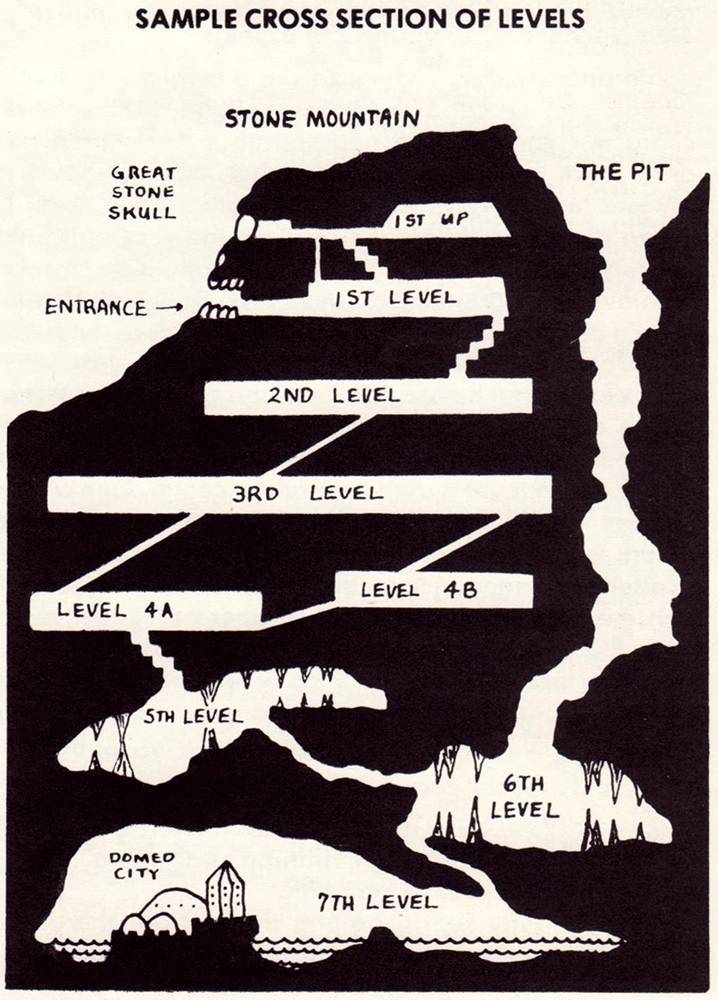
SAMPLE CROSS SECTION OF LEVELS

In OD&D Vol 3, the same page continues with an uncredited illustration of a dungeon:


The published Holmes Basic rulebook features a new cross-section, the famous 'Skull Mountain' drawing by Tom Wham, discussed in my previous post. Wham's drawing retains certain features from the original, including a split 4th level (A and B), a cavern at the bottom, and stairs, slanting passages and chutes connecting the levels.


The Holmes Manuscript also has a cross-section, but one that is different from either the original or Skull Mountain:

The dungeon cross-section from the Holmes Manuscript

This was presumably drawn by Holmes himself, or possibly his son Chris, an artist. To my eye, the handwriting is similar to that found on the two maps in Holmes' 1981 book. A nice treat, since we have only a handful of maps from the hand of Holmes.

Holmes' cross-section shares some elements with the original, most significantly a split 2nd level connected by a slanting passage and stairs, and a cavern area at the bottom. Holmes changes the chutes of the original to ladders, and adds an outside area, a ravine  reminiscent of the Caves of Chaos, housing the entrances to the dungeon. One entrance is a mine that goes straight to the 2nd level, whereas the original had two staircases entering into 1st level. Holmes' cross-section is more evocative than the original by having features such as "Hill Side", "Mine" and "Mine Shaft" labeled, as well as drawings of the ravine and trees, and stalagmites in the cave. It's possible that Wham included features from Holmes' version as Skull Mountain also contains two entrances, a main one also labeled "Entrance", and a second one, "The Pit", a vertical entrance in the same approximate location as the Mine/Mine Shaft of the manuscript. However, we can conclude that Wham added the most distinctive features of Skull Mountain, including the skull-face entrance and the domed city in the water-filled cavern.

Holmes' most significant change to the original is to limit the cross-section to three levels, aligning with the scope of the Basic rules, which includes wandering monsters for only levels 1-3. The next page of OD&D Vol 3 states that "In beginning a dungeon it is advisable to construct at least three levels at once...", so Holmes may have kept to this guidance even when constructing a much smaller dungeon than suggested by the original ("no less than a dozen levels down"). While Skull Mountain is fantastic, and perfect for stimulating the imagination of new players, Holmes' original is more line with the limits of Basic. The Moldvay set would later return to Holmes' original idea by including a similarly limited cross-section, drawn by Erol Otus:

Haunted Keep dungeon cross-section by Erol Otus, from the Moldvay Basic rulebook, 1981

Continue on to Part 42: "Sample Floor Plan, Part of First Level" (a forgotten map by Holmes)
Or go back to Interlude: "Skull Mountain by Tom Wham"
Or go back to Part 40: "Acts Like a Cannon Blast on Walls" (Miscellaneous Magic Items)
Or go back to the Index: The Holmes Manuscript

Monday, November 10, 2014

Interlude: Skull Mountain by Tom Wham


The "Sample Cross Section of Levels", known colloquially as "Skull Mountain", is arguably the most iconic interior art in the Holmes Basic rulebook. No other details about this dungeon are given in the text, but many beginning DMs were inspired by the evocative picture to design their own version.

The work is unsigned, like most TSR dungeon maps, and the rulebook lacks credits for art or cartography, so for the past three decades it hasn't been clear who drew it. One of the other rulebook artists, Holmes himself or his son Chris, or someone else? I assumed David Sutherland as the most likely, because the bulk of the artwork in the rulebook is his, and he later worked on cartography for D&D modules and even drew a cavernous cross-section for the Dungeoneer's Survival Guide. Or perhaps Dave Trampier. 

But for some reason I never considered that it was by the third Holmes Basic artist, Tom Wham. Last May on Facebook, Benoist P. posted the above picture to which Tom himself responded, "The black & white image is something I drew back in the 70's for the Dragon Magazine." Obviously this piece was used in the Holmes rulebook rather than Dragon magazine, but looking at it with new eyes I thought - of course! A quick search showed that only Timrod had guessed this previously. Skull Mountain is not in Wham's typical style, but in retrospect the round eye of the skull is perhaps a clue, many characters in his art having round eyes.

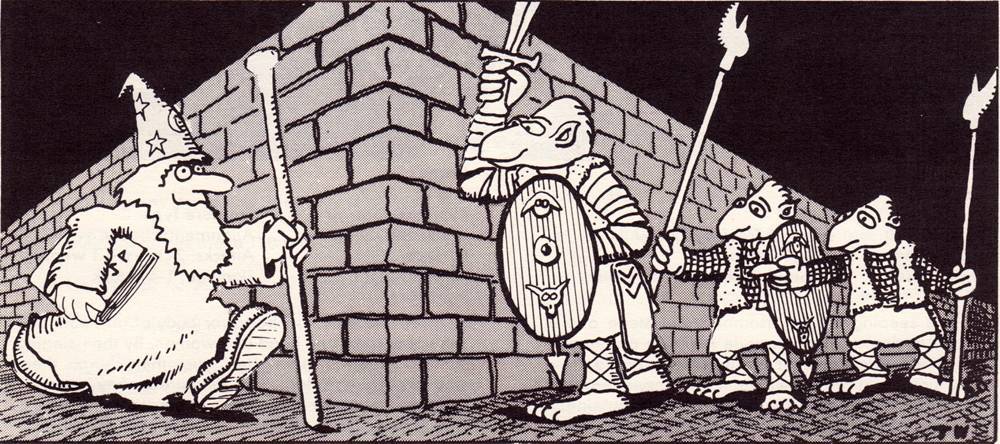
Tom started work for TSR in the spring of 1977, with his work appearing as early as Dragon #5 (March 1977), and credited as a staff artist starting in Dragon #7 (June 1977). The Holmes Basic rulebook was published in July 1977, so his art for it was among his earliest TSR work. He has only one signed ("TW") artwork in the rulebook, which shows a typically Whamian wizard about to be ambushed by three gnolls armed & armored very similarly to Sutherland's gnoll in the Monster Manual:


A DF poster, Rhuvein, also reported that Tom claims the sword in the Magic Item section:


Late in 1977, Tom's work would also join the two Daves in the original Monster Manual. His beholder is probably his most well-known from that book, but he also illustrated the stag beetle, blink dog, herd animal, giant lynx, mind flayer, giant pike, and three of the four sphinxes. Each of these signed with a tiny "TW". There are possibly other drawings of his where the signature is obscured or cut-off. Some, like the giant lynx, giant pike and mind flayer are in his typical cartoon style, but others like the stag beetle, blink dog and sphinxes, are more naturalistic.

Tom didn't illustrate many other dungeon cross-sections, but he did illustrate many other cross-sections, often as boards for the games he designed. His second game published by TSR in Dragon #11, Snit's Revenge, featured a large cross-section of a Bolotomus:


Snit's Revenge board, original version from Dragon #11, Dec 1977


A cross-section of the spaceship Znutar from The Awful Green Things from Outer Space 
(a favorite of mine):


TAGTOS board, original version from Dragon #22, Aug 1979


Note that in both of these game boards the individual rooms are each lettered in comic-book-style block capitals, the same as in Skull Mountain.

Here's a rare magazine cover by Tom, for Polyhedron #29 in 1986, showing the cross-section of a tower filled with busy inhabitants:


And more than a decade after Holmes Basic, he included another underground cross-section as one of the boards in his Mertwig's Maze (1988, TSR), the "Caves of Congor":


See also Tom Wham's website, with lots of historical information about his games.

* * * * *

In my next post I'll look at the Sample Cross-Section in the Holmes Manuscript.

* * * * * 

This was an interlude during my series of posts on the Holmes Manuscript.

Continue on to Part 41: "Dungeon Mastering as a Fine Art" (DM Guidance, Sample Cross Section)
Or go back to Part 40: "Acts Like a Cannon Blast on Walls" (Miscellaneous Magic Items)
Or go back to the Index: The Holmes Manuscript

Friday, August 30, 2013

The Great Stone Face


The Great Stone Face vs The Great Stone Skull

Recently I learned that the famous rock formation known as The Old Man of the Mountain was also referred to as The Great Stone Face. The Old Man, which unfortunately collapsed in 2003, was located on Cannon Mountain in the White Mountains of New Hampshire. Nathaniel Hawthorne traveled to the area in 1832, which later inspired him to write the short story, The Great Stone Face (1850). Incidentally, Hawthorne was a favorite of H.P. Lovecraft as related in his celebrated essay Supernatural Horror in Literature

The Great Stone Face was a mimetolith, a natural rock formation that resembles another object such as a face. Here in Holmes-country, our most famous rock-face is the Great Stone Skull in the Sample Cross Section (pg 38), colloquially known as Skull Mountain. In the past I've assumed the Skull to be carved rather than natural, but an alternate origin could have the site for the dungeon being chosen because of a pre-existing mimetolith. The evocative 1950s postcard of the moonlit Old Man shown above could even be used as an illustration for a Skull Mountain type-dungeon.

Comparing the Old Man and the Skull, we see that each appears in a left-facing profile at the top of a mountain. In fact, the Old Man could only be seen when viewed in this direction. And the phrasing of "Great Stone Face" is very similar to "Great Stone Skull". I've previously noted that the exact phrase "Great Stone Skull" appears in Shadows in the Skull, a 1975 Conan sequel by de Camp and Carter. In the 1940s, de Camp attended a Naval Training School at Dartmouth in NH, about one hour from the Old Man. There's no direct evidence that the Old Man inspired either the Conan story or the Cross-Section, but the similarities are intriguing.

Another "Great Stone Face" appears on page 30 of the Greyhawk Supplement (1975) by Gygax and Kuntz:


This drawing, apparently by Gygax himself, brings to mind an Easter Island moai and is not  further explained, although page 62 includes the following in a list of Tricks and Traps:

"A great bas-relief face which if looked upon will either bestow some worthwhile
knowledge or increase to the beholder or else cause him to save versus magic or else
be turned into a wart on its face or something similar (see A. Merritt's FACE IN THE
ABYSS for a good example)".


The reader might conflate these two conceptions, and one sentence in the Face in the Abyss (1923) does describe the titular face as the "great stone Face", but the consensus is that the "Enigma" and "Bas-relief face" were two separate locations in Castle Greyhawk.

Update: In the time since I first wrote this article, we've learned that the Great Stone Skull cross-section was drawn by Tom Wham.

Tuesday, March 19, 2013

Lemunda = Tiger Lily?


From J.M. Barrie's original Peter Pan novel (1911, courtesy Project Gutenberg):

"Marooners' Rock stood alone in the forbidding waters as if it were itself marooned. 

The boat drew nearer. It was the pirate dinghy, with three figures in her, Smee and Starkey, and the third a captive, no other than Tiger Lily. Her hands and ankles were tied, and she knew what was to be her fate. She was to be left on the rock to perish, an end to one of her race more terrible than death by fire or torture, for is it not written in the book of the tribe that there is no path through water to the happy hunting-ground? Yet her face was impassive; she was the daughter of a chief, she must die as a chief's daughter, it is enough.

They had caught her boarding the pirate ship with a knife in her mouth. No watch was kept on the ship, it being Hook's boast that the wind of his name guarded the ship for a mile around. Now her fate would help to guard it also. One more wail would go the round in that wind by night. 

In the gloom that they brought with them the two pirates did not see the rock till they crashed into it." 

Compare with Lemunda in Room M (Sea Cave) in the Sample Dungeon:
"The [pirates'] prisoner is a girl, Lemunda the Lovely, whose father is a powerful lord in the city above. Lemunda is a good fighter in her own right and carries a concealed dagger in her girdle, but right now she is bound and gagged. She is lying in the bottom of the second boat, not the one occupied by the pirates. Her family would be very grateful to get her back."

It may just be a coincidence, but in each story the pirate's captive is the daughter of a chief/lord, is a warrior herself (proficient with knife or dagger), and is bound in a rowboat.

In Disney movie of Peter Pan (1953), Marooner's Rock becomes Skull Rock, and Tiger Lily is brought there by Hook and Smee to a location more like a sea cave. I came across the similarities between Lemunda and Tiger Lily, when reading about Skull Rock, which is one predecessor (among many) of the Great Stone Skull (aka Skull Mountain) in the Basic Rulebook.

For the full list of possible Holmes Basic Easter Eggs, see this post on OD&D Discussion.


Hook and Smee take Tiger Lily to Skull Rock

Sunday, February 3, 2013

Draw Your Own Floor Plan, II

Three Level Dungeon, click for a larger view

Here's a three-level dungeon I drew on a copy of the Draw Your Own Floor Plan sheet from B2. It's in the same style as the previous map by my friend E.H., with green ink dungeon walls (presumably because the grid is in black), red secret doors, yellow 10' falling blocks (here outlined in green ink) and black pits. It also shows the influence of the Holmes Basic rulebook in two places: the levels are Lvl 1, Lvl1 up, and 2nd Lvl, like the first three levels of Skull Mountain, and there's an underground cave with a beach and water (Room 21) per the Sample Dungeon.

Some of the other traps on the map:
Room 3 - The "L" on the door indicates it is locked.
Room 7 - The brown-colored trap at the entrance is a blade that swings out sideways when the door is opened. The wavy lines along the walls are curtains, surely concealing a hiding monster. Boo!
Room 8 -  In the hall leading to this room, the circle with a line in the hall is a "pendulum ball" trap (ball swings down from the ceiling). There's also one at the entrance to room 12.
Room 15 - A key I have elsewhere indicates that a "red man" is a teleporter, though it's possible I had something else in mind here.
Room 17 - At the bottom of the stairs to the east is a "pendulum blade" trap (blade swings down from the ceiling). 
Room 19 - The entrance to this room is just a wall, which may mean it was bricked shut. Perhaps the teleporter sent you here. Or I just forgot to draw a door, as there seems to be one missing between rooms 26 and 27. 

I do have two pages of unfinished notes for this dungeon, including the two upper levels, but I think they date from several years after I originally drew the map. In this conception some kind of evil cult had taken up residence in the lower level and was intent on summoning an evil horror in room 19.

Thursday, December 6, 2012

Skullcap Dungeon in TSR module DL3

Illustration of the entrance to Skullcap dungeon by Keith Parkinson


I'd never looked at DL3 Dragons of Hope (1984, Tracy Hickman) before yesterday, so I didn't know that it contained a dungeon similar to the "Skull Mountain" dungeon in the Basic rulebook. Over on the Dungeon Fantastic blog, Peter has been reviewing the Dragonlance series, looking for the good bits that could be used elsewhere ("Salvaging Dragonlance"). It's interesting to me since I only had DL1 back-in-the-day, and never read any of the other modules. I knew from DL1 that some of them at least had cool maps. So after Peter mentioned the Skullcap dungeon I dug up a copy and took a look, and sure enough Skullcap is another one with an interesting map. 

Skullcap was once the mountain fortress of the wizard Fistandantilus, but "was blasted until only the shattered and glazed form a giant skull remain". Below is the cross section map of Skullcap from the front inside cover of the module; cartography is credited to Dennis Kauth and Elizabeth Riedel. Much like the Holmes cross section, the skull faces west, and the dungeon can be entered through its eyes (Area 47) or mouth (Area 48). As in Skull Mountain, the mouth of Skullcap leads directly to Level One of the dungeon, which here is given a separate map. Then there's the large crater at the top (Area 49), which descends through a vertical shaft to the bottom of the dungeon, somewhat like "The Pit" in the Holmes cross section. I won't give away what's found in the bottom of Skullcap, but it's certainly not for Basic level characters!

So the question is, was Tracy Hickman influenced by the Holmes Basic cross-section, or is this coincidence?


Sunday, January 22, 2012

The Tower of Zenopus - free WOTC download (2008)


START of the Tower of Zenopus Sample Dungeon


With the talk of 1E reprints and hope for a return of the official oldschool D&D pdfs, I'll note one free D&D pdf that has remained officially available from WOTC for the past three years: the Sample Dungeon from the Blue Book. In October 2008, in conjunction with the release of the 4th edition starter set, the wizards.com website featured a retrospective on past D&D Basic Sets by Bart Caroll. This retrospective covered only the Holmes and Mentzer Basic Sets, and included free downloads from the Sample Dungeon found in each:
(be warned, the quality of the scans is poor albeit readable):

http://www.wizards.com/dnd/files/Basic_1977.pdf (Tower of Zenopus, by J. Eric Holmes)

(This link now leads to the Internet Archive of this page)

Ignore the first page of this pdf, as the scenario actually begins on page 2. Also note, while it is labeled "1977 Dungeon", it's actually from a later revised version ('78 or '79) of the Blue Book, which replaces the original, tougher "enormous spider" with a standard giant spider.

http://www.wizards.com/dnd/files/Basic_1983.pdf (Mistamere Castle, by Frank Mentzer)

(This link now leads to the Internet Archive of this page)

Carroll makes a nice comparison between the two: 

"What did these two sets have in common? Both provided an introductory assemblage of the rules, allowing players to experience the first few levels of the game. Both provided newcomer DMs with a sample dungeon to fill out, and both suggested an evil wizard as the final adversary to an intro adventure".

However, the retrospective also places a picture of the Skull Mountain graphic by a quote from the intro to the Sample Dungeon, perpetuating an occasional misperception that the Sample Dungeon is part of Skull Mountain, which it is not. The Sample Dungeon is under a town on the sea (Portown); Skull Mountain is a huge dungeon inside a mountain and is not described in any other way other than the cross-sectional graphic.

Friday, January 13, 2012

de Camp's Great Stone Skull

 Detail from King Conan #4 (1980), Marvel, art by John Buscema

Today we head back to the Blue Book, where the illustrated "Sample Cross Section of Levels" features a "Great Stone Skull" on "Stone Mountain", known colloquially as "Skull Mountain". A "Great Stone Skull" also appears in the Conan story “Shadows in the Skull” by L. Sprague de Camp and Lin Carter. This story is most easily found in the book Conan of Aquilonia (1977), a compilation of four Conan stories, but was first published as the featured story in the February 1975 issue of Fantastic magazine. This places the story’s first publication before that of the Holmes Basic Set in mid-1977.

This late story (completely non-Howard) recounts King Conan's search for the sorcerer Thoth-Amon in a region far to the south of Zembabwei. Traveling south with son Conn on flying dragons, they spot a strange rock formation:

     "Following his son's indication, Conan peered through the haze and saw a curious thing. This was a mountain of chalk white stone, the lower slope of which had been rudely carved into the shape of an immense grinning death's head. 

     Conan's barbarian heritage of superstition rose within him, bringing a gasp of awe to his lips and a prickling of premonition to his skin. The Great Stone Skull, whereof Rimush [royal soothsayer of Zembabwei] had spoken!

    Conan's blazing blue eyes stabbed through the murk. Ahead a flat, barren strip of dead earth stretched to the foot of the cliff. There, the black arch of a portal yawned. Its lintel was carved like the fanged upper jaw of a skull. From the upper works peered two round ports, like the eye sockets of a skull. It was an eerie thing to see" (pg 145-146). 

The Great Stone Skull of the Blue Book is an entrance to a dungeon leading to an underground city ("The Domed City"). Likewise, the Great Stone Skull of the Conan story turns out to be the entrance to a dwelling of "prehuman serpent-folk", former rulers of the world, and the last allies of Thoth-Amon.

This story was later illustrated in King Conan #4 (Marvel, Dec 1980; see detail above). While it remains to be shown conclusively whether the details of the Sample Cross Section illustration originate with Dr. Holmes or someone else at TSR (e.g., the artist, probably DCSIII), there is a feature similar to "The Pit" in Holmes' later novel Maze of Peril: an open hole leading straight down into the Underworld. Furthermore, Holmes was a fan of Conan: he wrote in his 1980 Psychology Today article that his "players have wandered ... through worlds created by ... Robert E. Howard".


Update: In 2014, we learned that the Skull Mountain drawing is by Tom Wham, and is not present in the Holmes Manuscript. Thus, it would seem that any influence de Camp's "Great Stone Skull" on this drawing would have come solely through Wham and not Holmes.

Tuesday, November 8, 2011

Rappan Athuk: inspired by Skull Mountain

Bill Webb (tsathogga) of Frog God Games recently announced that his company will release an expanded version of his Rappan Athuk megadungeon "next summer as a hardbound, library-stitched book in both Pathfinder and Swords and Wizardry formats".

He further shared some of the inspiration for the origins of this megadungeon:
"The background of the big announcement goes all the way back to 1978, when I read a small book by Gary Gygax detailing the use of outdoor and wilderness adventures in D&D. This book, along with what has affectionately been termed the “Skull Dungeon” of John [Eric] Holmes fame, formed the basis of my thinking when I began to write my own vast dungeon that I called Rappan Athuk". The "small book" is Vol 3 of OD&D (The Underworld & Wilderness Adventures), and the "Skull Dungeon" is the "Sample Cross Section of Levels" from page 39 of the Blue Book:


Friday, September 23, 2011

Skull Mountain review on tenfootpole.org


Tenfootpole has a new review of the Skull Mountain module, Jeff Sparks' take on the famous Blue Book cross section of levels, published in 2010 by Faster Monkey Games (and still available for purchase on their website) for the Labyrinth Lord system (a B/X retroclone). He's also posted the review in this review thread on Dragonsfoot, which has an earlier review by petespahn.

See also last year's review by Grognardia.