This is the blog. Click here to go to the Zenopus Archives website.

Note: Many older posts on this blog are missing images, but can be viewed at the corresponding page in the Internet Archive

FEATURED POST

The Forgotten Smugglers' Cave: Index of Posts

An index of posts describing the Forgotten Smugglers' Cave, an adventure for Holmes Basic characters levels 2-4.                    ...

Showing posts with label Great Kingdom. Show all posts

Friday, September 27, 2024

Blackmoor Week: Blackmoor Foundations (New Book)


Blackmoor Week is the week leading up to the anniversary of Dave Arneson's birthday on October 1st, which is designated Dave Arneson Game Day. Thanks to Havard at Havard's Blackmoor Blog, who is making a whole series of posts this week, for reminding me of this.

The Making of OD&D wasn't the only book of historical D&D documents to come out this year. The end of May also saw the release of Blackmoor Foundations, which is subtitled "The Early Fantasy RPG Works of David Arneson" (and can be purchased here). I recently ordered a copy, and while I'm only partway through, I thought I should highlight it in a post now for Blackmoor Week.

Here is an overview of Blackmoor Foundations:

---Paperback with glossy cover, 103 pages in length, and includes approximately 30 original documents including maps & letters, some of which are multiple typed pages in length including one ("Return to Black Moor") that is 15 (!) pages long.

---Nicely laid out with commentary by Griffith Morgan, the director of the Secrets of Blackmoor documentary, on the lefthand pages in a very readable san-serif font, and with the images of the documents on the right. I like this format for presenting these types of documents; it makes makes reading the notes while looking at the document very easy.

---Also credited for consultation are the "Northern Marches Historical Society", which among others includes D.H. Boggs, who has been presenting Blackmoor research for years over at the Hidden at Shadows blog.

---The publisher's product page here has a table of contents and even a complete flip-through of the book.

---There are two lengthy reports of delves into Blackmoor Dungeon, "The Dungeons of Black Moore Castle" (5 typed pages) and "Into the Dungeons of Black Moor Castle and Back" (6 typed pages). These look interesting but are very dense and I haven't read through them fully yet.

---For actual use in gameplay, it could serve as a supplement to Judge's Guild First Fantasy Campaign (1977), which was the original publication sharing Arneson's notes about Blackmoor, but which sadly remains out of print. For example, while the FFC has a map of Blackmoor town, the Blackmoor Foundations has a "Blackmoor Surrounding Landscape Map" that shows more of the immediate surrounding area, laid out in hexes.

---In all, I applaud the publisher & Arneson estate for making these historical documents directly available to the public.

Blackmoor Foundations can be ordered for $39.95 via the publisher's page (linked above) or via Amazon where it is currently on sale for $32.75:

Blackmoor Foundations


Saturday, August 31, 2024

Early Greyhawk Lore in the 1973 D&D Draft


Cover of the 1973 draft, previously posted on Playing at the World,
and now included in MODD

The Making of Original D&D: 1970-1977 (hereafter MODD) has been out for a few months now; if you haven't picked up a copy yet, find it here. You can read more about the book and find a table of contents in my previous posts, which are linked down below.

The longest section of "new" material in the book is the long-awaited The First Draft of D&D, as it is termed in MODD, which sheds light on the early development of the game, now in its 50th year. This document is alternately known as either the 1973 Draft or Guidon D&D, based on the "Forward" [sic], which Gygax signs as an editor for Guidon Games, and with a date of 1 July 1973, months before the November date of the revised Forward in the published rules.

Beyond the rules themselves, the draft also contains some "lore" (as the kids call it) from Gygax's early Greyhawk campaign, which is the subject of this post. These tidbits provide some insight as to what had already rapidly developed in the campaign in the months since February of 1973, when Arneson first ran his game for Gygax and Kuntz.

The list sticks to direct mentions of the Greyhawk campaign, and includes page numbers from the draft itself and MODD for reference. The notes include whether the made it into the published rulebook in revised form, but some of it did not.

THE LAND OF THE GREAT KINGDOM

On page ii of the draft (page 87 of MODD), in the "Forward" [sic], Gygax writes:

"From the map of the "land" of the Great Kingdom" and its environs, Dave [Arneson], Dave located the wierd [sic] enclave of "Blackmoor", just below the terrible "Egg of Coot".

This material made it into the published book in slightly revised and expanded form, reading:

"From the map of the "land" of the "Great Kingdom" and environs -- the territory of the C & C Society -- Dave located a nice bog wherein to nest the wierd [sic] enclave of "Blackmoor", a spot between the '''Great Kingdom" and the fearsome "Egg of Coot".

This text refers to the "Great Kindgom" map(s) that I've written about previously. The description of Blackmoor's location was changed as published, but remains accurate as it is both "below" (south) the Egg of Coot, and also between it and the Great Kingdom.

In 1977, the published version was also included in Holmes Basic with slight revisions, as "Foreword from the Original Edition".

NON-REAL PLAYERS

On page 11 of the draft (page 101 of MODD), in the section "NON-REAL PLAYERS" (an unintentionally hilarious term which later became "NON-PLAYER CHARACTERS"):

"In the "Greyhawk Castle" campaign most players have 1-4 men (or elves or dwarves) and quite a few have orcs, ogres, etc". The monster-types, however, with the exception of orcs, cannot serve in the underworld, but they will man castles or lurk in dungeons built under players' own stronghold".

Many years later, Gygax recalled the use of orcs in theses early games, particularly by Rob Kuntz's character Robilar, in an Up On a Soapbox column called "The First Orc Hero" in Dragon (Oct 2003); see this thread.

This material was removed from this section in Vol 1 as published, although Vol 3 has a section titled "Men-At-Arms" that indicates that Chaotic characters may employ Orcs and provides costs for such. No specific reference to the Greyhawk campaign remains, however.

EXAMPLE OF A MULTI-LEVEL DUNGEON

On page 32 of the 1973 draft (page 126 of MODD), in the section on the "UNDERWORLD", subsection "Levels", Gygax provides an example of a dungeon by describing his own creation:

"Consider "Greyhawk Castle" for example: It has over ten levels down (as it is still being played exact information cannot be given), and on some levels are items like an underground lake, a bowling alley for 30' giants, and enormous caverns filled with weirdly shaped and colored fungi"

This text, in expanded form, made it into the published version, Vol 3, page 4, section the "UNDERWORLD":

""Greyhawk Castle", for example, has over a dozen levels in succession downwards, more than that number branching from these, and not less than two new levels under construction at any given time. These levels contain such things as a museum from another age, an underground lake, a series of caverns filled with giant fungi, a bowling alley for 20' high Giants, an arena of evil, crypts, and so on."

Thus, from 1973 to 1974, the descripton of the dungeon grew: 10 levels becomes 12, and the three named features become six. The bowling giants are changed from 30 feet to 20, possibly to match the tallest Giants in Vol 2, and the fungi in the caverns change from "weirdly shaped and colored" to "giant".

The three added features ("museum of another age", the "arena of evil", and "crypts") were possibly either created or discovered by players, and thus revealable, after the time of the 1973 draft. Note that the original text expressly states Gary's concern with revealing secrets to the players of an ongoing campaign.

EXAMPLE OF A CAMPAIGN WORLD

On page 34 of draft, in the section "UPPER WORLD", Gygax describes part of his campaign world:

"In the Greyhawk game the world is somewhat like the real one, and players who are incautious can get transported thousands of miles away. Then, adventuring across a parallel world's India they might meet living gods with eight arms, learn the "rope trick", how to walk over beds of glowing coals, and so on. The mythology of each land can supply the referee with a basis for their surroundings."

Gygax's use of Earth for portions of his campaign suggests why Gods, Demigods & Heroes (1976), and then Deities & Demigods (1980), leaned so heavily into real world mythology. This text also reveals the origin of the spell Rope Trick, which was introduced in the Greyhawk supplement (1975).

This text disappeared completely from the published book, but in 1975 in Alarums & Excursions #15, Gygax made a similar reveal with respect to Greyhawk:

"The game world is a parallel earth, but the continents are somewhat different. Most of our campaign activity takes place on what corresponds to North America, on the eastern half of the continent. The "Blackmoor" lands lie far up on the northeast coast. "Greyhawk" is in the central portion. There are a few other independently run campaigns located on this map. There are also some other dungeons related to the "Greyhawk" campaign located at some distance from the free city of Greyhawk. Players in our campaign may freely play in "Blackmoor", but to get there they must adventure cross country. With one or two other campaigns, we do not allow any cross-campaign play other than this, for these is too great a disparity of DMing. The territory within 500 or so miles of our main dungeon is mapped out at 5 miles to the hex. Territory within 50 miles of Greyhawk city is mapped more closely, and monster locations are indicated. The entire world is mapped out in rough form, with notes regarding typical encounters in given areas as well as particular special places, for hardy souls who wish to go forth to seek their fortunes."

This also shows that the existence of Arneson's Blackmoor in the Great Kingdom/Greyhawk, mentioned in the "Forward" (see above) was still in effect in Gygax's campaign world in 1975.

* * * * 

In summary, these references to Greyhawk in the first draft show that by July of 1973, the Greyhawk campaign had a central dungeon with over ten levels and a variety of unusual features, characters commonly employing multiple henchmen/hirelings including orcs and other monsters, and a campaign world leaning heavily on the real world for details of the broader world.

See also these earlier posts:

"The Making of Original D&D: 1970-1977": Out Today! 

"The Making of Original D&D: 1970-1977": Table of Contents

"The Making of Original D&D: 1970-1977": What Might the Precursors Be?

"How Dungeons & Dragons Started" (video about the book)

"The Making of Original D&D: 1970-1977": Everything we know about this upcoming WOTC book

Playing at the World revised edition out in July


Tuesday, June 18, 2024

"The Making of Original D&D: 1970-1977": Out Today!


Promo ad showing pages from the Greyhawk Supplement (1975)

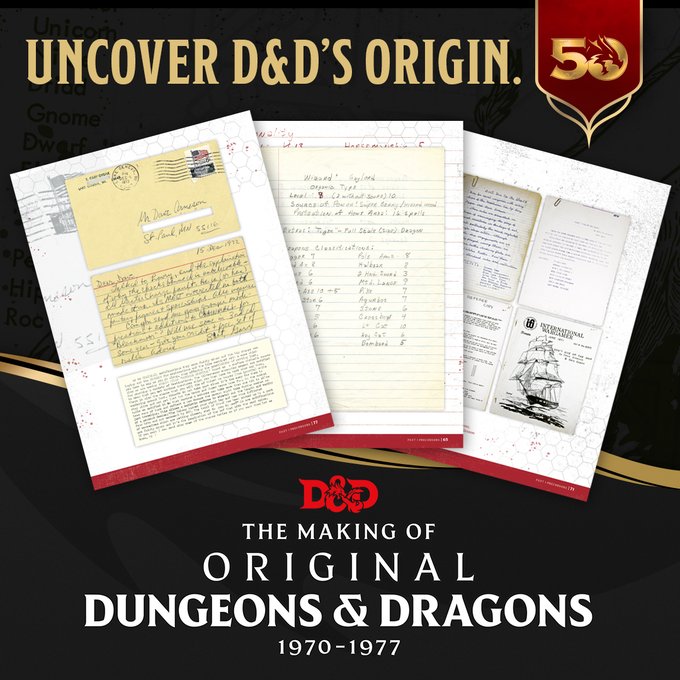
Today is the day! As a reminder, today is the released date of highly anticipated book, The Making of Original Dungeons & Dragons: 1970-1977, a massive (almost 600 pages) tome reprinting the original D&D booklets & supplements; the original draft of D&D and a wealth of other related documents & correspondence. More details about the contents can be found in two of my earlier posts:

"The Making of Original D&D: 1970-1977": Table of Contents

"The Making of Original D&D: 1970-1977": What Might the Precursors Be?

If you haven't ordered the book yet, it can be found here on Amazon:

The Making of Original Dungeons & Dragons: 1970-1977

Recent Promos:

The official D&D account has posted several promo photos over the last few weeks, including the one at the top of this post. Here are two of the others:


Promo ad showing pages from Chainmail 2nd Edition


Promo ad showing correspondence between Gygax & Arneson


Monday, May 20, 2024

The Making of OD&D Book: What Might the D&D "Precursors" Be?


The Making of OD&D comes out in less than a month, and the approximately 600-page tome was revealed "in the flesh" last week on the official D&D account on Twitter, with the above photo of an advance copy captioned: "The Making of Original Dungeons & Dragons... it's BIG!" 

If you haven't ordered the book yet, it can be found on Amazon for $99, and with a price-drop guarantee:

The Making of Original Dungeons & Dragons: 1970-1977


Based on the Table of Contents that I re-posted at the beginning of this month, let's take a closer at what might be in the interesting section "Part 1: Precursors", which covers the ancient era before the first draft of D&D (1973). I don't have any particular insider knowledge, so these are simply my best educated guesses based on titles alone:

   Grayte Wourmes (page 10) 

   Fittingly for a game that includes "Dragons" in the title, the Precursor section starts with material that is clearly from a series of articles about Dragons that Gary Gygax wrote in 1969-1970 for the Diplomacy zine Thangorodrim (named after the mountains home to Morgorth's fortress Angband), describing White, Black, Green, Blue and Mottled (aka Purple Worm) Dragons.

   Maps of the Great Kingdom (page 18)

    The use of plural "Maps" suggests this will include at least two maps. One may be the original Great Kingdom map from Domesday Book #9 (1970/1971), which was previously reprinted on page 32 of Playing at the World (2012) by Jon Peterson. 

    Another may be a later one showing the territories of the Great Kingdom; one version of this map was uncovered by Dave Megarry in 2017; see my post from that year titled "Megarry's Copy of the Great Kingdom Map".

    Medieval Weaponry in the Encyclopedia Britannica (page 20)

    In 2014, Jon Peterson wrote in a post on his Playing at the World blog that, "Gygax did indeed rely heavily on the 1911 Encyclopedia Britannica for medieval information in the early 1970s for certain particulars, though that would be a story for another time". So it seems we are getting that story now. 

    I also note that on EnWorld in 2002, Gygax mentioned his "set of Eleventh Edition ENCYCLOPEDIA BRITANNICA that my most honored maternal grandfather bequeathed to me". The Eleventh Edition of EB has its own Wikipedia page.

   Chainmail's Fantasy Supplement (page 26)

    This is, obviously, the fantasy section that makes up about a quarter of the Chainmail miniatures rules. From the preview page that has been shown, the book will reprint the version from the 2nd Edition, published by Guidon Games in 1972.

    Gygax on Armor (page 46)
    
    This may be an article that Gygax wrote for Panzerfaust #43, April 1971, which Jon Peterson discussed on his blog in 2014.

    The Battle of the Brown Hills (page 50)

    This is a relatively well-known Chainmail scenario between the forces of Law and Chaos that Gygax wrote up for Wargamer's Newsletter #116, published in November 1971. These days you can play in it on a sand table as part of the Legends of Wargaming series run annually at Gary Con thanks to Paul Stormberg. This year it was run in the basement of 330 Center Street, where Gygax lived when he worked on the initial D&D rules.
    
    Arneson's "Medieval Braunstein" (page 54)

    In a 2014 post on the Playing at the World blog, Jon Peterson described a document with this same name "A surviving set of instructions for a 1970 medieval multiplayer game".
    
    Blackmoor Gazette and Rumermonger 2 (page 58)

    This is an issue of a campaign newsletter put out by Dave Arneson. The first issue can be seen here on the Playing at the World blog.
    
    "Points of Interest in Black Moor" (page 60)
    
    An article by Dave Arneson that originally ran in Domesday Book #13 (July 1972), and was later reprinted in the First Fantasy Campaign supplement published by Judges Guild.

    The Wizard Gaylord (page 64)
    
    Likely the same "surviving character sheet from the Blackmoor Campaign, that of Pete Gaylord's character the Wizard of the Wood (best known from the brief biography in First Fantasy Campaign)" that previously appeared on page 367 of the Playing at the World book (2012).

    Loch Gloomen (page 68)
    
    Blackmoor historian Dan Boggs described, in a 2014 post on his blog Hidden in Shadows, how in the spring of 1972, play in the Blackmoor campaign moved to an area known Loch Gloomen, or Lake Gloomy. Material from this era appears in a section titled "Loch Gloomen" in the First Fantasy Campaign. So this is likely some of the surviving original material from this era written by Arneson.

    Outdoor Survival (page 72)
    
    Excerpts from the rules of the board game Outdoor Survival, published by Avalon Hill, which was in the list of recommended Equipment in OD&D Vol 1 (Men & Magic) and heavily influenced the rules for Wilderness Exploration in Vol 3 (The Underworld and Wilderness Adventures).

    Gygax/Arneson Blackmoor Correspondence (page 76)

    Personal letters between Gary Gygax and Dave Arneson prior to the development of the first draft of D&D.

Wednesday, May 1, 2024

"The Making of Original D&D: 1970-1977": Table of Contents


Above is a screenshot of the Table of Contents for the forthcoming book, The Making of Original Dungeons & Dragons: 1970-1977, which I've written about previously. This was shown at a 50th Anniversary Panel at Gary Con in March, and later shared on D&D Beyond, and now can be seen on the Amazon order page, where the book is available for pre-order for $99, and with a price-drop guarantee:

The Making of Original Dungeons & Dragons: 1970-1977

There's over 576 pages of content in this book, and the page numbers confirm the previously reported but still-stunning news that the tome will include all or most of the original 1973 OD&D draft (pages 84-181), the three OD&D LBBs (pages 202-328), the Greyhawk supplement (pages 356-415), the Blackmoor supplement (pages 430-497), the Eldritch Wizardry supplement (pages 506-569), plus a slew of material from correspondence, drafts, player notes, and magazine articles.

For posterity (including future searchability), here is a text transcript of the contents, into which I've inserted some of the promotional images for the book in their appropriate places:

Table of Contents

Preface (page 4)
Foreword (page 6)

Pages 8 and 9

Part 1: Precursors (page 9) (Read more about what these documents are here)
    Grayte Wourmes (page 10)
    Maps of the Great Kingdom (page 18)
    Medieval Weaponry in the Encyclopedia Britannica (page 20)
    Chainmail's Fantasy Supplement (page 26)
    
Pages 28 and 29
    
    Gygax on Armor (page 46)
    The Battle of the Brown Hills (page 50)
    Arneson's "Medieval Braunstein" (page 54)
    Blackmoor Gazette and Rumermonger 2 (page 58)
    "Points of Interest in Black Moor" (page 60)
    The Wizard Gaylord (page 64)
    Loch Gloomen (page 68)
    Outdoor Survival (page 72)
    Gygax/Arneson Blackmoor Correspondence (page 76)

Part 2: The 1973 Draft of Dungeons & Dragons (page 79)
    Greyhawk and the Revised Great Kingdom Map (page 80)
    The First Draft of D&D (page 84)
    The Twin Cities Draft (page 182)
    The Mornard Fragments (page 188)
    The "Clean-Up Crew" (page 198)

Part 3: Original Dungeons & Dragons (page 201)
    Expanding the Rules (page 201)
    Draft Versus Published Version (page 202)
    The Brown Box and the White Box (page 202)

Pages 288 and 289

Part 4: Articles & Additions  (page 329)
    Monsters' Attacks and Damage (page 330)
    Greyhawk Player Maps (page 336)
    Gygax in Europa (page 338)
    The Strategic Review 1 (page 348)
    Greyhawk (page 356)

Pages 199, ?, and 414


    Excerpts from the Strategic Review (page 416)
    Blackmoor (page 430) 
    Additional Excerpts from the Strategic Review (page 498)
    Eldritch Wizardry (page 506)
    The Dragon (page 570)
    Gods, Demi-gods and Heroes (page 574)

Afterword: A Whole New Game (page 576)

While it remains jaw-dropping that WOTC is publishing a book of this nature, and the contents themselves are far beyond what anyone would have predicted, just for completeness sake I will note a few items that are apparently not included:

---The contents only list Chainmail's Fantasy Supplement, so it looks like it will not include the entirety of Chainmail, making it a bit less useful as a complete resource for OD&D, as running OD&D using Chainmail combat also requires the non-Fantasy portions. However, you can get a reprint of the complete Chainmail for less than $10 at DMs Guild, so it's easy to find this material.

---Gods, Demigods & Heroes is listed in the contents, but starts only two pages before the Afterward, so obviously this section is just a brief look at this supplement rather than the whole book.

---There's no mention of Holmes Basic in the contents; thus, if there's any coverage it will the be in Afterword ("A Whole New Game"). I haven't seen an exact page count for the book, so I don't know how long the Afterword is. Based on the originally announced title for the book, which included the dates "1970-1976", I wasn't expecting anything about Holmes Basic in it; but when the title was tweaked to "1970-1977", it seemed possible that it might get at least a page or two of its own, possibly discussing the Holmes Manuscript, which is based purely on OD&D. 

As noted above the book is over 575 pages as it is, so I'm not really surprised that there was indeed some limit to the expansiveness of the material that they could include.

See also these other posts:

The Making of OD&D Book: What Might the "Precursors" Be?

"How Dungeons & Dragons Started" (video about the book)

"The Making of Original D&D: 1970-1977": Everything we know about this upcoming WOTC book

Megarry's Copy of the Great Kingdom Map

Wednesday, February 14, 2024

"The Making of Original D&D: 1970-1977"

Everything we know about this upcoming WOTC book


"The Making of OD&D 1970-1977" promotional book image,
showing four ribbon bookmarks!


Last December, at a panel at PAX Unplugged called "50 Years of D&D Adventures", Wizards of the Coast announced their new books for 2024, which included a surprising release tied to the 50th anniversary of D&D: The Making of Original Dungeons & Dragons: 1970-1976  (The panel was recorded & is available here; see the 57:20 mark).


"Sneak Peak" image shown during the panel presentation


The panel members indicated that the book will be over 500 pages (!), will "a replica of the original Dungeons & Dragons game, page for page", "never-before seen correspondence" between Gygax and Arneson, and historical context by Jon Peterson (of Playing at the World). The "Sneak Peek" image appearing on the screen during the presentation shows two page spreads from the book, the one to the left showing the first page of the Fantasy Supplement of Chainmail, and the one to the right showing the title page of OD&D Volume 3, The Underworld & Wilderness Adventures. And the background shows a version of the Great Kingdom map, suggesting this may appear in the book as well.

Just after this I saw Jason Tondro, a WOTC Senior Designer who started playing with Holmes Basic, and previously worked on the Deck of Many Things (which looks interesting), post on FB that he had spent "most of the last six months on it and y’all are in for some surprises". 

Then, a few days ago, WOTC provided an updated release schedule that says that the book will come out on June 18th. Interestingly, the title has now been updated to "1970-1977" in this press release and also the mock-up promotional image shown at the top of this page. Does this change mean that it will discuss Holmes Basic, released in 1977, and edited by J. Eric Holmes from the OD&D booklets?

The full description from the press release reads:

"The ultimate book showcasing D&D's inception, including Gary Gygax's never-before-seen first draft of D&D written in 1973, a curated collection of published fanzine and magazine articles contribute to D&D's origin story. Each document is introduced, described, and woven into the story by one of the game's foremost historians, Jon Peterson."

The "new news" here is that the book will also include a "draft of D&D", which is most likely the draft termed "Guidon D&D" by Peterson, and also contemporary articles. The inclusion of the draft is particularly noteworthy and exciting as this is a document that has never before been shared with the public in its entirety.

The promo image of the cover shows four ribbon bookmarks in different colors that appear to correspond to sections of the book, which are colored along the bottom of the page in the "Sneak Peek" images, with red corresponding to Chainmail and yellow corresponding to the original D&D volumes.

I saw a post on Twitter that unlike the other forthcoming WOTC books, which will be released in both physical and digital formats, this one will only have a physical release. So unfortunately no pdf option. 

So, in summary, we now know the 500 pages of this tome will cover the years 1970-1977, and include at least:
  • "Gary Gygax's never-before-seen first draft of D&D written in 1973"
  • "a replica of the original Dungeons & Dragons game, page for page"
  • "never-before seen correspondence" between Gygax and Arneson
  • "a curated collection of published fanzine and magazine articles"
  • historical context by Jon Peterson

The book is already available for pre-order at Amazon for $99, but also with a price-drop guarantee:

The Making of Original Dungeons & Dragons: 1970-1977

I've already pre-ordered it myself!

Note that while The Art & Arcana Deluxe, which is the previous WOTC publication most similar in nature to this one, still has a list price of $125 on Amazon, it is currently for sale for $66. Looking at my records, the price when I pre-ordered it was $100, but with the pre-order price guarantee I got it for $63.50.

Update: 

Just out today (2/15/24) is a fascinating interview with Jason Tondro, who I quoted above, further detailing the contents of this book. From this it's clear it will include the entirety of 2nd Edition Chainmail, the "Guidon D&D" draft, the first printing of the LBBs (complete with the Tolkien references) and the first three supplements, among much other correspondence and magazine articles. It's a long interview (38+ minutes) but well worth the time spent watching it.

See also:

OD&D Discussion thread

Dragonsfoot discussion thread

EnWorld discussion thread

See also these other posts:

The Making of OD&D Book: What Might the "Precursors" Be?

The Making of OD&D Book: Table of Contents

Megarry's Copy of the Great Kingdom Map

Thursday, February 4, 2021

Chainmail Announcement from Domesday Book #9


Above is an early (perhaps the first) announcement for Chainmail, from the Domesday Book periodical, issue #9. While referred to simply as "Medieval Miniatures rules", they are by Gary Gygax and Jeff Perren, include a Fantasy Supplement "for fighting Tolkien-type battles", and are sold by Lowrys Hobbies, so there's no mistaking what it is for.

This excerpted image was posted by Rob Kuntz here on EnWorld in 2019, and its existence was earlier noted in Playing at the World, both the book (page 42) and the blog ("this issue contains the first notice of the publication of Chainmail in the Domesday Book"). I'd thought I'd share it here because I don't think a lot of folks have seen it.

For search-engine posterity, here is the transcribed text:

"Announcing a completely revised set of Medieval Miniatures rules, with a large         fantasy suppliment for fighting Tolkien-type battles, by Gary Gygax and Jeff                   Perren (of course!). For this and your wargaming needs it's                                     LOWRYS HOBBIES, Box 1123, Evansville, Indiana 47713 Giant Catalog - 50¢"

Lowrys Hobbies was the previously established Evansville-based mail-order business of Don Lowry, who in 1971 founded Guidon Games to publish Chainmail and other games; in 1972 he moved both to Belfast, Maine. Here's the cover of a 1972 Lowrys catalog still showing the Evansville address:


The "(of course!)" aside presumably refers to the fact that Perren & Gygax had published their medieval rules in an earlier issue of the Domesday Book (#4, July 1970), titled "The LGTSA Miniatures Rules". You can read more about these rules, which did not yet include a Fantasy Supplement, here on the Playing at the World blog.

The Acaeum page for the Domesday Book has issue #9 as "Date Unknown" (indicated here as "undated"), but dates the next issue as "April 1971", which would place issue #9 as earlier that that. However, this April date seems to be taken from the date of the one of the articles ("Ancients Society Report, Last Issue, 4/30/71"), which since this is at the very end of April might mean that #10 was actually published later. Playing at the World indicates that issues #8-11 came out "roughly quarterly" (page 634).

Over on the mostly defunct but still useful Tome of Treasures forum, poster scribe wrote that the April 1971 issue of International Wargamer has a full-page advertisement for Guidon Games that includes Chainmail: International Wargamer April 1971 listing at ToT.

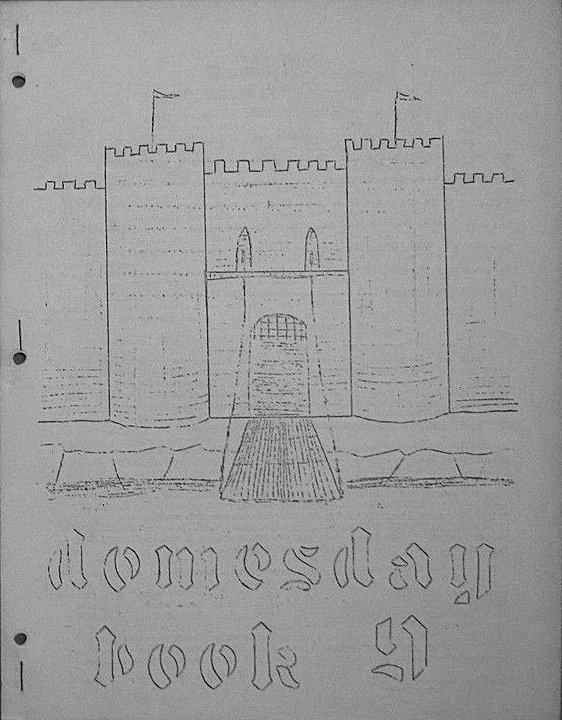
Domesday Book #9 also contained the first map of the Great Kingdom, which eventually led to the settings for both Arneson's Blackmoor and Gygax's Greyhawk campaign. An auspicious publication!


The cover of Domesday Book #9 as shown on the Acaeum


(The above material is revised from my posts on the EnWorld thread link above).

Friday, October 26, 2018

Locations for the Tomb of Horrors on the Great Kingdom Map


Promo image of the deluxe Art & Arcana from Amazon


"THE TOMB OF HORRORS"


Possible locations:

The highest hill in the Egg of Coot
An island lying 100 miles east of Blackmoor
In the great desert west of the Wild Coast
On the border between the Paynim Kingdom and Perrunland
At the Eastern edge of the Duchy of Geoff
In a swamp somewhere in the Wild Coast

These suggested locations for the Tomb of Horrors come from the original version of the adventur not the 1978 monochrome-colored module  but an even earlier iteration that was produced in 1975 for running as a tournament at Origins I in Baltimore, Maryland. This version is finally available as an extra included with the "special edition" of the new D&D art book Art & Arcana. You can see its cover in the promo image above; it's the small beige booklet featuring the original artwork by Tracy Lesch of the infamous Green Devil Face, which was later memorably rendered in color on the back of the 1981 reprint. Given its early date, it's a purely OD&D version of the tomb and is a great addition to the meager assortment of "TSR" adventures for OD&D.

These original suggested locations fit well with the "Great Kingdom" (early World of Greyhawk) map that I've discussed in previous posts such as Megarry's copy of the Great Kingdom Map, and suggest that Gygax may have been using this map for Greyhawk at the time. For reference, here is the map image 


On this map, the Egg of Coot lies in the center north, with hills in the northern region of the realm to possibly house "the highest hill". Blackmoor is to the south on the coast of the Great Bay, with plenty of space for an island "lying 100 miles east" in the bay, or depending on the scale, past the island kingdoms of the "Sea". To the west and southwest of Blackmoor, the Paynim Kingdom borders on Perrunland. Much further to the south lies the Duchy of Geoff, the eastern edge of which borders on the Kingdom of Faraz (not mentioned in the Tomb). Only the twice-mentioned Wild Coast is missing from this map, but the "great desert west of the Wild Coast" may be the Sea of Dust, suggesting the Wild Coast is to the south where the coast past of Keoland.

In the published version of Tomb of Horrors, the suggested locations were changed to:


The highest hill on the Plains of luz
An island (unmapped) In the Nyr Dyv
In the Bright Desert
At the western border of the Duchy of Geoff
Somewhere in the Vast Swamp south of Sundi
On an island beyond the realm of the Sea Barons

These revised locations correspond more closely to the published World of Greyhawk, although note that they were suggested in 1978, which was still several years before the World of Greyhawk Folio was first published in 1980.

The Egg of Coot was changed to "the Plain of Iuz"; Iuz occupies a somewhat similar north-central location in published Greyhawk and has "the Howling Hills" to the north.

The second entry, the island, was relocated to an unmapped island in Nyr Dyv, and second island was added "beyond the realms of the Sea Barons", which is closer in spirit to the island to the east of Blackmoor, particularly if the islands shown on the Great Kingdom map were an early version of the Sea Barons.

The desert was changed to "the Bright Desert", which on the published Greyhawk map is to to the east, rather than west, of the Wild Coast across the Woolly Bay. The "great" bit is dropped, presumably because the Bright Desert is much smaller than the Sea of Dust.

The eastern border of Geoff was changed to the western, presumably because that borders the great Crystalmist mountain range.

The swamp location was changed to "south of the Sundi", which means the Vast Swamp south of the County of Sunndi (member of the Iron League) on the Darlene map.

Finally, the suggestion of the border of Paynim/Perrenland was completely removed. In the Darlene map, the Plains of the Paynims no longer directly borders Perrenland; there are several new kingdoms between — Tusmit, Ket.

When the World of Greyhawk folio was finally published in 1980, the true location of the Tomb was finally revealed as being in the Vast Swamp:

There are many tales and legends concerning this area, but the most likely is that of the TOMB OF HORRORS (ADVANCED DUNGEONS & DRAONGS MODULE S1), the lost burial place of a lich who once ruled the morass and beyond into the cockscomb of Tilvanot. (a peninsula in the shape of a rooster's comb).

And then the expanded 1983 Word of Greyhawk boxed set further fixed the location as "probably" in "the heart of the Vast Swamp, in hex K2-97".