This is the blog. Click here to go to the Zenopus Archives website.

Note: Many older posts on this blog are missing images, but can be viewed at the corresponding page in the Internet Archive

FEATURED POST

The Forgotten Smugglers' Cave: Index of Posts

An index of posts describing the Forgotten Smugglers' Cave, an adventure for Holmes Basic characters levels 2-4.                    ...

Showing posts with label Monster List. Show all posts

Wednesday, May 29, 2024

Gygaxian Monster Paralysis: Permanent?


Letter from Gygax to an fan (1989)


A not uncommon question about the rules in Holmes Basic is: "How long does the paralysis inflicted by Carrion Crawlers, Gelatinous Cubes or Ghouls last?"

This is asked because, in the Holmes rulebook, an attack by each of these monsters inflicts paralysis unless a saving throw is made, but none of the respective entries indicate how long the victim remains immobilized. One might assume that it wears off at some point after an encounter is over, or one might turn to the Wand of Paralyzation, which in Holmes has a duration of 6 turns for a failed save. Other than that, there's no specific guidance.

The lack of durations reflects the OD&D source material that Holmes relied on when editing the manuscript for the Basic rulebook. Carrion Crawlers and Gelatinous Cubes were introduced in the Greyhawk supplement, but neither specifies any duration for the paralysis they inflict. Ghouls were introduced earlier, in Vol 2 (Monsters & Treasure), where it says, "As stated in CHAINMAIL for Wights, Ghouls paralize any normal figure they touch, excluding Elves" (page 9). In Chainmail, the entry for "Wights (and Ghouls)" does make clear that their paralysis lasts for "one complete turn" of that game (page 33, 2nd edition), and while it is clear that Holmes did consult those rules for some aspects of Basic (such as the Parrying rule), for whatever reason he did not include this information, and neither did Gygax when he revised the manuscript before publication.

If Gygax eventually recognized that the omission of durations for paralysis in OD&D and Holmes Basic was an oversight, he had an opportunity to correct that in the AD&D Monster Manual, which came out about 6 months after Holmes and revised most of the existing D&D monsters. But he did this for only one of the three, the Gelatinous Cube, which now paralyzes for 5-20 (5d4) rounds. Notably, this duration also corresponds to the revised duration for the Wand of Paralyzation given in the AD&D Dungeon Masters Guide, published a few years later in 1979.

The Monster Manual still lacks durations for the Carrion Crawler and Ghoul as well as a number of new sources of paralysis: the breath weapon of Silver Dragons, the touch of Ghasts, the tentacles of the Giant Portuguese Man-O-War, and the secretions of the Slithering Tracker. 

Why the seeming reluctance to add durations for monster paralysis? Later TSR products varied quite a bit in attempting to fill in the "missing" durations (look below for a list), which suggested that it was simply an oversight that was only slowly corrected. But was there another reason?

A recently uncovered 1989 letter from Gygax to a fan in Ecuador, posted on FB (see the image up above), sheds some light on his original view of paralysis. Unexpectedly, Gygax writes: 

"Paralysis might be permanent. I finally gave in and said 5-20 minutes, but... I like it better as permanent until removed by something. You choose."

As an AD&D round corresponds to one minute, the 5-20 minutes noted here corresponds exactly to the 5-20 rounds that newly appears for the Gelatinous Cube in the Monster Manual, and for the wand in the Dungeon Masters Guide.

Thus, Gygax's comment surprisingly suggests that the reason he didn't include a duration for monster paralysis in early D&D products was because he viewed such paralysis as "permanent until removed by something"...! 

His "something" is vague and not further explained in the letter. One possibility would simply be the same thing that restores hit points in OD&D: a return to base for complete rest. Per OD&D Vol 3: "On the first day of complete rest no hit points will be regained, but every other day thereafter one hit point will be regained until the character is completely healed. This can take a long time" (page 35). Others include those given in later rulesets: the second iteration of the Basic rulebook (Moldvay Basic) in 1981 newly allowed for Cure Light Wounds or Healing Potions to remove paralysis, and for AD&D, Lenard Lakofka created a new 3rd level cleric spell, Remove Paralysis, that appeared in Dragon #58 (February 1982) and then was compiled in Unearthed Arcana in 1985

While "permanent" paralysis may seem harsh, if viewed in the context of a game also replete with "save or die" poisons, "save or permanent paralyzation" fits in as a permanent consequence that is not quite as bad as death.

* * * * *

As an addendum, with regard to Carrion Crawler & Ghoul paralysis, later TSR D&D products gave a variety of answers to this:

---In T1 The Village of Hommlet (1979) by Gygax, ghoul paralysis is given a duration of 3-12 (3d4) turns.

---In Dragon #37 (May 1980), the Sage Advice column written by Jean Wells answered the question, "How long does the paralysis caused by a carrion crawler, ghast or ghoul last?" with "I have always assumed it to be 24 hours. However, since the duration of the paralysis is not clearly defined in any of the books, I suggest that each DM decide the duration in his particular campaign" (page 12). I note that a duration of a full day is much closer to the "permanent until removed by something" suggested by Gygax than any of the other suggested durations listed here.

---In Dragon #39, a followup Sage Advice column clarifies the above: "According to Lawrence Schick, Vice-President for Production and Design at TSR Hobbies, the paralyzation caused by carrion crawlers is of the same duration as that caused by ghouls— 3-12 turns. Paralyzation caused by a ghast takes twice as long—6-24 turns—to wear off". This duration for ghouls is the same as given in T1.

---In Moldvay Basic (1981), the paralyzation of Carrion Crawlers, Gelatinous Cubes, Ghouls and new Thouls is standardized as a shorter 2-8 (2d4) turns.

---In Polyhedron #2 (Autumn 1981), in the Dispel Confusion column, Gary Gygax answered the question, "How long does (or should) paralysis caused by a carrion crawler last? And what, if any, are the effects of multiple hits by this creature?", with: 

"Paralysis from creatures lasts as long as paralysis from a wand: 5d4 (5-20) rounds (DMG page 136). Multiple hits from a carrion crawler (or any other paralyzing creature) forces multiple saving throws on the part of the victim; when any one is failed, the other hits have no further effect on the paralysis (damages still apply if given, such as by a ghoul or ghast)." 

This is the only published source that really matches Gygax's later letter in giving a generalized 5d4 rounds for paralysis. 

---In TSR's Monster Cards (1982), part of the AD&D line, Ghoul and Carrion Crawler paralysis are instead each given a duration of 2d6 turns. These cards include revised entries from the Monster Manual, so are often viewed as "official" revisions for AD&D.

---In the AD&D 2E Monstrous Manual (1989), we see a different duration for each monster: Carrion Crawler, 2d6 turns; Gelatinous Cube, 5d4 rounds; Ghoul, 1d6+2 rounds; and the Ghast, 1d6+4 rounds.

Thursday, September 1, 2022

Slurry (New Monster)

Slurry

Move: 30 feet/turn on land, 180 feet/turn in water
Hit Dice: 2
Armor Class: 2
Treasure Type: Q (gems only)
Alignment: neutral
Attacks: 1 blast of sandy water
Damage: 1d6

It is rumored that grizzled beachcombers search on forlorn shores for springs that bubble forth from the sand, because some such springs, if fed certain metals and a rough gem, will return the gem in expertly polished ovoid form.

Sages speculate that such springs are the temporary dwelling of a slurry, a small elemental haling from the Plane of Water, which has opened a gate from that plane in order to visit the Prime Material Plane in search of rare minerals to feed on. Being composed of primarily of water, but with an admixture of gritty sand, their natural form is amorphous and allows them to take on a variety of small watery shapes, be it sandy bubbling pool, eddy or spout.

Each turn that a creature is within the vicinity of such a spring has a 1 in 6 chance of drawing the attention of the slurry, unless it is fed as outlined below. The slurry will surface in the center of the waters and begin spraying the intruder with concentrated blasts of sandy water, once per round, until they retreat out of range (which is equivalent to a long bow). As with other elementals, a slurry can only be hit by magical weapons, and if it is destroyed, the gate will close in 1d6 rounds.

Living creatures that enter the churning waters of the spring will be able to swim, but will take 1 point of damage per round from the abrasive force of the sand in the water, unless they have a natural AC equivalent to chain mail or better.

Anything non-buoyant, yet lighter than fifteen pounds, dropped into the waters will bubble back to the surface in 1d6 rounds (1-9 in 10) or pass through the gate to the Plane of Water (on a 10). A gem treated in such a manner that resurfaces has a 1 in 6 chance of returning at the next higher value on the Gems table. Adding gold or platinum (10 GP worth) increases the churning of the pool as the slurry feeds on the metals, raising to 4 in 6 the chance of the gem increasing in value, but only once per day, and there is a 1 in 6 chance each day that it is fed that the slurry will be sated and depart to its home plane, closing the gate behind it.

Anything heavier than fifteen pounds that sinks into the waters has a lower chance of being ejected (1-8 in 10) passing to the Plane of Water (9 or 10 in 10). Furthermore, such an object will have a 3 in 6 chance of causing the slurry to surface in the middle of the pool and attack as outlined above.

Notes

(1) A slurry appears in Area 12 of the Forgotten Smugglers' Cave adventure.

(2) Inspiration for this monster comes from my childhood. A beach on a river near where I grew up had a spring that produced a tiny patch of bubbling sand several feet from the shore. We would push our plastic animals and dinosaurs several inches down into the bubbling waters (which we called "The Bubbly") and wait for them to be pushed back to the surface.

Sunday, February 13, 2022

Superb Owl Sunday

Giant Owl by Darlene

Here's my pick for today's Superb Owl:

 "Giant owls speak their own language ... [t]hese creatures are intelligent and will sometimes befriend other creatures" --- Gary Gygax, from the entry for Giant Owl in the AD&D Monster Manual, 1977

There was no illustration accompanying the Giant Owl entry in the original Monster Manual, but one by Darlene (attributed at the time to Darlene Pekul) was included in the Dungeon Masters Guide in 1979, on page 184 beneath the table for "OUTDOOR RANDOM MONSTER ENCOUNTER TABLES: Arctic Conditions", which includes a Giant Owl among the entries; presumably this represents a Snowy Owl variant.

Find more "Superb Monsters" from the Monster Manual here:

d20 Unexpectedly Intelligent Monsters in the Original Monster Manual

Tuesday, July 27, 2021

d20 Unexpectedly Intelligent Monsters in the Monster Manual (1977)


Tom Wham's classic comic commentary on unexpectedly intelligent monsters


Happy Gary Gygax Day 2021! 

To celebrate, here's a post about Gygax and Arneson's monsters:

Every competent adventurer expects to encounter intelligent monsters like dragons, minotaurs and vampires, but in other cases brainpower and the ability to communicate lurk where they might not be expected. This type of twist didn't feature much in the original monster list in Monsters & Treasure (Vol 2 of OD&D), but really started to take off in the monsters added in the supplements (particularly Blackmoor and Eldritch Wizardry) and in the Strategic Review. These were eventually compiled, along with more additions, in the AD&D Monster Manual, with each monster now having a formal Intelligence stat. Many of the "secretly intelligent" monsters remain under-appreciated and/or underused, at least with respect to their intellect. Let's take a look at them, and since it's D&D, I've written it up as a table so you can roll one to use as a potentially "chatty" encounter in your next dungeon:

d20 Unexpectedly Intelligent Monsters in the Monster Manual

1. Ape, Carnivorous: "Low (upper)" (7). The ordinary ape, listed as "Ape, (Gorilla)", has Low (5-7) intelligence, but its "larger, stronger and very aggressive relative" is at the upper end of that range, having a "fair intelligence (IQ 70+) and being "very cunning". Disturbingly, these smarts correspond with a sinister craving, as it "hungers particularly for human flesh"...

2. Beaver, Giant: Low to Average (5-10). While the other unusually-sized rodent in this book, the Giant Rat, is only semi-intelligent, the Giant Beaver at the high end approaches the average for human intelligence, i.e., 10.5 on a 3-18 bell curve. Furthermore, their description indicates an interest in coins, trading, and building dams for profit, which means that they are essentially an unexpected and woefully underused NPC race for characters to interact with. The details in the Monster Manual go back to the original writeup in the Blackmoor supplement, which also includes "gourmet bark" (!) in the list of valuables they will trade for. Dan Boggs has speculated in a post on ODD74 that they were one of the monsters written up by Dave Arneson himself. To me, they feel like an amalgamation of the prehistoric giant beavers that existed in the U.S. until relatively recent times, which were similarly 6 feet long, and Mr & Mrs Beaver from The Lion, the Witch and the Wardrobe.

3. Beetle, Boring: Animal (1). With six different varieties of giant beetle, each one needed a distinguishing trait, and for the Boring Beetle this feature is a hive mind. Thus, alone among beetles, the Boring Beetle has an intelligence score above zero, which fuels alternative-agriculture skills in the form of farming "molds, slimes and fungi substances", and (per rumor, but in D&D the monster rumors are always true, right?) developing "a communal intelligence which generates a level of consciousness and reasoning ability approximating that of the human brain". As with the Giant Beaver, these details go back to the Blackmoor supplement, and likely Arneson, which elaborates on these farming practices: they grow "yellow mold for food, as well as cultivating many of the other vile jellies and slimes often encountered in dungeons" and "[t]hey start their nauseating cultures by gathering various dead bodies and rotting offal and add a small bit of the substance to stimulate growth (sort of putrid Petrie dishes)" I think the implication here is that their practices are partly responsible for the "the clean-up crew" being so prevalent in dungeons! Not quite so, ahem, boring?

4. Dolphin: Very (11-12). While everyone knows that Dolphins are on the intelligent side for animals, in D&D they boast a score above the average for humans, and towering over their underachieving cetacean kin, the whales, who can only boast a score of Low (5-7). Furthermore, ten percent of dolphins go so far as to form "underwater communities" that are sufficiently organized to employ guards from other species, such as swordfish or narwhals. This is yet another creature first written up for the Blackmoor supplement, but Boggs places their authorship with contributor Steve Marsh, later thanked in the Monster Manual for "for devising the creatures for undersea encounters which originally appeared in BLACKMOOR". The original writeup places even more emphasis on their "great intelligence", as they can communicate with other dolphins using telepathy, and in battle employ a "war harness", a rig with "a long wicked spear that protrudes in front"...!

5. Gray Ooze: Animal (1). Most of the clean-up crew cohort are non-intelligent, including Black Puddings, Gelatinous Cubes, Green Slimes and Ochre Jellies, but the Gray Ooze is a slightly higher order of creature, having animal intelligence. And with great size they can transcend even this modest brain-power: "In exceptionally large individuals an intelligence of a sort is well developed. Furthermore, these exceptional individuals have a latent psionic ability..." that includes a psychic crush attack. This ability was first added in an entry in Eldritch Wizardry in the section on Psionics. Now you are now probably wondering, "Do psionic Grey Oozes dream of deliquescing sheep"?

6. Invisible Stalker: High (13-14). In OD&D, these were "an extra-dimensional monster" conjured by the 6th-level magic-user spell of the same name, but here they are revealed to be from the Elemental Plane of Air. Unlike their clerically-summoned cousins, the Aerial Servants, who are only semi-intelligent, or garden-variety Air Elementals, who are of low intelligence, the Invisible Stalker is extremely bright, which is probably why they so often resent being whisked from their home to do a magic-user's grunt work. Note that the entry for Air Elemental also indicates that on the plane of air are "certain intelligent air elementals which have special abilities beyond the above". 

7. Lynx, Giant: Very (11-12). See Tom Wham's cartoon at the top of the page, which sums it all up much better than this wordy blog post.

8. Mimic, Lesser: "Semi- to Average" (2-10). Mimics have a much wider range in intelligence than most monsters because, as the text reveals, there are actually two types: the larger "killer mimic", which is only semi-intelligent and "the slightly smaller, intelligent sort". The smart ones are "generally friendly if offered food", which is a rare instance of the Monster Manual using the term "friendly" in reference to a non-humanoid monster, and even better, they may "tell a party about what they have seen nearby". To aid in this advanced food-gathering tactic they have evolved a facility for languages, typically being able to speak "several other tongues such as common, orcish, etc" in addition to their own.

9. Mold, Yellow: "Non- (see below)" (0). While the typical Yellow Mold is not a deep thinker, or even a thinker at all, here size once again begets unexpected brainpower: "When formed into great colonies of at least 300 square feet in area this growth will form a collective intelligence about 1 time in 6. If this should happen the yellow mold will be aware mentally and psionically" and can attack equivalent to "the most powerful form of id insinuation." As with the Grey Ooze, this ability was first noted in Eldritch Wizardry. In addition to a psionic attack, the mental awareness suggests the colony might be communicated with via telepathy, assuming you took "Yellow Mold" as one of your languages.

10. Neo-Otyugh & Otyugh: Very (11-12) & Average (8-10). I've combined these because they obviously should have been one entry in the Monster Manual like the Mimic. I mean, the Neo-Otyugh entry is basically just: "bigger and smarter otyugh". These creatures dwell in the same ecological niche as the trash compactor monster in Star Wars, although they were published first, with the Neo-Otyugh appearing in the 1976 tournament version of the Lost Caverns of Tsojconth (see a pic here at the OSR Grimoire). Nobody expects a trash monster to be an Einstein, but unexpectedly the Otyughs are often as smart as the average human, speaking their own language and being "semi-telepathic, thus often able to communicate with other life forms when the otyugh so desire". Which is presumably useful for telling the boss when the dungeon septic tank needs to be cleaned out.

11. Octopus, Giant: Animal (1). While only a single point smarter than their dimmer cousins the Giant Squid, Gygax casts these overgrown cephalopods in a completely sinister light that appears to hint at even greater mental prowess. Specifically, they have an alignment of "Neutral (evil)", are "malicious", have "a cunning intent" and can form gangs with other members of their species "to overwhelm a larger ship if the opportunity presents itself". This evil disposition is a distinct change from their earlier writeup in the Blackmoor supplement, where they were "generally peaceful" and only attacking ships "after provocation". 

12. Owl, Giant: Very (11-12). While less unexpected than the other entries here in view of the association of owls with intelligence, giant owls "will sometimes befriend other creatures" and "speak their own language". A value is still given for their eggs, because humans are horrible.

13. Roper: Exceptional (15-16). This living stalagmite with octopus arms turns out to have the highest intelligence of all the monsters in this list, being way smarter than most humans. It was originally written up in Strategic Review #2 in very similar format, including a "Highly Intelligent" stat. There is no further mention of this intellect in either source, but it goes to show that in D&D, one would be foolish to underestimate "a mass of foul, festering corruption".

14. Shambling Mound: Low (5-7). Being a walking pile of swamp moss, one might expect a score of "Non-" here, but no, "Shamblers" (in Gygaxian slang) are actually smarter than a number of Fighters, as per the AD&D Players Handbook, with an intelligence of 5 or lower one can only be a Fighter. There's no other mention of any particularly brainy behavior, but I'm guessing that this score is a result of its comic book inspiration ala Swamp Thing, Man-Thing or the Heap.

15. Slithering Tracker: Average (8-10). This awesomely-named, plasma-draining, cleaning-crew-adjacent monster is often overlooked, most likely because there is no picture of it (but see the never published one here by Bill Willingham). They are much smarter than any of their relatives, perhaps having evolved such intelligence to aid in tracking their prey. A candidate for your next ranger character?

16. Spider, Giant, Phase & Giant Water: Low (5-7) or Semi- (2-4). Spiders in general follow the trend noted above of "bigger is brighter": Large Spiders (HD 1+1) are "Non-" (0), Huge Spiders (HD 2+2) are "Animal (1)", Giant Water Spiders (HD 3+3) are "Semi- (2-4)" and Giant Spiders (HD 4+4) and Phase Spiders (HD 5+5) are "Low (5-7)". There's not much elaboration on the intelligence of the Giant or Phase spiders in their entries, other than that they will flee superior foes (Giant Spiders) or that they will (in more erudite fashion) "seek to evade encounters which are unfavorable" (Phase Spiders), which based on their powers brings to mind Bilbo using the One Ring to avoid unwelcome visitors at Bag End. Giant Water Spiders, despite being only semi-intelligent, exhibit the most interesting of the noted spider behaviors, being approachable if offered food, and thus occasionally becoming pals with aquatic folk like nixies.

17. Strangleweed: Animal (1). Nobody expects an "intelligent kelp". Need I say more...? This is another undersea encounter originally devised by Steve Marsh for the Blackmoor supplement, although the word intelligent does not appear there.

18. Toad, Ice: Average (8-10). This oft-overlooked variety of overgrown amphibian has almost human-level intelligence, which is much, much higher than the "Animal (1)" intelligence of the typical Giant Toad. Furthermore, Ice Toads even have their "own weird language", which might prove useful when asking them for directions to the Glacial Rift of the Frost Giant Jarl.

19. Trapper: Highly (13-14). As this creature is the dungeon-floor counterpart of the more awesomely-named Lurker Above, one might predict a similar "Non-" intelligence, but instead the Trapper is a good degree smarter than the average human. This is perhaps an evolutionary necessity to stay ahead of all those suspicious adventurers. They are further described as "clever" and able to create a "protuberance which resembles a chest or a box", perhaps suggesting a relation to the more intelligent breed of Mimic (see above).

20. Wolf, Winter: Average (8-10). As with the Giant Lynx and Ice Toad, the Winter Wolf is a cold-climate species that is more intelligent than its temperate-dwelling relatives; in this case, both regular and dire wolves, each of which are only semi-intelligent. Winter Wolves are even a cut above the low-intellect Worgs, which based on Tolkien alone one might predict would possess a bit of cunning. What is it about the arctic that fosters intelligence in Gygaxia? As with the other arctic-intellects, they speak "their own language", but being "Neutral (evil)" and having a "foul disposition", I'm sensing a cultural rivalry with the neutrally-inclined Giant Lynx and Ice Toads.

Honorable mentions (since I wanted to keep the above list to 20 entries)Perytons and Umber Hulks, each of "Average (8-10)" intelligence, and each speaking their own language. Perytons were new for the Monster Manual, but Umber Hulks were first written up for the Greyhawk Supplement, but without any note of intelligence or language.

Coda 
Some of these cryptically intelligent races, such as the Giant Beaver, Ice Toad or even Mimic, might even be suitable for use as PCs, particularly in OD&D or Holmes Basic. As it says in OD&D, Vol 1 (and is echoed in Holmes Basic), "There is no reason that players cannot be allowed to play as virtually anything, provided they begin relatively weak and work up to the top". While Gygax infamously later changed his mind on this for AD&D, there was a time when he allowed it in his own games; for more on this, see Balrog PCs gone missing.

See also previous posts for Gary Gygax Day:

Friday, July 19, 2019

Save or Die! Podcast #154


I recently had the pleasure of returning as a guest on the podcast Save or Die!, this time with DMs Carl, Courtney and Chrispy, and it is now available for listening:
Save or Die! Adventure 154 - Holmes Basic
"The three hosts are together again in the latest Save Or Die! where we talk Holmes Basic with our guest the Arch Zenopus himself Zach of the Zenopus Archives. A SOD favorite gets reexplored as we take a deep dive into what makes Holmes Basic such an endearing part of D&D history."
Also, don't miss the Actual Play of the dungeon run by Carl, the first part of which is at the end of the episode (I'm not part of this).

Links for Further Reading on Topics Discussed on the Show:

The Warlock D&D Rules

Holmes Manuscript Part 3: "Elves Muse Decide"

Holmes Manuscript Part 16, covering attacks per round in combat

Holmes Manuscript Part 10, section on Magic Missile

Holmes Manuscript Part 17, section on The Parry

Article on origins of the Ochre Jelly and Blob

Summary of Tolkien References in the Blue Book

Holmes Manuscript Part 19: "If One Wanted to Use a Red Dragon..."

Holmes Manuscript Part 46: "Zenopus Built a Tower": intro to the Sample Dungeon

Zenopus Dungeon Factions, including the Thaumaturgist

Article in a New Cthulhu Zine, Bayt Al Azif issue #1

The Tower of Zenopus in Ghosts of Saltmarsh


Earlier Save or Die episodes that may be of interest:

Side Adventure 20: NTRPGCon Wrap Up 6/14/19 --- at 17:30 Carl talks about how I guested as his version of Zenopus in his Sat night Discos & Dragons game

Side Adventure 16: Favorite Boxed Set 1/7/19 --- at 8:50 Carl talks about Holmes Basic and mentions this site

Side Adventure 14: House Rules! with guest Chris Holmes 10/6/18

Episode 124: Save vs. Zenopus 7/17/16 --- my previous occasion as guest

Adventure 136: Michael Thomas on Journeymanne Rules 5/16/17

Side Adventure 12: J. Eric Holmes Seminar NTRPGCon 8/14/16 --- Audio recording of a  panel with Chris Holmes, Allan Grohe & myself 

Episode 122: Save vs. Chris Holmes 5/11/16

Episode 117: Save vs. Blueholme 11/16/15 --- guest Michael Thomas

Saturday, September 1, 2018

Lizardmen PCs for Holmes Basic

Illustration by Greg Bell from Greyhawk (1975)

     Lizardmen --- are swamp-dwelling saurianoids about seven feet in height when fully grown. Members of the more advanced hut-dwelling tribes can speak a hissing version of Common in addition to their own tongue, and occasionally seek out employment as muscle in more civilized areas. They progress as members of the fighting class, but due to their size and strength gain a bonus hit point at first level and attack on the Monster Table for 1 to 8 points of damage when employing a weapon. Claws and teeth also allow them to attack for 1 to 6 points of damage without weaponry. Their scaly hide affords protection equivalent to chainmail (armor class 5) but due to their affinity for swimming they shun metal armor of any type other than a shield. They move at twice normal rate in water.


Notes
---Adapted from comments I first left to a post in the Holmes G+ group, with some changes on further reflection.

---Holmes has lizardman guards in two Boinger & Zereth stories, The Sorceror's Jewel and In the Bag. One speaks with a hiss and the other wields a halberd (much like the image above). Holmes uses the term "saurianoid" in In the Bag, and "saurian" in the other story.

---The height of seven feet, and the concept of more advanced hut-dwelling tribes, comes from the Monster Manual.

---The stat details comes from the Holmes Basic entry: AC 5, HD 2+1, AT 1, D 1-8 with spear or club. The bonus hit point at first level leads to a total HD of 2+1 at second level, meaning a 2nd level lizardman fighter here is equivalent to the monster version.

---Compared to a first level human fighter they get +1 HP and +1 damage, but with a loss of 2 points of AC (no plate mail). If using variable damage for weapons, you can give them a +1 to damage or step the dice up one notch (d8 to d10, etc). Using the Monster Table (which varies slightly between OD&D and different printings of Holmes) for attacks means a lizardman fighter will generally attack better than a human fighter of equivalent level, but their AC will remain much worse without magic armor (e.g., no plate mail +2). In addition to shunning metal armor, magic armor would generally not be available that fits their size and proportions.

Wednesday, August 29, 2018

Ochre Jelly Inspiration?


Illustration from Worlds of Fantasy #1 (1968)


I've just finished reading Conan of Cimmeria (1969), the second volume of the famous Lancer/Ace series of Conan paperbacks from the late 1960s (the second in internal chronology, not publication order). Nowadays one can easily find compilations of pure Howard material, but back then these slim paperbacks were the main way to encounter Conan. This particular volume is a dog's breakfast of material that includes Howard Conan stories; a non-Conan Howard story edited to be Conan; a Howard draft finished by de Camp; and pastiches written completely by L. Sprague de Camp and Lin Carter. The origin of each story is helpfully identified in the front matter of the book.

The de Camp/Carter stories are essentially filler connecting the Howard tales --- brief stories about Conan encountering some menace while traveling from one region to another. Though less exciting than the Howard stories I've found them to be competently written, and quick reads. And certainly suitable as inspiration for D&D encounters.

The first pastiche in the book is The Curse of the Monolith and was originally printed as Conan and the Cenotaph in the magazine Worlds of Fantasy #1 (1968). The illustration above shows the monster which threatens Conan in this story. It is described as a "huge lump of quivering, semi-translucent jelly", pulsing with "throbbing, bloated life" and glistening wetly as it beats "like a huge, living heart". It first extends a single "slippery pseudopod" that exudes "a digestive fluid, by means of which is consumed its prey", later joined by more pseudopods. Elsewhere it is described as a "wet jelly", "living jelly", "jelly-beast" or a "slime-monster". 

The description of course immediately brings to mind the "clean-up crew" of D&D, and in particular the Ochre Jelly. These creatures appeared fully formed in the original D&D rules, with Ochre Jelly, Black (or Gray) Pudding, Green Slime, Gray Ooze all being described in Volume 2, Monsters & Treasure. They are not, however, in Chainmail or the pre-publication "Guidon D&D" draft from 1973, which means they were added to the D&D draft at some point between "Guidon" and the first publication of D&D in Jan 1974. So the The Curse of the Monolith was available well before their first appearance.

In OD&D we learn that the Ochre Jelly "is a giant amoeba which can be killed by fire or cold, but hits by weaponry or lightening [sic] bolts will merely make them in to several smaller Ochre Jellies. Ochre Jelly does not affect stone or metal, but it does destroy wood, and it causes one die of damage per turn it is in contact with exposed flesh. It seeps through small cracks easily".

The jelly of the monolith is not specifically described as an amoeba, but has pseudopods, a term that is closely associated with amoebas. The jelly-beast is not described as being ochre in color, instead being semi-translucent and turning pink after feeding. But its abilities and vulnerabilities are similar to the Ochre Jelly. It dissolves flesh but not stone, like the Monolith on which it lives,  or metal, such as a rusty dagger of a former victim that Conan finds. And Conan finally destroys the jelly with fire, which is one of the vulnerabilities of the Ochre Jelly. Compare with the Black Pudding and Green Slime, which are also vulnerable to fire but can dissolve metal, or the Gray Ooze, which is immune to fire.

I don't want to read too much into this, because it is certainly possible that these similarities are pure coincidence. There are many stories out there about the inspiration for the oozes --- the Blob, the Green Slime movie, etc. Rob Kuntz mentions these in a 2009 blog post, Origin of the Black Pudding? Roots in CA Smith Conceptions? These stories don't generally call out the Ochre Jelly specifically, so I'm not sure whether it originated with Arneson or Gygax.

The Ochre Jelly may have just been created as an alternatively colored "goo monster" to the Black Pudding and Green Slime, and then given different characteristics to distinguish it. But the frequent use of the name "jelly" in the story coupled with its similar abilities and vulnerabilities is certainly worth noting in a list of possible inspirations.

See also ---
Holmes on Solomon's Stone by de Camp
Conan on the River of Doom (unfinished Conan novel by Holmes; de Camp was editor)
de Camp & Holmes in Dragon Magazine

Update: Re-reading the summary of the Blob, which I saw many years ago, I see that it grew redder to more victims it consumed, which is a specific detail very similar to the color change of the jelly-beast in the Conan story. This suggests that de Camp and Carter had this movie in mind for their story, ala Conan meets the Blob.

Update #2: Here on DF, Gygax credits the Black Pudding to Arneson --- 

"Dave Arneson evidentally disliked English black pudding, made up an amoeboid monster of that name which I glommed onto..figuratively of course. 

If he was thinking of Shoggoths when he envisaged the critter, only Dave knows..."

The "glommed onto" presumably refers to adding the various other members of the cleanup crew.

Here in his EnWorld Q&A, Gygax takes credit for the Ochre Jelly, but disclaims any influence other than nature ---

"Because of the large and varied ecology of the D&D dungeons and underground, it was necessary to have scavengers of all sorts, so I made up the gelatinous cube, carrion crawler, ocher jelly, etc. There was no particular inspiration save for nature--amobeas, insect larva, and imagination."

Update #3: Here's a link to Dave Arneson indicating (in 2008) that he read the Ace/Lancer Conan series. Thanks to Geoffrey McKinney for finding this (see his comment below).

Official Dave Arneson Q&A at ODD74

Tuesday, October 4, 2016

Gygaxian Orc Tribes


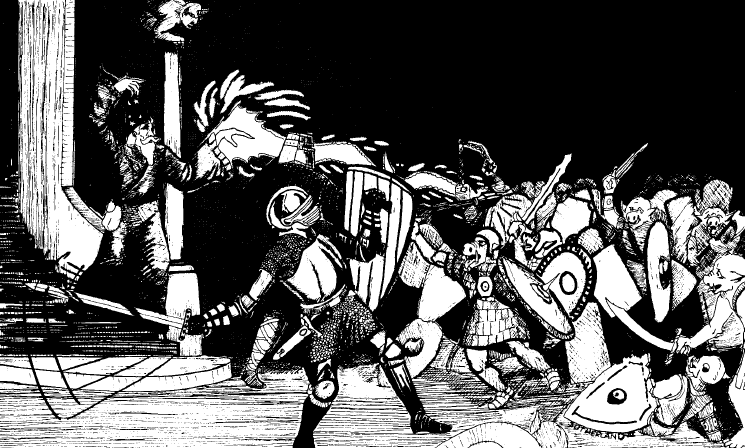
Fighting Man, Magic-User and Cleric take on dungeon orcs. By David Sutherland III.


Gary Gygax on the orc tribes of Castle Greyhawk, EnworldQ&A 2/2/04:
"The orcs in the dungeon were of two separate tribes, but I have forgotten the names I gave them. As near as I can recollect, one was the Grinning Skull and the other was the Bloody Axe. They were all cut down or made into vassals by Robilar and Terik, with a good deal of assistance from Tenser."

Chronology of Orc Tribes in Gygaxian D&D:


Lord of the Rings: Tolkien is, of course, the original source of orcs and their tribes. Aragorn refers to Saruman's Isengarders as "Orcs of the White Hand" (TT, Bk 1, Ch 2) after seeing shields with a
"small white hand in the centre of a black field" (TT, Bk 1, Ch 1). He notes that orcs "in the service of Barad-dur [Sauron's tower] use the sign of the Red Eye" (TT, Bk 1, Ch 1). Pippin and Merry later see Mordor orcs with "a red eye painted on their shields" (TT, Bk 1, Ch 3). Also called the Evil Eye in at least two instances; for example, "One [orc-helmet] fitted Frodo well enough, a black cap with iron rim, and iron hoops covered with leather upon which the Evil Eye was painted in red above the beaklike nost-guard" (RoTK, Bk 2, Ch 1). There is at least one further group; In Cirith Ungol, Sam notices two liveries, "one marked by the Red Eye, the other by a Moon disfigured with a ghastly face of death" (RotK, Bk 2, Ch 1). The Moon device is that of the Witch-King, ruler of Minas Morgul, formerly the Tower of the Moon.


Chainmail (1971): The names of five tribes are given, all based on Tolkien:

  • Orcs of the Red Eye
  • Orcs of Mordor
  • Orcs of the Mountains
  • Orcs of the White Hand
  • Isengarders
These are from the 2nd print (1972), but are presumably also in the 1st. They were removed from later printings along with other Tolkien references. The list is duplicative because in the Lord of the Rings, the Orcs of the Red Eye are the same as the Orcs of Mordor, and the Orcs of the White Hand are Isengarders. The Orcs of the Red Eye and White Hand also appeared in Patt's earlier Rules for Middle Earth (The Courier, 1970). Falconer pointed out that Arneson used these same five names, as seen in the First Fantasy Campaign (1977, Judges Guild).

Battle of the Brown Hills (pg 8-10 of the Wargamer's Newsletter #116, November 1971):

In this article, Gygax describes a fantasy battle between the forces of Law and Chaos, played using the Chainmail rules. Notably, the forces of Chaos include three tribes: Orcs of the Mountains (wielding sword & shield or bows), Orcs of the Vile Rune (wielding sword & shield) and Orcs of the Longspear (presumably wielding long spears). We can surmise shields would feature each tribe's device.

OD&D Vol 2 (1st print, 1974): "the number of different tribes of Orcs can be as varied as desired, basing the decision on Tolkien or random chance". No tribe names are given. The reference to "Tolkien or random chance" was deleted in later printings.


Scruby Fantasy 30mm minis (1975): Per Gygax on Enworld (10/8/07), "Jack Scruby began casting orcs, so we had real miniatures for them -- the Orcs of the Vile Rune whose symbol was a fist with a raised digit."

Holmes (July 1977): "There are many tribes or nations of orcs".


Monster Manual (Dec 1977): Here we get Gygaxian tribe names, including: 

  • Vile Rune (as seen previously in the Battle for the Brown Hills)
  • Bloody Head (perhaps the actual name for Grinning Skull?)
  • Death Moon (perhaps inspired by the Moon device of Minas Morgul?)
  • Broken Bone
  • Evil Eye (perhaps an update of Red Eye?)
  • Leprous Hand (perhaps an update of White Hand?)
  • Rotting Eye
  • Dripping Blade (perhaps the actual name for Bloody Axe?)
Gone are the names directly from Tolkien, but he sticks to a similar two-word style.

Gygax further notes that a "standard is always present where the tribal chief is" and "Their garments are tribal colors, as are shield devices or trim".

Dungeon Masters Guide (Aug 1979): This introduces a major new facet of humanoid tribes, including orcs, that departs from Tolkien: shamans & witch doctors (pg 40). These became a standard part of humanoid tribes, as shown by the citation from WG4 below.

B2 Keep on the Borderlands (1979): In the Caves of Chaos, there are two rival orc tribes in Caves B & C. This is the only type of humanoid having two different groups. The tribe in Cave B decorates its cave entrance with "cheerful greetings" - heads and skulls placed in niches in a wall - perhaps a reference to the Grinning Skull/Bloody Head/Bloody Skull tribe. And Falconer notes that the leader of Cave C wields a magic hand axe - a possible reference to the Bloody Axe tribe. So the two tribes of the Caves of Chaos are in some ways analogous to the two tribes of the Greyhawk Castle dungeons. 


World of Greyhawk Folio (1980): Includes a series of shield devices for various kingdoms, including a grinning human skull for the "Orcs of the Pomarj" (the dominant humanoid of the Pomarj). This device was retained in the World of Greyhawk boxed set (1983). It's possible that Gygax was remembering this device when he mentioned "Grinning Skull" as the possible name of the Greyhawk Castle tribe.


Orcs of the Pomarj


Developments from Stonefist to South Province (Dragon #57, Jan 1982): "Three major groups vie for control of the whole of the Bone March. The most powerful group, until the Battle of the Loftwood, was the humanoid group under the orcs of the Vile Rune. Now paramount are the orcs of the Death Moon tribe. Both groups have considerable numbers of various sorts of humanoids serving them. Both are also led by half-orcs and assisted by evil humans. The third power group is a force of ogres and gnolls based in the hills at the head of the Teesar Torrent" (pg 15).

The Gods of the Orcs (Dragon #62, June 1982): "The division of orcs into separate tribes (Evil Eye, Death Moon, Broken Bone, etc.) is usually made along cult lines. The tribal symbol is the holy symbol of the orcish god the tribe holds as its patron" (pg 29). "Luthic’s worship is one of the few that allow male and female orcs to become clerics ... Orcs in her tribe (Vile Rune) generally dwell underground, and seem to commit fewer raids against other creatures, though they are especially fierce if their lair is threatened" (pg 32). This is an article by Roger E. Moore detailing the gods of the Orcs other than Gruumsh, who appeared in Deities & Demigods (1980). Gygax later incorporated the article into Unearthed Arcana (1985) with credit to Moore.

WG4 Forgotten Temple of Tharizdun (1982): "These are Orcs of the Rotting Eye tribe, belonging to the clan of the Jagged Knife. The standard is a huge, glaive like knife blade with a serrated edge ... colored a rust red and atop a long shaft, beneath it being the circular target depicting a rotting eye colored yellow green and red. This symbol is repeated on the shields of the soldiers, with the jagged-bladed knife seeming to grow out of the rotting eye device. Guards and ranking figures wear dull red clothing. The sub-chief, shaman, and chief also have cloaks of yellowish green, the chief‘s being striped with red, the shaman’s merely bordered with that color" (pg 8). This module is set in the Yatil Mountains of Greyhawk.


Castle Zagyg (2008): The first dungeon level ("Storerooms") has a Bloody Skull orc tribe. Bloody Skull may have been the actual name, or was used to replace Bloody Head as the name was already published in the Monster Manual. Update: I also checked the earlier Yggsburgh hardcover (2005). There are some orc encounters, but no mention of tribes.

Tuesday, May 24, 2016

Appendix B: Chris Holmes Manuscript Artwork

As a further bonus to the Holmes Manuscript series, here are pics of some of Chris Holmes' artwork from the earlier (2nd) draft of the manuscript.

Each of these images, except for the Dragon, was previously posted publicly on the grizzlebanged tumblr by someone who works with Billy Galaxy. I've cropped a few so they will show off the artwork better in the blog format. The Dragon picture was sent to me directly by Billy as part of the missing page of the final version of the manuscript. I believe they are all cell phone pics; if I ever get good scans of these I'll make an updated post.

I've ordered them based on their appearance in the published rulebook, and added some of the descriptive text from the published rulebook. Chris sticks closely to the given details.
As noted previously, Chris drew these illustrations directly on the manuscript document.


Carrion Crawler
"This scavenger is worm shaped, 9' long, 3 feet high at the head and moves quickly on multiple legs ... The mouth parts are surrounded by eight tentacles, two feet long, which produce paralysis on touch..."


Displacer Beast
The beast "resembles a puma with six legs and a pair of tentacles which grow from its shoulders. It attacks with the tentacles which have sharp horny edges", which Chris captures perfectly.  I'm not sure a Displacer Beast had been illustrated previously in D&D. Gygax's original inspiration for the creature was the Coeurl in the Voyage of the Space Beagle by A. E. Van Vogt.


Dragon


Gargoyle

"As depicted in medieval architecture, gargoyles are reptilian, horned, taloned, fanged, winged beasts of hideous aspect."


Manticore
"A huge lion-bodied monstrosity with human face, dragon wings, and a tail full of iron spikes. There are 24 spikes ... and they can be fired, 6 at a time..."


Ochre Jelly
The text of the entry refers to it as a "giant amoeba", and Chris has given it a large central nucleus like their real-world microbial kin.


You can see more of Chris' illustrations on his website, HolmesWest.

This is the final post in the Holmes Manuscript series.
Go Back to Appendix A: Manuscript Copy Order Form
or Go Back to the Index: The Holmes Manuscript