This is the blog. Click here to go to the Zenopus Archives website.

Note: Many older posts on this blog are missing images, but can be viewed at the corresponding page in the Internet Archive

FEATURED POST

The Forgotten Smugglers' Cave: Index of Posts

An index of posts describing the Forgotten Smugglers' Cave, an adventure for Holmes Basic characters levels 2-4.                    ...

Showing posts with label Dragon magazine. Show all posts

Thursday, January 20, 2022

Dragonsfoot Thread: How many AD&D players knew of OD&D?


A recent thread over on Dragonsfoot asks: How many AD&D players who started in the 80s knew about OD&D?

Here is my answer, which I posted there, and have expanded a bit here:

My first D&D set, from 1982, was (obviously) Holmes Basic, and the rulebook includes a Preface stating that it is "based upon the original work published in 1974 and three supplementary books published in the two year period after the initial release of DUNGEONS & DRAGONS", and then a reprint of the "Foreword from the Original Edition", where Gygax gives a brief yet evocative history lesson on the origins of D&D that begins, "ONCE UPON A TIME, long, long ago..." And my copy was the 3rd edition, which has a product listing on the back cover of "OTHER ITEMS FROM TSR" available for mail order, including the "Original Dungeons & Dragons Collector's Editions".

So I was aware of the original D&D rules basically as soon as I had my first rule set. I quickly moved onto AD&D from Holmes Basic, owning all of the hardcover rulebooks by mid-1983, but there again I encountered OD&D: my copies of the Monster Manual and the Players Handbook again have product listings that include it. 

And I learned even more about the early history once I started reading Dragon. On the rack at B. Dalton at the local mall where I bought my Dragon magazines, I found the Best of Dragon #1 and #2, which reprint a number of articles from the early years, including "Gary Gygax on D&D: Origins of the Game" in BoD #1.


At some point I found a copy of Moldvay Basic at a Goodwill thrift store. This set included a copy of one version of TSR's Gateway to Adventure catalog, which had a page for the "Collectors Edition" which showed the OD&D set and supplements. This was the first place that I actually saw what the OD&D booklets looked like, other than Eldritch Wizardry, which early on I once spotted on the rack at B. Dalton. 

Later in the '80s, I came across a still new-on-the-shelf copy of the Original Collector's Edition (OCE) of Whitebox OD&D at a game shop and bought it, and still have. I was actually somewhat surprised that the rules were so similar to what I was familiar with, as I was expecting more differences. In the next year or two after that I ordered Chainmail and the Blackmoor supplement directly from TSR's Mail Order Hobby Shop, which was still selling copies through '89 or so, although the copy of Blackmoor I received from them was essentially a high grade photocopy.

So, with different degrees of understanding, I was aware of OD&D throughout my years in the 1980s playing Holmes Basic and AD&D.



Saturday, July 10, 2021

Dragon #46 retrospective on Enworld


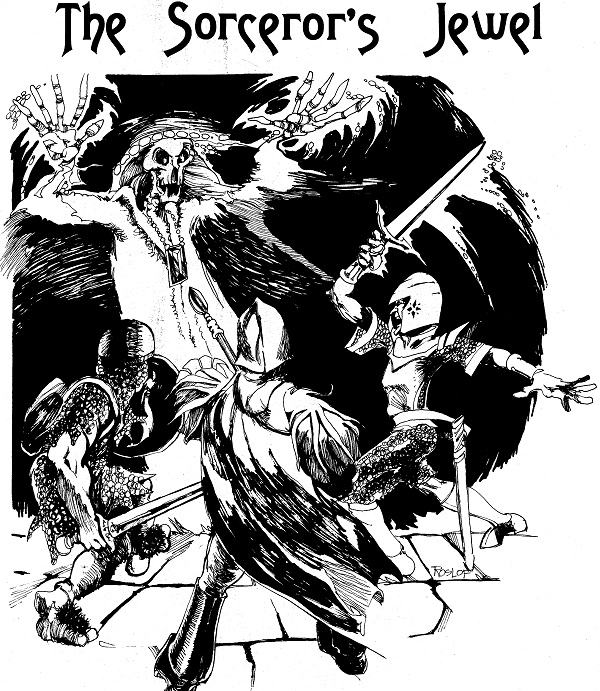
Dragon Reflections, by M.T. Black, is a regular column on Enworld that offers retrospectives of Dragon magazine in chronological order. This week they've reached issue #46, which among other content includes Holmes' second published Boinger and Zereth story, "The Sorcerer's Jewel":


Dragon Reflections #46


Black covers the entire magazine, so doesn't say too much about Holmes' story, just that it is "pretty typical D&D-inspired fiction", but the first commenter offers this gem:

I would point the reader to Tales of Peril: The Complete Boinger and Zereth Stories of John Eric Holmes by Black Blade Publishing. Over the span of months, me and my D&D group read the entire collection out-loud together, on nights we weren't up for playing TTRPGs. More than "typical", I say the stories are "archetypal." It was so interesting to see how one of the authors of BD&D interpreted and portrayed how the class and race traits work in a story. The stories are zany and fun. We laughed out loud many a time. I recommend the book. (And I'm not sure, but I believe they're all autographed and numbered too.)

I followed up on this to comment that the Black Blade ordering page:

"hasn't been updated, but from communication with Allan and John (the folks behind Black Blade), I've heard that the first printing of Tales of Peril has sold out, and they are planning a reprint. If anyone who reads this is interested in a copy, if you email them at the address on that page they will add you to a list for notification when it has been reprinted."

I also commented that:

"One interesting bit in Holmes' story is a reference to "under Witch's Hill, where the old Suloise city is supposed to be buried". I believe this is only reference to specific setting material from the World of Greyhawk in the Boinger and Zereth stories. Given that the World of Greyhawk folio, which as noted above was also reviewed in this issue, mentions "A lost, ruined city of the Old Suloise is said to be hidden somewhere in the Suss forest" (page 26), and the Sea of Dust has buried Suel cities (also page 26), this suggests that Holmes had a copy of the new WoG folio, or at least had heard about the material from Gygax."


"The Sorcerer's Jewel" versus "The Sorceror's Jewel"

The title of contents spell the title of the story as "The Sorcerer's Jewel", but Kim Mohan's editorial on the same page, and the formal title above Jim Roslof's art on page 8 spell it "The Sorceror's Jewel": 


However, given that "sorceror" is a fairly common misspelling, and that the word is correctly spelled "sorcerer" throughout the actual story, I'd suggest "The Sorcerer's Jewel" as the correct spelling. Tales of Peril (2017) titles it as "The Sorcerer's Jewel", except where it reproduces the title as part of Jim Roslof's art. 

Furthermore, this wasn't even the original title of story; a few years back I briefly saw a typed manuscript for this story that was instead titled "The Apprentice Treasure Hunter", which appears to reference the character of Tarkan, pictured above between Boinger and Zereth. It's unclear whether Holmes was asked to change the title, or whether Dragon simply changed it themselves. Along these lines, it's also possible the use of Suloise (see above) was also an editorial change or suggestion.

Interestingly, "The Sorcerer's Jewel" is also the title of 1939 story by Robert Bloch. I've read this and it doesn't seem related in any way to Holmes' story.

Wednesday, July 1, 2020

The Tower of Zenopus in Dragon+ Issue 32!


Wander over to the Wizards site, where you will find that the latest issue of Dragon+ features the Tower of Zenopus, both old and new:


...And There Be Snowy Owlbears!


This electronic publication is the successor to Dragon magazine, and runs a regular column by Bart Carroll called "D&D Classics", who has written history pieces for WOTC for years, including a few mentioned on this blog previously (here and here). It uses the earliest masthead for "The Dragon" as a header (see the image up top).

This month's installment of "D&D Classics" has three parts: "Color Me Adventurous", "The Green Dragon Inn" and the "Tower of Zenopus". The first relates to the 1979 AD&D Coloring Album and the second to the Greyhawk version of the Green Dragon Inn (rather than Holmes' version), and with a tie-in to the Green Dragon in the "Maps of the Month" column.

The "Tower of Zenopus" section includes links to two free pdfs: the original dungeon (the same available on their website since 2008), and an excerpt of the section of Ghosts of Saltmarsh that briefly describes the Tower of Zenopus adventure site. 

It also plugs The Ruined Tower of Zenopus at DMs Guild, and for new content features an interview with me, where I answer six questions posed by Bart Carroll! A thank you to Bart for asking me to do this. The kid in me is geeking out a bit on finally getting into Dragon...

Click here to read "D&D Classics" in Dragon+ #32

Click here to see the full Table of Contents for Dragon+ #32

[As of 2022, Dragon+ has been removed from its original site so the above links are now directed to the pages as saved on the Internet Archive]

Click here to find The Ruined Tower of Zenopus on DMs Guild

Click below on the "RTOZ review" label to find reviews of the Ruined Tower of Zenopus

Tuesday, August 25, 2015

Holmes at Gen Con XII (1979)


Thanks to Tony at The Cryptic Archivist for providing a high res scan of the above photo from The Dragon #31, November 1979, which shows John Eric Holmes with his wife and son Chris talking to Tim Kask, the editor of the magazine. The photo was taken at fifth Strategists Club Banquet at Gen Con XII, August 16-19. This issue also has the distinction of including Trollshead, the first Boinger and Zereth story published in The Dragon. For more on issue #31, see this recent review on The Land of Nod blog.


Above is an advertisement for Gen Con XII from the Dragon #25, May 1979, with fantastic artwork by Kenneth Rahman aka Elladan Elrohir aka Eymoth. His tag is not to be mistaken for the EO used by Erol Otus, and can also be seen on the covers of other TSR games including Boot Hill and Divine Right (which Rahman co-designed with his brother Glenn). The same artwork, but printed in red and black was also used for cover of the convention program. A thumbnail of this can be seen on a page over at Tome of Treasures, which also gives an overview of the contents.

According to the info listed there, Holmes ran two games at Gen Con XII, "D&D For Beginners" and "D&D on Barsoom". Holmes had earlier used the title "D&D For Beginners" on his original draft of the rulebook for the Basic Set. In running the "D&D For Beginners" game, the Holmes employed an impressive game aid. Per Chris, we used "my rather large model dungeon 3'X6' ... Dad did the basic carpentry on it and together we ran "Beginners D&D" at our 2nd Gen Con". 

Monday, July 20, 2015

Holmes' Mi-Go

 
The Mi-Go by Erol Otus from Deities & Demigods, image from oldschoolfrp

Continuing with the Pluto theme in honor of the New Horizons fly-by, here is Holmes' OD&D write-up of the Fungi from Yuggoth.

Background: Dragon Magazine #12 (Feb 1978) included "The Lovecraftian Mythos in Dungeons & Dragons" by J. Eric Holmes and Rob Kuntz. This was the first systematic write-up of the Cthulhu Mythos for D&D, with the entries written in the style of the Gods, Demi-Gods & Heroes (1976) supplement for OD&D. This entry, with some editing, was later included in the Cthulhu Mythos in Deities & Demigods (1980). The entry in the Dragon article appears verbatim in Holmes' original draft of the article.

* * * * *

The Mi-Go, the Fungi from Yuggoth, the Abominable Snow Man

Armor Class - 3
Move - 15", fly 30"
Hit points - 35
Magic Ability - (see below)
Fighter Ability - 8th level
Psionic Ability - Class 5

Eight foot high, many legged, red, crab like creatures with two great bat-like wings, the Mi-Go are found in mountain wilderness, the Himalayas and Vermont. Their main base of operations in this solar system in on Yuggoth (the planet Pluto). Immune to cold, dark and vacuum, they can fly the interstellar space and teleport across interstellar distances. They can not speak but they possess machines that produce a buzzing imitation of human speech (The Whisperer in Darkness). They mine minerals or other items from the earth and will try to make alliances with human races. They sometimes kidnap humans and carry off their living brains in metal cylinders for study.

The entry for the Elder Sign also lists them as a being against which the Sign protects.

Per Gods, Demigods & Heroes pg 11, Class 5 Psionic Ability is an Attack Strength of 100, Attack Modes A, B, C, E and Defense Modes F, G, H. 

* * * * *

See also:
Yuggoth Resolves
Dr Holmes and the Cthulhu Mythos in Deities & Demigods
Dr Holmes and the Cthulhu Mythos Part II
Dr Holmes and the Cthulhu Mythos Part III
The Cthulhu Mythos in D&D in the 1970s

Wednesday, January 18, 2012

Holmes & de Camp in Dragon magazine


     Another point of intersection between J. Eric Holmes & L. Sprague de Camp is Dragon magazine. In the 1970s, Gary Gygax was corresponding with a number of authors, including at least Holmes, de Camp,  Fritz Leiber and Gardner Fox, which led to each having one or more short stories published in Dragon (Holmes' first book, Mahars of Pellucidar, was published in 1976). This lead to the coincidental simultaneous appearance or mention of de Camp's and Holmes' work in several issues of Dragon.

     Dragons #15 and #16 (June and July 1978) have a two-part reprint of The Green Magician, the final Harold Shea/Incomplete Enchanter story by de Camp and Fletcher Pratt, which was out-of-print at the time. The cover of Dragon #15 (pictured above), by Dave Trampier, illustrates a scene from this story. Interspersed with the story in each issue is a full-page advertisement for Gen Con XI (Aug 17-20, 1978) that mentions "special D&D Events for beginners DMed by J. Eric Holmes" (pg 30).


     In addition, Dragon #16 also contains a letter to the editor from Holmes, a rebuttal to a reader's letter in Dragon #14 criticizing the Cthulhu mythos article in Dragon #12 by Holmes and Kuntz.

     Dragon #31 (Nov 1979) has Holmes' first Boinger and Zereth short story for Dragon, Trollshead. In the Sorceror's Scroll column in the same issue, Gary Gygax mentions the Incomplete Enchanter as inspiring the G-series of modules (pg 28-29).

Dragon #46 (Feb 1981) has Holmes' second Boinger and Zereth short story, The Sorcerer's Jewel. This issue also has a Boot Hill scenario by Roger E. Moore called "This Here's Tyrannosaurus Tex (pg 28-29), which cites a book by de Camp and his wife, The Day of the Dinosaur (1968), for inspiration.