This is the blog. Click here to go to the Zenopus Archives website.

Note: Many older posts on this blog are missing images, but can be viewed at the corresponding page in the Internet Archive

FEATURED POST

The Forgotten Smugglers' Cave: Index of Posts

An index of posts describing the Forgotten Smugglers' Cave, an adventure for Holmes Basic characters levels 2-4.                    ...

Showing posts with label Castle Greyhawk. Show all posts

Monday, October 30, 2023

Yggsburgh reprint now shipping


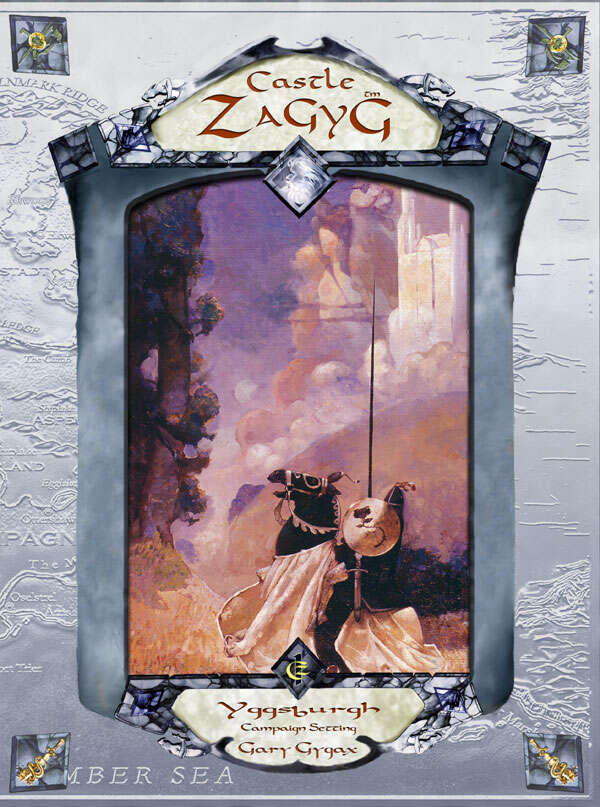
Yggsburgh front cover

Last month, I wrote about the reprint of Yggsburgh, the sandbox setting (256 pages...!) written Gary Gygax in 2005 for his Castle Zagyg project (aka Castle Greyhawk). Troll Lord Games recently announced via their mailing list that shipping of orders of the reprint is now in progress, and buyers are reporting that copies are appearing in their mailboxes; see for example the photos posted here and here.

From the photos, we can see that the reprint appears to be the same as the original, but per reports can be distinguished by the label "Second Printing" and 2023 copyright given inside.

As a reminder, you can order the hardcover from the TLG site for $65, which also includes an immediate download of the PDF, or you can buy the PDF alone from DrivethruRPG for $19.99:


Yggsburgh Print + PDF 

Yggsburgh PDF only


Friday, September 8, 2023

Gygax's Yggsburgh (2005) available once again


The front cover of Yggsburgh,
with an illustration by Jeffrey Catherine Jones


If you haven't heard, Gary Gygax's Yggsburgh sandbox campaign setting, originally released in 2005 and withdrawn from sales after he passed away in 2008, is once again available for purchase from Troll Lord Games, following an agreement with the Gygax estate. You can pre-order the hardcover from the TLG site for $65, which also includes an immediate download of the PDF, or you can buy the PDF alone from DrivethruRPG for $19.99:


Yggsburgh Print (pre-order) + PDF 

Yggsburgh PDF only


For those unfamiliar with it, Yggsburgh is a re-casting of Gygax's long-delayed City of Greyhawk project, intended as a setting for exploring the Castle Greyhawk dungeons, here re-christened Castle Zagyg.  

Back in May of 1980, shortly before the initial publication of the World of Greyhawk campaign setting, Gary Gygax discussed future releases for the setting in issue 37 of The Dragon, where in his regular column "From the Sorcerer's Scroll", under the title "Greyhawk: The Shape of the World", he estimated that "The City of Greyhawk might make a 1981 publication date, certainly 1982, and about the same time the series which will eventually represent the whole of the Dungeons of Castle Greyhawk will begin". Sadly, neither title ever appeared under Gygax's byline, and became the most infamous of TSR vaporware. 

Decades later, in the early 2000s, Gygax finally started a new project to publish this material, this time under the aegis of TLG's Castles & Crusades RPG. However, only Yggsburgh and the first portion of the Castle Zagyg, titled the Upper Works (2007), were finished and released before Gygax passed away, and the license to publish them was withdrawn.

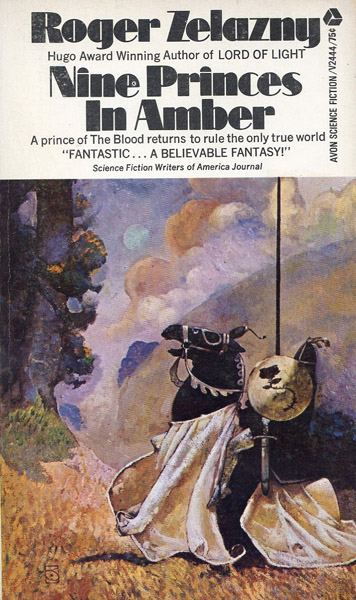
Yggsburgh is a sprawling 256-page hardcover book, with cover art by the great Jeffrey Catherine Jones, repurposed from the 1972 Avon paperback edition of Nine Princes of Amber by Roger Zelazny. This was the first novel in the Amber series, which was included by Gygax in Appendix N in the AD&D Dungeon Masters Guide in 1979. Originally, the entire series of Castle Zagyg books was slated to feature covers with Jones' classic work from the 1970s.


The book itself is also accompanied by an 8-page hexmap, drafted by Darlene in a style similar to her original maps for the World of Greyhawk, which was tipped into the back cover in the 2005 publication. This depicts an area 50 hexes east-west and 34 hexes north-south, at 1 mile per hex, for a total area of 1,700 square miles:


Players Version of the Yggsburgh Hex Map by Darlene

Rather than just being a high-level gazetteer, Yggsburgh is a big sandbox, which I'd compare to Lenard Lakofka's AD&D module L1 The Secret of Bone Hill. There's a city with 93 described areas, including the famous Green Dragon Inn, and an area map with 48 described locations, and including a number of fully detailed small dungeons, which is often overlooked: 

  • Thieves' Underground (13 rooms)
  • River King's Tomb (19 rooms)
  • The Cursed Mine (14 rooms)
  • The Gnome Burrows (25 rooms)
  • The Unholy Ringstones (25 encounter areas)

These could easily be extracted and run as one-shots or dropped in other settings. 

Castle Zagyg and Rob Kuntz's Dark Chateau (2005) are also two of the intended locations in the sandbox, so there is the potential for larger dungeons, although this does make the campaign setting incomplete on its own if you intend to use those.

I've had the original hardback for many years, and it's probably my favorite late-era Gygax product. While I haven't run anything from it yet, I will pick it up every now and then and read a bit. It's sort of a glorious sprawling mess like the original AD&D DMG, but in campaign setting form.

Monday, December 11, 2017

Gygax's Dungeon Level from Hall of Many Panes


The "Dungeon Delving" map from Hall of Many Pane


I recently found a cheap second-hand copy of the Hall of Many Panes boxed set, a mega-adventure written by Gary Gygax and published by Troll Lord Games in 2005, with dual stats for 3.5E D&D and the Lejendary Adventures (LA) RPG. The Hall was playtested by Gary back in 2002 using LA, his preferred system in his last decade. I was subscribed to his Gygax-Games email list back then and remember his regular play-test reports.

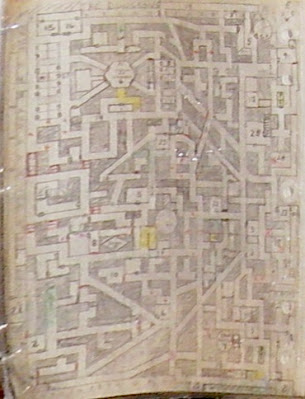
This is my first time owning the final product, so I'd never seen the "Dungeon Delving" Map that was one of the "Many Panes" (Pane 8 / Rose). In the text, Gary describes it at as a "dungeon of the days of yore". Once a party enters via the pane, they are stuck on the level and must explore it thoroughly until they figure out how to leave again.

The published map is a bit of an oddity, as the cartographer seems to have taken a scan of Gary's original map (whatever the source may be), made a negative image out of it, and then drew right over that digitally. The graph from the original paper can be seen in white, as well as many of Gary's notes - some written over completely, some written over partially, and some not written over at all, like the pool in Room 9. The cartographer must have had some trouble following the original notations because, as T. Foster has pointed out, the final map has a number of discrepancies between it and the text of the module.

The design is interesting because it's a rare published example in Gary's early style of dungeons, as glimpsed in the tips in OD&D Vol 3, TSR's Dungeon Geomorphs and the unpublished levels of Castle Greyhawk (CG). In the '00s, Gary kept the original castle notes in a binder that he would use to run it at conventions, under OD&D rules, and a few of the levels were photographed by players of these games. The two most well-known images are of Levels 1 and 3, which I've included below for comparison (see also Visualizing Castle Greyhawk). On the whole, "Dungeon Delving" is closest in style to CG Level 3:


Castle Greyhawk Level 3 ("binder" version)


Below is a list of elements in "Dungeon Delving" that are found in Gygax's other dungeons. Note this list contains spoilers if you think you might ever play through Hall of Many Panes.

Diagonal Passages: In "Dungeon Delving" the central START area is an octagonal room similar in design to the hexagonal room in the northern half of Level 3 (see above). In each, a door leads out to a diagonal passage in four directions: NW, NE, SW, SE - essentially an X-shape with a room at the intersection.

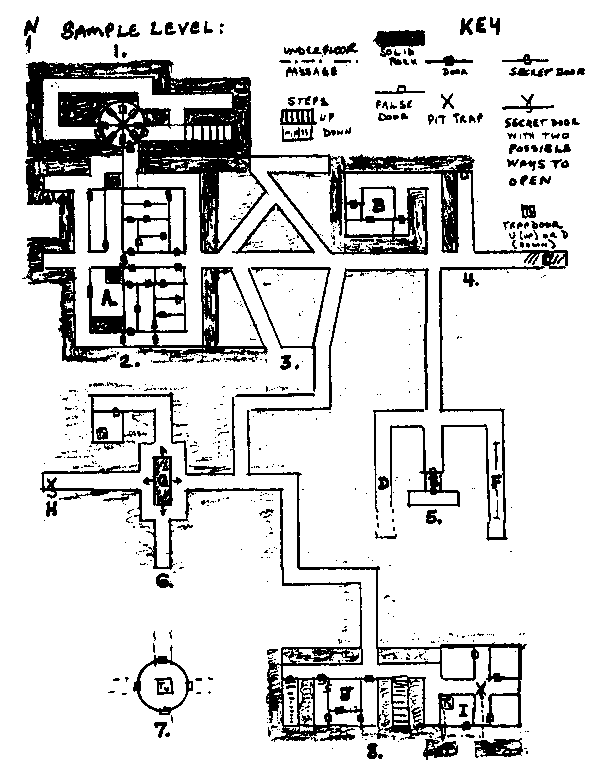
Gary's use of diagonal passages was first illustrated way back in the "Sample Level" in OD&D Vol 3; see Area 3 in the image further down this page. The note for this explained, "This area simply illustrates the use of slanting passages to help prevent players from accurately mapping a level (exact deviation from cardinal points is difficult for them to ascertain)."

His "Solo Dungeon Adventures" article in Strategic Review #1 (Spring 1975) is a close relative of these early dungeons, and was later reprinted as Appendix A: Random Dungeon Generation in the Dungeon Masters Guide. In this, Table III: Side Passages includes an entry that the "passage "X's" (if present passage is horizontal or vertical it forms a fifth passage into the "x")".

Diagonal passages and even a few "X-shaped" rooms can also be found in the Dungeon Geomorphs, originally published in 1976-1977, for example in Geomorph A from Set 1:


Geomorph A from Dungeon Geomorphs Set 1: Basic Dungeon (1976)


Room-Labyrinths: A prominent feature of the early dungeons are the maze-like series of empty rooms, which Gygax terms a "room-labyrinth" in OD&D Vol 3. Area 2 of the "Sample Level" illustrates this (see below), with the note stating, "This is a simple room-labyrinth, generally leading nowhere, but "[Room] A would be a room containing a monster and treasure". The section on "Distribution of Monsters and Treasures" further explains, "As a general rule there will be far more uninhabited space on a level than there will be space occupied by monsters, human or otherwise" (page 6). The random distribution instructions that follow give each room a 1-2 in 6 chance of having a monster, which means that on average 33% of the rooms will be occupied. 

The Dungeon Geomorphs are also chock-full of the room-labyrinths (see above). The original notes for the Dungeon Geomorphs restricted this even further: "Approximately 25% of the rooms and large spaces should contain monsters, treasures and other notable items. For every five such rooms there should be approximately one trap. Slanting passages, teleportation areas, slides and the like should be added sparingly thereafter -- one or two such items per level is a fair guideline".


Detail of the map from S1 Tomb of Horrors


Some other less filled-in Gygax dungeons have isolated room-labyrinths. The infamous Tomb of Horrors has a small room-labyrinth south of Area 8. One section of this leads to a false door concealing a spear trap (more on those below), and the other is a series of secret doors (Area 9) leading to the next area of the dungeon (Area 10). His last publication, Castle Zagyg, also has a room-labyrinth (Area 103) consisting of over 30 10' by 10' rooms with 50 (!) different doors, part of the defenses of his beloved Old Guard Kobolds.


Castle Greyhawk Level 1 ("binder" version)


Transporters: "Dungeon Delving" has three different two-way transporters; A1 & A2 are corridor/stair transporters, and B1/2 & B2/1 and B3/4 & B4/3 are two sets of room transporters. The L-shaped A1 & A2 transporters are in a style similar to those on the Level 1 CG map as pointed out by T. Foster here

Back in the Tricks and Traps section of OD&D Vol 3, the list of suggestions by Gygax include "Intra-level teleportation area, so that a player will be transported to a similar (or dissimilar area on the same level, possibly activated by touching some items (such as a gem, door, or the like)". The "Sample Level" in OD&D Vol 3 also includes two different examples of transporters, one a two-way room-based transporter, the other a one-way corridor transporter, although neither is explicitly "intra-level". See areas E and F below. 

Likewise, in the original notes for the Dungeon Geomorphs he suggests "putting in areas where those who entered are teleported to a similar spot elsewhere". Tomb of Horrors also has a number of teleporters.


The original version of the OD&D Vol 3 "Sample Level"


Pits: In "Dungeon Delving", the pits are marked with X's and are generally at intersections of corridors, similar to the example in the OD&D "Sample Level". See above, the "X" near Room I. The note for this states,  "Note the pit (X) at the four-way intersection containing a secret door on its south surface" (pg 5). The use of X's to marked covered pits became standard in D&D modules, at least for a time, for example the infamous pit in the Kobold lair in the Caves of Chaos.

The text for "Dungeon Delving" indicates that its pits are of three types, all 10' deep: an unboxed X to indicate an open pit, a boxed X to indicate a covered pit, and a boxed X with a cross-bar to indicate a covered pit with spikes at the bottom. I don't actually note any of the third type on the map itself, which suggests one of the mapping errors noted above.

Arrow/Spear Traps: An "A" on the "Dungeon Delving" map indicates an arrow trap that fires three arrows from the dungeon wall when the square is stepped on. Area 14 also has a more interesting variant on this. 

There are no arrow traps in the OD&D Sample Level, but the sample encounters for the Dungeon Geomorphs Set 1 have one that fires when a door is opened. Arrow and spear traps are part of the line-up in the Trick/Trap Table in "Solo Dungeon Adventures", and are part of the standard line-up in the trap tables in the Dungeon Masters Guide, including Appendix A: Random Dungeon Generation Tables and Appendix G: Traps. Tomb of Horrors has a number of door-triggered spear traps.

Cage Traps: A "C" on the map indicates a "cage trap" where "spike-ended bars fall from the ceiling above to enclose the exit(s) from the place". There are two of these, each opened differently. In the south, one side must be levered a foot off the floor to cause the bars to raise. In the north, a trapped lever near the cage must be pulled to raise it.

OD&D Vol 3 mentions a "return passage blocked by bars", although no other details are given. Appendix G: Traps in the Dungeon Masters Guide includes "Passage, blocked by falling bars". Most famously, the Moat House dungeon in the Village of Hommlet has a hidden grate that will fall to block the exit when a false door is pulled open; it can be raised by use of a hidden winch.

Sloping Passages: Along the NE edge of "Dungeon Delving" is a passage that "slopes up going north 300 feet, so as to bring those traversing it back to the normal level of surrounding dungeon without noticing the incline. Going south the slope is downwards, so as to require the flight of steps up to regain the level of the dungeon proper". This means that if approached from the north, the steps will appear to lead up a level, and if approached from the south, the steps will appear to lead down a level. This is straight out of OD&D Vol 3, which suggests, "Steps which lead to a slanting passage, so the player may actually stay on the same level..." The reverse is also suggested in the Sample Level, where "D" indicates a passage to a lower level with such a gentle slope that "even dwarves won't recognize it".

Carved Face: Area 14 also has a "huge leering face chiseled into the stone wall", reminiscent of other Gygaxian carved faces, including the "great bas-relief face" in the Tricks and Traps list of the Greyhawk Supplement, and of course the Face of the Great Green Devil in the Tomb of Horrors.

Weird Statues: In Dungeon Delving, the START area also has nine statues, a number that reminds me of the infamous room in CG with nine statues - actually imprisoned demigods, later freed by Robilar. The statues here do not similarly house prisoners, but are important to solving the dungeon level. The use of weird statues was suggested in several of the "Trick and Traps: (Additions)" found in the Greyhawk Supplement.

Evil Human Lair with Escape Route: Room 17 of "Dungeon Delving" is called the "Jolly Priest" and is home to an evil priest masquerading as good, ala the "jovial priest" in the Keep on the Borderlands. The description includes his plans for escape via a secret door and nearby passages, which is another design element Gygax often included in his dungeons. 

In the note for Area 8 of the OD&D Sample Level, "The western portion contains the room of some evil man [Room J], complete with two secret doors for handy escape". Likewise, the evil priest in the Caves of Chaos has a secret escape door from his chamber in Area K. And in the evocative yet incomplete DMG Sample Dungeon, the Wandering Monster Table indicates an evil cleric lairs in Areas 35-37, which contain two concealed doors - presumably an escape route.

See also: Gygax's Playtest Reports for the "Dungeon Delving" Level from HoMP

Friday, April 21, 2017

Gygax's Killer Die

As a follow-up to yesterday's post on the Marked 20-sided Die, here are some quotes from Gygax on his own Marked d20. Thanks to T. Foster at the Mystical Trash Heap blog for bringing this to my attention.

3/13/03
"Those low-impact d20s did get pretty round in short order--well short order in terms of gaming time. Rob Kuntz had one that would stand on a point now and again. I still have a couple that I use when playing OD&D as the DM. One with gray faces on 10 sides is a "killer" die that comes up on those faces a lot--the 11-20 range, of course! Can't find it now, but it's likely in a box of old dice somewhere in the basement here. I have a second one with red faces that's as good for the monsters' rolls, of course" (EnWorld Q&A post)

1/29/04
"As it happens I have quite a number of the old low-impact dice around here somewhere. The points on the d4 were very sharp but wore down quickly. Rob had a d20 that would stand on a worn point about one roll in 50 : )"

"Somewhere I lost my d20 with half the faces colored gray. It was my "killer die" that rolled an inordinate number of 20s, and the players really hated it : )" (EnWorld Q&A post)

Following this, T. Foster wrote
"I played with you in "Necropolis" at Glathricon (in Evansville, IN) in 1988 and am pretty sure I encountered your infamous 'killer' d20 -- it was white, numbered 0-9 twice, and rolled awfully well (for you, badly for us :) )."

2/6/04 - in response to T. Foster
"It was either my gray or red "killer die," undoubtedly. It has since sent a large number of adventurers to their doom when rolled on behalf of my OD&D game "Old Guard Kobolds." The ninth party of six or more 2nd level characters fell to them at JanCon last month" (EnWorld Q&A post)

(A few minor edits to Gary's comments to correct obvious typos)

Tuesday, October 4, 2016

Gygaxian Orc Tribes


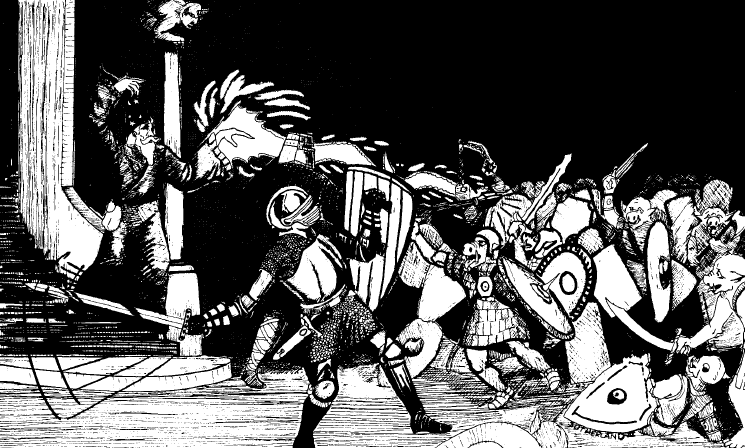
Fighting Man, Magic-User and Cleric take on dungeon orcs. By David Sutherland III.


Gary Gygax on the orc tribes of Castle Greyhawk, EnworldQ&A 2/2/04:
"The orcs in the dungeon were of two separate tribes, but I have forgotten the names I gave them. As near as I can recollect, one was the Grinning Skull and the other was the Bloody Axe. They were all cut down or made into vassals by Robilar and Terik, with a good deal of assistance from Tenser."

Chronology of Orc Tribes in Gygaxian D&D:


Lord of the Rings: Tolkien is, of course, the original source of orcs and their tribes. Aragorn refers to Saruman's Isengarders as "Orcs of the White Hand" (TT, Bk 1, Ch 2) after seeing shields with a
"small white hand in the centre of a black field" (TT, Bk 1, Ch 1). He notes that orcs "in the service of Barad-dur [Sauron's tower] use the sign of the Red Eye" (TT, Bk 1, Ch 1). Pippin and Merry later see Mordor orcs with "a red eye painted on their shields" (TT, Bk 1, Ch 3). Also called the Evil Eye in at least two instances; for example, "One [orc-helmet] fitted Frodo well enough, a black cap with iron rim, and iron hoops covered with leather upon which the Evil Eye was painted in red above the beaklike nost-guard" (RoTK, Bk 2, Ch 1). There is at least one further group; In Cirith Ungol, Sam notices two liveries, "one marked by the Red Eye, the other by a Moon disfigured with a ghastly face of death" (RotK, Bk 2, Ch 1). The Moon device is that of the Witch-King, ruler of Minas Morgul, formerly the Tower of the Moon.


Chainmail (1971): The names of five tribes are given, all based on Tolkien:

  • Orcs of the Red Eye
  • Orcs of Mordor
  • Orcs of the Mountains
  • Orcs of the White Hand
  • Isengarders
These are from the 2nd print (1972), but are presumably also in the 1st. They were removed from later printings along with other Tolkien references. The list is duplicative because in the Lord of the Rings, the Orcs of the Red Eye are the same as the Orcs of Mordor, and the Orcs of the White Hand are Isengarders. The Orcs of the Red Eye and White Hand also appeared in Patt's earlier Rules for Middle Earth (The Courier, 1970). Falconer pointed out that Arneson used these same five names, as seen in the First Fantasy Campaign (1977, Judges Guild).

Battle of the Brown Hills (pg 8-10 of the Wargamer's Newsletter #116, November 1971):

In this article, Gygax describes a fantasy battle between the forces of Law and Chaos, played using the Chainmail rules. Notably, the forces of Chaos include three tribes: Orcs of the Mountains (wielding sword & shield or bows), Orcs of the Vile Rune (wielding sword & shield) and Orcs of the Longspear (presumably wielding long spears). We can surmise shields would feature each tribe's device.

OD&D Vol 2 (1st print, 1974): "the number of different tribes of Orcs can be as varied as desired, basing the decision on Tolkien or random chance". No tribe names are given. The reference to "Tolkien or random chance" was deleted in later printings.


Scruby Fantasy 30mm minis (1975): Per Gygax on Enworld (10/8/07), "Jack Scruby began casting orcs, so we had real miniatures for them -- the Orcs of the Vile Rune whose symbol was a fist with a raised digit."

Holmes (July 1977): "There are many tribes or nations of orcs".


Monster Manual (Dec 1977): Here we get Gygaxian tribe names, including: 

  • Vile Rune (as seen previously in the Battle for the Brown Hills)
  • Bloody Head (perhaps the actual name for Grinning Skull?)
  • Death Moon (perhaps inspired by the Moon device of Minas Morgul?)
  • Broken Bone
  • Evil Eye (perhaps an update of Red Eye?)
  • Leprous Hand (perhaps an update of White Hand?)
  • Rotting Eye
  • Dripping Blade (perhaps the actual name for Bloody Axe?)
Gone are the names directly from Tolkien, but he sticks to a similar two-word style.

Gygax further notes that a "standard is always present where the tribal chief is" and "Their garments are tribal colors, as are shield devices or trim".

Dungeon Masters Guide (Aug 1979): This introduces a major new facet of humanoid tribes, including orcs, that departs from Tolkien: shamans & witch doctors (pg 40). These became a standard part of humanoid tribes, as shown by the citation from WG4 below.

B2 Keep on the Borderlands (1979): In the Caves of Chaos, there are two rival orc tribes in Caves B & C. This is the only type of humanoid having two different groups. The tribe in Cave B decorates its cave entrance with "cheerful greetings" - heads and skulls placed in niches in a wall - perhaps a reference to the Grinning Skull/Bloody Head/Bloody Skull tribe. And Falconer notes that the leader of Cave C wields a magic hand axe - a possible reference to the Bloody Axe tribe. So the two tribes of the Caves of Chaos are in some ways analogous to the two tribes of the Greyhawk Castle dungeons. 


World of Greyhawk Folio (1980): Includes a series of shield devices for various kingdoms, including a grinning human skull for the "Orcs of the Pomarj" (the dominant humanoid of the Pomarj). This device was retained in the World of Greyhawk boxed set (1983). It's possible that Gygax was remembering this device when he mentioned "Grinning Skull" as the possible name of the Greyhawk Castle tribe.


Orcs of the Pomarj


Developments from Stonefist to South Province (Dragon #57, Jan 1982): "Three major groups vie for control of the whole of the Bone March. The most powerful group, until the Battle of the Loftwood, was the humanoid group under the orcs of the Vile Rune. Now paramount are the orcs of the Death Moon tribe. Both groups have considerable numbers of various sorts of humanoids serving them. Both are also led by half-orcs and assisted by evil humans. The third power group is a force of ogres and gnolls based in the hills at the head of the Teesar Torrent" (pg 15).

The Gods of the Orcs (Dragon #62, June 1982): "The division of orcs into separate tribes (Evil Eye, Death Moon, Broken Bone, etc.) is usually made along cult lines. The tribal symbol is the holy symbol of the orcish god the tribe holds as its patron" (pg 29). "Luthic’s worship is one of the few that allow male and female orcs to become clerics ... Orcs in her tribe (Vile Rune) generally dwell underground, and seem to commit fewer raids against other creatures, though they are especially fierce if their lair is threatened" (pg 32). This is an article by Roger E. Moore detailing the gods of the Orcs other than Gruumsh, who appeared in Deities & Demigods (1980). Gygax later incorporated the article into Unearthed Arcana (1985) with credit to Moore.

WG4 Forgotten Temple of Tharizdun (1982): "These are Orcs of the Rotting Eye tribe, belonging to the clan of the Jagged Knife. The standard is a huge, glaive like knife blade with a serrated edge ... colored a rust red and atop a long shaft, beneath it being the circular target depicting a rotting eye colored yellow green and red. This symbol is repeated on the shields of the soldiers, with the jagged-bladed knife seeming to grow out of the rotting eye device. Guards and ranking figures wear dull red clothing. The sub-chief, shaman, and chief also have cloaks of yellowish green, the chief‘s being striped with red, the shaman’s merely bordered with that color" (pg 8). This module is set in the Yatil Mountains of Greyhawk.


Castle Zagyg (2008): The first dungeon level ("Storerooms") has a Bloody Skull orc tribe. Bloody Skull may have been the actual name, or was used to replace Bloody Head as the name was already published in the Monster Manual. Update: I also checked the earlier Yggsburgh hardcover (2005). There are some orc encounters, but no mention of tribes.