This is the blog. Click here to go to the Zenopus Archives website.

Note: Many older posts on this blog are missing images, but can be viewed at the corresponding page in the Internet Archive

FEATURED POST

The Forgotten Smugglers' Cave: Index of Posts

An index of posts describing the Forgotten Smugglers' Cave, an adventure for Holmes Basic characters levels 2-4.                    ...

Showing posts with label B2. Show all posts

Wednesday, August 23, 2023

Where is L3 Deep Dwarven Delve located?


The Area Map from L1


In my previous post, I noted that the published version of L3 Deep Dwarven Delve (1997) omits a separate map showing "an aerial view of the mountain and surrounding areas" that the cover of 1979 draft indicated would be included along with maps of the three dungeon levels. In the published module, the map of the first dungeon level does include an outline of the hill at 80 feet, which is the height at which this level is located, and also three surrounding lower topographic lines at 20' increments. This could be considered "an aerial view of the mountain", but there is nothing on it showing "surrounding areas".

The two earlier entries in the L-series, L1 The Secret of Bone Hill (1981) and L2 The Assassin's Knot (1983), each had large area maps. The one in L1, shown above, is drawn in a black & white topographic style similar to the famous one in B2 Keep on the Borderlands, but employs hexes rather than squares, and depicts a much larger area, about 28 miles east-west and 17 miles north-south. The map in L2 overlaps with this to the south, but only adds about half as much territory because much of the map is water. Here is a fan-made splice of these two maps, from a post on the Restenford Project blog, which may be useful if you are running a Lendore campaign:


Area Map combining the maps from L1 and L2


In contrast to the earlier modules, the content in L3 consists of one large dungeon under a single hill, which means it doesn't necessarily need such a large area map, particularly if its location can be referenced using one of the earlier maps. But L3, in addition to omitting an area map, does not even clearly indicate where the Delve is in relation to the maps from L1 and L2...! 

Instead, it keeps the location vague. The "Background" relates that humanoids have been attacking Restenford and Lake Farmin (aka Garrotten), and that after the most recent attack on the former, "a member of the militia, a ranger, tracked the humanoids back to their lair" and thus "[s]omewhere in the dark wilderness nearby lurks a great threat..." (page 3). The module further explains that the town council will "provide the directions to the Delve..." (page 4, "Preparing to Play"); and that "[t]he Delve resides beneath one of the many hills in the area" (page 7, "External Locale"), which could be almost anywhere on the L1 or L2 maps, each of which depicts numerous peaks, or somewhere off the edge of those.

To some degree this vagueness may be because the adventure was introduced by means of an event in Lakofka's campaign. In comments on FB, he wrote: "L3 starts with the attack on Restenford in 576CY. The party follows the retreating humanoids back to their lair: an ancient Dwarven cave complex" (see here); "...But the little road to the front door is not obvious. A ranger tracked them and came back to Restenford to report ... He told the adventuring party what to look for and left a token along the road that tells them where he spotted their movement. Once they know the proper peak and the approximate location of the main entrance they should be able to find it" (see here); and "If it’s too easy to find others will go up and discover the orcs etc" (see here). So, it's clear that he intended for the Delve, in game, to be a "hidden location" that is not accessible until it is "unlocked" by the attack.

But note that while Lakofka didn't want players to find the Delve early, he also didn't intend for the published module to keep it completely hidden from the DM, as evidenced by his original 1979 intention to include an area map, and also more recent comments: "I looked at L3. There is no area map. I would not miss something that basic. But TSR did. The entrance is up 80 feet and the hill at that point is around 2,000 feet. The height of the entire hill is not given" (see here). (Note that on review there's nothing in L3 stating the hill is 2,000 feet high at the entrance; in fact, it clearly states, "The main entrance is some 80 feet above ground level and cannot be seen from the base of the hill" (page 7)).

The lack of a specific location poses some problems for actual play as part of a campaign. In what direction do you tell the players they are headed? What do you do once they get there and want to leave and then return? Or what if you want to include it as a hidden but possibly findable location in the Lendore sandbox from the get-go?


Lakofka's aerial map for L3


Fortunately, in 2018, Lakofka found among his papers a draft of the aerial map of the exterior of the Delve, and shared this on FB, where he wrote:

"And I found the real location! Guardian Peak. On the L1 map it’s labeled Garden Peak!!"

The map he shared, shown above, is possibly the exterior map referred to in the 1979 draft, or a later drafting of it, as to me it looks like something drawn on a computer program in the 1980s. It's not an area map like in the earlier modules, just an immediate location map showing the exterior of the hill up to its peak at 3,145 feet, and with topographic lines at 500 foot intervals. It shows the two entrances to the dungeon, each at 2,000 feet as referenced in Lakofka's quote above, rather than at the 80 feet indicated in the module (and which means that TSR most likely did not have a copy of this map when they produced L3). 

It also depicts the "Humanoid Trail" leading to Entrance A, which Lakofka referenced in one of the above quotes. The published module instead describes this singular trail in the plural, describing that "[t]he humanoid trails leading from the front gate (entrance A) are well hidden. At ground level, the trails can be found only by inspection and are not obvious to casual searchers". 

Most crucially, there is a label added to the map in pencil reading, "Garden Peak aka Guardian Peak". If you look at the L1 area map at the top of this page you will see a Garden Peak near the upper center. The reason for the dual names is that while the peak is labeled Garden on the L1 map, the text of the module refers to it as Guardian (page 8). Lakofka's comment quoted above implies that Guardian is the correct name. In a game, one might use both names if Garden is assumed to be a corruption of the earlier name, Guardian.

There is a discrepancy in the contour lines shown on the aerial map of Guardian, which are at 500 foot increments, and the map in L1, which the key indicates are at 400 foot increments. When he found the map, Lakofka noted this discrepancy, and issued a correction: "Based on the L1 map these elevations are incorrect. The contour lines should be 400 not 500. The very top contour line should be eliminated. So the A [and] B entrances should be on the 1600 foot line and the peak 2145 not 3145" (see here). The L1 map shows only five contour lines between the river and the peak of Garden, so this correction does allow the Guardian map to fit in better. Even adjusting for this, the shape of the contour lines on the Guardian map don't quite match the ones on the L1 map, but are close enough to use. If using this map, make sure to note the direction of north on the Guardian map; it should be turned to line up with the map in L1.

In retrospect, Garden/Guardian Peak is a good location for the Delve, as there are no encounters or areas of interest that are specifically tied to it in L1. It's referenced a single time in the text of the module (page 8), where it is simply given as part of a list of locations, also including Lark Hill, High Top, Low Point and Reddy Forest, that are described as potential sites for encounters with NPCs: "These sites are often used as campgrounds by travelers, and for the purpose of this module they will be sites for special encounters. Other hills and forests may also be added to this list if the DM desires". The text goes on to describe four NPCs that can be encountered in these areas, about 1/3 of the time a random encounter in indicated. While it's a bit difficult to believe that a lone NPC could safely camp on Guardian if it is home to the large force of humanoids found in the Delve, but it is easy enough to remove Guardian from this list and make it more desolate. The module further describes these peaks as "grass-covered, with bushes and rock outcroppings every 50 to 300 feet. Small stands of trees are quite common. The larger copses are shown on the map", which fits well with the aerial map shown above, although there should be one "larger copse" at the north end of the map.

In conclusion, this unearthed treasure provides us with a specific location for the Delve in relation to the other L-series locations. The dungeon in L3 is very linear, but clearly situating it in the L1 Area Map helps to give it more of a feel as just another location in the sandbox.

Friday, September 27, 2019

A Brief History of Tolkien RPGs by John Rateliff

It's once again Tolkien Week, the week containing Hobbit Day (Sep 22nd, Bilbo & Frodo's birthday). Recently there's been some talk on EnWorld and the Piazza about TSR's failed attempt to license Middle-Earth in 1992. A post on the Piazza thread by Falconer led me back to where this was originally revealed: a very interesting talk entitled "The Brief History of Tolkien RPGs" by John Rateliff, given as his guest-of-honor speech at MERPcon in August 2008. Rateliff is the author of the History of the Hobbit and also a former TSR editor and author, where his works included the excellent Return to the Keep on the Borderlands.

His talk is available in two formats: 

(1) A series of posts of the same name on his blog, Sacnoth's Scriptorium. I've been following this for years (since ~2012), but this series is even older (2008) and I'd never come across it before. 

Part IV

(2) A video/audio recording posted on YT. It's over an hour long and is interrupted by many audience questions & comments, but is an enjoyable watch/listen (but if you just listen you'll miss out on some of his exhibits, like the prototype cover for TSR's canceled ME game).

Tolkien Moot 2008 MerpCon IV John D. Rateliff solo speech History of the Hobbit author

http://tolkienmoot.org John D. Rateliff, author of The History of the Hobbit at MerpCon 4 Tolkien Moot 2008. Tolkien Moot is an annual Tolkien convention sponsored by the Inland Empire Tolkien Society for fans and scholars, enthusiasts, and Tolkien role-playing gaming gamers of J.R.R.


* * * * *

Earlier Tolkien posts on this blog that you may have missed:

Green Dragon Miniature (Mythical Earth Minifig)
Gygaxian Orc Tribes (originally derived from Tolkien)
The Endless Caverns of Tu (D&D in Middle-Earth campaign idea)

Monday, March 26, 2018

Into the Borderlands review by paleologos


Advance copies of Into the Borderlands were on sale at Gary Con earlier this month, as shown above in a photo of the Black Blade Publishing booth. Also on the table are copies of Tales of Peril and issues one and two of the Holmes Basic art-inspired zine Fantastic! Exciting! Imaginative!

Dragonsfoot member paleologos purchased a copy of Into the Borderlands at the con and has now posted a comprehensive review of the book over there in the Reviews section:

Into the Borderlands (Goodman Games, 2018)

Tuesday, January 30, 2018

Into the Borderlands for Pre-Order


The new project from Goodman Games, Into the Borderlands, is now available for pre-order, per an announcement on their site a few days ago. This compilation includes reprints of the Holmes Basic versions of the modules B1 In Search of the Unknown and B2 The Keep on the Borderlands, along with the later B/X versions and new 5E conversions, plus other material. 

The format is hardcover and in a standard 8.5 by 11 inch size, as opposed to their oversized Metamorphosis Alpha and Judges Guild books. A whopping 384 pages, some of that due to 5E stat bloat as they admit in the FAQ. $49.99, and there will also be a PDF option eventually.

One interesting detail is that this is labeled "Original Adventures Reincarnated #1" on the order page and in the upper left corner of the book - see the yellow banner and the circled 1. This implies there will be further projects in this series.

Direct link to pre-order page

Tuesday, May 9, 2017

Keep on the Borderlands cover study


This is a study for the famous cover of the module B2 Keep on the Borderlands by the late Jim Roslof (a bibliography of his work here). It just sold on Ebay for almost $10,100 (!). The auction listing (by the Collector's Trove, from the collection of Laura Roslof), states that "This is Jim's original color study that he used to determine how he wanted to paint the final cover art", and is in pencil, ink and watercolor on parchment paper.

The composition is very close to the finished product. Here the humanoids have more elongated snouts (and the one to the left has a pointed ear), perhaps more orc-like than the ones in the final picture, who are clearly hobgoblins with the orange-red faces and blue noses specifically described in the AD&D Monster Manual. 

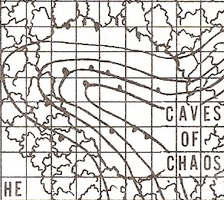
Of note, the apparent caves on the hills in the background are more prominent in this study, particularly the one under the right arm of the elvish archer (who is bald here!). This supports that these holes are actually intended to depict the entrances to several of the Caves of Chaos entrances. For comparison, see this annotated cover image from an earlier blog post: Caves of Chaos Revealed.

Monday, November 17, 2014

Part 41: "Dungeon Mastering as a Fine Art"

Part 41 of a comparison of Holmes' manuscript with the published Basic Set rulebook. Turn to page 39 of your 'Blue Book' (page 38 for the 1st edition) and follow along...

The next two sections in the manuscript come from the first page of content (page 3) in the third volume of OD&D, The Underworld & Wilderness Adventures.

DUNGEON MASTERING AS A FINE ART

Holmes changes the title from "THE UNDERWORLD" to "DUNGEON MASTERING AS A FINE ART". I can think of two reasons for this change. First, Holmes' guidance is mostly limited to dungeons, with just a brief mention wilderness treks, so he no longer needs the original's separate headers for "The Underworld" and "The Wilderness". Second, Holmes' new title helps convey the significance of the work of the Dungeon Master, and that D&D is more than just a board game. Referring to a performing or practical art like acting or photography "as a fine art" is a long-standing tradition going back more than a century. Searching Google Books turns up numerous usages from the 19th century including books such as "Dress as a Fine Art" and "Walking as a Fine Art". In his 1981 FRPG book, Holmes later wrote that "The art of the creative storyteller has been with Homo sapiens since he first learned to build fire in front of his cave and gather around it with a few companions to while away the long winter nights in friendly excitement" (pg 46). 

Immediately after the title, the manuscript has a single paragraph adapting the very first paragraph of OD&D Vol 3. This is the original source material:


And here is Holmes' edit of this material:


The first edition of the published rulebook keeps these sentences unchanged (except for adding a comma between "passages" and "stairs") but adds an additional one at the end: "The geomorphic dungeon levels provided with this game contain many suggestions and will prove very useful", referring to the Dungeon Geomorphs Set One: Basic Dungeons included in the first edition of the Basic Set.

In the second edition (Nov 1978), the Geomorphs were replaced with the new module B1 In Search of the Unknown, so this sentence was revised to "The geomorphic dungeon levels (available from TSR or your retailer) contain many suggestions and will prove very useful", and a new paragraph was added referring to the module: "The Basic Set of DUNGEONS & DRAGONS includes the introductory module "In Search of the Unknown", which will be usable for initial adventuring as well as provide ideas for dungeon construction." This paragraph was left unchanged even in the third edition when the module B2 Keep on the Borderlands replaced B1.

SAMPLE CROSS SECTION OF LEVELS

In OD&D Vol 3, the same page continues with an uncredited illustration of a dungeon:


The published Holmes Basic rulebook features a new cross-section, the famous 'Skull Mountain' drawing by Tom Wham, discussed in my previous post. Wham's drawing retains certain features from the original, including a split 4th level (A and B), a cavern at the bottom, and stairs, slanting passages and chutes connecting the levels.


The Holmes Manuscript also has a cross-section, but one that is different from either the original or Skull Mountain:

The dungeon cross-section from the Holmes Manuscript

This was presumably drawn by Holmes himself, or possibly his son Chris, an artist. To my eye, the handwriting is similar to that found on the two maps in Holmes' 1981 book. A nice treat, since we have only a handful of maps from the hand of Holmes.

Holmes' cross-section shares some elements with the original, most significantly a split 2nd level connected by a slanting passage and stairs, and a cavern area at the bottom. Holmes changes the chutes of the original to ladders, and adds an outside area, a ravine  reminiscent of the Caves of Chaos, housing the entrances to the dungeon. One entrance is a mine that goes straight to the 2nd level, whereas the original had two staircases entering into 1st level. Holmes' cross-section is more evocative than the original by having features such as "Hill Side", "Mine" and "Mine Shaft" labeled, as well as drawings of the ravine and trees, and stalagmites in the cave. It's possible that Wham included features from Holmes' version as Skull Mountain also contains two entrances, a main one also labeled "Entrance", and a second one, "The Pit", a vertical entrance in the same approximate location as the Mine/Mine Shaft of the manuscript. However, we can conclude that Wham added the most distinctive features of Skull Mountain, including the skull-face entrance and the domed city in the water-filled cavern.

Holmes' most significant change to the original is to limit the cross-section to three levels, aligning with the scope of the Basic rules, which includes wandering monsters for only levels 1-3. The next page of OD&D Vol 3 states that "In beginning a dungeon it is advisable to construct at least three levels at once...", so Holmes may have kept to this guidance even when constructing a much smaller dungeon than suggested by the original ("no less than a dozen levels down"). While Skull Mountain is fantastic, and perfect for stimulating the imagination of new players, Holmes' original is more line with the limits of Basic. The Moldvay set would later return to Holmes' original idea by including a similarly limited cross-section, drawn by Erol Otus:

Haunted Keep dungeon cross-section by Erol Otus, from the Moldvay Basic rulebook, 1981

Continue on to Part 42: "Sample Floor Plan, Part of First Level" (a forgotten map by Holmes)
Or go back to Interlude: "Skull Mountain by Tom Wham"
Or go back to Part 40: "Acts Like a Cannon Blast on Walls" (Miscellaneous Magic Items)
Or go back to the Index: The Holmes Manuscript

Thursday, July 3, 2014

Holmes in the New Basic


The new D&D Basic Rules are out, available as a free pdf download from the Wizards website. They are longer than expected for a free pdf, 110 pages with no art (except for the last page which shows the art from the Starter Set) and this only covers material from the Player's Handbook. Later releases will include monsters from the Monster Manual, to make it a complete game.

Holmes is nicely included in the credits on the first page, being the first name listed for "further development" of the "original game", and followed by his Basic Set successors in order.

The new rules use Dexterity for initiative, though rather than directly comparing Dexterity scores as in Holmes Basic, Dexterity checks are compared (d20 roll + plus Dex modifier). 

Updates:

DMDavid notes a reference to the Bugbear Lair (Cave H) from the Caves of Chaos in B2, which Gygax wrote for Holmes Basic, in the humorous disclaimer on the first page:

Disclaimer: Wizards of the Coast is not responsible for the consequences of splitting up the party, sticking appendages in the mouth of a leering green devil face, accepting a dinner invitation from bugbears, storming the feast hall of a hill giant steading, angering a dragon of any variety, or saying yes when the DM asks, “Are you really sure?”

Rob Conley at Bat in the Attic references Holmes Basic when reviewing the new rules:

"Like the Basic DnD Holmes Blue Book there are references to the larger rule set embodied by the 5e PHB, DMG, and MM. I am fine with that as obviously one purpose of this FREE PDF is to be a very large brochure to sell the core rulebooks."

Wednesday, May 7, 2014

Part 30: "It Is, Of Course, Ochre-Colored"

Part 30 of a comparison of Holmes' manuscript with the published Basic Set rulebook. Turn to page 30 of your 'Blue Book' and follow along... 

Nomads


Yet another Man-type from OD&D Vol 2 that Holmes included in the manuscript but TSR cut from the rulebook. The introductory sentence is directly from the source, and the leader composition is taken from the OD&D entry for Bandits, which the original only makes reference to. The composition of forces is from the original's "Nomads of the Desert" column; Holmes omits similar info for "Nomads of the Steppes", as well as a sentence about the additional guards at Nomad encampments. Much of the manuscript Nomad entry is repetitive with the entry for Bandits, so in terms of saving space it makes sense that TSR cut it.

Ochre Jelly

Holmes leaves out the first sentence describing them as part of the "clean-up crew", and adds a line explaining they are ochre-colored. This didn't really help me as a kid since I didn't know what color ochre was. The rest of the entry follows the original closely, including that they do 1 die per round damage to exposed skin. The published version changes this to 2 dice per round, which fits with the 2-12 points of damage they were given in Greyhawk and which is used for the "Damage" stat in the rulebook.

Ogres


This is the only monster where Holmes includes a "Damage" stat. Labeled a "Damage Bonus", the amount (1 die + 2 points, or 1d6+2) is from the original entry in OD&D Vol 2. Greyhawk changes this to 1d10, which the published Holmes Basic rulebook uses for the "Damage" stat. The rulebook also changes "and do additional damage when they score a hit" to "and are of various disgusting colors". The published rulebook also adds "...in their giant-like sacks" to the end of the last sentence, referring to the sacks in the Giant entry.

In the original version of B2, written by Gygax for Holmes Basic, Gygax further ups the Ogre's strength to 1d10+2; see page 17. It's not just that the Ogre in Cave E is exceptionally strong, because the Bugbear chieftain on page 17 is described as being equal to an Ogre and also does the same amount of damage. This could be an editorial oversight. In B/X and the Monster Manual, Ogres do the standard 1-10, although the Monster Manual does allow for leader types doing more damage, 2d6 or 2d6+2.

The B2 Ogre also has AC 4 by wearing a bearskin - one of several humanoids in B2 with improved AC due to armor upgrades. So Gygax didn't feel that humanoids were stuck with the AC they were given in the rulebook. B/X and the Monster Manual each have them at AC 5.

Orcs

Orcs have a lengthy entry by OD&D standards, almost half a page. Much is the composition of Orc tribes/lairs, which Holmes greatly reduces in the manuscript.

In the original printing of the OD&D rules, the first sentence of the Orc description refers to Tolkien: "The number of different tribes of Orcs can be varied as desired, basing the decision on Tolkien or random chance". This was changed in the fall of 1977, after Holmes Basic was out, so we know Holmes worked from an earlier print. Naturally the Holmes manuscript includes the Tolkien Orc reference in edited form: "There are several tribes or nations of orcs as described in Tolkien. Assignment can be made to one of these on a random basis". The published rulebook drops the "as described in Tolkien" and the second sentence entirely. As far as I can remember, this is the only Tolkien reference in the manuscript that was changed before publication of the first printing. In the second and third printing various references to "hobbits" were changed to "halflings", but other Tolkien references (balrogs, Nazgul) were left unchanged. So it's not clear why this one Tolkien reference was omitted. For more on the Tolkien references in the Holmes Basic rulebook, see this page: Tolkien & the Blue Book.
 

The published rulebook makes two other changes to the manuscript. Drawing on the original entry, Holmes gives a group of 100 orcs a 10% chance of being accompanied by a dragon. The published rulebook deletes this line, leaving only a chance of Ogres or Trolls. The rulebook also adds a stray sentence at the end about Orcs having a -1 to hit in sunlight.This was in the original entry, so Holmes seems to have overlooked it, perhaps because it is made by reference to Goblins ("Orcs do not like full daylight, reacting as do Goblins").

Owl Bear 

This beast was added in the Greyhawk Supplement. In the manuscript, Holmes draws from the Greyhawk description, and adding a clarification that they are "huge bears with the heads of owls". There are no changes to the published version other than the usual addition of Attacks and Damage stats (3, for 1-8 each). Since Holmes original description is unchanged, the implication is that these three attacks are for "beak, claw and bear-hug". However, in the module B2 it clarifies that the three attacks are for 2 claws and 1 beak, with no mention of the bear-hug. For the description of the hug, we have to go back to Greyhawk, which gives them "2 claws/1 bite" for "1-6/claw****, 1-12/bite", where the asterisks indicate "hug on score of 18 or better causes 2-16 points of additional damage". 

Continue on to Part 31: "This Inoffensive Looking Little Creature"
Or Go Back to Part 29: "They Usually Inhabit Tunnels, Mazes and Labyrinths"
Or Go Back to Start: The Holmes Manuscript

Wednesday, April 30, 2014

Part 29: "They Usually Inhabit Tunnels, Mazes and Labyrinths"

Part 29 of a comparison of Holmes' manuscript with the published Basic Set rulebook. Turn to page 29 of your 'Blue Book' and follow along... 

Medusa 

Holmes changes a few concepts from the original description in OD&D Vol 2. Originally they were a "human-type monster with the lower body of a snake, a human torso and head, with tresses which are asps", but Holmes leaves out the part about a "lower body of a snake", making them humanoid - which is how they were described later in AD&D and B/X. Holmes also adds "Usually female", which wasn't mentioned in the original. In the Monster Manual and B/X they are described as strictly female. 

Holmes adds a concept from the original myth that was missing from OD&D: "It can be looked at in a mirror without harm" - providing another use for those mirrors in the Equipment List. He leaves out one concept from the original that "It also is subject to the effects of its reflected glance", but the published rulebook adds this  back by appending "...and if it sees its own gaze in a mirror is is turned to stone". 

Greyhawk has the attacks as "1 or 2" and damage as "by weapon type and turn to stone" but the published rulebook gives them 1 attack for 1-6, without specifying exactly what form of attack this is. B/X later clarified that the 1-6 is for snakebite.

Mermen


In OD&D, Mermen were one of the "categories of men". See page 3, 5 and 7 of Vol 2. Thus, Mermen represent another OD&D "man-type" that Holmes included in the manuscript but that was cut from the published version. The brief description in OD&D also does not indicate whether they have fish tails or are simply humans who live in the water. Holmes clarifies this by adding a paragraph describing them as having the familiar form of a mermaid.

Minotaur

The original description is brief, and Holmes follows it closely, including the joke about bull-headed men debating rules. As with Medusa, he adds a new sentence based on the original myth, specifically that minotaurs usually inhabit tunnels, mazes and labyrinths (this concept was also included as the last sentence of the entry in B/X). There are no changes in the description from the manuscript to the published version. 

Greyhawk gave them three attacks, "1 butt/1 bite/1 weapon" for 2-8, 1-3 and by weapon type, but the published rulebook changes this significantly to "2 horns + 1 bite" for 1-6 each. In the module B2, Gygax merges these by allowing the additional weapon attack when charging, but only two attack forms when not charging. The Monster Manual and B/X each have other variations on these combinations. Lots of options to choose from here!

Mummies

Holmes follows the description in OD&D closely, with no conceptual changes. The two paragraphs in the manuscript are retained in the published rulebook, which adds an entirely new third paragraph describing the fear induced by a mummy.

Nixies

Holmes simplifies the seven sentences of the original down to three, dropping a few concepts such as Dispel Magic possibly working against the Charm, and the Nixies not being afraid of flame. There are no changes to the description from the manuscript to published rulebook. Greyhawk allowed them an alternate attack "by weapon type" but as with most other humanoid monsters the rulebook drops this option.

The Nixie entry was included in the first edition of the rulebook (1977) but was later deleted when the monster section was reformatted for the second edition (Nov 1978). If you have a later edition and haven't seen this entry before, here it is:


Continue on to Part 30: "It is, Of Course, Ochre-Colored"
Or Go Back to Part 28: "Thus We Find Weresharks in Polynesia"
Or Go Back to Start: The Holmes Manuscript

Thursday, March 20, 2014

Part 26: "Always Attack Dwarves on Sight"

Part 26 of a comparison of Holmes' manuscript with the published Basic Set rulebook. Turn to page 27 of your 'Blue Book' and follow along...

Gnome 

Holmes' description is a rewording of the short original in OD&D, Vol 2 (pg 4 and 16). OD&D Vol 1 listed Gnomes along with Dwarves in the column of "Lawful", but Holmes gives them a "Neutral" alignment. In Strategic Review #5 (Feb 1976), Gygax introduced the 5-point alignment system and had placed gnomes in the square for Chaotic Good (near the border for Lawful). Thus it's no surprise that the published rulebook changes the alignment to "chaotic good 75%, neutral 25%". Later editions have them as "Neutral to Lawful Good" (Monster Manual) or "Lawful/Neutral" (B/X).

The published rulebook adds one sentence to the end of the description: "They favor crossbows". This preference doesn't appear in the Monster Manual, where they use short bows, slings and spears as missile weapons, but Tom Moldvay did keep it in B/X.

Gnomes as PCs is usually considered an AD&D-ism, but like many other rules it has roots in OD&D. In the Greyhawk Supplement, the section on Dwarf PCs on page 5 describes Dwarves as being "...of various types (hill, mountain, or burrowers)(such as gnomes)". Being in the character section, the implication is that the player can choose a type for a dwarf character, including a gnome. Holmes used some of the Dwarf descriptive material from Greyhawk in his section on characters, but left out the reference to the sub-types. 

In the Monster Manual gnomes receive an extensive new write-up that gives the first hint of their magical powers: "It is rumored that there exist gnomes with magical abilities up to 4th level, but this has not been proved" (pg 46). Gnomes were finally introduced as a full player character race in the Player's Handbook, where these magical abilities were revealed to be illusionist abilities, but of 5th to 7th level rather than 4th.

Goblin

Holmes draws on OD&D, Vol 1 (alignment) and Vol 2, pages 3 (stats) and 7 (description). Holmes lists their Alignment as "chaos", unusual because he doesn't usually include alignment if the monster is chaotic. Holmes has their Hit Dice as "1 - 1 point (but always a 1)", a typo corrected in the published rulebook as "1 -1 point (but always at least 1)". Holmes has their Treasure as "1-6 Gold Pieces each" which is from page 3 of Vol 2. The published rulebook changes this to a new Treasure Type, L, which is 2-12 electrum pieces per individual. 

The manuscript description is taken from two paragraphs on page 7 of OD&D, Vol 2, and follows it closely but drops a reference to morale since Basic doesn't include morale rules. Holmes adds a new sentence at the end about the leader-types: "They are large and fearless, fight at full strength under all conditions and take nothing of their hit die, in dark or light". Holmes may be equating these big goblins with Saruman's Uruk-Hai, who had resistance to sunlight. Holmes uses the term "hit die" to refer to the attack roll, something seen occasionally in OD&D. The published rulebook doesn't make any changes to the description.

Goblins are an important part of Holmes' "flavor text" in Holmes Basic: the first combat example is a battle with one, and a group appears in a room in the Sample Dungeon.


Update: Another tibdit. In Greyhawk, Goblins do 1d4 per hit. In the published Holmes Basic rulebook its upgraded to 1d6, the same as would later appear in the Monster Manual.


Illustration from the 1st edition rulebook

Holmes included all of the original OD&D "Clean-Up Crew" in Basic. We've previously seen the Black Pudding and Gelatinous Cube (added in Greyhawk), and next up are two more.

Gray Ooze

The manuscript retains all of the concepts from the original with just the typical minor editing & re-phrasing. The published manuscript changes "two dice of damage" (2d6 in OD&D Vol 2) to "two 8-sided dice of damage" to bring the damage in line with the alternate damage introduced in Greyhawk. Note that both the original and Holmes Basic say it takes a turn to do this damage, which would be ten minutes in OD&D, or 10 combat rounds in Holmes Basic. This may be a place where the original rules used "turn" to mean "round", because B/X clarifies the damage is per round.

Also, Gygax used Grey Oozes in the Shunned Cavern (Area G) in the module B2, which was originally written for Holmes Basic. There he provides some clarification for the Grey Ooze attack: "Each causes 1-8 points of damage on the first round, unless attacking from above, because half of their damage will be taken up in destroying the foot and leg protection of the victim. Thereafter, attacks cause 2-16 points of damage, as do attacks from above".

The 1st edition rulebook includes an illustration of the grey ooze (see above) that was cut from later editions. The art is unsigned but is likely by David C. Sutherland, or possibly Tom Wham. 

Green Slime

Again the manuscript retains all concepts from the original, even the reference to the Cure Disease spell, a third level Cleric spell which is not described the Basic rulebook. Holmes changes the word "non-mobile" to "non-motile, which the published rulebook changes back. I guess Holmes thought "motile" (able to move on its own) was more accurate than "mobile" (which more broadly includes things that can be set in motion). As we've seen repeatedly, the published rulebook adds a new sentence at the end of the description: "It often drops from high places, such as ceilings", perhaps to clarify how it might attack without being able to move. Does it drop from ceilings on its own accord when it senses the heat of an animal?

The Monster Manual clarifies that green slime is a "plant monster", so it could be subject to a Plant Control ring. Perhaps one could keep it from releasing from a ceiling, or even cause it to release itself from flesh. 

Continue on to
Or Go Back to Start: The Holmes Manuscript

Saturday, June 29, 2013

Turns in Holmes Basic

Holmes Basic is known for having "shifting" turns. Normal turns (moving, exploring) are ten minutes long, but during combat the turns shift to ten rounds of 10 seconds, so yielding a "combat turn" that are only 100 seconds long; i.e., 1 minute and 40 seconds.

Here are the relevant quotes from the rulebook:
"Each turn is ten minutes except during combat where there are ten melee rounds per turn, each round lasting ten seconds" (pg 9)
"There are ten "rounds" of combat per turn. Each round is ten seconds, so a combat turn is shorter than a regular turn, but results in at least as much muscular fatigue" (pg 20)

However the rulebook doesn't specify what the purpose of tracking "combat turns" is. Why not just track rounds during combat? Combat movement per round is given on pg 20, so it's not like the "combat turn" is needed for movement.

The main thing that "combat turns" would seem to apply to is spell/magic (i.e., potion) durations. However, the shortest spell duration is 2 turns, which is 20 rounds, longer than most combats. Once combat is over, the tracking of time shifts back to normal, which means the remainder of the spell duration then shifts back to "normal turns" until it ends. So what the different turns are used for is tracking how much of your spell turns are used up by melee rounds (10 combat actions = 1 turn) vs exploration (1 movement or search = 1 turn).


As an example, Mar Pres the Conjurer, a third level magic-user, casts the spell Enlargement on fellow party member Tensho the Warrior during the 1st round of a combat with an ogre. This spell has a duration of 1 turn plus caster level, so Tensho will remain enlarged for 4 turns. If the combat is 10 rounds or less, 1 turn of the spell would be used. After combat is over, 3 "regular turns" (30 min) would remain. If combat went between 10-20 rounds, a second "combat turn" would be used, so after combat Tensho would only remain enlarged for 2 more "regular turns" before returning to normal size.

In the module B2, the original version of which was written specifically for Holmes Basic, Gygax gives some useful advice on the "combat turns":

"If fighting should occur, the time reference shifts to a melee turn which is subdivided into ten, 10 second melee rounds. The concept of a melee turn is designed to simulate the quick exchange of blows in combat. For the sake of convenience, a DM can consider one entire melee turn to equal one normal turn (that is, 10 minutes), no matter how many melee rounds the combat took. The extra time is spent recovering one's breath, checking for woulds, re-sharpening blunted weapons, etc." (pg 4, section TIME)

This is practical because it results in the actual time length between combat turns and normal turns being the same, and fits with Holmes statement that combat turns result in the same amount of fatigue as a normal turns.

[the above is adapted from several recent posts in a thread on OD&D Discussion]

Tuesday, January 29, 2013

Draw Your Own Floor Plan


The Cyclops' Treasure. Click on the map for a larger view

One feature of the module B2 Keep on the Borderlands, in both the original Holmes edition (1st and 2nd printings) and the revised Moldvay version (later printings), is a single sheet of detachable graph paper on page 27 of the module. This sheet is labeled DRAW YOUR OWN FLOOR PLAN in the same Futura font used in the module, Holmes Basic and the first three AD&D hardcovers. The grid area on the sheet is 10.25 by 7.5 inches at 4 squares per inch, giving 41 by 30 squares. The back side of the sheet (pg 28) contains a blank table for listing ADDITIONAL NON-PLAYER CHARACTERS. 

This sheet is part of the guidance for new DMs found on pages 1-7 and 24-28. The page preceding the graph paper is a map of Area 16 of the Keep, labeled GUILD HOUSE FLOOR PLAN, which shows two levels of the Guild House at a scale of 2 feet per square. It's the only area of the Keep with a map at that level of detail. This floor plan is described on page 24 in the section DESIGNING FLOOR PLANS, as an example of how to detail the buildings of the Keep, followed by the instructions to "lay out as many buildings of the KEEP as you can". So it's clear that the graph paper was intended for drawing the floor plans of more buildings. However, I never used it that way...

Shortly after learning how to play Holmes Basic D&D from some neighbors who had the same set, I found out my best friend E.H. had also learned the game from his older cousins. He had the Moldvay Basic and Expert sets, so he also had a version of B2. One of our fathers photocopied the graph paper page for us, and for a while we used these sheets for drawing our dungeons. E.H. also introduced me to his method of drawing dungeons with colored pens, generally with the dungeon in green ink and each trap or other feature in a different color. I retained one of his maps from our youth, which I recently returned to him after scanning, and this is shown above as an example.

I always thought my friend's maps turned out better than mine, in part because he had finer-tipped pens. This particular dungeon started with rooms 1-19 that he drew, with rooms 20-24 added by myself at a later date. Unfortunately, no corresponding key remains, and I have only the vaguest memory playing this through this dungeon. Other than room numbers, the only words on the map are "Cyclop Trease" (Cyclops Treasure, I believe), which means room 15 probably had a Cyclops from the D&D Expert Set.

I don't remember all of the notations he used, but a black square is obviously a Pit, a red "S" is a secret door, a yellow square is where a 10' Ceiling Block falls, a red square is a 10' fire wall, a blue-lined circle is a falling net (I may have added these later), and the blue lines in the corridor are a Moaning Corridor. Other possible features:

Room 2 - Ice (I think I added this later)
Room 6 - Magic Pool "whose waters have strange effect"
Room 7 - Red lines = Spray "that attracts Wandering Monsters"
Room 8 - Curtain in front of circular pit that may lead to red Chute near room 20
Room 9 - Hexagonal room with statue?
Room 9a - Gold behind some kind of special door?
Room 15 - Black lines = Spring-fired Darts
Room 16 - Room-filled with Poison Gas
Room 17 - Red line = Flying weapon that attacks "only if disturbed"
Room 18 - Yellow circle with BC? or BL? Blinding Lights?

Our early dungeons were typical Funhouse Dungeons / Monster Zoos, each room having a different monster essentially in stasis until encountered, without reason or connection to the other rooms. But they were perfect for us at that age (late elementary school). I would see E.H. every other weekend when he visited his father, and we would take turns DMing each other through our dungeons, each of us controlling an entire party of our own characters, typically 4 or 5 characters each.

The title Draw Your Own Floor Plan remains etched in my mind, and I even considered using it as a name for this blog. Instead I plan to post other maps drawn on this paper in a gallery on the ZA site

Did anyone else use this graph paper for their maps? Searching on the net, I found one other blogger who posted a map he drew on this paper: The RPG Corner's Own Floor Plan.

5/20/15 Update: Looking over the list of Traps in Moldvay Basic reminded that E.H. started with B/X, and the traps he used were clearly influenced by that list. I've bolded the ones that seem to correspond.

Friday, June 22, 2012

The Travelers Inn by paleologos (1981)


The Green Lilac Travelers Inn (1981) - click link below for a larger version


The above piece is great, back-in-the-day game art illustrating part of B2:

"I was going through some papers over the weekend, and I found this sketch I made in Grade 8 of a group of adventurers entering the Inn in the Outer Bailey of the Keep"

"I haven't seen this picture in over 20 years, but it immediately brought back some of my first memories playing D&D...good times."

     -paleologos, writing on Dragonsfoot

The layout of the Tavern (Area 15) and Inn (Area 16) match the map in B2, with the wall to the Inner Bailey to the north.

Monday, May 28, 2012

Monster Ability Scores

     D&D Next gives each monster type a full set of six ability scores, necessary because saving throws (in addition to other stat checks) are based on these scores. Monster ability scores are not generally used in old-school D&D, but are also not entirely antithetical - particularly in Holmes Basic. The very module from which the playtest scenario was derived, B2 Keep on the Borderlands, is the only TSR module to include a DX (dexterity) score in the stat block for each monster. This was because initiative in Holmes Basic went in order of dexterity. In the rulebook, Holmes simply suggested rolling the dexterity of each monster on the spot; In B2, Gygax sped this up for novice DMs by including the stat for each monster. Most of the monsters in B2 have the same DX score for each type, allowing extrapolation of Gygaxian typical DX scores for these monsters. Here's a breakdown of the DX scores for the Caves of  Chaos monsters in Holmes Basic vs D&D Next:

     Most monsters have from 1-3 points added from Holmes Basic to D&D Next, while a few remain exactly the same (Ogre, Minotaur) and a number of others have 6 or 7 points added (stirge, giant rat, wight, gelatinous cube, bugbear). Only a single monster, giant centipede, is 1 point slower in D&D Next. Dexterity inflation!

     Another section of Holmes that implies monster ability scores is the Charm Person spell, which allows new saves based on intelligence for all persons, including various humanoids. The INT scores for humanoids are not specified, but it could be inferred from the suggestion for dexterity that the referee should roll for these monsters. Furthermore, the table ends with "18 or higher", suggesting higher than human INT scores exist. This was furthered in the AD&D Monster Manual, which provided an Intelligence rating for each monster entry, which were correlated to character INT ranges in the introduction. The Monster Manual also has a few residual mentions of monster dexterity scores (e.g. the Brownie has an 18 dexterity). In Holmes, the Gauntlets of Ogre Power refer to "an ogre (18 strength)", suggesting ogres have 18 strength. Strength scores for humanoids were elaborated in the 1E Dungeon Master's Guide (1979, pg 15), which also listed ogre strength as 18.

     The DM of the group I play in (1E/2E hybrid, currently going through T1-4) uses roll-under d6 stat checks. 2d6 if really easy, 3d6 average, 4d6 hard, 5d6 extremely difficult etc. He'll sometimes require a 3d6+1 or 3d6+2 as a modifier to make it a bit harder. As a player, it's fun to roll a handful of dice (despite the fact it means you are more likely to fail). These are more often used for players than monsters. I asked on OD&D Discussion where this system originated, and 3d6 (Bruno's Demise) replied that he first saw it in The Halls of Beoll-Dur module in Dragon #41 (Sep 1980), which has:

     "[T]here is an original procedure for saving throws which is used in some locations... roll 3, 4 or 5d6 (the number of dice varies) and subtract one point from the dice roll for every two levels of experience the character has attained. Compare the resulting number to a specified ability (this also varies), and if the adjusted dice roll is less than the character's score for the ability in question, the saving throw is considered made" (page M1).

     Looking through the module, these are used for "new" forms of stat checks rather than replacing the traditional saving throws, and would generally only be used for characters in the adventure rather than monsters.

Sunday, May 27, 2012

The Next Caves of Chaos...are here!


The D&D Next (5E) playtest materials are now available from WOTC, and as predicted, the playtest scenario is the Caves of Chaos from B2. The scenario is not a "reimagining" like the 4th edition version (2010); instead it's a straight conversion of the original to the playtest rule set. Here are the credits:

Dungeon Module B2
The Caves of Chaos
By Gary Gygax
Revision by Robert J. Schwalb and Bruce R. Cordell
Revision Developed by Chris Sims and Matt Sernett
An Adventure for Character Levels 1-3.

It's good to see the Gygax credit included. The cover page re-uses a painting by Michael Komarck titled "Caves of Chaos (2005)" - originally used as an interior illustration in the 3.5E Players Handbook II. This is the only artwork included in the playtest module other than a scan of the pale blue Caves map from the inside cover of the original B2. While I'll always prefer the original blue maps, you could also use the "modernized" CoC maps by Weem for the playtest, which I believe are large enough to print for use as battle mats.

The playtest was adapted from the original Holmes version of B2, rather than the revised B/X version, because the minotaur's treasure includes potions of strength and delusionary healing, rather than potions of growth and healing (spoiler alert, highlight to see).
     There are many small changes with respect to the original Holmes version, so even if you know the Caves very well there will still be small surprises. The only significant addition is a list of five different possible backstories to use - reasons why the evil humanoids are grouped in the Caves. Each is a paragraph in length, and could be used with the original version. Any DM could come up with their own version that is just as good but these are interesting and might inspire you to take a different approach.
     
Rob Conley at Bat in the Attic wrote the following about the playtest scenario:
     "Despite the differences in mechanics it works out about the same way you expect if you ran it with Mentzer rules ... 
      I am optimistic at this point mainly because of the format ... the fact it works as is in actual play and that it is the full caves and not some stripped down version ...
     The Cave of Chaos adventure is almost as verbatim copy of the original and it uses ONE line stats blocks that are useful in actual play. If this format continues to be used this means that it is highly likely that D&D Adventures, Settings, and maybe supplements would be of some use to the OSR. Much in the same way that Swords and Wizardry gamers find material useful that was written for OSRIC."