This is the blog. Click here to go to the Zenopus Archives website.

Note: Many older posts on this blog are missing images, but can be viewed at the corresponding page in the Internet Archive

FEATURED POST

The Forgotten Smugglers' Cave: Index of Posts

An index of posts describing the Forgotten Smugglers' Cave, an adventure for Holmes Basic characters levels 2-4.                    ...

Showing posts with label Cthulhu. Show all posts

Monday, June 22, 2020

Reviews from R'lyeh on Bayt Al Azif #2


Reviews from R'lyeh recently reviewed the second issue of the Call of Cthulhu RPG zine Bayt Al Azif (link below), in a column entitled, "A Cthulhu Collecteana II".

As I announced last fall, this issue of this zine includes a reprint of J. Eric Holmes' 1983 review of the Call of Cthulhu RPG, along with some commentary on his review by myself. This was a follow-up to the article I wrote for the first issue about Holmes role in bringing the Cthulhu Mythos to D&D in the '70s. Each issue can be found at DrivethruRPG in either PDF or Print format:


(links include my DrivethruRPG affiliate number)


The R'lyehian reviewer Pookie provides an in-depth review of the issue, concluding:
"Overall, Bayt al Azif Issue 02 is a good second issue, much improved on the first. Its better sense of professionalism is combined with a good range of voices, scenarios, and articles about Lovecraftian investigative roleplaying"
And specifically regarding Holmes' review, Pookie writes:
"The second review is actually of Call of Cthulhu itself, but not of Call of Cthulhu, Seventh Edition. Rather, ‘“It is not dead which can eternal lie…” Game Review: Call of Cthulhu’ is actually a review of Call of Cthulhu, First Edition by J. Eric Holmes, the editor of the 1977 Dungeons & Dragons Basic Set RPG. This is fascinating continuation of Zach Howard’s ‘Clerical Cosmic Horror: The Brief Era of the Cthulhu Mythos as Dungeons & Dragons Pantheon’ from Bayt al Azif Issue 01 and he adds a commentary to the end of the review. Together they provide a contrast between a time when Cthulhu was just beginning to appear in the gaming hobby and its prevalence today."

Read the rest of the review here: 

A Cthulhu Collectanea II

s with editorial, 'Houses of the Unholy', which really takes stock of the progress of the magazine from the first issue to this one. So it is somewhat reflective in nature before it sets out what the -fulfilled and unfulfilled, the highlights, and the trends. From , .

Thursday, September 19, 2019

Bayt Al Azif #2: Unboxing Video


Over on YouTube, MaxWriter* has an unboxing video of the print-on-demand of issue 2 of Bayt Al Azif. He pages through all of the articles, so at 4:33 in the video you can get a glimpse of the reprint of Holmes' 1983 review of Call of Cthulhu and Chris Holmes' new art that accompanies it. For more details see my previous post. 


Purchase link:


(link includes my DrivethruRPG affiliate number)

*MaxWriter also has a long-running thread at ODD74, "Role Playing Journals", that details  game sessions he's run.

Bayt Al Azif #2 Unboxing

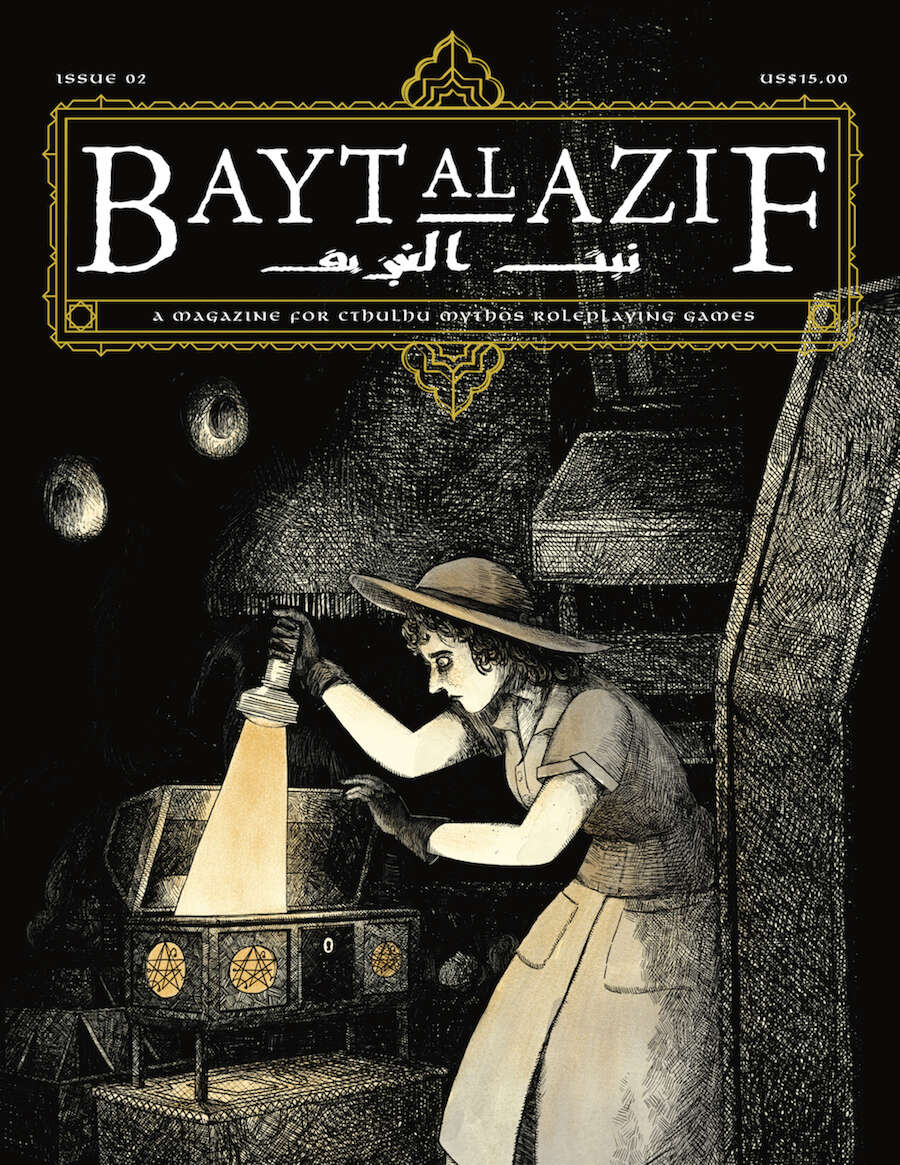
The second issue of Bayt Al Azif is out and it looks as amazing as the first. It's available as a softcover, hardcover, and PDF. Check it out. Bayt Al Azif Issue #2 - https://www.drivethrurpg.com/product/246849/Bayt-al-Azif-2-A-magazine-for-Cthulhu-Mythos-roleplaying-games Hi everyone - I'm Andy and I've been doing Minecraft videos for some time in addition to IRL stuff and tabletop roleplaying games.

Tuesday, September 10, 2019

Holmes' 1983 review of the Call of Cthulhu RPG: Rediscovered and republished in Bayt Al Azif #2


Cover art by Jensine Eckwall

A major announcement for Holmes enthusiasts: in 1983 Holmes wrote a review of the then relatively new Call of Cthulhu RPG (by Sandy Petersen), for the inaugural issue of the short-lived Gameplay Magazine (February '83 to April '84), a periodical similar to Dragon but with much more of a general gaming focus. I was completely unaware of this major piece by Holmes ⁠— one of his last in the field of writing about RPGs ⁠— until recently when the long-lost article was rediscovered by Tony A. Rowe of the Cryptic Archivist blog. The original 1986 author bio for the Maze of Peril novel mentions that Holmes had articles in several magazines including Gameplay, but after finding a computer game review he wrote in a later issue (detailed in the Holmes bibliography) I had assumed that was all he had written for that publication. Not so. The review, which is a two full pages as originally published, is written in his characteristic engaging and genre-fan style and includes anecdotes and advice based on CoC games that he himself had run, as well as providing more fodder for a Holmes "Appendix N"

And now, with the permission of Chris Holmes, I am thrilled to announce that this article is once again in print in the second issue of the Cthulhu RPG magazine Bayt Al Azif, along with brand new illustration by Chris of a scene from one of those actual-play stories (!), and a half-page of commentary on the review by myself (bringing the total to 3 full-pages):


(link includes my DrivethruRPG affiliate number)

Both digital and hardcopy are available through the above link. This second issue is longer ⁠— 108 pages ⁠— than the the first, and once again includes a wide variety of articles of interest to the Cthulhu RPG enthusiast, including multiple scenarios set in different eras. Here's a screenshot of the Table of Contents:


Thanks to Tony for locating and scanning the original article, to Chris for agreeing to reprint it and providing accompanying art, and to the editor Jared Smith for accepting it for his magazine and doing the layout.

See also the earlier post about my article for the first issue of Bayt al Azif.

Tuesday, August 6, 2019

Holmes' 1946 Letter to a Pulp


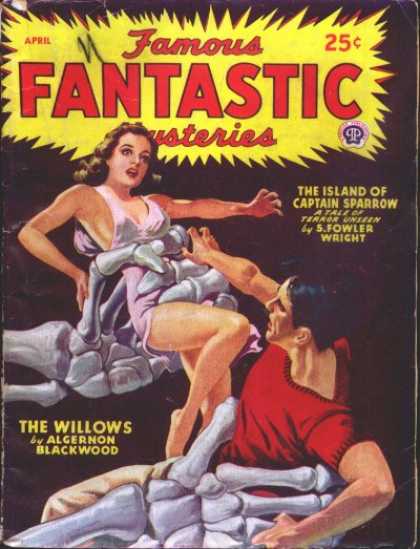
Above is "Advice", a letter from a sixteen-year-old John Eric Holmes to Famous Fantastic Mysteries, a fantasy and sci-fi pulp magazine, with many enthusiastic suggestions for older stories they might republish. The letter appeared on page 127 of the April 1946 issue.

At the time of writing this letter, Holmes attended the Punahou School in Honolulu where he lived with his parents; his father Wilfred "Jasper" Holmes taught engineering at the University of Hawaii, both before and after WWII. Wilfred had remained on the island during the war, serving as an intelligence officer in the Navy, about which he later wrote a book, Double-Edged Secrets (1979). Wilfred was himself an author of fiction, having written naval adventure stories under the pseudonym Alec Hudson since the '30s, the majority published in the Saturday Evening Post.

According to an interview with John Martin, at the age of eight Eric discovered the works of Edgar Rice Burroughs, and was even able to meet the author at his house in Hawaii and have a Tarzan book signed. And then around the time he turned ten, Eric found "the pulps". The author bio for his short story "Martian Twilight" (1991), states that "he read S. J. Perelman's review of the first issue of CAPTAIN FUTURE in the THE NEW YORKER's "Talk of the Town," [January 1940] and discovered the pulps. He has been a dyed in the wool fan ever since". While most of his recommendations in "Advice" are for "Weird Fiction" authors, he was also a fan of the adventure side of the pulps. His son Chris Holmes relays in "John Eric Holmes - The Books" that "[h]is favorite pulp hero, next to Captain Future, was Doc Savage. He also enjoyed the Shadow, the Spider, the Avenger and Fu Manchu."

Famous Fantastic Mysteries (FFM) was published from 1939-1953, and Fantastic Novels (FN) was a companion magazine published in 1940-1941. The stories that Holmes did not favor are "The Machine Stops" by E. M. Forster Wayland Smith, and "Before I Wake" by Henry Kuttner, both of which appeared in the March 1945 issue of FFM. When he refers to them as being like the fiction in Cosmopolitan, he is not referring to a fashion magazine, but an earlier incarnation that was a popular fiction magazine published by Hearst. A story he did favor, Machen's "The Novel of the White Powder", had appeared in the November 1944 issue of FFM. Presumably, Holmes was pleased that his letter appeared together in an issue that also included a reprint of Blackwood's classic "The Willows" (1907), as teased on the cover, and perhaps suggesting that the editors had listened to his advice:


Eric would graduate from Punahou the following year (1947), when his yearbook bio noted that he "keeps busy trying to crash the pulp market". Eventually he had a single story, the military sci-fi "Beachhead on the Moon", appear in the pulp Blue Book in 1951, when he was a psychology student at Stanford.

Eric Holmes remained a lifetime fan of these authors. Thirty years after this letter, he would write an authorized sequel to Burroughs' Pellucidar series, Mahars of Pellucidar (1976), as well a further unpublished continuation, Red Axe of Pellucidar. And I've described his role in bringing the Lovecraftian Mythos into D&D in the later '70s. Chris Holmes indicates that [h]e read everyone in the "Lovecraft Circle" and his favorite of Lovecraft's influences were William Hope Hodgson and Arthur Machen". In 1988, while living in the UK, Eric sent a short report describing a meeting of the Machen Society (an appreciation club) to the fanzine Crypt of Cthulhu, published in issue 57.

From this list, we can also see how from an early age Eric Holmes was "primed" to embrace D&D when it appeared in the mid-70's. While only three of the authors he suggests are are also found in Appendix N (Burroughs, Dunsany and Lovecraft, with an earlier version in Dragon also including Blackwood), the majority were strong influences on Lovecraft; all except Burroughs, Collier, Roberts and Taine are mentioned in H.P. Lovecraft's essay Supernatural Horror in Literature.

Authors Recommended for the Pulps by Holmes in 1946, in "Appendix N" format

Blackwood, Algernon

Burroughs, Edgar Rice

Chambers, Robert W.  THE KING IN YELLOW (1895)

Collier, John

Dunsany, Lord (Edward Plunkett)  TIME AND THE GODS, THE BOOK OF WONDER (1912), THE BLESSING OF PAN (1927)

Hodgson, William Hope

Lovecraft, H.P.  THE DREAM QUEST OF THE UNKNOWN KADATH (composed 1927, first published by Arkham in 1943)

Machen, Arthur  THE GREAT GOD PAN (1894), THE THREE IMPOSTERS (1895, includes "The Novel of the Black Seal" and "Novel of the White Powder"), THE RED HAND (1895), THE HOUSE OF SOULS (1906 compilation, includes "The Shining Pyramid" (1895) and "The White People" (1904))

Roberts, Charles   IN THE MORNING OF TIME (1919)

Smith, Clark Ashton 

Taine, John  THE IRON STAR (1930)

Tuesday, December 18, 2018

Holmes for the Holidays 2018


"Holmes for the Holidays" is back for 2018!  

This year I'm giving away a paperback copy of the first issue of the new Cthulhu RPG zine Bayt El Azif, which as described previously has an article that I wrote about Holmes' role bringing the Cthulhu Mythos into D&D, with a new illustration of a Mythos creature by Chris Holmes.

* * * * *

For the give-away I'm using the same system as before: if you are interested, add a comment in reply to this post within the next two days. The two days are the time limit before moderation starts on posts on this blog. After two days, I'll st
op accepting entries and treat the list of comments as a table and roll randomly for the winner, using dice from a Holmes Basic set.

I'll cover postage (media mail) for any U.S. address. I can ship to other countries but I ask that you cover the difference (any amount over $4) in shipping by PayPal; so if you are overseas please only participate if you have a PayPal account and willing to chip in the extra. I'll estimate the exact shipping and refund the difference if I overcharge. Note t
his is intended for folks who don't yet have a copy of the magazine.

Please note that due to the date I'm starting this that I may not have time to get this in the mail prior to Christmas, and it almost certainly won't be received by then. If you'd like get a copy of this sooner you can try ordering over at DrivethruRPG (link includes my affiliate number). And if you are looking for other gifts try my recent post "Things I've Written Published Elsewhere".

1/7 Update, including the Results:


A happy New Year everyone. My apologies for the delay in announcing these results.

I recruited a dice elf to make the roll for me. There were 36 comments (only 31 of which were entries), so we used Percentile Dice (pink 20-sider for 10s, white 20-sider for 1s), re-rolling any score for non-entries or and any over 36. 

After a few practice rolls, we made the official roll...


...which indicates that number 21 is the winner! That's Tony Rowe, who I will contact via email.

Thanks to all who entered the contest! Hope to have a new Holmes Ref sheet out soon.

Wednesday, October 31, 2018

Article in a New Cthulhu Zine


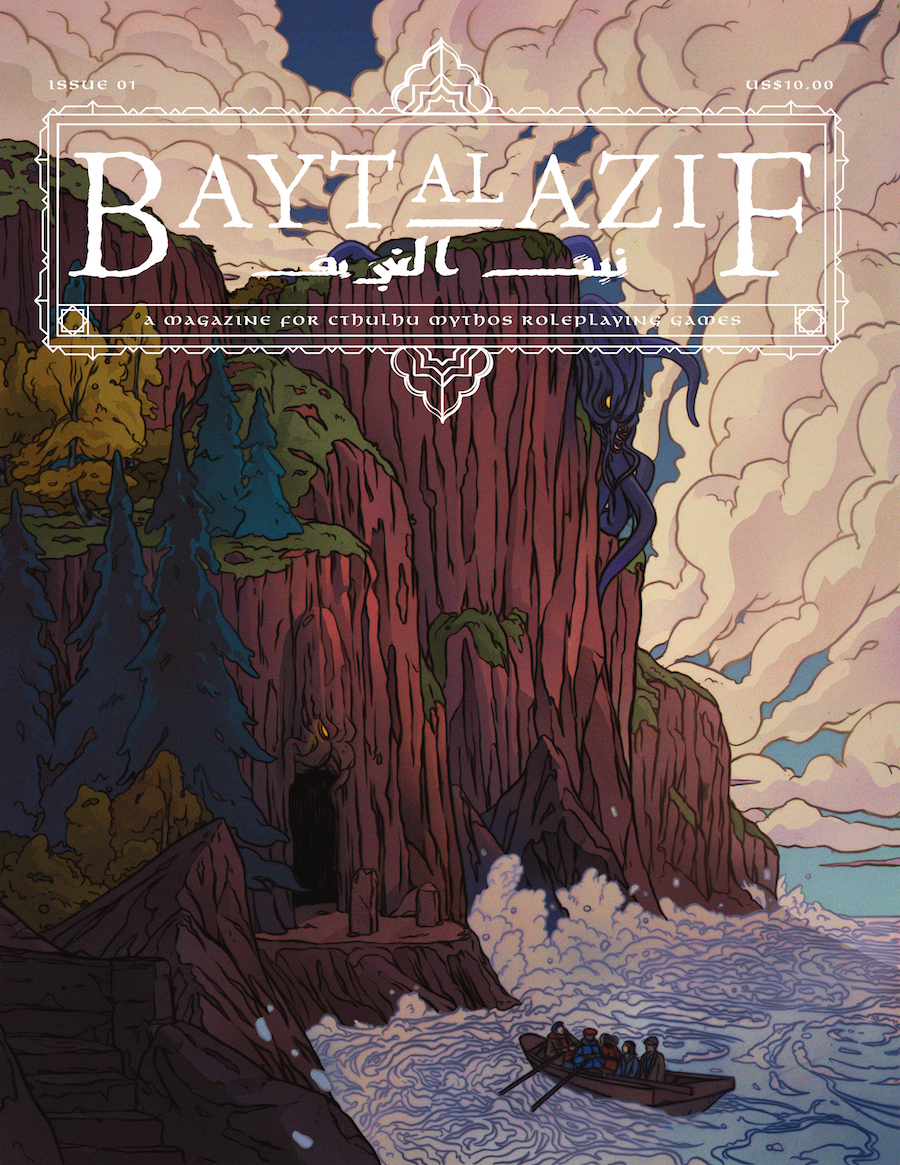
The cover of Bayt al Azif issue #1. Art by Maria Nguyen.


FYI, I have an article in the first issue of Bayt al Azif, a new magazine "for Cthulhu Mythos Roleplaying Games" (as stated on the cover), edited by Jared Smith. As Jared explains, 
"Al Azif" is one title Lovecraft used for the Necronomicon, perhaps referring to the howling of demons, and thus the full title of the new magazine can be interpreted as referring to the "House of the Necronomicon". It's available in both pdf and print versions, and can be previewed or purchased here at DrivethruRPG ---


(link includes my DrivethruRPG affiliate number)

The magazine is 80 pages long and includes a variety of articles of interest, including three scenarios for Call of Cthulhu. See the DrivethruRPG page for more details. Here's a screenshot of the Table of Contents ---


My article is "Clerical Cosmic Horror: The Brief Era of the Cthulhu Mythos as Dungeons & Dragons Pantheon", which is a rewrite and expansion of a topic I discussed on this blog a number of years ago. Essentially on Holmes roll in bringing the Cthulhu Mythos into Dungeons & Dragons where it served as part of the line-up of pantheons for a few years.

The best part is that the article is accompanied by a fantastic new piece of art by Chris Holmes! It's a Mythos creature, but I will keep which one a surprise (hint: it's not Cthulhu).

Happy Cthulhuween!

Friday, October 27, 2017

Maze of Peril Chapter 1, Scene 2: "Rumors of the Fabulous Treasures of the Underworld"

This post is part of the Tales of Peril Book Club, indexed here.

The second short "scene" of the Maze of Peril is a few paragraphs of compact world-building that expands the setting outward from the Green Dragon to the surrounding town and the Underworld beneath it. I quoted most of this section in a 2012 post, The Underworld of Holmes. As I wrote there, the term "The Underworld" is straight out of Vol 3 of the Original Dungeons & Dragons rules, "The Underworld & Wilderness Adventures", being the original term used to refer to the vast multi-layer dungeons of the game.

The narrator tells us that Zereth and "every man in the [Green Dragon] tavern" knows the rumors of the treasure of the Underworld. Holmes uses a favorite turn of phrase, "fabulous treasures", which also appears in the introduction to the Basic rulebook ("The dungeons are filled with fearsome monsters, fabulous treasure and frightful perils") and the Sample Dungeon ("Whispered tales are told of fabulous treasure and unspeakable monsters in the underground passages"). 

The rumors draw all sorts of adventurers and other types to the "tiny town", indicating that it is special in the land in its relation to the Underworld. The name of the town, Caladan, is first given here, and is noteworthy in that it was previously used by Frank Herbert as the name of the homeworld of the Atreides in Dune. Chris Holmes said that his father was a fan of Herbert but didn't know of any other specific reason for its use.

The description of the Underworld, like the name, is very much in line with OD&D: "corridors of wealth, they were also tunnels of deadly peril" and "there must have been many layers of dungeons and underworlds laid down, one atop the other". But Holmes takes this concept further by giving a putative origin for these dungeons: they were built by a mysterious prehistoric race. This echoes the introduction to the Sample Dungeon, where "the reputed dungeons lie in close proximity to the foundations of the older, pre-human city". As I wrote previously, this theme is "reminiscent of the pre-human alien civilization described in Lovecraft's At the Mountains of Madness (1931), who built vast underground cities in remote locations". Holmes never reveals any more details about the mysterious builders, so on this blog I later took the idea one step further, positioning Lovecraft's creatures in that story as Holmes' architects of the Underworld, to create a "new" monster for Holmes Basic called the Ancient Builder. The write-up for this monster now appears in the recently released Blueholme Journeymanne rules as the "Old Ones" entry in the Monster List.

While the rumors of the Underworld are well known in Caladan, the entrances are not. The narrator indicates that Zereth has been looking for information about an entrance but has not been successful. One reason that the entrances are not well known is that "many of the rash adventurers who set forth for the secret entrances to the fabled Underworld were never heard from again". Again, this fits with the story's origins in actual OD&D games, where many first level parties perish on their first expedition below.

In the next scene, Zereth will finally succeed in learning of an entrance.

Wednesday, October 7, 2015

Part 52: "No End to the Rats"

Part 52 of a comparison of Holmes' manuscript with the published Basic Set rulebook. Turn to page 45 of your 'Blue Book' (page 44 for the 1st edition) and follow along...


Room RT: Rat Tunnels

Here Holmes includes an old-school "endless maze" with limitless monsters ("there is no end to the rats"). Rather than being arbitrary, this fits the undercity setting extremely well, with the rat tunnels "being dug through the soft earth of the cemetery". This also gives us a clue as to what is above this location on the surface.

I meant to mention back in Room N that Delta suggested that the rat encounters in Room N/Room RT bring to mind Lovecraft's Rats in the Walls. In a review of Lovecraft in the Comics in the zine Crypt of Cthulhu #97 (1997) - one of his last published articles - Holmes mentions that this is one of his favorite Lovecraft stories.

This area presents one of the larger divergences between Holmes' original map (above left) and the redrawn version in the Basic rulebook (above right). In the original the rat runnels have a single entrance to Room N, and another in the east-west corridor north of Room P. In the published version, the tunnels have been shifted west, with two entrances to Room N and one to a corridor to the west, which has been extended. It's not clear why this was done.

The original map fits the description of Room N better since it doesn't mention multiple entrance points for the rats that burst into the room "through the loose dirt at the north end of the room". The text of RT indicates that the tunnels intersect at Room N and and "at the northernmost corridor". In the original map this was the corridor north of Room P, but in the published version it is the extended corridor to the west of Room N. So the altered map was changed in a way that still fit the text for RT.

The tunnels are small, only 3 feet wide, requiring humans to crawl through them. Holmes gives a mechanic, not otherwise mentioned in the rules, for humans fighting in such a situation ("a minus 1 from his attack die roll"). This was changed in the published version to a -2, making it the same as the modifier for partial cover (pg 20). Holmes further notes that halflings and dwarves are not so disadvantaged.

Holmes gives chances for independently encountering a rat or treasure as the tunnels are traversed. A 50% chance of a rat every 100 feet, and the same chance for 5 gold pieces "or a piece of jewelry" every 200 feet. Notably, the jewelry is deleted from the published rulebook. This is a big change, as a piece of jewelry is worth 300-1800 gp (3d6 x 100 gp; the average value is 1050 gp) in these rules. Once again Gygax/TSR has reduced the amount of treasure Holmes placed in the dungeon. Holmes' original presents a much greater reward for entering the rat tunnels. Note that Holmes' rats originally had 1 HD as described in Room N (which the entry for RT references).

DM guidance:
Example of a lair maze with a repeated chance of encountering inhabitants/treasure 
Rules for fighting while crawling through tunnel

Continue on to Part 53: "The Room Contains a Giant Snake" (Rooms S and S1)
or Go Back to Part 51: "Indescribable Odds and Ends" (Room P)
or Go Back to the Index: The Holmes Manuscript

Wednesday, September 2, 2015

Part 51: "Indescribable Odds and Ends"

Part 49 of a series of posts, indexed here, comparing Holmes' manuscript with the published Basic Set rulebook. Turn to page 45 of your 'Blue Book' (page 44 for the 1st edition) and follow along... 

Recently it was noted that I missed the entry for Ghouls when I was going through the Monster List, so I'll cover them now. Timely, because the next room in the Sample Dungeon in Room P, home to ghouls.

Ghouls: Ghouls first appeared in Chainmail, as part of the entry for "WIGHTS (and Ghouls)", and there are no mechanical differences between the two. They have the ability to paralyze a "normal figure" (i.e. non-fantastic) for one complete turn. In OD&D Vol 2, Ghouls are treated separately from Wights with stats in the table on page 3 and a short description on page 9, which references the Chainmail entry with respect to paralysis, and adding that Elves are immune. This immunity
 wasn't indicated in the Chainmail entry for Wights/Ghouls, but normal figures in Chainmail are also paralyzed by Wraiths but can be restored by the touch of Elves, Heroes or Wizards. So the immunity has been carried forward generally for Elves, but not for Heroes or Wizards, who will have to rely on their saving throws. OD&D also adds that Ghouls are subject to normal combat rules, distinguishing them from the more powerful undead that are immune to normal weapons, and that any "man-type" killed by a ghoul becomes a ghoul.

In the manuscript Holmes keeps all of the ghoul stats the same as in OD&D Vol 2. Since there wasn't much of a description in Chainmail or OD&D, Holmes adds such a sentence to start off with: "Ghouls are hideous humanoid creatures of bestial aspect who live on dead bodies". This probably draws on Lovecraft; in particular Pickman's Model, which describes ghouls as canine bipedal beasts that feed on corpses:

"It was a colossal and nameless blasphemy with glaring red eyes, and it held in bony claws a thing that had been a man, gnawing at the head as a child nibbles at a stick of candy. Its position was a kind of crouch, and as one looked one felt that at any moment it might drop its present prey and seek a juicier morsel. But damn it all, it wasn’t even the fiendish subject that made it such an immortal fountain-head of all panic—not that, nor the dog face with its pointed ears, bloodshot eyes, flat nose, and drooling lips. It wasn’t the scaly claws nor the mould-caked body nor the half-hooved feet—none of these, though any one of them might well have driven an excitable man to madness."

This is different from how they've come to be viewed in D&D, which is more like Romero's Living Dead (who are now starring as the Walking Dead), but Holmes' description is generic enough to fit either embodiment. As pointed out recently, the entry doesn't actually mention they are undead, although it is clear from other parts of the book such as the turning that they are.

The manuscript then follows the OD&D entry, but omits the reference to Chainmail and, for unknown reasons, omits the last line about their victims rising as new ghouls. Holmes adds two sentences clarifying that the ghoul must make a hit, which also does damage, and that a character gets to make a saving throw against paralysis.

The published version keeps the stats from OD&D, but also adds an alignment of "chaotic evil" and gives them the three attacks of Greyhawk, although the damage for their bite is changed from 1d4 to 1d3, so that each of the three attacks does 1d3.

The published version makes two changes to the description: the paralysis of "any normal figure" becomes "any human/humanoid figure", and "does a regular die of damage" becomes "which also does regular damage". The latter change is due to change in attacks and damage.

Moldvay Basic keeps the descriptive language used by Holmes ("hideous", "beast-like") and the stats, and adds a few more clarifications: the paralysis only affects Ogres or smaller; they will attack a different opponent once one is paralyzed; and cure light wounds will remove the paralysis. The last two additions improve PC survivability. The Monster Manual provides its own description and restores the OD&D language about the creation of new ghouls, adding that a bless spell will prevent this. It also ups the bite attack to 1d6.

And now back to the Sample Dungeon...

Room P: The Ghoul Room. Holmes describes the room as 50 by 80 feet with doors in all four walls, and this is rendered accurately in the published map, although the doors are shifted about - in the original they are closer to centered. Holmes' text describes the east door as leading "to a short dirt tunnel which ends blindly under the cemetery". This description fits the irregular tunnel shown in the original map much better than the published one, which only has a single ten-foot square beyond the door.

The reference to "under the cemetery" probably refers back to the introduction to the Sample Dungeon (previously covered in this series), which stated that the Zenopus built his tower "next door to the graveyard" and the "reputed dungeons lie in close proximity to the foundations of the older, pre-human city, to the graveyard, and to the sea" (As noted by Delta, this language is similar to that found in Pickman's Model). So the tunnel beyond Room P gives us another clue to the surface features of Portown. Paleologos has synthesized these clues into a great map of Portown based on a real-world ancient city.

The room contains two ghouls and "some smashed coffins". To me the text implies the ghouls dug dug the coffins up from the cemetery, dragged them back here, and ate the corpses found within, leaving only their other contents behind.

Holmes simply notes that the two ghouls as "can take 2 die of hits" without giving any hit points; the published book changes this to "can take 2 hit dice (11, 9 hit points respectively)". Also note that in the original, the ghouls would only get one attack for 1d6 points of damage, and thus only one chance per ghoul per round to paralyze opponents, whereas in the published rulebook each ghouls gets three attacks per round.

Despite the increased power of the ghouls, Gygax drastically reduces their treasure from the original, as we've seen throughout  Holmes had 5000 silver pieces (500 gp) and 5 gems worth 500 gold pieces (2500 gp total) each in the coffins, for a total value of 3000 gp. He may have used the Treasure Type table to generate this; Type B includes a chance of silver and gems. But as I noted earlier, Gygax added guidance that the Treasure Type tables are only to be used for large numbers of mosters. So the published book changes the ghoul's treasure to 50 platinum pieces (the only place in the Sample Dungeon with platinum pieces), which is equal to 250 gold pieces, half the value of Holmes' coins, and five gems worth only 10 gp each. This gives a total treasure value of 300 gp, one-tenth of Holmes' original.

The closing paragraph of the Sample Dungeon also ties back to this room, asking "What inhuman rites are practiced deep in the ghoul haunted passages beneath the graveyard?" This invites the new DM to add more passages beneath the graveyard, perhaps leading off from the tunnel from Room P. 

DM guidance:
Example of linking a room to the introduction to the adventure.

Hints of further areas for expansion.

Continue on to Part 52: "No End to the Rats" (Room RT)
or Go Back to Part 50: "The Dancing Dagger is Hard to Hit"  (Room N)
or Go Back to the Index: The Holmes Manuscript

Monday, July 20, 2015

Holmes' Mi-Go

 
The Mi-Go by Erol Otus from Deities & Demigods, image from oldschoolfrp

Continuing with the Pluto theme in honor of the New Horizons fly-by, here is Holmes' OD&D write-up of the Fungi from Yuggoth.

Background: Dragon Magazine #12 (Feb 1978) included "The Lovecraftian Mythos in Dungeons & Dragons" by J. Eric Holmes and Rob Kuntz. This was the first systematic write-up of the Cthulhu Mythos for D&D, with the entries written in the style of the Gods, Demi-Gods & Heroes (1976) supplement for OD&D. This entry, with some editing, was later included in the Cthulhu Mythos in Deities & Demigods (1980). The entry in the Dragon article appears verbatim in Holmes' original draft of the article.

* * * * *

The Mi-Go, the Fungi from Yuggoth, the Abominable Snow Man

Armor Class - 3
Move - 15", fly 30"
Hit points - 35
Magic Ability - (see below)
Fighter Ability - 8th level
Psionic Ability - Class 5

Eight foot high, many legged, red, crab like creatures with two great bat-like wings, the Mi-Go are found in mountain wilderness, the Himalayas and Vermont. Their main base of operations in this solar system in on Yuggoth (the planet Pluto). Immune to cold, dark and vacuum, they can fly the interstellar space and teleport across interstellar distances. They can not speak but they possess machines that produce a buzzing imitation of human speech (The Whisperer in Darkness). They mine minerals or other items from the earth and will try to make alliances with human races. They sometimes kidnap humans and carry off their living brains in metal cylinders for study.

The entry for the Elder Sign also lists them as a being against which the Sign protects.

Per Gods, Demigods & Heroes pg 11, Class 5 Psionic Ability is an Attack Strength of 100, Attack Modes A, B, C, E and Defense Modes F, G, H. 

* * * * *

See also:
Yuggoth Resolves
Dr Holmes and the Cthulhu Mythos in Deities & Demigods
Dr Holmes and the Cthulhu Mythos Part II
Dr Holmes and the Cthulhu Mythos Part III
The Cthulhu Mythos in D&D in the 1970s

Tuesday, July 14, 2015

Yuggoth Resolves

Yuggoth

"There are mighty cities on Yuggoth [Pluto]—great tiers of terraced towers built of black stone like the specimen I tried to send you. That came from Yuggoth. The sun shines there no brighter than a star, but the beings need no light. They have other, subtler senses, and put no windows in their great houses and temples. Light even hurts and hampers and confuses them, for it does not exist at all in the black cosmos outside time and space where they came from originally. To visit Yuggoth would drive any weak man mad—yet I am going there. The black rivers of pitch that flow under those mysterious Cyclopean bridges—things built by some elder race extinct and forgotten before the things came to Yuggoth from the ultimate voids—ought to be enough to make any man a Dante or Poe if he can keep sane long enough to tell what he has seen.

But remember—that dark world of fungoid gardens and windowless cities isn’t really terrible. It is only to us that it would seem so. Probably this world seemed just as terrible to the beings when they first explored it in the primal age. You know they were here long before the fabulous epoch of Cthulhu was over, and remember all about sunken R’lyeh when it was above the waters. They’ve been inside the earth, too—there are openings which human beings know nothing of—some of them in these very Vermont hills—and great worlds of unknown life down there; blue-litten K’n-yan, red-litten Yoth, and black, lightless N’kai. It’s from N’kai that frightful Tsathoggua came—you know, the amorphous, toad-like god-creature mentioned in the Pnakotic Manuscripts and the Necronomicon and the Commoriom myth-cycle preserved by the Atlantean high-priest Klarkash-Ton."

- H.P. Lovecraft, The Whisperer in Darkness (1931, Weird Tales; Pluto was discovered in 1930 while Lovecraft was writing this story).

"Dave's Paladin had incurred the enmity of one of my sorceresses. She held him responsible, with some justification, for the death of her husband and swore unholy revenge. She sought out a particularly dangerous book of magic and successfully summoned the Mi-Go, the Fungi from Yuggoth, some of H.P. Lovecraft's more hideous interstellar demons. It was a moonlit night. The paladin and his friends were busily engaged in fighting a tribe of gremlins in another part of the forest. The awful Fungi swooped down on the unsuspecting knight, snatched him into the air, and vanished into the night sky before his companions had time to react.

The paladin came to in a bare stone cell. A tiny window showed him a black starlit cyclopean city. His weapons and armor had been removed. Yuggoth is modeled on the planet Pluto in the outermost reaches of our solar system. The poor paladin tried forcing his way out of his prison and tried several spells, without result. The window showed his cell to be thousands of feet up the sheer side of a black stone building. The door opened and three of the Mi-Go entered. Although Dave has never read Lovecraft, he knew he was in big trouble, confronting a fate that is really worse than death"

-J. Eric Holmes, Confessions of a Dungeon Master (1980, Psychology Today)

Find out what happened to Dave's paladin in the full "Confessions" article, which will appear in the forthcoming Holmes collection Tales of Peril

* * * * *

And "Cthulhu" has entered the list of names proposed for surface features on Yuggoth.

Monday, January 21, 2013

The Cthulhu Mythos in D&D in the 1970s


Cover by Bruce Pennington for 1975 Panther paperback reprint of Tales of Cthulhu Mythos (1969), including Lovecraft's "Call of Cthulhu" and Mythos stories by Howard, Smith and others

A chronology of early references to the Cthulhu Mythos in Dungeons & Dragons:

Feb 1975
Greyhawk --- Supplement I by Gygax and Kuntz
Description of the Gate spell: "Employment of this spell opens a cosmic portal and allows an ultra-powerful being (such as Odin, Crom, Set, Cthulhu, the Shining One, a demi-god, or whatever) to come to this plane" (pg 28)

July 1975
Letter from Gary Gygax, Alarums & Excursions #2, an APAzine edited by Lee Gold

"...in Greyhawk we do not have existing religions included, for this is a touchy area. We have such groups as "The Church of the Latter Day Great Old Ones," "Church of Crom, Scientist," "Brethren of St. Cuthbert of the Cudgle", and so on. Gods sometimes intervene"
Mike Mornard (aka Gronan) also mentioned the first two of these in a post on ODD74.

July 1976
God, Demi-gods & Heroes --- Supplement IV by Kuntz and Ward
No Cthulhu mythos per se, but does include Robert E. Howard's Hyborea (i.e., Conan), on pages 45-52 including numerous deities, monsters and magic items. Some of note: Tsathoggus [sic, for Tsathoggua], a Clark Ashton Smith creation also used by Lovecraft and appearing only in Conan the Buccaneer by De Camp/Carter (pg 46). A note at the bottom of page 46 includes "The Old Ones" among other deities mentioned by Howard, likely due to a reference to the "Nameless Old Ones" in the Phoenix on the Sword. The Kraken "comes to us fully described in A. Meritt's Dwellers in the Mirage" (pg 48).

See also this article: Conan and Cthulhu Mythos

Dec 1976
"Fantasy/Swords & Sorcery Recommended Reading" by Gary Gygax, The Dragon #4
Gygax includes H.P. Lovecraft, Algneron Blackwood, Robert E. Howard and A. Merritt in this list, which can be seen here. With some revisions and additions, this list would later appear as Appendix N in the Dungeon Masters Guide (1979, see below). Lovecraft was also included the new Fantasy Gaming Hall of Fame in The Dragon #7 (June '77, pg 4). 

Mar 1977
The Adventure of the Lost City: Part Two, Boinger & Zereth campaign story, by J. Eric Holmes, in the APAzine Alarums & Excursions, issue #19. 
The party finds excerpts from the Necronomicon and spies the Spawn of Cthulhu: "In the center of the tower, rising up from the sea caves beneath, momentarily visible above the horizon before it fell back into the depths, the polyploid tentacled monstrosity wavered in the air, and its eerie screeching reached them across the waves. 'The Spawn of Cthulhu!'"

July 1977
Dungeons & Dragons Basic Set edited by J. Eric Holmes
"When characters swear they call on the wrath of their appropriate deities, be it Zeus, Crom, Cthulhu or whatever" (pg 39). 

Aug 1977
Kuntz and Holmes meet at Gen Con and discuss "ideas for a revision of the old "Gods Demigods & Heroes" D&D supplement ... a brief summary of the gods presented in the works of H.P. Lovecraft". This led to the article below.


Feb 1978
Lovecraftian Mythos in D&D” by Holmes and Kuntz, The Dragon #12
"J. Eric Holmes (known for his work with Basic Dungeons and Dragons) with additions by my humble self bring you parts of the Cthulhu mythos. They are laid out to be compatible with Dungeons and Dragons Supplement IV: Gods, Demi-Gods & Heroes" (i.e., for OD&D).
Includes Azathoth, Cthulhu, Hastur, Nyarlathotep, Shub-Niggurath, The Necronomicon, The Elder Sign, Cthuga, Ithaqua, Yig, Yog Sothoth, Byakhee, The Deep Ones, The Great Race, The Old Ones, The Mi-Go and The Shaggoths [sic].

May 1978
"The Cthulhu Mythos Revisited" by Gerald Guinn, The Dragon #14
A letter from a reader criticizing some of the interpretations of the Mythos in the Feb article.

July 1978
"A Rebuttal to the Cthulhu Mythos Revisted" by J. Eric Holmes, The Dragon #16.
Holmes' response to Guinn, mentions that sources for the article included "The Cthulhu Mythos: A Glossary" by Francis Laney, in Beyond the Wall of Sleep (1943), and "H.P. Lovecraft: The Gods" by Lin Carter, in The Shuttered Room and Other Pieces (1959).


Summer 1979
AD&D Dungeon Masters Guide
Appendix N on page 224 is a revision of Gygax's 1976 recommended reading list (see above). The names of Lovecraft, Howard and Merritt are retained. No specific works are specified for Lovecraft, but Howard is tagged with the Conan Series, and Merritt is tagged with three works, incluidng the Dwellers in the Mirage. Algernon Blackwood is the only author from the earlier list that is dropped. August Derleth is added without specifying any particular works. Notably, Clark Ashton Smith is still not included.

Nov 1979
Trollshead, a Boinger and Zereth short story, by J. Eric Holmes, The Dragon # 31
At one point, Zereth swears, "Oh, Hastur, Cthulhu and Azathoth!", to which Boinger responds with a Sign of Protection (pg 42).

April 1980
Giants in the Earth column, by Lawrence Schick and Tom Moldvay, The Dragon #36
Includes an entry for "H.P. Lovecraft's Richard Upton Pickman (King of the Ghouls)", a character from the story Pickman's Model, including his seven magical paintings: The Lesson, Ghoul Feeding, Subway Accident, Welcome to Innsmouth, The Silver Key and The Colour Out of Space. Illustration of Pickman by Jeff Dee. The next issue of The Dragon included Lovecraft's Abdul Alhazred in list of candidates for future write-up, but this entry never appeared.

Aug 1980

Cthulhu Mythos in Deities & Demigods, AD&D hardcover rulesbook, pages 44-48. 
This is a revision by Jim Ward of the material from Holmes & Kuntz article.

1981
Call of Cthulhu RPG, Chaosium
The is a non-D&D game, but is included here for reference. Reviewed by Dave Cook in Dragon magazine in 1982.

X2 Castle Amber, Expert D&D module by Tom Moldvay
Clark Ashton Smith finally gains some belated appreciation in this module which includes an Averoigne setting based on Smith's stories set in the region of the same name.

This is just a start; I haven't done a comprehensive search of periodicals of the time period, so there are probably other references in Alarums & Excursions, The Dragon, White Dwarf, The Dungeoneer, Judges Guild Journal etc. If you come across them, let me know & I'll update this list.

One thing that I noted is that until Deities & Demigods in 1980, not one of these articles has a single illustration of any of the eldritch horrors that are mentioned! Which is why I included a 1975 paperback cover at the top of the post as a representation of what was available in bookstores around the time the chronology begins.

Updated 1/22 to include more Dragon Magazine references; thanks to jbeltman for valuable assistance in finding these.

Updated 6/16/20 to include a July 1975 reference by Gygax in A&E (see above)