This is the blog. Click here to go to the Zenopus Archives website.

Note: Many older posts on this blog are missing images, but can be viewed at the corresponding page in the Internet Archive

FEATURED POST

The Forgotten Smugglers' Cave: Index of Posts

An index of posts describing the Forgotten Smugglers' Cave, an adventure for Holmes Basic characters levels 2-4.                    ...

Showing posts with label Holmes Manuscript. Show all posts

Sunday, December 1, 2024

Tower of Xenopus: Mazes & Minotaurs RPG adaptation by Tony Stroppa


In the comments to "Zenopus Built a Tower", Part 46 of the Holmes Manuscript series on this blog, reader Tony Stroppa wrote in about his adaptation of Holmes' Tower of Zenopus dungeon for the Mazes & Minotaurs RPG, a reimagining of OD&D as if it was inspired only by Greek mythology, and which can be found for free on DriveThruRPG. With Tony's permission, I'm sharing his comments here:

"I am running a game of "Mazes & Minotaurs", which is Mythic Greek inspired OSR game (instead of based on Tolkien and the Middle Ages). The setting is "Kriti" (Crete) during a quasi-mythical version of the Late Bronze Age. As an homage (plus, I am lazy) I repurposed and repackaged "The Tower of Zenopus" to be more Greek-sounding as "The Tower of Xenopus", and tied it into the myth of the Labyrinth of the Minotaur. The stone tower was a fortification built by a Mycenaean warlord, Xenopus ("Strange Foot") which is still standing. It is built on top of the earlier ruins of a Minoan temple on a mountaintop (a "peak sanctuary") in central Crete. Like many Minoan peak sanctuaries it was also a sacred burial cave, which dovetails nicely with parts of the original "Tower of Zenopus". The tunnels of the "dungeon" would have been carved out of the soft limestone rock common to Crete and filled with bones. (Minoans practiced primary and secondary burial, where remains would first be stripped of flesh, then re-interred en masse in ossuaries like jars, small caskets, etc. with several sets of remains in one container). Floors are limestone, all walls have extensive Minoan murals (dolphins, bulls, female goddess figures of Rhea/Cybele, etc.). Most doors have been removed to fit the archaic burial cave theme. Also, metal for hinges was scarce in the Late Bronze Age.

To adapt the map I flipped it over left-to-right but left it mostly unchanged. Above the initial entry stairs was a Mycenaean square stone tower fortification typical of the period (a ground floor and a roof accessed by a stairs). As the underground complex is on a mountain the underground river is the same. But the tunnel to the ocean is now instead a mystical passage to the Underworld. The pirates inside it are all changed to be "Telkines", mythical Greek "fish-children" (aka "Sons of Dagon" or off-brand Deep Ones). The goblins are changed to "Kobaloi". ("Kobalos" is linguistically related to "Kobold", which is itself linguistically related to "Goblin".) The ghouls become "Vrykolakes", a sorta-similar undead cannibal of Greek folklore. Giant rats and the Giant Spider are the same. Room S still has stairs up, these lead to another burial cave. The sorcerer inside is changed to be a Telkine water Elementalist with a Telkine guard.

Room S now also has stairs down, these lead to the Labyrinth of the Minotaur. At the middle of the maze are the remains of the Minotaur, slain by Theseus (and with the sword he used still in its ribs). At the entrance to the Labyrinth a "clue" (ball of thread) is tied off. This is what Theseus used to navigate the Labyrinth. It becomes clear the Labyrinth is not a real maze; although the path twisted and turned there are no branching paths or dead ends. (This is the classical Cretan labyrinth diagram.) It becomes clear the thread does not somehow mark off branches to aid in navigation, it simply measures distance to the middle of the Labyrinth. This is because it was intended all along the Greek (Hellene) sacrifices would be forced to travel a single path inwards to the centre where the Minotaur would be waiting to kill them. There would be no side passages, no dead ends. They would simply travel the path and it turned back and forth, becoming disheartened and confused, then die. Theseus, as he knew how far he would go, was forewarned by the thread running out. Thus when nearing the centre of the Labyrinth he was ready for a fight, unlike all the other sacrificial victims.

Thus, the classic "Tower of Zenopus" becomes the "Tower of Xenopus"!"


"Silver coin from Knossos displaying the 7-course "Classical" design to represent the Labyrinth, c. 400 BC." Source: Wikipedia page on the Labyrinth


Followup comment:

"It would be my pleasure! There are a couple of monsters that do not need adapting: the giant spider and crab, and the skeletons. The players are very into the quest; they have passed up every chance of looting even though there are glints of gold and valuables mixed within the bones in the ossuary vessels, a couple chests of silver in the boats on the shore of the vast underground ocean (the Gods warned them to not proceed further in that direction as it leads to the underworld, and it was not yet their time). As another "Greek" touch the rotating statue is of Poseidon, and the talking mask looks like the "death mask" of Agamemnon. In the central circular room are stairs leading up (into come caves on the mountainside) and a trap door leading down into the labyrinth.

The labyrinth is a classic "Cretan" one: circular with no branching paths with dead ends. One single path to the end. Clearly not the confusing maze they are expecting! The purpose of the labyrinth was to execute prisoners. So they wander the single path to the end where the Minotaur waited to end their lives. By that time they would be disoriented and demoralised, easy prey in the darkness. How Theseus prevailed was using a "clue", a ball of yarn. I could never figure out how that would help to navigate a maze unless it was really, really big! But if the path has no branches then a strand of twine can do one thing well: measure distance. Therefore Theseus would know exactly how far he'd gone and how close to the end. Instead of the Minotaur ambushing him as he stumbled along, confused, he would know to be armed and ready for a fight. A fight the Minotaur would not expect, the advantage would be his. In this case the PCs would follow the twine to the centre, there to face the Minotaur."

Second follow-up comment:

I decided to not do random encounters, although the Kobaloi (employed by the sorcerer as guards) are not doing a great job and could start patrolling. The sorcerer "boss" is a recurring NPC in my game, a woman. She's annoyed the Kobaloi are not doing their job!

Although like everyone I read Zenopus in the D&D Basic set, I never experienced it as a player or DM. It just has so many nice touches. And as mentioned it converts well to other fantasy systems.

As a GM's note, I thought the giant crab would give them a lot of trouble as their claws are very deadly in a low-HP system like Mazes & Minotaurs. But this turned out to not be the case. We are using the optional "Homeric" combat rules (critical hits) and the first shot with a sling stone nailed it in the eye and it spasmed, losing its turn. I determined it had been flipped on its back and needed a turn to right itself. (The actual result was the target fell down, which doesn't make sense for a squat 6-legged behemoth. Instead of ignoring the result I decided on something cinematic.) The PCs piled on and got several good hits in. By the time it stood back up the fight was practically over. It tried to disengage and they finished it off.

My commentary: This is a very creative adaptation of Holmes' Sample Dungeon and would be a great deal of fun to play through!

Tuesday, November 26, 2024

The Tower Card


"The Tower" card from the Rider-Waite-Smith Tarot deck

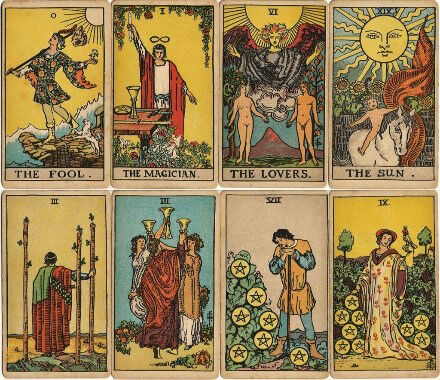
The recent miniseries Agatha All Along features the famous Rider-Waite-Smith Tarot deck, originally published by Rider in 1908, with sublime illustrations by Pamela Colman Smith and instructions by poet-mystic A. E. Waite, both members of the Hermetic Order of the Golden Dawn, a secret society devoted to occultism.


Pamela Colman Smith

A pivotal scene in one episode of the series employs the Major Arcana card The Tower (pictured above), which per Waite's instructions in the Pictoral Key to the Tarot represents: 

"Misery, distress, indigence, adversity, calamity, disgrace, deception, ruin. It is a card in particular of unforeseen catastrophe. Reversed: Negligence, absence, distribution, carelessness, distraction, apathy, nullity, vanity"

Note the emphasis on "unforeseen catastrophe", which is illustrated on the card by the lightning strike that knocks the crown and "wizards" from the tower and sets it afire. Per the Wikipedia page, Smith's design for this card is drawn from the card in the Tarot of Marseilles, which in turn had merged earlier concepts.


Rider-Waite-Smith cards at the Whitney

I've been a fan of Smith's illustrations since seeing the Rider deck on display in an exhibit of modernist art at the Whitney in NYC, where the Tower card jumped out at me, obviously, given my interest in the Tower of Zenopus. Seeing it again in the Agatha show reminded me of how well it resonates with the backstory of Holmes' sample dungeon, where the wizard and his tower are destroyed by unknown forces and a consuming fire, although here from beneath rather than above:

"Fifty years ago, on a cold wintry night, the wizard's tower was suddenly engulfed in green flame. Several of his human servants escaped the holocaust, saying their master had been destroyed by some powerful force he had unleashed in the depths of the tower"

I'm not suggesting that the Tower Card had any particular influence on Holmes' story, only that it has a similar theme, which also recalls ancient legends like the Tower of Babel or Zeus smiting the legendary doctor Asclepius with a bolt-from-the-blue for advancing his medical knowledge so far that he brought the dead back to life.

Holmes was a doctor and a scientist, but being a life-long fan of pulp and weird fiction, would have been familiar with the occultism as practiced around the turn of the 20th century. For example, he was a member of the Machen Society, devoted to the author Arthur Machen, who was friends with A. E. Waite and even briefly joined the Golden Dawn. In writing his own fantasy, Holmes occasionally employed the trappings of the occult. One Boinger and Zereth story, The Sorcerer's Jewel, features a medium, Misteera, who conducts seances, and another, In the Bag, even has the wizard Murray employ a tarot deck, albeit for solitaire rather than fortune telling; Boinger suggests that he "Play the knave on the Queen of Cups". 

However, in crafting the tale of Zenopus, Holmes was more likely directly inspired by the various doomed wizards in the Weird Fiction. In the Holmes Manuscript series, part 46, I went through the introduction to the Sample Dungeon and examined where Holmes may have taken inspiration from the works of H.P. Lovecraft, Clark Ashton Smith and Robert E. Howard.

Wednesday, May 29, 2024

Gygaxian Monster Paralysis: Permanent?


Letter from Gygax to an fan (1989)


A not uncommon question about the rules in Holmes Basic is: "How long does the paralysis inflicted by Carrion Crawlers, Gelatinous Cubes or Ghouls last?"

This is asked because, in the Holmes rulebook, an attack by each of these monsters inflicts paralysis unless a saving throw is made, but none of the respective entries indicate how long the victim remains immobilized. One might assume that it wears off at some point after an encounter is over, or one might turn to the Wand of Paralyzation, which in Holmes has a duration of 6 turns for a failed save. Other than that, there's no specific guidance.

The lack of durations reflects the OD&D source material that Holmes relied on when editing the manuscript for the Basic rulebook. Carrion Crawlers and Gelatinous Cubes were introduced in the Greyhawk supplement, but neither specifies any duration for the paralysis they inflict. Ghouls were introduced earlier, in Vol 2 (Monsters & Treasure), where it says, "As stated in CHAINMAIL for Wights, Ghouls paralize any normal figure they touch, excluding Elves" (page 9). In Chainmail, the entry for "Wights (and Ghouls)" does make clear that their paralysis lasts for "one complete turn" of that game (page 33, 2nd edition), and while it is clear that Holmes did consult those rules for some aspects of Basic (such as the Parrying rule), for whatever reason he did not include this information, and neither did Gygax when he revised the manuscript before publication.

If Gygax eventually recognized that the omission of durations for paralysis in OD&D and Holmes Basic was an oversight, he had an opportunity to correct that in the AD&D Monster Manual, which came out about 6 months after Holmes and revised most of the existing D&D monsters. But he did this for only one of the three, the Gelatinous Cube, which now paralyzes for 5-20 (5d4) rounds. Notably, this duration also corresponds to the revised duration for the Wand of Paralyzation given in the AD&D Dungeon Masters Guide, published a few years later in 1979.

The Monster Manual still lacks durations for the Carrion Crawler and Ghoul as well as a number of new sources of paralysis: the breath weapon of Silver Dragons, the touch of Ghasts, the tentacles of the Giant Portuguese Man-O-War, and the secretions of the Slithering Tracker. 

Why the seeming reluctance to add durations for monster paralysis? Later TSR products varied quite a bit in attempting to fill in the "missing" durations (look below for a list), which suggested that it was simply an oversight that was only slowly corrected. But was there another reason?

A recently uncovered 1989 letter from Gygax to a fan in Ecuador, posted on FB (see the image up above), sheds some light on his original view of paralysis. Unexpectedly, Gygax writes: 

"Paralysis might be permanent. I finally gave in and said 5-20 minutes, but... I like it better as permanent until removed by something. You choose."

As an AD&D round corresponds to one minute, the 5-20 minutes noted here corresponds exactly to the 5-20 rounds that newly appears for the Gelatinous Cube in the Monster Manual, and for the wand in the Dungeon Masters Guide.

Thus, Gygax's comment surprisingly suggests that the reason he didn't include a duration for monster paralysis in early D&D products was because he viewed such paralysis as "permanent until removed by something"...! 

His "something" is vague and not further explained in the letter. One possibility would simply be the same thing that restores hit points in OD&D: a return to base for complete rest. Per OD&D Vol 3: "On the first day of complete rest no hit points will be regained, but every other day thereafter one hit point will be regained until the character is completely healed. This can take a long time" (page 35). Others include those given in later rulesets: the second iteration of the Basic rulebook (Moldvay Basic) in 1981 newly allowed for Cure Light Wounds or Healing Potions to remove paralysis, and for AD&D, Lenard Lakofka created a new 3rd level cleric spell, Remove Paralysis, that appeared in Dragon #58 (February 1982) and then was compiled in Unearthed Arcana in 1985

While "permanent" paralysis may seem harsh, if viewed in the context of a game also replete with "save or die" poisons, "save or permanent paralyzation" fits in as a permanent consequence that is not quite as bad as death.

* * * * *

As an addendum, with regard to Carrion Crawler & Ghoul paralysis, later TSR D&D products gave a variety of answers to this:

---In T1 The Village of Hommlet (1979) by Gygax, ghoul paralysis is given a duration of 3-12 (3d4) turns.

---In Dragon #37 (May 1980), the Sage Advice column written by Jean Wells answered the question, "How long does the paralysis caused by a carrion crawler, ghast or ghoul last?" with "I have always assumed it to be 24 hours. However, since the duration of the paralysis is not clearly defined in any of the books, I suggest that each DM decide the duration in his particular campaign" (page 12). I note that a duration of a full day is much closer to the "permanent until removed by something" suggested by Gygax than any of the other suggested durations listed here.

---In Dragon #39, a followup Sage Advice column clarifies the above: "According to Lawrence Schick, Vice-President for Production and Design at TSR Hobbies, the paralyzation caused by carrion crawlers is of the same duration as that caused by ghouls— 3-12 turns. Paralyzation caused by a ghast takes twice as long—6-24 turns—to wear off". This duration for ghouls is the same as given in T1.

---In Moldvay Basic (1981), the paralyzation of Carrion Crawlers, Gelatinous Cubes, Ghouls and new Thouls is standardized as a shorter 2-8 (2d4) turns.

---In Polyhedron #2 (Autumn 1981), in the Dispel Confusion column, Gary Gygax answered the question, "How long does (or should) paralysis caused by a carrion crawler last? And what, if any, are the effects of multiple hits by this creature?", with: 

"Paralysis from creatures lasts as long as paralysis from a wand: 5d4 (5-20) rounds (DMG page 136). Multiple hits from a carrion crawler (or any other paralyzing creature) forces multiple saving throws on the part of the victim; when any one is failed, the other hits have no further effect on the paralysis (damages still apply if given, such as by a ghoul or ghast)." 

This is the only published source that really matches Gygax's later letter in giving a generalized 5d4 rounds for paralysis. 

---In TSR's Monster Cards (1982), part of the AD&D line, Ghoul and Carrion Crawler paralysis are instead each given a duration of 2d6 turns. These cards include revised entries from the Monster Manual, so are often viewed as "official" revisions for AD&D.

---In the AD&D 2E Monstrous Manual (1989), we see a different duration for each monster: Carrion Crawler, 2d6 turns; Gelatinous Cube, 5d4 rounds; Ghoul, 1d6+2 rounds; and the Ghast, 1d6+4 rounds.

Wednesday, May 1, 2024

"The Making of Original D&D: 1970-1977": Table of Contents


Above is a screenshot of the Table of Contents for the forthcoming book, The Making of Original Dungeons & Dragons: 1970-1977, which I've written about previously. This was shown at a 50th Anniversary Panel at Gary Con in March, and later shared on D&D Beyond, and now can be seen on the Amazon order page, where the book is available for pre-order for $99, and with a price-drop guarantee:

The Making of Original Dungeons & Dragons: 1970-1977

There's over 576 pages of content in this book, and the page numbers confirm the previously reported but still-stunning news that the tome will include all or most of the original 1973 OD&D draft (pages 84-181), the three OD&D LBBs (pages 202-328), the Greyhawk supplement (pages 356-415), the Blackmoor supplement (pages 430-497), the Eldritch Wizardry supplement (pages 506-569), plus a slew of material from correspondence, drafts, player notes, and magazine articles.

For posterity (including future searchability), here is a text transcript of the contents, into which I've inserted some of the promotional images for the book in their appropriate places:

Table of Contents

Preface (page 4)
Foreword (page 6)

Pages 8 and 9

Part 1: Precursors (page 9) (Read more about what these documents are here)
    Grayte Wourmes (page 10)
    Maps of the Great Kingdom (page 18)
    Medieval Weaponry in the Encyclopedia Britannica (page 20)
    Chainmail's Fantasy Supplement (page 26)
    
Pages 28 and 29
    
    Gygax on Armor (page 46)
    The Battle of the Brown Hills (page 50)
    Arneson's "Medieval Braunstein" (page 54)
    Blackmoor Gazette and Rumermonger 2 (page 58)
    "Points of Interest in Black Moor" (page 60)
    The Wizard Gaylord (page 64)
    Loch Gloomen (page 68)
    Outdoor Survival (page 72)
    Gygax/Arneson Blackmoor Correspondence (page 76)

Part 2: The 1973 Draft of Dungeons & Dragons (page 79)
    Greyhawk and the Revised Great Kingdom Map (page 80)
    The First Draft of D&D (page 84)
    The Twin Cities Draft (page 182)
    The Mornard Fragments (page 188)
    The "Clean-Up Crew" (page 198)

Part 3: Original Dungeons & Dragons (page 201)
    Expanding the Rules (page 201)
    Draft Versus Published Version (page 202)
    The Brown Box and the White Box (page 202)

Pages 288 and 289

Part 4: Articles & Additions  (page 329)
    Monsters' Attacks and Damage (page 330)
    Greyhawk Player Maps (page 336)
    Gygax in Europa (page 338)
    The Strategic Review 1 (page 348)
    Greyhawk (page 356)

Pages 199, ?, and 414


    Excerpts from the Strategic Review (page 416)
    Blackmoor (page 430) 
    Additional Excerpts from the Strategic Review (page 498)
    Eldritch Wizardry (page 506)
    The Dragon (page 570)
    Gods, Demi-gods and Heroes (page 574)

Afterword: A Whole New Game (page 576)

While it remains jaw-dropping that WOTC is publishing a book of this nature, and the contents themselves are far beyond what anyone would have predicted, just for completeness sake I will note a few items that are apparently not included:

---The contents only list Chainmail's Fantasy Supplement, so it looks like it will not include the entirety of Chainmail, making it a bit less useful as a complete resource for OD&D, as running OD&D using Chainmail combat also requires the non-Fantasy portions. However, you can get a reprint of the complete Chainmail for less than $10 at DMs Guild, so it's easy to find this material.

---Gods, Demigods & Heroes is listed in the contents, but starts only two pages before the Afterward, so obviously this section is just a brief look at this supplement rather than the whole book.

---There's no mention of Holmes Basic in the contents; thus, if there's any coverage it will the be in Afterword ("A Whole New Game"). I haven't seen an exact page count for the book, so I don't know how long the Afterword is. Based on the originally announced title for the book, which included the dates "1970-1976", I wasn't expecting anything about Holmes Basic in it; but when the title was tweaked to "1970-1977", it seemed possible that it might get at least a page or two of its own, possibly discussing the Holmes Manuscript, which is based purely on OD&D. 

As noted above the book is over 575 pages as it is, so I'm not really surprised that there was indeed some limit to the expansiveness of the material that they could include.

See also these other posts:

The Making of OD&D Book: What Might the "Precursors" Be?

"How Dungeons & Dragons Started" (video about the book)

"The Making of Original D&D: 1970-1977": Everything we know about this upcoming WOTC book

Megarry's Copy of the Great Kingdom Map

Saturday, November 27, 2021

TSR's 1976 "Lower Prices" Dice Ad (that shares text with Holmes Basic)


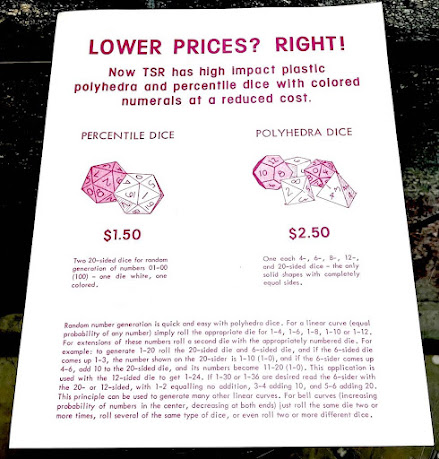
Over on Ebay, Jim Ward has been auctioning items accumulated from his career working at TSR, and among them I noted this early advertisement for dice from TSR that I don't recall seeing before. It appears to be from 1976, as the reverse side is an announcement for the new Metamorphosis Alpha RPG. TSR produced a number of these monochrome advertising sheets in the 1970s, some of which were also used as ads in magazines.

The lengthy explanatory text at the bottom of the page especially caught my attention because it's extremely similar to the "USING THE DICE" section found near the end of the Holmes Basic rulebook. Back in the last post of the Holmes Manuscript series, I presumed that this section originated with TSR, as it is not found in Holmes' manuscript.


Image originally posted in the Holmes Basic G+ Community (archived here)


The above image is from a 2nd or 3rd printing of the rulebook, but the "Using the Dice" text is the same in the 1st printing. Below is a transcription in which I've bolded the text that is the same as in the "Low Impact" Ad:

        Players need not be confused by the special dice
called for in DUNGEONS & DRAGONS. By using the
assortment of 4-, 6-, 8-, 12- and 20-sided dice, a wide
range of random possibilities can be easily handled.
        For a linear curve (equal probability of any
number), simply roll the appropriate die for 1-4, 1-6, 1 -
8, 1-10 , or 1-12. If some progression is called for,
determine and use the appropriate die (for instance, 2-
7 would call for a 6-sided die with a one spot addition).
For extensions of the base numbers, roll a second die
with the appropriately numbered die. For example: to
generate 1-20, roll the 20-sided die and 6-sided die,
and if the 6-sided die comes up 1-3 , the number shown
on the 20-sider is 1-10 (1-0), and if the 6-sider comes up
4-6, add 10 to the 20-sided die and its numbers become
11-20 (1-0). This application is used with the 12-sided
die to get 1-24. If 1-30 or 1-36 are desired, read the 6-
sider with the 20- or 12-sided die, with 1 -2 equalling no
addition, 3-4 adding 10, and 5-6 adding 20. This
principle can be used to generate many other linear
curves.
        For bell curves (increasing probability of numbers
in the center, decreasing at both ends), just roll the
same die two or more times, roll several of the same
type of dice, or even roll two or more different dice.

The introductory sentence has been replaced with two sentences, and one extra sentence covering modified ranges has been added, but otherwise the text is almost identical. From this we can see how another portion of the text of the Holmes Basic rulebook was constructed from some pre-existing text. I don't know whether this text is original to this ad, or if there is yet another source text from which it was taken. I assume the author here is Gygax based on the lengthier "Dice" section in the AD&D Dungeon Masters Guide.

A later version of the "Using the Dice" text that is revised to include the chits can be seen in my recent post, Jim Ward on the Why of Chits.

See Also
Dice of the Gods (Creative Publications Dice Packaging)

Friday, July 23, 2021

Now at DMsGuild: Chainmail POD & July Sale


CHAINMAIL by Gary Gygax and Jeff Perren is now back "in print"...! 

Thanks to JeffB over at ODD74 for letting us know that DMs Guild and DrivethruRPG are now offering a Print-on-Demand option for Chainmail.

Get it here:

Or here:

As I wrote over on ODD74, from the preview, the version of Chainmail they are offering is a 3rd Edition (copyright 1975), 7th printing (April 1979), and scanned from an original rather than re-typeset like most of the OD&D booklets they are currently offering. This version is from after the Tolkien references (Hobbits/Ents/Balrogs) were altered or removed.

The print plus digital version costs the same as the print version alone, $6.99. I've ordered a copy, and will report on quality when it arrives. The total with tax and media mail shipping was $11.91.

According to Chris Holmes, his father purchased Chainmail along with the LBBs, Greyhawk, Warlock and the Dungeon boardgame from Aero Hobbies shortly after they learned about the game (Tales of Peril, page 328). And Holmes had his copy handy while preparing the Basic rulebook, as is evident from the entry for Giants, which states, "There are several ways to calculate catapult (giant) fire. This one is adapted from CHAIN MAIL", and by his inclusion of the Parry rule from Chainmail that didn't appear elsewhere in OD&D (See Part 17 of my Holmes Manuscript series).

The published rulebook also directly references Chainmail in Gary Gygax's Foreword, which is carried over from Vol 1 of the original rulebooks: "From the CHAINMAIL fantasy rules he drew ideas for a far more complex and exciting game, and thus began a campaign that still thrives as of this writing!" Chainmail also appears in the TSR product listings appearing in the back of the Holmes Basic rulebook. 

This means that I personally have known about Chainmail since the days of my original Holmes Basic set. This led me to purchase a copy, the same edition being offered now, directly from the TSR Mail Order Hobby Shop in the late '80s. I later sold this on Ebay in the late '90s when trying to downsize my collection (ha!), and later regretted that, but soon I will have a copy again.

See also:

Chainmail Announcement from Domesday Book #9


* * * * * * * * * *


Also at DMs Guild and DrivethruRPG is their annual Xmas in July sale, with many products 25% off, which means that the The Ruined Tower of Zenopus is just $1.49 until the end of the month.


Get it here:


Most of the classic TSR titles are included in the sale, at least in PDF format, including the PDF of Chainmail (but not the new POD). Most of the in-print stuff is not, although I note that the Rules Cyclopedia in print is $21 instead of $25.


(All links include my DMsGuild/DrivethruRPG affiliate number)

Friday, July 10, 2020

A Dagger in the Boot: Location-Based Encumbrance of the 1970s


Location-based Encumbrance in the Lost Caverns of Tsojconth


Encumbrance, while often ignored, has been part of D&D since the first published rules.

An entire page of OD&D Vol 1 (Men & Magic) is given over to item weights and how this affects movement. Instead of detailing every item of Equipment, this list focuses mostly on specific weights for armor, weapons and gold pieces, with "Miscellaneous Equipment (ropes, spikes, bags, etc)" being equivalent to 80 gold pieces (8 lbs). A few other treasures are also given weights such as scrolls, jewelry, gems, potions, wands & staves. 

Even a simplified system like this is easily ignored during actual play, which may be why Holmes left this list out of the manuscript for Basic D&D, only including "fully armored" or "heavily loaded" (left undefined) as categories in the Movement table. Gygax apparently did not want to go this far, as he added in a section titled "Encumbrance" to the rulebook as published. Even so, Gygax left out the specific weights that had appeared in OD&D. Instead he just references the "miscellaneous equipment" (giving it as 75 pounds minimum here), and then outlines what is essentially an alternate system where the only weight that is tracked is that of coins (600 coins / 60 lbs being "heavily loaded"), together with suggesting that each PC list where other items would be carried:


As you can see, this adds some nice flavor to a character's list of equipment, such as Malchor's hidden dagger and purse. It also fixes in place the locations of these items, making it easier for the DM to judge how quickly an item can be used in melee. And the right and left hand notations fit nicely with the rule in Holmes Basic (taken from OD&D) that a surprised character has a 1 in 6 chance of dropping a held item when surprised. 

Gygax didn't use this location-based system only in Basic. His pre-generated characters in Lost Caverns of Tsojconth, the 1976 tournament version of S4 The Lost Caverns of Tsojcanth, have equipment written up in a similar format. The picture at the top of this post shows the items for the first pre-gen, and here is the second:


We can see from the three above examples that Gygax favored a small sack slung over the shoulder, holding holy water, oil and/or potions of healing, presumably at-hand for quick use during melee.

This system is also suggested by the 1977 D&D character sheets, published the same year as Holmes Basic. These sheets are ostensibly for OD&D but contain some proto-AD&Disms, such as ten armor classes (ACs). The top of the flip side of the sheet contains space to list the "Distribution of All Items Carried". There's no dedicated space for recording items weights, just location carried, but the bottom of the page does ask for "Total Extra Weight Able to Carry" at normal or encumbered movements, and an adjustment for Strength, per the table in Supplement I: Greyhawk. So the implication here is that both the location and the weight of items would be recorded:


AD&D was slow to elaborate its rules for Encumbrance. The Players Handbook (1978) contains weights for weapons, but nothing else, and a very short section on Encumbrance on page 101-102 mostly indicating how weight would affect movement. 

When the Dungeon Masters Guide was first published, in August 1979, the further rules  for encumbrance were limited to types of armor in the section "Types of Armor & Encumbrance"; for more on these, see my post on Gygaxian Armor

The weights for other items didn't appear until the end of that year, when a revised DMG appeared (labeled "Revised Printing - December 1979"), including a new "Appendix O: Encumbrance of Standard Items". This section harkens back to OD&D by providing a list of items and their equivalent weight in gold pieces. It mostly leaves out weapons and armor, as they were detailed elsewhere, but does include a few more of these items such as bows and helmets. The list covers most of the Miscellaneous Items from the Equipment list in the PHB, and even adds a few items not otherwise explained the AD&D rules such as caltrops and the grapnel (aka grappling hook), a fan favorite of D&D players over the years.

In addition, the accompanying text provides an example describing how two adventurers, Dimwall and Drudge, carry their equipment in a manner similar to that of the Tsojconth and Holmes Basic, except that it is written out descriptively rather than as a list.


Also out in 1979 was the set of AD&D Player Character Record Sheets, which followed the earlier sheets including a section, again at the top of the reverse, noting where each item was carried, but also including a dedicated space for each item this time. So again, the implication here is that both methods would be used, weight and location.


AD&D Player Character Record Sheet, reverse side. Source: Ebay


When the new Moldvay-edited Basic Set was released in 1981, it returned to the weight-based Encumbrance system of OD&D (page B20), but with no mention of Gygax's alternate or supplemental location-based system. The 1980 PC record sheets that went along with this set also lacked any dedicated spaces for noting item location or weight. 

Overall, it seems that this system of listing out item locations is mostly forgotten or overlooked because it featured prominently only in the Holmes Basic. In OD&D, it only appeared on late-appearing character sheets; in AD&D, it was relegated to several dense paragraphs in an appendix and the back of character sheets that players only occasionally used; and in B/X it was left out entirely.

[I started writing this post last year & just finished it up! --- Z]

Monday, February 3, 2020

Delta on the Monsters & Treasures of the Dungeon of Zenopus


As part of a continuing Subterrane Surveys series, Delta's D&D Hotspot has two posts up that look in detail at the monsters and treasures of the Dungeon of Zenopus, and the resultant experience point totals. The first one covers Holmes' original version as seen in the Holmes Manuscript, and the second one looks at the dungeon as published, which includes a number of changes made by Gygax.


Subterrane Surveys: Dungeon of Zenopus (per Holmes)

Today we're looking at the sample dungeon from the first-ever D&D Basic Set, edited by Eric Holmes (1979) -- what many of us now call the "Dungeon of Zenopus". This has been very influential over the years -- and just last week, our friend Zenopus Archives published a 5E conversion on DM's Guild.

Subterrane Surveys: Dungeon of Zenopus (per Gygax)

Today we're again looking at the sample dungeon in the first Basic D&D set (1979), the "Dungeon of Zenopus". Last time we looked at Eric Holmes' original unpublished draft. But after Holmes submitted that work, Gary Gygax took an editorial pass at it, changing many items on a line-by-line basis.

Friday, July 19, 2019

Save or Die! Podcast #154


I recently had the pleasure of returning as a guest on the podcast Save or Die!, this time with DMs Carl, Courtney and Chrispy, and it is now available for listening:
Save or Die! Adventure 154 - Holmes Basic
"The three hosts are together again in the latest Save Or Die! where we talk Holmes Basic with our guest the Arch Zenopus himself Zach of the Zenopus Archives. A SOD favorite gets reexplored as we take a deep dive into what makes Holmes Basic such an endearing part of D&D history."
Also, don't miss the Actual Play of the dungeon run by Carl, the first part of which is at the end of the episode (I'm not part of this).

Links for Further Reading on Topics Discussed on the Show:

The Warlock D&D Rules

Holmes Manuscript Part 3: "Elves Muse Decide"

Holmes Manuscript Part 16, covering attacks per round in combat

Holmes Manuscript Part 10, section on Magic Missile

Holmes Manuscript Part 17, section on The Parry

Article on origins of the Ochre Jelly and Blob

Summary of Tolkien References in the Blue Book

Holmes Manuscript Part 19: "If One Wanted to Use a Red Dragon..."

Holmes Manuscript Part 46: "Zenopus Built a Tower": intro to the Sample Dungeon

Zenopus Dungeon Factions, including the Thaumaturgist

Article in a New Cthulhu Zine, Bayt Al Azif issue #1

The Tower of Zenopus in Ghosts of Saltmarsh


Earlier Save or Die episodes that may be of interest:

Side Adventure 20: NTRPGCon Wrap Up 6/14/19 --- at 17:30 Carl talks about how I guested as his version of Zenopus in his Sat night Discos & Dragons game

Side Adventure 16: Favorite Boxed Set 1/7/19 --- at 8:50 Carl talks about Holmes Basic and mentions this site

Side Adventure 14: House Rules! with guest Chris Holmes 10/6/18

Episode 124: Save vs. Zenopus 7/17/16 --- my previous occasion as guest

Adventure 136: Michael Thomas on Journeymanne Rules 5/16/17

Side Adventure 12: J. Eric Holmes Seminar NTRPGCon 8/14/16 --- Audio recording of a  panel with Chris Holmes, Allan Grohe & myself 

Episode 122: Save vs. Chris Holmes 5/11/16

Episode 117: Save vs. Blueholme 11/16/15 --- guest Michael Thomas

Saturday, December 15, 2018

Player Map for Zenopus Dungeon

Player Map - click for a larger view and/or download


Above is a Player Map for my Return to the Tower of Zenopus game (now retitled In Search of the Brazen Head of Zenopus) that I ran this past June at North Texas RPG Con. I took the original manuscript map drawn by J. Eric Holmes and removed the letters and the secret passage. Also note that this map doesn't exactly correspond to the dungeon as published, as the TSR cartography added a few empty rooms and rearranged some corridors. In game, this can reflect the inaccuracy of the mapper who made it.

You can use this for the original dungeon, perhaps with brand new players who have never mapped before or if you have limited session time. Or with any sequel or other dungeon using the same map. In my con game it represents the efforts of earlier adventurers, 40 years prior.