This is the blog. Click here to go to the Zenopus Archives website.

Note: Many older posts on this blog are missing images, but can be viewed at the corresponding page in the Internet Archive

FEATURED POST

The Forgotten Smugglers' Cave: Index of Posts

An index of posts describing the Forgotten Smugglers' Cave, an adventure for Holmes Basic characters levels 2-4.                    ...

Showing posts with label Dagonites. Show all posts

Thursday, February 29, 2024

Leap Day: Giant Zenopus (New Monster)


Xenopus laevis from Amphibia and Reptiles by Hans Gadow (1901).
Source: Wikimedia Commons 


Giant Zenopus

Move: 30 feet/turn land; 180 feet/turn swimming
Hit Dice: 4
Armor Class: 5
Treasure Type: incidental
Alignment: neutral
Attacks: 1 rake with hindclaws
Damage: 2d4

The giant zenopus, an entirely aquatic frog, can grow to enormous proportions given a sufficiently nutritious diet, with specimens up to ten feet long having been reported. A ravenous scavenger, it will eat anything, locating and shoveling food into its tongueless mouth with strangely sensitive and prehensile hands. A strong swimmer, the zenopus is known to float motionless with its unblinking eyes just above the water, waiting for the opportunity to leap and grab its prey, raking with the large claws on its hindfeet as it pulls them under.

For defense, the skin of the zenopus exudes a slime that makes them extremely slippery (AC 5). Even worse, the slime of 1 in 10 frogs carries a parasitic aquatic chytrid fungus, and anyone scratched by the claws of such a frog must Save vs Poison or have their skin become infected. After 1 week, infection will cause loss of 1d4 hp per day due to the sloughing of skin, unless a Cure Disease or an anti-fungal poultice (consult a herbalist) is administered.

The eggs of the giant zenopus are prized by wizards for use in magical research due to their size (6" diameter), fetching 1,000 GP in larger cities. The eggs must be kept wet at all times or will perish. There are rumors that there are secret alchemical methods of cloning the eggs, and even darker tales speak of ways of transforming the egg into a frog that walks upright like a man.

The only other treasure that might be found is incidental to their behavior; i.e., that which was possessed by their prey.

Notes:
---Based on the real world Xenopus, a frog long used in biological research, and which was presumably J. Eric Holmes' inspiration for the name of Zenopus. The name "Xenopus" means "strange foot" in Greek. The 94th anniversary of Holmes' birth was just a few weeks ago, on February 16th (Holmes Day).

---The concept of breeding frogmen from giant frogs goes back to Dave Arneson's Temple of the Frog adventure found in the Blackmoor OD&D supplement

"He has genetically modified the killer frogs to begin breeding frogmen..." --- the Temple of the Frog by Dave Arneson

And of course frogmen tie-in nicely to Holmes' Dagonites, who as described are more froggy than than fishy. 

"...surely your recent encounter with the frog-man should have convinced you of the reality of the Dagonites"  --- Murray the Mage, The Maze of Peril

---I originally drafted this in 2019 in comments to a post made to the late lamented Holmes Basic G+ group, just before G+ was shut down. While I transferred most of the posts from that group to an archive blog, this one didn't make it for unknown reasons. But I found it in an XML file I had downloaded and recovered the comments and revised them into this post.

Happy Leap Day!

See also:

Thursday, August 6, 2020

Original Printing of The Maze of Peril on Amazon

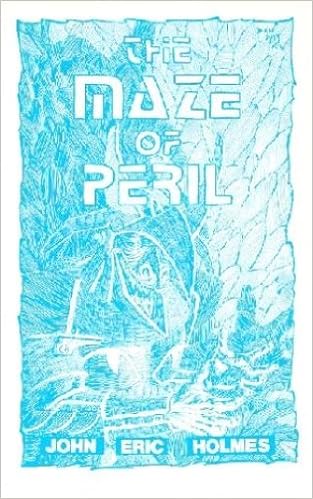
The cover of The Maze of Peril (1986)


The Maze of Peril, J. Eric Holmes' 1986 fantasy novel, can now be ordered via Amazon from the original publisher, Space & Time Books. Follow this link to find it


For the uninitiated, this novel details the meeting of Boinger the Halfling and Zereth the Elf and their first grand adventure. The two characters had previously appeared in three short stories in Dragon magazine, and before that in several campaign stories in the Alarums & Excursions D&D APAzine. The adventures in the Maze of Peril are based on some of the characters and events from the original D&D campaign that Holmes ran for his sons and their friends in the mid-1970s. Here's the Amazon product teaser, which is straight from the back cover and highlights the OD&D megadungeon influence on the setting:

What race or races built the maze, no one knew. In the opinion of the sages of Caladan, many layers of dungeons and underworld were laid down, one atop the other, as the world crust was formed, so that now no one knew or even guessed how many levels extended below the surface. Corridors of wealth, they were also tunnels of deadly peril, for many of the rash adventurers and soldiers of fortune who set forth for the secret entrances were never heard from again. To those with the courage and ability to survive the challenges, however, the maze had always paid equal tribute with its fabulous mysteries and treasures from countless civilizations.

Now the Dagonites--creatures part human, part frog--seek to keep these riches for themselves and extend their domain to the surface. It falls to Boinger the halfling and his companions, in the midst of their quest for personal glory and wealth, to discover the Dagonite stronghold, challenge their warriors and wizards, rescue a kidnapped friend, preserve the waterways of Amazonia, and...perhaps...save the world!

This new retail outlet was brought to my attention via a thread on Dragonsfoot, and a commenter there that purchased the book confirmed with photos that this is remaining stock from the original 1986 printing
Tavis of the Mule Abides reported back in 2008 that 1,000 copies were originally printed and about half had been sold at the time.

This is much more convenient than the previous method of ordering directly from the publisher; when I ordered it more than twenty years ago I had to send in a check to the address listed on their website. 

As of February 2024, the book is still in stock at Amazon, with a cost of
$17.95, which is $11 more than the original cover price of $6.95. 

The novel was later compiled in Tales of Peril by Black Blade Publishing, along with the short stories and other writings of J. Eric Holmes, although that is now out of print, with a second edition still in planning stages.

Despite the reprint, I  have a fondness for the original printing. Reading this book kickstarted my interest in the work of Holmes which eventually led to this blog. 

The original printing is zine-sized, with shiny cardstock covers and 147 pages plus endpapers. It has a few features not found in the reprint, including the pastel blue cover art by Dan Day (echoing the Holmes Basic rulebook color?) and a frontispiece illustration by Gregario Montejo. There are two excerpts from the story before the frontispiece, and another on the back cover (which you can see in the Dragonsfoot thread linked above). There is also an author bio for Holmes along with each of the artists.

Several reviews of the book:
Dragonsfoot review (2006) - by myself, points out the many similarities with Holmes Basic
Carjacked Seraphim review (2010)
Delta's D&D Hotspot review (2011)

And a few years ago I began a Tales of Peril Book Club and made it through most of the first chapter of the Maze of Peril (warning, spoilers abound). I hope to return to this series eventually.

Tuesday, September 12, 2017

Tales of Peril - Dust Jacket Flaps


In the previous post, we looked at the cover art for Tales of Peril.

Moving inside, here are the contents from the dust jacket flaps:

Front Flap, upper: Quote from the Maze of Peril, Chapter 9, "Visible and Invisible", providing a preview of the battle against the Dagonites.

Front Flap, lower: List of contents. Focuses on highlights, and is more explanatory than the table of contents.

Back Flap, upper: Two paragraph biography of Holmes, different than the one that appeared at the back of the 1986 publication of Maze of Peril. It mentions his medical career, his Korean War service (which I don't think is well known), and gives an overview of his writing career.

Back Flap, lower: Photo of Holmes gaming. I've included a larger version of this photo above. Photo by Steve Pyryeztov. This photo is from the same session as the one near the front of Holmes' book Fantasy Role-Playing Games (1981).

In these photos we see Holmes running a game at his chalk board table in his basement. In his book, Holmes wrote "My own gaming table is spray-painted with "chalk board paint" so that the green surface can be marked with chalk and then, when the characters move on, a new set of doors and walls can be drawn around them. In this way, the little figures never move off the table, they only move to new positions as the scenery shifts around them" (pg 93). 

An earlier photo of Holmes at this same table can be see in the post, Holmes' Little Metal People Take II.

Looking at the above photo in more detail, we see chalked dungeon corridors, and Holmes pointing at a battle occurring at an intersection of these corridors. 

The wizard with staff held aloft vertically appears to be "ME4 Wizard" from Minifigs' Mythical Earth line. Thanks to Tony at the Cryptic Archivist for posting a picture of this figure in the Holmes Basic group recently. I'm sure some of our readers will ID some of the other minis.

Under Holmes' arms are visible at least three of the dime-store Hong Kong-manufactured monsters that inspired the Bulette of D&D. See this post by Tony DiTerlizzi, a former TSR artist, for more history and photos of these toys. I had several sets of these myself as a child. 

An AD&D Players Handbook rests on the table under the elbow of one player, so at this point (1980-81?) they were using the AD&D rules.

Behind the players are shelves of boxes filled with comic books. Each box has a comic, or just the cover, attached to it to show the contents. Between this picture and the one in the book, I can make out one cover for the Incredible Hulk Special 2 (1969)In this picture it's the barely visible box with the "K" to the right of the player with glasses. In the book, the Hulk is clearly visible on the cover.

This post is part of the Tales of Peril Book Club.

Tuesday, August 8, 2017

Portown Adventuring Eras

This is a brief outline of the history of Portown, including adventures that could be set in each time period. The dates are set in YBB (Years Before Basic) or YAB (Years After Basic). Some are from the Holmes Sample Dungeon, the rest are extrapolations:

Prehistory: A "pre-human city" of "doubtful history" exists in the future site of Portown. A vast layered underworld is constructed by the Ancient Builders.


~500 YBB: Portown is founded to link "caravan routes from the south to the merchant ships" traveling the Northern Sea. Catacombs beneath the town are constructed, where the former Lords and Ladies of Portown are buried in sarcophagi (see Room N).

100 YBB: Zenopus arrives, builds a tower on the hill over the sea cliffs to the west of town and near the graveyard. Green Dragon Inn established.


~75 YBB: Zenopus excavates beneath his tower in search of ancient treasures.


Adventure of the era: Zenopus hires PCs to investigate pre-human tunnels under his tower.

50 YBB: Zenopus vanishes when his tower in engulfed in green flame. "Several of his human servants" escape and relate that he was destroyed by "a powerful force he unleashed in the depths of the tower".


Adventure of the era: Investigate disappearance of Zenopus

~45 YBB: Town demolishes 'haunted' tower.


Adventure of the era: Investigate haunted tower prior to demolition

~5 YBB: Thaumaturgist arrives, builds or moves into a short tower (Room S) not far from the Zenopus ruins.


0 YBB/YAB: Present day. Lord Leomund (Level 10 Fighter) is the ruler of Portown. His daughter Lemunda has just gone missing. The Green Dragon Inn is a popular gathering place for adventurous types. Pirates and smugglers are very active on the Northern Sea. Bodies are going missing from the graveyard, possibly being transformed into ghouls (as in Room P) by cultists. 

Adventures of the era: Sample Dungeon as written, including rescue Lemunda. 
Investigate cult activities; possibly adapt a Call of Cthulhu scenario?

5-35 YAB: Quiet years. Old dungeon entrance sealed by Lord Leomund.

40 YAB: Lady Lemunda (now a L10+ Fighter) now ruler.

Adventure of the era: Return to the Tower of Zenopus, deal with new threat(s) in the old dungeon. Pirate & cultists have merged/transmogrified into Dagonites.

(Revised from a post on G+, thanks to Andy C for suggesting I add the "pre-history" era)

See also: Portown Rumors (which are all in relation to the "Present Day" time period)

Sunday, January 20, 2013

Ancient Builder: "New" Monster


Old Ones with Shoggoth, art by Howard V. Brown for At the Mountains of Madness
Astounding Stories, Feb 1936 issue. Source.


During the decade or so of time that Holmes wrote for and about D&D and RPGs (about 1976-1986), he didn't provide us with many "new monsters" that are not found on the standard Monster List of Basic. Most notably, he introduced the Were-Shark into D&D, and there are a few non-standard monsters in the Sample Dungeon, mostly giant animals, such as the giant crab, large octopus and giant snake, each given partial stats and description, and which serve to demonstrate a new DM that they are not limited to the standard monsters. 

Turning to magazines, we can look to Alarums & Excursions #18, published in January of 1977, for Holmes' adaptation of several Pellucidar creatures from his authorized sequel, the Mahars of Pellucidar, including the intelligent pterodactylan Mahars, their ape-like Sagoth servants, and the giant, flying Thipdars. And his most extensive write-up was for the article "The Lovecraftian Mythos in D&D" in Dragon #12, published in February 1978. While co-author Rob Kuntz wrote the entries for the deities Cthuga, Ithaqua and Yig, Holmes was responsible for the rest of the deities, as well as all of the "monsters": Byakhee, The Deep Ones, The Great Race, The Old Ones, The Mi-Go (aka the Fungi from Yuggoth), and The Shaggoths [sic, for Shoggoths]. These monster entries were later revised and partially re-written by Jim Ward for inclusion in Deities & Demigods, where The Old Ones were retitled The Primordial Ones to avoid confusion with Lovecraft's deities, such as Cthulhu, that are also referred to as Old Ones. These creaturesare alternately referred to as The Elder Things by Lovecraft and the Call of Cthulhu RPG.

The intro to the Sample Dungeon, the ruins of the tower of the wizard Zenopus sit upon "the ruins of a much older city of doubtful history" which is several paragraphs later referred to as a "pre-human city". And then in his D&D novel The Maze of Peril, first published in 1986, Holmes writes of the origin of the vast underworld: "Somewhere beneath the surface of this ancient land the tunnels and corridors of some prehistoric race coiled and raveled, delved, and probed unimaginable depths into the core of the world" (pg 3). Holmes does not further disclose the nature of this race, but Lovecraft's Old Ones are a natural fit, being both pre-human and extensive builders. Here's my analog of the Old Ones where they fulfill this role of original architects of the underworld, written up in Holmes Basic format. It also mentions Dagonites and Whisperers, which are analogs for The Deep Ones and the Mi-Go, respectively. 


Ancient Builder

Move: 120 feet/turn
Hit Dice: 8
Armor Class: 5
Treasure Type: 50% chance of 1 weird device with the power of a ring or wand
Alignment: neutral
Attacks: 1d4 leg tentacles
Damage: 1d8 points per tentacle

Sages speculate that the vast underworld was the effort of many races, toiling over the eons, but that it began with vast underground cities built by a pre-human race that came to the lands from regions unknown. This race of Ancient Builders flourished for a time but was eventually weakened by wars with the malign Whisperers, and ultimately overthown by their own creations, the now mindless Black Puddings. Over the ages their cities were much changed and expanded by later races such as the Dagonites and Troglodytes, but there are still occasional reports of adventurers finding hibernating Builders far below the surface.
Extreme caution is urged as these sleepers may lash out at intruders if awakened or capture them for further study without care for their well-being.  

The Builders are said to be slightly larger than man-sized, but wholly inhuman in form, with a columnar body with a ring of tentacles at the top (sense organs) and bottom (legs), and more at the sides for grasping and holding items. From the relics of their culture it is clear they are highly intelligent albeit in fashion alien to humans, and they often wield weird devices that duplicate the powers of rings or wands (1d20 charges).

Update

The Ancient Builder now appears under the name "Old One" in the Blueholme Journeymanne rules, available at DriveThruRPG.
 

Saturday, September 1, 2012

The Maze of Peril at Noble Knight


I noticed yesterday that Noble Knight Games now has Holmes' novel The Maze of Peril in stock (11 8 3 1 0 15 9 copies as of 11/26/12) for $9.95 plus shipping. NK presumably ordered these from the publisher, Space and Time in NY, who still sells copies of the original 1986 printing. S & T charges only $6.95 + $1.50 shipping, but requires a check or money order, so you may find it more convenient to order from NK, who take PayPal, credit cards, etc.

If you are not familiar with the novel, it's a 150-page OD&D-ish adventure featuring the duo Boinger the Halfling and Zereth the Elf, who had earlier appeared in Holmes' three short stories for Dragon Magazine - though Maze of Peril is set earlier, as the pair meet for the  first time in the beginning.

A few reviews of the book:
Dragonsfoot review (2006) - by myself, points out the many similarities with Holmes Basic

And here's the NK blurb:

"To those with the courage and ability to survive, the maze pays equal tribute in its fabulous mysteries and treasures from countless civilizations. Now the Dagonites plot to keep these riches for themselves. Boinger the halfling and his companions must discover the Dagonite stronghold, challenge their warriors and wizards, rescue a friend, preserve the waterways of Amazonia, and maybe even save the world. [this portion is taken from the back cover of the book]

Inspired by Dungeons & Dragons and written by Dr. John Eric Holmes who was the editor of the basic set blue book which is generally referred to as the "Holmes Basic" and is widely considered to be the best set of rules for introducing a new player to the original D&D rules. By his own words, Mr. Holmes stated that he was rather upset after reading the original small books from the first box set and he still had no idea how to play the game. Because of this he spoke with Gary Gygax and offered to rewrite the rules into a form that would be good for beginners and Gary readily agreed."

Sunday, April 29, 2012

The Underworld of Holmes


     The formal title of the third volume of the original D&D set is "The Underworld & Wilderness Adventures". The word "The" is often misplaced when the volume is referred to casually, which changes the emphasis from a mythic "The Underworld" to a more pedestrian "Underworld Adventures". The Underworld is described on pages 3-13, and the term appears eight times in the booklet, often as part of section headers. The term "underworld" is only used once in the Blue Book, and generally fell away in D&D (to be later replaced by The Underdark), but Holmes uses it again in his Boinger & Zereth novel, The Maze of Peril:

      "Rumors of the fabulous treasures of the Underworld drew adventurers, brigands, journeymen magic users, soldiers of fortune and even less savory types to the tiny town. Zereth had been in Caladan long enough to discover there was truth to the stories of the Underworld, more truth than he had imagined. Somewhere beneath the surface of this ancient land the tunnels and corridors of some prehistoric race coiled and raveled, delved, and probed unimaginable depths into the core of the world. Corridors of wealth, they were also tunnels of deadly peril, for many of the rash adventurers who set forth for the secret entrances to the fabled Underworld were never heard from again.
 
     What race or races had built the original maze no one knew. It seemed, in the opinion of the sages and magicians of the time, that there must have been many layers of dungeons and underworlds laid down, one atop the other, as the world crust was formed, so that now no one knew, or even guessed, how many levels it extended below the surface. 

     But rumors of the Underworld were mostly false leads. Most of the contacts Zereth had made did not know how to reach the entrances to the fabled realm, or else their exaggerated claims turned out to be schemes to fleece the unwary adventurer of his resources" (pg 3).

    Holmes uses these rumors to provide some in-story justification (though still mysterious) for the existence of endless levels of dungeons. They may reach to the core of the world - a "Terradungeon", perhaps? Much as character advancement is theoretically unlimited, the dungeons levels can also be nearly endless.

     Looking back at Holmes' intro to the Sample Dungeon in the Blue Book, there are some similarities to the creators of those dungeons:

    "The town is located on the ruins of a much older city of doubtful history and Zenopus was said to excavate in his cells in search of ancient treasures ... the story tellers are always careful to point out that the reputed dungeons lie in close proximity to the foundations of the older, pre-human city, to the graveyard, and to the sea".

     The pre-human city is reminiscent of the pre-human alien civilization described in Lovecraft's At the Mountains of Madness (1931), who built vast underground cities in remote locations. Given Holmes' fondess for the Cthulhu mythos, and that The Maze of Peril also includes a race of Dagonites (essentially Deep Ones), it's not hard to imagine a Lovecraftian origin for his Underworld.

Monday, March 12, 2012

The Shadow Over Portown


Xenopus laevis, Daudin (1802)


The name of the wizard Zenopus is very close to Xenopus, which means “strange foot” in Greek, but is also the name for a genus of African clawed frogs, which are social, aquatic, fish-eating, and have unusually large hindfeet that are webbed and clawed. The use of the name was presumably an in-joke as Dr. Holmes was a neurophysiologist and Xenopus laevis is commonly used in biological research. Holmes would also have been aware of the Temple of the Frog adventure in the Blackmoor supplement, as he mentioned going through all of the OD&D supplements when preparing the Basic rulebook.

In the fall after the publication of the Basic Set, Holmes wrote up the Cthulhu mythos for publication in Dragon magazine #12 (Feb 1978), with additions by Rob Kuntz. This was later used as the basis of the Cthulhu mythos in Deities & Demigods (1981), with further revision by Jim Ward. One of the entries was for the Deep Ones from Lovecraft's The Shadow Over Innsmouth. In Holmes' original write-up, the Deep Ones "occupy certain coastal towns" and "are frog like in appearance with webbed hands and feet. As they grow older they spend more time in the ocean and become more icthic in appearance. They are potentially immortal, as are their halfbreed offspring". Holmes later used a highly similar race of frog/fish-men called the Dagonites as the antagonists of his own D&D-derived novel, The Maze of Peril (1986).

Since Zenopus lives in a coastal town (Portown) and has an amphibious name, we can speculate a connection between him and the frog-folk for whom Holmes had a literary affinity. Like the narrator of The Shadow Over Innsmouth, perhaps Zenopus was a half-breed Deep One who discovered his roots at an older age, perhaps while exploring the pre-human city upon which Portown was built.

"What lies in the (undiscovered) deeper levels where Zenopus met his doom?"