This is the blog. Click here to go to the Zenopus Archives website.

Note: Many older posts on this blog are missing images, but can be viewed at the corresponding page in the Internet Archive

FEATURED POST

The Forgotten Smugglers' Cave: Index of Posts

An index of posts describing the Forgotten Smugglers' Cave, an adventure for Holmes Basic characters levels 2-4.                    ...

Saturday, August 31, 2024

Early Greyhawk Lore in the 1973 D&D Draft


Cover of the 1973 draft, previously posted on Playing at the World,
and now included in MODD

The Making of Original D&D: 1970-1977 (hereafter MODD) has been out for a few months now; if you haven't picked up a copy yet, find it here. You can read more about the book and find a table of contents in my previous posts, which are linked down below.

The longest section of "new" material in the book is the long-awaited The First Draft of D&D, as it is termed in MODD, which sheds light on the early development of the game, now in its 50th year. This document is alternately known as either the 1973 Draft or Guidon D&D, based on the "Forward" [sic], which Gygax signs as an editor for Guidon Games, and with a date of 1 July 1973, months before the November date of the revised Forward in the published rules.

Beyond the rules themselves, the draft also contains some "lore" (as the kids call it) from Gygax's early Greyhawk campaign, which is the subject of this post. These tidbits provide some insight as to what had already rapidly developed in the campaign in the months since February of 1973, when Arneson first ran his game for Gygax and Kuntz.

The list sticks to direct mentions of the Greyhawk campaign, and includes page numbers from the draft itself and MODD for reference. The notes include whether the made it into the published rulebook in revised form, but some of it did not.

THE LAND OF THE GREAT KINGDOM

On page ii of the draft (page 87 of MODD), in the "Forward" [sic], Gygax writes:

"From the map of the "land" of the Great Kingdom" and its environs, Dave [Arneson], Dave located the wierd [sic] enclave of "Blackmoor", just below the terrible "Egg of Coot".

This material made it into the published book in slightly revised and expanded form, reading:

"From the map of the "land" of the "Great Kingdom" and environs -- the territory of the C & C Society -- Dave located a nice bog wherein to nest the wierd [sic] enclave of "Blackmoor", a spot between the '''Great Kingdom" and the fearsome "Egg of Coot".

This text refers to the "Great Kindgom" map(s) that I've written about previously. The description of Blackmoor's location was changed as published, but remains accurate as it is both "below" (south) the Egg of Coot, and also between it and the Great Kingdom.

In 1977, the published version was also included in Holmes Basic with slight revisions, as "Foreword from the Original Edition".

NON-REAL PLAYERS

On page 11 of the draft (page 101 of MODD), in the section "NON-REAL PLAYERS" (an unintentionally hilarious term which later became "NON-PLAYER CHARACTERS"):

"In the "Greyhawk Castle" campaign most players have 1-4 men (or elves or dwarves) and quite a few have orcs, ogres, etc". The monster-types, however, with the exception of orcs, cannot serve in the underworld, but they will man castles or lurk in dungeons built under players' own stronghold".

Many years later, Gygax recalled the use of orcs in theses early games, particularly by Rob Kuntz's character Robilar, in an Up On a Soapbox column called "The First Orc Hero" in Dragon (Oct 2003); see this thread.

This material was removed from this section in Vol 1 as published, although Vol 3 has a section titled "Men-At-Arms" that indicates that Chaotic characters may employ Orcs and provides costs for such. No specific reference to the Greyhawk campaign remains, however.

EXAMPLE OF A MULTI-LEVEL DUNGEON

On page 32 of the 1973 draft (page 126 of MODD), in the section on the "UNDERWORLD", subsection "Levels", Gygax provides an example of a dungeon by describing his own creation:

"Consider "Greyhawk Castle" for example: It has over ten levels down (as it is still being played exact information cannot be given), and on some levels are items like an underground lake, a bowling alley for 30' giants, and enormous caverns filled with weirdly shaped and colored fungi"

This text, in expanded form, made it into the published version, Vol 3, page 4, section the "UNDERWORLD":

""Greyhawk Castle", for example, has over a dozen levels in succession downwards, more than that number branching from these, and not less than two new levels under construction at any given time. These levels contain such things as a museum from another age, an underground lake, a series of caverns filled with giant fungi, a bowling alley for 20' high Giants, an arena of evil, crypts, and so on."

Thus, from 1973 to 1974, the descripton of the dungeon grew: 10 levels becomes 12, and the three named features become six. The bowling giants are changed from 30 feet to 20, possibly to match the tallest Giants in Vol 2, and the fungi in the caverns change from "weirdly shaped and colored" to "giant".

The three added features ("museum of another age", the "arena of evil", and "crypts") were possibly either created or discovered by players, and thus revealable, after the time of the 1973 draft. Note that the original text expressly states Gary's concern with revealing secrets to the players of an ongoing campaign.

EXAMPLE OF A CAMPAIGN WORLD

On page 34 of draft, in the section "UPPER WORLD", Gygax describes part of his campaign world:

"In the Greyhawk game the world is somewhat like the real one, and players who are incautious can get transported thousands of miles away. Then, adventuring across a parallel world's India they might meet living gods with eight arms, learn the "rope trick", how to walk over beds of glowing coals, and so on. The mythology of each land can supply the referee with a basis for their surroundings."

Gygax's use of Earth for portions of his campaign suggests why Gods, Demigods & Heroes (1976), and then Deities & Demigods (1980), leaned so heavily into real world mythology. This text also reveals the origin of the spell Rope Trick, which was introduced in the Greyhawk supplement (1975).

This text disappeared completely from the published book, but in 1975 in Alarums & Excursions #15, Gygax made a similar reveal with respect to Greyhawk:

"The game world is a parallel earth, but the continents are somewhat different. Most of our campaign activity takes place on what corresponds to North America, on the eastern half of the continent. The "Blackmoor" lands lie far up on the northeast coast. "Greyhawk" is in the central portion. There are a few other independently run campaigns located on this map. There are also some other dungeons related to the "Greyhawk" campaign located at some distance from the free city of Greyhawk. Players in our campaign may freely play in "Blackmoor", but to get there they must adventure cross country. With one or two other campaigns, we do not allow any cross-campaign play other than this, for these is too great a disparity of DMing. The territory within 500 or so miles of our main dungeon is mapped out at 5 miles to the hex. Territory within 50 miles of Greyhawk city is mapped more closely, and monster locations are indicated. The entire world is mapped out in rough form, with notes regarding typical encounters in given areas as well as particular special places, for hardy souls who wish to go forth to seek their fortunes."

This also shows that the existence of Arneson's Blackmoor in the Great Kingdom/Greyhawk, mentioned in the "Forward" (see above) was still in effect in Gygax's campaign world in 1975.

* * * * 

In summary, these references to Greyhawk in the first draft show that by July of 1973, the Greyhawk campaign had a central dungeon with over ten levels and a variety of unusual features, characters commonly employing multiple henchmen/hirelings including orcs and other monsters, and a campaign world leaning heavily on the real world for details of the broader world.

See also these earlier posts:

"The Making of Original D&D: 1970-1977": Out Today! 

"The Making of Original D&D: 1970-1977": Table of Contents

"The Making of Original D&D: 1970-1977": What Might the Precursors Be?

"How Dungeons & Dragons Started" (video about the book)

"The Making of Original D&D: 1970-1977": Everything we know about this upcoming WOTC book

Playing at the World revised edition out in July


Thursday, August 22, 2024

FIGHT ON fanzine returns with an issue dedicated to J. Eric Holmes!


The long dormant OSR zine Fight On! has returned from the crypt with a new issue, #15, dedicated to none other than J. Eric Holmes...! 

Find it on DrivethruRPG (currently PDF only; print is coming) or on Lulu (print or PDF).

For this issue I contributed an article, titled "Ten Ways to Holmesify Your Game", which goes over ten different rules or themes you can use to make your D&D game more "Holmesian". It is accompanied by an illustration by Cameron Hawkey of adventurers tangling with a purple worm.

Other Holmesian content in this issue includes:

  • "Holmes Town Heroes" by Tony Rowe (with whom I co-authored an chapter about Holmes in the recent book Fifty Years of D&D), which provides D&D character write-ups for Boinger, Zereth and Murray the Mage from Holmes' stories.
  • "Bringing it All Back Holmes": Holmes Basic origin stories from Aron Clark (author of the Holmes & Clark RPG), Grodog and Calithena.
  • "Distributary of Darkness" by Alex Zisch expands an area of the Sample Dungeon.
  • Two original dungeon maps by J. Eric Holmes that relate to the Maze of Peril (these can also be found in Things Better Left Alone).
  • A page of art by Chris Holmes

Plus loads of other content, including a continuation of the long-running Darkness Beneath megadungeon!

All of the Back issues of Fight On are also available, either individually or in compilations (see the links above).

Sunday, July 28, 2024

Reminder: The first volume of the revised Playing at the World is out in two days!


As a reminder, in just two days (July 30th), the first volume of the revised edition of Jon Peterson's Playing at the World, subtitled The Invention of Dungeons & Dragons, arrives from MIT Press with an amazing cover by legendary TSR artist Erol OtusPer the publisher info, this volume "distills the story of how the wargaming clubs and fanzines circulating around the upper Midwest in the 1970s culminated in Gary Gygax and Dave Arneson’s seminal role-playing game, D&D". 

You can find it here on Amazon, currently priced at $27.85, and with a pre-order price guarantee:

Playing at the World, 2nd Edition, Volume 1: The Invention of D&D

It will be followed next year (April 8th) by Volume 2: The Three Pillars of Role-Playing Games, which is "a deeper dive into the history of the setting, system, and character of D&D", and appears to correspond to chapters 2-4 of the original edition, which were: 2: Setting - The Medieval Fantasy Genre; 3: System - The Rules of the Game; and 4: Character - Roles and Immersion. 

The pre-order page for Volume 2 can be found here:

Playing at the World, 2nd Edition, Volume 2: The Three Pillars of Role-Playing Games

See also my earlier post about the release here, and see the Erol Otus art without the text here


Tuesday, June 18, 2024

"The Making of Original D&D: 1970-1977": Out Today!


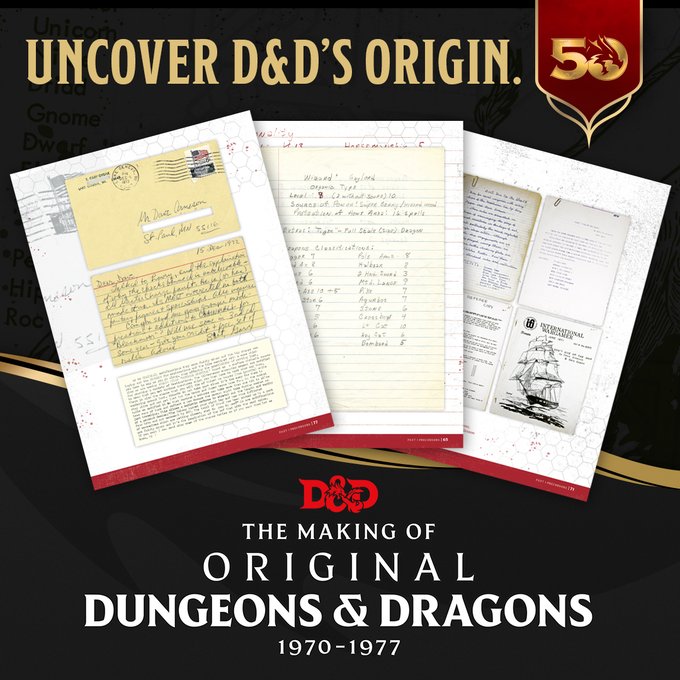
Promo ad showing pages from the Greyhawk Supplement (1975)

Today is the day! As a reminder, today is the released date of highly anticipated book, The Making of Original Dungeons & Dragons: 1970-1977, a massive (almost 600 pages) tome reprinting the original D&D booklets & supplements; the original draft of D&D and a wealth of other related documents & correspondence. More details about the contents can be found in two of my earlier posts:

"The Making of Original D&D: 1970-1977": Table of Contents

"The Making of Original D&D: 1970-1977": What Might the Precursors Be?

If you haven't ordered the book yet, it can be found here on Amazon:

The Making of Original Dungeons & Dragons: 1970-1977

Recent Promos:

The official D&D account has posted several promo photos over the last few weeks, including the one at the top of this post. Here are two of the others:


Promo ad showing pages from Chainmail 2nd Edition


Promo ad showing correspondence between Gygax & Arneson


Tuesday, June 11, 2024

Pacesetter Games: Islands of Peril


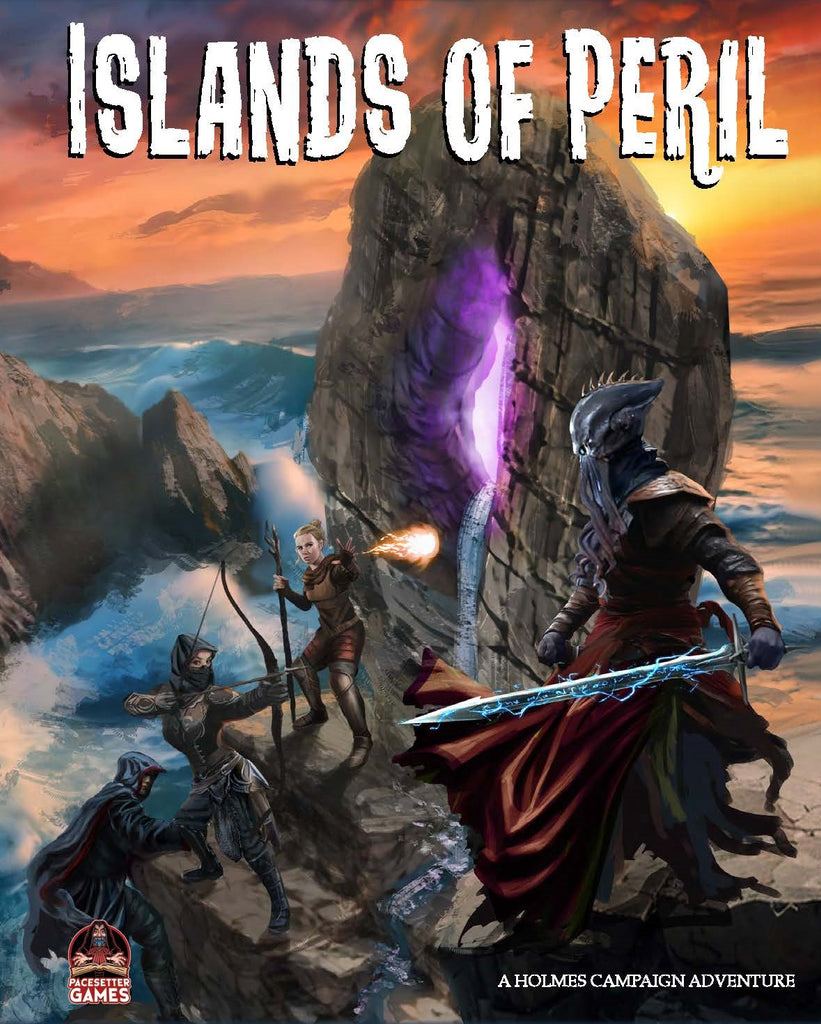
Cover of the standard edition

Islands of Peril is the latest adventure from Pacesetter Games 
written by Bill Barsh based on the 1970s maps and notes of J. Eric Holmes (with permission from the Holmes estate).  This follows last year's Things Better Left Alone dungeon adventure; read my post about that one here. I contributed a Foreword to this one, where I give an overview of the original maps that it is based on. Note that this one is a sandbox wilderness, and is the first of a two-part series of island-based adventures.

The adventure was released last weekend at North Texas RPG Con, where Chris Holmes is a regular attendee. To quote Pacesetter's announcement: 

"This year we bring you Islands of Peril: Book One. This massive island (wilderness) adventure includes five fully-detailed islands within Holmes' home campaign. Designed for Classic D&D using character levels 1-4, there are numerous sandbox style adventure locales on each of the islands. PCs can explore the Crying Cyclops Isle, Shadow Island, Isle of the Creeping Doom, Barrow Island, and Isle of Ash. Each features unique adventures and encounters within this first installment featuring the maps and notes from Dr. Holmes, the father of Basic Dungeons & Dragons.

We have three versions to choose from; softcover, hardcover, and special edition hardcover. In case you missed Things Better Left Alone last year, we have brought it back into print (it sold out last year at NTX). Available in both softcover and brand new hardcover edition.

Lastly, but most importantly, Chris Holmes, the son of Dr. Holmes, is attending the convention. Find him at the con or at our booth and have him sign your copy! Not only did he provide us with the original hand-drawn maps (included in each book), he contributed his artistic talents to the illustrations in each book.

If you cannot make it to the convention, look for the books at pacesettergames.com."

Find three different hardcopy versions of Islands of Peril, as well the PDF version, here on the Pacesetter games website:

Pacesetter Games: Islands of Peril


Wednesday, May 29, 2024

Gygaxian Monster Paralysis: Permanent?


Letter from Gygax to an fan (1989)


A not uncommon question about the rules in Holmes Basic is: "How long does the paralysis inflicted by Carrion Crawlers, Gelatinous Cubes or Ghouls last?"

This is asked because, in the Holmes rulebook, an attack by each of these monsters inflicts paralysis unless a saving throw is made, but none of the respective entries indicate how long the victim remains immobilized. One might assume that it wears off at some point after an encounter is over, or one might turn to the Wand of Paralyzation, which in Holmes has a duration of 6 turns for a failed save. Other than that, there's no specific guidance.

The lack of durations reflects the OD&D source material that Holmes relied on when editing the manuscript for the Basic rulebook. Carrion Crawlers and Gelatinous Cubes were introduced in the Greyhawk supplement, but neither specifies any duration for the paralysis they inflict. Ghouls were introduced earlier, in Vol 2 (Monsters & Treasure), where it says, "As stated in CHAINMAIL for Wights, Ghouls paralize any normal figure they touch, excluding Elves" (page 9). In Chainmail, the entry for "Wights (and Ghouls)" does make clear that their paralysis lasts for "one complete turn" of that game (page 33, 2nd edition), and while it is clear that Holmes did consult those rules for some aspects of Basic (such as the Parrying rule), for whatever reason he did not include this information, and neither did Gygax when he revised the manuscript before publication.

If Gygax eventually recognized that the omission of durations for paralysis in OD&D and Holmes Basic was an oversight, he had an opportunity to correct that in the AD&D Monster Manual, which came out about 6 months after Holmes and revised most of the existing D&D monsters. But he did this for only one of the three, the Gelatinous Cube, which now paralyzes for 5-20 (5d4) rounds. Notably, this duration also corresponds to the revised duration for the Wand of Paralyzation given in the AD&D Dungeon Masters Guide, published a few years later in 1979.

The Monster Manual still lacks durations for the Carrion Crawler and Ghoul as well as a number of new sources of paralysis: the breath weapon of Silver Dragons, the touch of Ghasts, the tentacles of the Giant Portuguese Man-O-War, and the secretions of the Slithering Tracker. 

Why the seeming reluctance to add durations for monster paralysis? Later TSR products varied quite a bit in attempting to fill in the "missing" durations (look below for a list), which suggested that it was simply an oversight that was only slowly corrected. But was there another reason?

A recently uncovered 1989 letter from Gygax to a fan in Ecuador, posted on FB (see the image up above), sheds some light on his original view of paralysis. Unexpectedly, Gygax writes: 

"Paralysis might be permanent. I finally gave in and said 5-20 minutes, but... I like it better as permanent until removed by something. You choose."

As an AD&D round corresponds to one minute, the 5-20 minutes noted here corresponds exactly to the 5-20 rounds that newly appears for the Gelatinous Cube in the Monster Manual, and for the wand in the Dungeon Masters Guide.

Thus, Gygax's comment surprisingly suggests that the reason he didn't include a duration for monster paralysis in early D&D products was because he viewed such paralysis as "permanent until removed by something"...! 

His "something" is vague and not further explained in the letter. One possibility would simply be the same thing that restores hit points in OD&D: a return to base for complete rest. Per OD&D Vol 3: "On the first day of complete rest no hit points will be regained, but every other day thereafter one hit point will be regained until the character is completely healed. This can take a long time" (page 35). Others include those given in later rulesets: the second iteration of the Basic rulebook (Moldvay Basic) in 1981 newly allowed for Cure Light Wounds or Healing Potions to remove paralysis, and for AD&D, Lenard Lakofka created a new 3rd level cleric spell, Remove Paralysis, that appeared in Dragon #58 (February 1982) and then was compiled in Unearthed Arcana in 1985

While "permanent" paralysis may seem harsh, if viewed in the context of a game also replete with "save or die" poisons, "save or permanent paralyzation" fits in as a permanent consequence that is not quite as bad as death.

* * * * *

As an addendum, with regard to Carrion Crawler & Ghoul paralysis, later TSR D&D products gave a variety of answers to this:

---In T1 The Village of Hommlet (1979) by Gygax, ghoul paralysis is given a duration of 3-12 (3d4) turns.

---In Dragon #37 (May 1980), the Sage Advice column written by Jean Wells answered the question, "How long does the paralysis caused by a carrion crawler, ghast or ghoul last?" with "I have always assumed it to be 24 hours. However, since the duration of the paralysis is not clearly defined in any of the books, I suggest that each DM decide the duration in his particular campaign" (page 12). I note that a duration of a full day is much closer to the "permanent until removed by something" suggested by Gygax than any of the other suggested durations listed here.

---In Dragon #39, a followup Sage Advice column clarifies the above: "According to Lawrence Schick, Vice-President for Production and Design at TSR Hobbies, the paralyzation caused by carrion crawlers is of the same duration as that caused by ghouls— 3-12 turns. Paralyzation caused by a ghast takes twice as long—6-24 turns—to wear off". This duration for ghouls is the same as given in T1.

---In Moldvay Basic (1981), the paralyzation of Carrion Crawlers, Gelatinous Cubes, Ghouls and new Thouls is standardized as a shorter 2-8 (2d4) turns.

---In Polyhedron #2 (Autumn 1981), in the Dispel Confusion column, Gary Gygax answered the question, "How long does (or should) paralysis caused by a carrion crawler last? And what, if any, are the effects of multiple hits by this creature?", with: 

"Paralysis from creatures lasts as long as paralysis from a wand: 5d4 (5-20) rounds (DMG page 136). Multiple hits from a carrion crawler (or any other paralyzing creature) forces multiple saving throws on the part of the victim; when any one is failed, the other hits have no further effect on the paralysis (damages still apply if given, such as by a ghoul or ghast)." 

This is the only published source that really matches Gygax's later letter in giving a generalized 5d4 rounds for paralysis. 

---In TSR's Monster Cards (1982), part of the AD&D line, Ghoul and Carrion Crawler paralysis are instead each given a duration of 2d6 turns. These cards include revised entries from the Monster Manual, so are often viewed as "official" revisions for AD&D.

---In the AD&D 2E Monstrous Manual (1989), we see a different duration for each monster: Carrion Crawler, 2d6 turns; Gelatinous Cube, 5d4 rounds; Ghoul, 1d6+2 rounds; and the Ghast, 1d6+4 rounds.