This is the blog. Click
here to go to the Zenopus Archives website.
Note: Many older posts on this blog are missing images, but can be viewed at the corresponding page in the Internet Archive
FEATURED POST
The Forgotten Smugglers' Cave: Index of Posts
An index of posts describing the Forgotten Smugglers' Cave, an adventure for Holmes Basic characters levels 2-4. ...
Wednesday, March 28, 2018
Save for Half Episode 10: Holmes Basic D&D
Episode 10 of the podcast Save for Half is dedicated to Holmes Basic D&D!
Here's the blurb: "It’s the grandaddy of Basic D&D, the blue book edited by Dr. J. Eric Holmes! This little gem from the late 1970s brings us the question of trying to sell RPGs in mass market stores. It also begs other questions, such as how many ogres you need to mug to level up, why unicorns blow, and what vampires are doing in a game that limits players’ characters to levels 1-3? All this and more will be answered on this episode of Save for Half! No ogres were harmed in the making of this episode, not even the ones with 500 gold pieces in their bags."
The links section kindly includes a link to this blog.
Listen here:
Save for Half Episode 10: Holmes Basic D&D
Two of the hosts, DMs Liz and Mike, were previously on the Save or Die podcast and I joined them on the 124th episode.
Click on the "Podcasts" label below for links to previous podcasts of interest to the Holmes Basic aficionado.
Monday, March 26, 2018
Into the Borderlands review by paleologos
Advance copies of Into the Borderlands were on sale at Gary Con earlier this month, as shown above in a photo of the Black Blade Publishing booth. Also on the table are copies of Tales of Peril and issues one and two of the Holmes Basic art-inspired zine Fantastic! Exciting! Imaginative!
Dragonsfoot member paleologos purchased a copy of Into the Borderlands at the con and has now posted a comprehensive review of the book over there in the Reviews section:
Into the Borderlands (Goodman Games, 2018)
Saturday, March 17, 2018
Maze of Peril Ch 1, Scene 5: "The Ancients Worked on a Grand Scale"
This post is part of the Tales of Peril Book Club, indexed here.
Boinger and company now prepare to descend the staircase into the dungeon. They leave their horses behind, hobbled, but bring the mule with them. This is in line with the Basic rulebook: "Mules can often be taken into dungeons and they can carry 3,500 gold pieces. Horses can usually carry more, but lack the ability and calm necessary for dungeon expeditions", which is in turn adapted from OD&D Vol 2, "Only mules are agile enough to be taken in dungeons".
The marching order is specified, very much like a D&D party entering a dungeon. The "advance party" has a front rank of Zereth, with lit torch, and Olaf, and Haldor behind them with a second torch. Following are Murray, Bardan and finally Boinger leading the mule. The mule has shod feet that make loud "clomp-clomp" noises in the dungeon.
They descend straight down the ancient stone stair to a passageway of roughly cut stone blocks. Compare with Sample Dungeon in the Basic Rulebook: "The stairway from the surface leads twenty-five feet straight down and ends in the corridor marked START on the Dungeon Master's map."
The east-west corridor is immense, 25' high and 25' wide, leading Boinger to comment that the "ancients worked on a grand scale". Murray is less impressed, replying "this is nothing...The dungeons are endless. Some of the old books say they extend to the heart of the earth". Murray's comment indicates he is familiar with the description of the Underworld given earlier in the chapter. While the Sample Dungeon in the Basic Rulebook has standard-sized corridors (10' wide, 10' high), some of the rooms are similarly large scaled.
Room A, for example, is 120 by 100 feet in size.
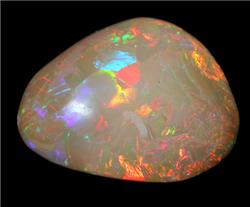
They unexpectedly find that the floor of the corridor is coated in "a trail of opalescent grey slime". Opalescent is an obscure word meaning that something shows "a glimmer of different colors when rotated or seen in different angles" (per minerals.net). I imagine the slime trail is illuminated in this manner as the party moves its torches about.
Zereth identifies the slime as coming from a "Worm", and that it is "nearly dry. Made hours ago", suggesting some familiarity with this. The others don't question this, so they must have at least heard of what he is referring to. They then refer to it as a "creature", and worry about it encountering it, giving the sense that it is a large creature. If you are familiar with D&D, you'll certainly suspect that they are talking about a Purple Worm, although Holmes has added the detail about the slime, perhaps based on the trails of snails and slugs or simply the sliminess of earthworms.
The party debates over whether to head east or west, worrying about whether they will come up behind the monster if they go west, or have the entrance cut off if they go east.
Zereth scouts each direction in the dark using his infravision. Bardan says he thinks that Zereth can see better than him in the dark, though in D&D they both have infravision to 60'.
When Zereth returns, his eyes reflect green in the torchlight, suggesting a tapetum lucidum like found in many animals, for example cats, giving improved night vision. Holmes researched neurobiology using cats as a model animal, for example see this abstract.
Zereth reports a cross corridor 70' in either direction. While Boinger has a snack (a recurring theme), Bardan and Zereth decide to head east, based on Bardan sensing more corridors in that direction. Per the Basic Rulebook (and OD&D), dwarves are attuned to underground construction, being able to "detect slanting passages, traps, shifting walls and new construction about one-third of the time" (i.e., 1-2 in 6).
In the next scene we'll see what they find when head east down the dark corridor.
Descriptions:
Murray: Long robe, conical hat - again this is in line with the standard D&D wizard as seen on the cover of the Basic rulebook.
Boinger and company now prepare to descend the staircase into the dungeon. They leave their horses behind, hobbled, but bring the mule with them. This is in line with the Basic rulebook: "Mules can often be taken into dungeons and they can carry 3,500 gold pieces. Horses can usually carry more, but lack the ability and calm necessary for dungeon expeditions", which is in turn adapted from OD&D Vol 2, "Only mules are agile enough to be taken in dungeons".
The marching order is specified, very much like a D&D party entering a dungeon. The "advance party" has a front rank of Zereth, with lit torch, and Olaf, and Haldor behind them with a second torch. Following are Murray, Bardan and finally Boinger leading the mule. The mule has shod feet that make loud "clomp-clomp" noises in the dungeon.
They descend straight down the ancient stone stair to a passageway of roughly cut stone blocks. Compare with Sample Dungeon in the Basic Rulebook: "The stairway from the surface leads twenty-five feet straight down and ends in the corridor marked START on the Dungeon Master's map."
The east-west corridor is immense, 25' high and 25' wide, leading Boinger to comment that the "ancients worked on a grand scale". Murray is less impressed, replying "this is nothing...The dungeons are endless. Some of the old books say they extend to the heart of the earth". Murray's comment indicates he is familiar with the description of the Underworld given earlier in the chapter. While the Sample Dungeon in the Basic Rulebook has standard-sized corridors (10' wide, 10' high), some of the rooms are similarly large scaled.
Room A, for example, is 120 by 100 feet in size.
They unexpectedly find that the floor of the corridor is coated in "a trail of opalescent grey slime". Opalescent is an obscure word meaning that something shows "a glimmer of different colors when rotated or seen in different angles" (per minerals.net). I imagine the slime trail is illuminated in this manner as the party moves its torches about.
Zereth identifies the slime as coming from a "Worm", and that it is "nearly dry. Made hours ago", suggesting some familiarity with this. The others don't question this, so they must have at least heard of what he is referring to. They then refer to it as a "creature", and worry about it encountering it, giving the sense that it is a large creature. If you are familiar with D&D, you'll certainly suspect that they are talking about a Purple Worm, although Holmes has added the detail about the slime, perhaps based on the trails of snails and slugs or simply the sliminess of earthworms.
The party debates over whether to head east or west, worrying about whether they will come up behind the monster if they go west, or have the entrance cut off if they go east.
Zereth scouts each direction in the dark using his infravision. Bardan says he thinks that Zereth can see better than him in the dark, though in D&D they both have infravision to 60'.
When Zereth returns, his eyes reflect green in the torchlight, suggesting a tapetum lucidum like found in many animals, for example cats, giving improved night vision. Holmes researched neurobiology using cats as a model animal, for example see this abstract.
Zereth reports a cross corridor 70' in either direction. While Boinger has a snack (a recurring theme), Bardan and Zereth decide to head east, based on Bardan sensing more corridors in that direction. Per the Basic Rulebook (and OD&D), dwarves are attuned to underground construction, being able to "detect slanting passages, traps, shifting walls and new construction about one-third of the time" (i.e., 1-2 in 6).
In the next scene we'll see what they find when head east down the dark corridor.
Descriptions:
Murray: Long robe, conical hat - again this is in line with the standard D&D wizard as seen on the cover of the Basic rulebook.
Labels:
Boinger and Zereth,
Portown Campaign,
Tales of Peril
Tuesday, March 6, 2018
Gary Con Trip Cancelled
I regret to announce I've had to cancel my trip to Gary Con this year due to a death in my family. My dear father-in-law passed away a few days ago, and I will be traveling to attend his wake and funeral over the next few days. So my event "Return to the Tower of Zenopus" won't be held. I've messaged the registered players and deleted the event in the system, but I wanted to post this here as well to get the news to them.
Tuesday, February 27, 2018
Warlock influenced Chivalry & Sorcery
A new thread on Dragonsfoot asking about Chevalier led to a reply linking a 2013 post on the Castelli & Chimere blog that I vaguely remember. Chevalier is the original, unpublished version of Chivalry & Sorcery that is an original D&D variant rather than a stand-alone game. The story goes that Ed Simbalist and Wilf Backhaus brought this manuscript to Gen Con with the idea of selling it to TSR, but ended up instead selling it to FGU, where it was published with further revision as Chivalry & Sorcery in 1977. A very limited reprint of the Chevalier manuscript was made by the authors in 1999, from which a few scans are shown on the C&C blog, including the "Forward" shown above, the title of which reproduces the font and mispelling found in Men & Magic (Vol 1 of OD&D).
What I didn't notice previously was the role of Warlock - the 1975 OD&D variant from Caltech - in the development of Chevalier. I've written previously about Warlock and its influence on Holmes Basic; for a general overview see the post "WARLOCK or how to play D&D without playing D&D?" and for other articles mentioning it click the Warlock label at the bottom of this post.
Ed Simbalist writes not only that "Warlock gave further ideas. And Petal Throne presented the concept of an integrated world" but also that "CHEVALIER is not intended to be a replacement for Dungeons and Dragons. Indeed, to play CHEVALIER, one requries at least the three D&D volumes and the Greyhawk Supplement. The other supplements make playing even more complete. If one throws in Warlock for good measure, the picture becomes complete. However, CHEVALIER changed a good many of the rules and, and the prospective player is forewarned to read very, very carefully."
The Introduction to the original Warlock made a similar statement that it is "not intended to replace D&D, nor is it intended in any way to interfere with it". Both games went on to develop their own complete systems, with C&S in 1977 and the Complete Warlock books in 1978-1980.
Furthermore, I can see some specific influences of Warlock in the scans posted on the posted scans in that blog article.
The Elf advancement table is formatted similarly to the one in Warlock and the Fatigue dice are pretty close to the Hit Dice for Elves in the original 1975 Warlock rules.
The M-U spell list includes not just spells from OD&D but also ones original to Warlock.
From the portion shown:
1st level: Match, Silence (as a 1st level spell), Sound Amplification, Telescope
2nd level: Awaken (one of the Holmes A&E stories has this on a scroll), Create Sound, Detect Experience [Group], Detect Evil/Good (as separate 2nd level spells), Freeze Water, Hallucination, Measure Distance, Measure Volume
3rd level: Ball Lightning, Cone Cold, Continual Darkness, Dark Cone, Detect Clairvoyance, Detect Clairaudience, Detect Teleport, Heat Cone, Illusion I, Light Beam
I don't have the 1st edition of Chivalry & Sorcery for further comparison, but I imagine much of this was changed by the time it saw print in 1977. Even so, it's clear that Warlock provided a template for Simbalist and Backhaus in assembling their own D&D variant, an important step in developing the game that eventually led to C&S.
What I didn't notice previously was the role of Warlock - the 1975 OD&D variant from Caltech - in the development of Chevalier. I've written previously about Warlock and its influence on Holmes Basic; for a general overview see the post "WARLOCK or how to play D&D without playing D&D?" and for other articles mentioning it click the Warlock label at the bottom of this post.
Ed Simbalist writes not only that "Warlock gave further ideas. And Petal Throne presented the concept of an integrated world" but also that "CHEVALIER is not intended to be a replacement for Dungeons and Dragons. Indeed, to play CHEVALIER, one requries at least the three D&D volumes and the Greyhawk Supplement. The other supplements make playing even more complete. If one throws in Warlock for good measure, the picture becomes complete. However, CHEVALIER changed a good many of the rules and, and the prospective player is forewarned to read very, very carefully."
The Introduction to the original Warlock made a similar statement that it is "not intended to replace D&D, nor is it intended in any way to interfere with it". Both games went on to develop their own complete systems, with C&S in 1977 and the Complete Warlock books in 1978-1980.
Furthermore, I can see some specific influences of Warlock in the scans posted on the posted scans in that blog article.
The Elf advancement table is formatted similarly to the one in Warlock and the Fatigue dice are pretty close to the Hit Dice for Elves in the original 1975 Warlock rules.
The M-U spell list includes not just spells from OD&D but also ones original to Warlock.
From the portion shown:
1st level: Match, Silence (as a 1st level spell), Sound Amplification, Telescope
2nd level: Awaken (one of the Holmes A&E stories has this on a scroll), Create Sound, Detect Experience [Group], Detect Evil/Good (as separate 2nd level spells), Freeze Water, Hallucination, Measure Distance, Measure Volume
3rd level: Ball Lightning, Cone Cold, Continual Darkness, Dark Cone, Detect Clairvoyance, Detect Clairaudience, Detect Teleport, Heat Cone, Illusion I, Light Beam
I don't have the 1st edition of Chivalry & Sorcery for further comparison, but I imagine much of this was changed by the time it saw print in 1977. Even so, it's clear that Warlock provided a template for Simbalist and Backhaus in assembling their own D&D variant, an important step in developing the game that eventually led to C&S.
See also:
WARLOCK or how to play D&D without playing D&D? (Overview of Warlock)
Saturday, February 17, 2018
Holmes Basic at DunDraCon 2018
This weekend is the 42nd DunDraCon, the long running convention in the San Francisco area. For the second year in a row, a DM is running Beyond the Door to Monster Mountain, a Holmes Basic mini-scenario available on the Zenopus Archives site. The scenario is being run twice, once at 10 AM and once at 2 PM, and is family/kid-friendly. See the convention listings here.
The DM also started a thread about the game on ODD74, where he wrote:
"I will be running this great module with a few added encounters back to back Sunday Feb 18th at DunDraCon here on the left coast. The module by Zach is loads of fun for kids and adults alike and I run it in the room (along with my [wife's] help) with a horde of kids and young at heart in the children's room at the convention. Last year I had just as many adults as kids but it was a hoot. I hope to see some of you there as we celebrate 40 years of Holmes!
Based on attendance this time, if there are slots open, I will allow players to participate in both sessions. Maybe even leveling up!"
For those interested in the history of Dundracon, their website has a great pdf archive of past Dundracon programs going back to Dundracon III, President's Day weekend, 1978.
Here's the cover from the program for DunDraCon IV, 1979 (the cover has a typo which was hand-corrected):
Wednesday, February 7, 2018
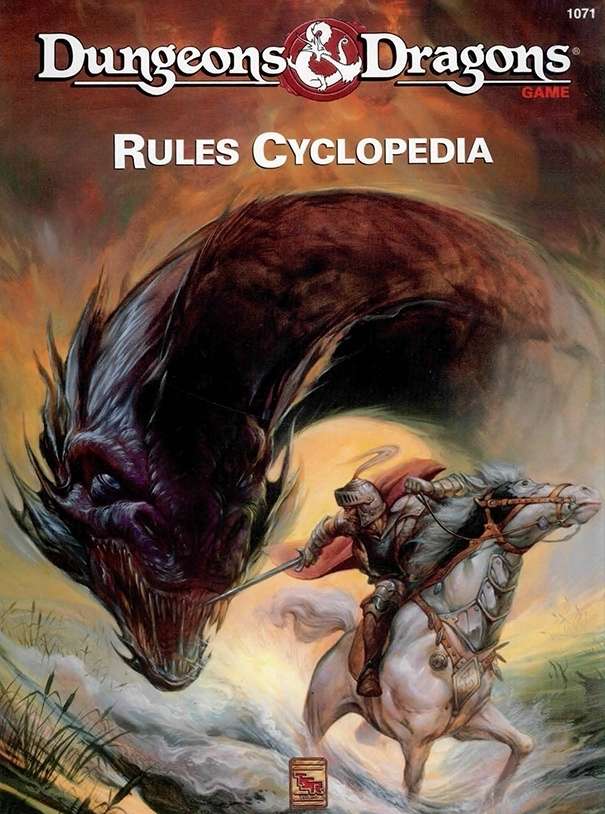
Rules Cyclopedia now available in print
The Rules Cyclopedia is now available in print-on-demand!
RPGnow link: Rules Cyclopedia
DriveThruRPG link: Rules Cyclopedia
The links include this blog's affiliate #, which gives a store credit of 5% of the price.
Published in 1991 by TSR, the Rules Cyclopedia was the culmination of the Basic/Classic line developed from J. Eric Holmes' work in 1977. Holmes is thanked in the Acknowledgements, along with the many other editors and authors who worked on the line, as the "Cyclopedia has also been drawn from the works and benefitted from the input of the following people".
The Cyclopedia incorporates the entire 36 character levels developed in the BECMI (Basic-Expert-Companion-Masters-Immortals) line by Frank Mentzer as well as some rules from the Gazetteer series into a single hardcover rulebook of approximately 300 pages. The price of original copies has steadily risen to near $100 in recent years, so the print-on-demand option is welcome for those that wish affordable copies for actual use in play.
The rules remain highly compatible with the Original D&D line, so this book could easily be used as an expansion to Holmes Basic if you wish to have 36 character levels. The major difference is the ability scores, which use the bell-curve of bonuses developed by Tom Moldvay in the 1981 Basic rulebook revision. The "Full-Size Preview" link (shown above) on the page shows off a few of the early pages, including the Table of Contents if you want to see the scope of the material in the book.
While this is great news from a legacy point-of-view, I'll use this moment to point out that they still don't have a Holmes Basic pdf or print-on-demand available. It's a gaping maw in their catalog!
Subscribe to:
Posts (Atom)