This is the blog. Click here to go to the Zenopus Archives website.

Note: Many older posts on this blog are missing images, but can be viewed at the corresponding page in the Internet Archive

FEATURED POST

The Forgotten Smugglers' Cave: Index of Posts

An index of posts describing the Forgotten Smugglers' Cave, an adventure for Holmes Basic characters levels 2-4.                    ...

Tuesday, June 24, 2014

Part 32: "Commonly Found Near Graveyards, Dungeons, or Deserted Places"

Part 32 of a comparison of Holmes' manuscript with the published Basic Set rulebook. Turn to page 32 of your 'Blue Book' and follow along...

Shadow

These were first mentioned by name in OD&D, Vol 3, in a list of "Other monsters to consider" following the Monster Level Tables. The list ends with five monsters not described elsewhere in the set: "...Cyborgs, Robots, Androids, Shadows, Dopplegangers."  

In Greyhawk they receive a full write-up, where we learn they are "non-corporeal intelligent creatures" but not undead. Holmes preserves this concept, as well of the rest of the entry without any significant changes other than the usual editing for brevity. Greyhawk has Shadows listed with the forces of Chaos so Holmes leaves out an alignment as typical for Chaotics.  

No changes from the manuscript to the published rulebook, other than to add a different alignment (Lawful Evil) and the variable damage from Greyhawk (1d4 per hit). In AD&D, Gygax made a big conceptual shift in these monsters, changing them to undead, as well as changing a bunch of details: upping their HD to 3+3 (from 2+2), damage to 2-5, and alignment to Chaotic Evil. In B/X, Moldvay instead follows the wording of Holmes closely, including having them as non-undead, although the alignment goes back to Chaotic. Moldvay clarifies that they look like real shadows and can alter their shape slightly.

Skeleton 


A fundamental monster of Basic D&D, as shown by Holmes' use of them in two different rooms (B and N) of his Sample Dungeon. Skeletons first appear in OD&D Vol 2 in a dual entry with Zombies; the only mechanical distinctions between the two is that Skeletons are 1/2 HD 1 HD and AC7, and Zombies are 1 HD 2 HD and AC8. 

Update: The strike-throughs in this entry are because I have learned that Skeleton/Zombie Hit Dice varied over the early printings of OD&D; see this ODD74 thread for details. It appears that Holmes had an early print where the HD was listed as "1/2". This may have been meant to give skeletons 1 HD & zombies 2 HD, but Holmes interpreted each of them having 1/2 HD. See also my entry for Zombie in this series.

Holmes follows this uses 1/2 HD for Skeletons except that he but seems to have accidentally used the AC8. We also see here that he intended for monsters to use a d6 for Hit Dice as in the original D&D books (Greyhawk introduced the d8 for Hit Dice as an option). The published rulebook keeps the 1/2 HD (and the AC8), but changes the note to "(1-4 hit points)", in line with a d8 for Hit Dice. 

Holmes' description follows the original, including that they are motivated by a M-U or Cleric, although OD&D perhaps only intended that cleric was chaotic ("Magic-User or Cleric (Chaos)"), while Holmes has "a chaotic magic-user or cleric". The published rulebook changes the "chaotic" to "evil" and also the reference to the "lawful cleric" to "good cleric"

At the end of the entry Holmes adds two sentences not found in the OD&D entry, one describing the immunities of the undead class, and another indicating skeletons are usually silent since they don't move until they attack. For this second one he probably drew on OD&D Vol 3, page 9, "Note "Undead" never made any sound". The Blackmoor Supplement even takes this a bit farther by noting (in the section on Monks) that extremely silent creatures including Undead double the chances of surprise. Interestingly, the Monster Manual and Moldvay Basic both drop this concept of skeletons moving silently.

The entry for skeleton was originally unillustrated, but the 2nd edition (Nov 1978) adds a small picture below the entry which depicts two skeletons lying on the ground with some armor & weapons:

Skeletons by DCSIII, image courtesy Desert Scribe
Spectre 

Holmes closely follows the wording of the original description in OD&D, Vol 2, including the reference to the Nazgul of Tolkien. This Tolkien reference, along with many others, was removed from later editions of OD&D, but was never changed in the Holmes rulebook (the only change in Holmes being 'hobbits' to 'halflings'). So all of us kids who started with Holmes Basic got to see the direct connection between Nazgul/Spectres and Barrow Wights/Wights. 

Holmes adds one sentence of clarification to the end of the original material, "Magical weapons score full hits on spectres" (as opposed to normal and silver, which do no damage). The published rule-book makes one change, adding "low-strength" to the "spectres under the control of the one who made them", but doesn't explain further, such as quantifying the "low strength". The Monster Manual clarifies this somewhat by changing "low strength" to "half strength".

Stirge

Kind of the vampire bats of D&D. They first appear in Greyhawk, seemingly bigger than in later depictions: "Large bird-like monsters with long, dangling proboscuses, the Stirges might call to mind evil-looking, feathered ant eaters". Holmes preserves this description, as well as most of the other concepts, omitting only their attraction to warm-blooded creatures. Holmes correctly translates their attack (as 4th level fighter) as a +2 on an attack rolls for a 1 HD monster. 

The only change in the published rulebook is to change Greyhawk's Treasure Type D to Type Q, one of the new types debuting in Holmes Basic. Type Q is simply a 50% chance of 1-4 gems, suggesting that Stirges have a fondness for gems, and only gems. In the Monster Manual, their treasure returns to the earlier Type D, whereas Moldvay Basic has them with Type L, which is actually the same as Type Q in Holmes.

In the original version of B2, Gygax adds a few interesting details to the 'Holmes Basic' stirge: Minotaurs love to eat stirges, and starving stirges will make so much noise that 90% of the time they ruin any chance of surprise.

Troll

Trolls go back to Chainmail, which distinguishes 'Trolls' (Ogres) from 'True Trolls (the D&D Troll), referencing Poul Anderson's Three Hearts and Three Lions, which features a battle with a regenerating troll. OD&D Vol 2 describes their regeneration powers in detail, quantitating it as 3 hit points per turn. Holmes follows this description closely.  

In 1979 Holmes was interviewed as part of a LA Times article, "Fantasy Life In a Game Without End", where he mentioned that "his revision attempted to preserve some of the Byzantine D&D flavor and didn't dare tamper with such beloved phrases as "loathsome trolls are tough and rubbery and have the ability to regenerate". The OD&D phrase is "Thin and rubbery, loathsome Trolls are able to regenerate..." and Holmes preserves this exact phrasing in the first sentence of his entray.

The only change to the description in the published rulebook is to change "they attack with talons or fangs" to "talons and fangs" in accord with the three attacks they are given. In Holmes the standard is a single attack for all monsters, thus this change was needed when the manuscript was revised by Gygax/TSR to add multiple attacks.


Continue on to Part 33: "Their Appearance Is As Spectral Armored Warriors"
Or Go Back to Part 31: "This Inoffensive Looking Little Creature"
Or Go Back to Start: The Holmes Manuscript

Tuesday, June 10, 2014

Hobbits as the Rangers of Basic

A Hobbit Ranger? From OD&D, Vol 1, Men & Magic, pg 9

Last week I was thinking about how Hobbits (later Halflings) are the 'Rangers' of Basic D&D, due to their abilities to disappear in the outdoors and their skill with missile weapons, implying they are good at hunting. Give them a tracking skill and you've got a great ranger in vein of Trotter, Tolkien's original hobbit version of Aragorn. And then I read a post by Wayne R at Semper Initiativus Unum where a hobbit in his game of his acted in just this manner.

The two abilities I mentioned have their roots in The Hobbit, and while they were mentioned in Chainmail they don't really feature in AD&D for PCs. Holmes played a role bringing these forward from Chainmail to Basic, and emphasizing the 'wild' aspect of their hiding ability.

Back when I posted Part 3 of the Holmes Manuscript commentary, I simply related there were no changes to the section on Hobbits from the manuscript to the published rulebook (pg 7), without further comment. So here I'll look into Holmes' development of this section.
 
Chainmail has Gygax's original description of Hobbits as they appear in D&D: 
"These little chaps have small place in the wargame, but you may want them for recreation of certain battles. Remember that they are able to blend into the background and so make excellent scouts. They can fire a stone as far as an archer shoots, and because of their well known accuracy, for every two halflings firing count three on the Missile Fire table" (pg 29).

The ability to "disappear quietly and quickly" around big people is mentioned at the start of The Hobbit, and Bilbo's skill with stones is revealed when he battles the Spiders in Mirkwood.

OD&D adds magic resistance, and refers to Chainmail for missile fire, but omits their abilities as scouts: 

"Should any player wish to be one, he will be limited to the Fighting-Men class as a hobbit. Hobbits cannot progress beyond the 4th level (Hero), but they will have magic-resistance equal to dwarves (add four levels for saving throws), and they will have deadly accuracy with missiles as detailed in CHAINMAIL" (pg 8, Vol 1).

Vol 3 of OD&D also mentions their (along with dwarves and elves) better-than-human hearing, 1-2 in 6, another skill fitting well with Rangers.

Greyhawk only adds info about thieves: 
"Hobbits can be either fighters or thieves, and as thieves they have better chances for doing most things (see STATISTICS REGARDING CLASSES) and are not limited to how high in levels they can progress" (pg 5).

But there is a Greyhawk 'Correction Sheet' that clarifies their "accuracy with missiles": 
"All hobbits add +3 to hit probabilities when using the sling." 

Synthesizing the above, Holmes gives us the following in the Basic manuscript:


The height of three feet is not explicitly stated in Chainmail or OD&D but is either taken directly from The Hobbit ("about half our height"), or extrapolated from the four and five feet stated for dwarves and elves in Greyhawk. 

Holmes clearly looked to the Chainmail entry (and perhaps The Hobbit), because he includes the ability to disappear not mentioned in OD&D. He also associates it much more strongly with wild environments than either The Hobbit or Chainmail, using the words: "out-of doors", "woods" and "undergrowth". They are really the only class/race in Basic that has an outdoor skill; not even Elves are described as having any affinity for the outdoors.

With respect to missile fire, he presumably missed the Greyhawk correction (slings at +3), and instead implements the Chainmail accuracy as a simple +1 to hit with any missile weapon. 

I couldn't find any reference to halfling-sized armor/weapons in the earlier books, so this might be a pure Holmes addition. Gygax actually takes this a bit farther in B2, mentioning elf and dwarf-sized suits of armor. Holmes also includes their enhanced hearing in another section of the rulebook.

Gygax didn't change any of the above; it all made it into the published Basic rulebook, but he also didn't include this material in AD&D. In the Monster Manual, Gygax expands the +3 to hit to also include bows, at least for NPC halflings. The Players Handbook refers to the MM entry, making it ambiguous whether PC players are meant to also have these bonuses. The PHB also omits any reference to their ability to hide in the woods, instead giving them a chance to move silently enough to surprise on 1-4 in 6, or 1-2 in 6 through a door.

Moldvay Basic (B/X) instead sticks with Holmes' version, including the 'cut down' weapons/armor, the +1 missile adjustment, and the ability to disappear under cover, here quantified as 1-9 in 10 (or 1-2 in 6 in a dungeon). They are also given two additional abilities that fit well with a 'Hobbit Ranger', including a +1 to individual initiative reaction and a -2 AC when fighting large monsters.

* * * * * 

Some possible Hobbit Ranger names from the Generator:

Glen Ael
Quetas the Searcher
Go I the Wary (!)
Dankrac Spoor
Ton Mun the Dun

Thursday, June 5, 2014

Holmesian Random Names in the Sidebar

Today Paul Gorman at Quickly, Quietly, Carefully wrote a great post called "Embedded Microgenerators for Dungeons & Dragons Blogs", complete with Javascript code examples. 
Inspired by this, I modified the code his second example for 'Magic Towers' to generate Holmesian Random Names. I placed this is a Gadget at the top of the sidebar on the right hand side of this blog. The Gadget will generate a Holmesian Random Name when clicked on. Repeated clicks will generate further names. Try it out!

Right now the names have two syllables, plus either a third syllable or a title (although there is an option for a 'null' variable for the second or third syllables, so it will occasionally make a one or two syllable name). I may tweak the options in the future but it's good enough for regular use right now.

The original version of the Holmesian Random Names tables are in this post. The new generator is based on the more extensive one-sheet pdf (which can be found here), although I took the opportunity to add more titles from Holmes' stories (e.g. "of Portown", etc). The random names can also be found automated in two other places; see this post. 

Post what you get below.

Here's a few I just got:
Mustas the Mutable
Zell Kan Hor
Mezas the Masked
I Traris
Gergen Sa
Mun Tar the Unknowable
Hagree the Barbarian
Jax Dre the Hunter

Wednesday, June 4, 2014

Dave Trampier - Basic D&D Artist


TSR promotional poster circa 1978; photo from a recent Ebay auction by the Collector's Trove

One of TSR's finest artists, Dave Trampier, passed away this past March. He was perhaps best known for the demon idol artwork on the cover of the original Player's Handbook (seen above in a poster from the era), and the long-running Dragon magazine comic strip, Wormy. It was also reported by the owner of the store Castle Perilous Games & Books that Trampier was planning on attending an upcoming game convention, after a long absence.

Here I'll take a look at Dave's work for the first Basic Set. Dave had three pieces of art in the rulebook. Two were in the first edition; one was added to the 2nd edition.


The first is an illustration of the spell Web on page 16, signed 'D.A. Trampier'. This picture is one that helps to show the 'dungeon' setting of the game. It's not clear who the villain is here, but the wizard certainly looks menacing. He wears a 'stars & moon's cap like the wizard on the cover of the rulebook, and carries an interesting three-prong staff.


The second is an illustration in the combat section of the rules on pg 18. I always associated this with Bruno the Battler's combat with a big goblin on page 21, but the details don't match: the creature here actually looks like a minotaur with a battle axe. The background here is abstract, perhaps meant to be a stone wall underground. I don't see Dave's signature, so illustration may have been cropped from his original art.


This thoughtful manticore, signed 'DAT', was added to the Monster List section of the 2nd edition of the rulebook in Nov 1978. Perhaps it was originally intended for the Monster Manual (which came out in late 1977) but wasn't completed in time? My original rulebook was pretty trashed, missing pages from the beginning and end, so I cut out this picture and turned it into a refrigerator magnet I keep with my Halloween decorations. 


In the same year a similar manticore, in a lair surrounded by treasure, also by Trampier appeared on the cover of the Monster & Treasure Assortment, Set 3, Levels 7-9. The original was tinged blue on the cover but the black & white original later appeared in the combined set in 1980.

Dave Trampier's original art that became the cover of the module B1

Trampier's work also formed the basis of the cover of the original cover of the module B1 In Search of Unknown, which in 1978 was the first module to be included in the Basic Set. The cover art on the published module is signed "DIS & DAT", indicating it is the combined work of David C. Sutherland (aka DCS) and Trampier. Dave's original version of this artwork was later shown in an early issue of Polyhedron (#5, 1982), thanks to the editor Frank Mentzer, who was given access to TSR's old art files. See a comparison with published art in this DF thread by paleologos.


Trampier didn't contribute any other work to B1 (all of the interior illustrations are by Sutherland), but he did do the cover and all interior illustrations for another introductory module of the era, T1 The Village of Hommlet (1978) This module was for the same levels as Basic D&D, 1-3, but was marketed as an introduction for AD&D rather than Basic. Above is Dave's cover art for the original version of this module, showing a montage of encounters from the ruined moathouse.


Finally, Trampier also illustrated this awesome "You'll Be Amazed" advertisement from the fall of 1978 for the D&D Basic Set and the Dungeon! boardgame, which I wrote about here. Note that it contains yet another Manticore.

Sunday, June 1, 2014

Holmes on Anti-D&D Hysteria


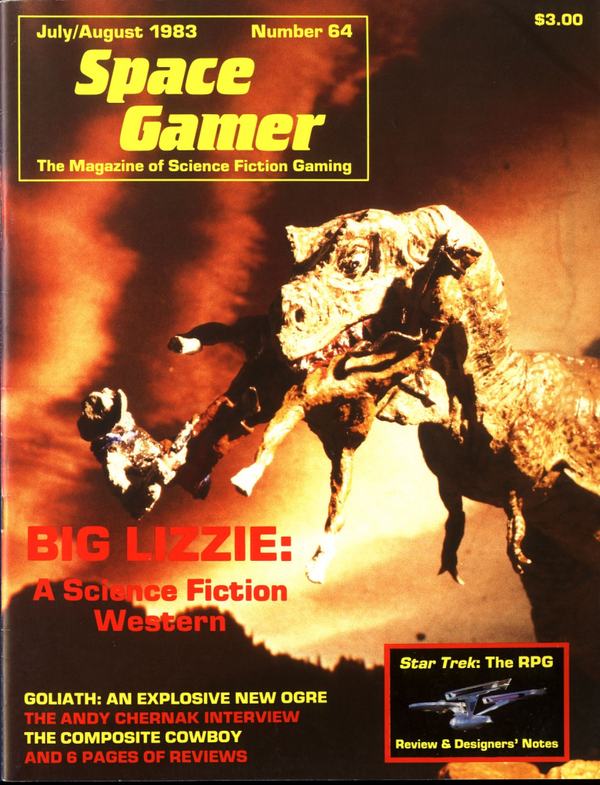
Recently I found an interesting letter from J. Eric Holmes that I wasn't aware of previously. It was sent in to Space Gamer issue 64, July/August 1983, in response to an earlier article. Holmes shares his thoughts on the anti-D&D hysteria which started in the early '80s:

"This letter is in praise of W.G. Armintrout's "Report from the Trenches: The D&D War" in Number 61. Congratulations, sir, on a cool head and a good article. I hope everyone will read it and take its message to heart. This is no joke, folks, and it concerns every one of us. There is a very real possibility of legislation outlawing role-playing games being passed by the States individually, or even by the Congress, may God help us. Such attempts have been made in the case of videogames.

Over a year ago I agreed to do a television interview for a local Los Angeles station. They told me they were doing a "series on youth" and wanted to have a program on D&D. I had done previous TV and radio interviews on the subject, and I accepted. A very nice couple, husband and wife team, came to my house to tape the interview in my game room. They honestly identified their station, but did not tell me anything else about it. I didn't even have a TV set, and so failed to identify them as a religious station. I would have agreed to the interview anyway, hoping to appear as sane, calm and sensible, but I would have insisted on seeing the final tape. My interviewers promised to let me know when the interview and associated material would be shown, but they never did. They had interviewed people at a game store. "There was one guy," they told me, "that the other young men told us not to bother talking to. They said he was too crazy, too far out, and wouldn't make any sense. But we found him to be the most interesting of the whole group."

About halfway through my hour-long interview, the subject of demons came up. I was asked what I thought of the charge that D&D teaches demonology. "I think it's silly." There was a hushed pause before the next question. Suddenly I knew why I was being interviewed!

Didn't I believe in demons? No, I said, no more than in dragons or unicorns. They are all mythological creatures. Didn't the rules of the game have specifications for demons? Yes, they did, I admitted, picking up the Monster Manual and demonstrating that the section on demons was no longer than that on dinosaurs or on dragons.

"Of course, if you believe in demons, then probably you shouldn't play the game," I continued, "even though it's perfectly possible to play the game without using demons. It's easy to understand the distress of those who do hold such beliefs."

The point is, however, that the Bill of Rights protects the rest of us from having these beliefs forced upon us against our wishes. Remember Armintrout's rules. Be confident in your own rights and beliefs.

Educate as best you can. I don't know how the video tape was edited, since my husband and wife team didn't keep their promise to tell me when it was aired, but one of my students saw it and was horrified. "They tried to make you out as a terrible evil person, and I said, 'I know Dr. Holmes, he's not like that at all,' and I turned it off." Wouldn't you like to know what the guy at the game store said to these same interviewers that they thought was such good sense?

Maybe, like Armintrout suggests, we can outlive this storm. He seems to have done so, I hope the rest of us can follow his sensible example."

John Eric Holmes
Shiprock, NM 

Notes:

-In regard to "previous TV and radio interviews", Holmes wrote in his 1981 book that, "Beth Ann Krier of the Los Angeles Times and Jim Mitchell of Channel 2 (CBS) News in  Los Angeles, showed a genuine interest in understanding the game and in presenting it in an informational and entertaining fashion". I also have a 1982 radio interview with Odessa College in Texas listed in the Holmes Bibliography. I haven't heard any of these interviews and there may be others that I'm unaware of; if any finds anything please let me know. Holmes also covers the public reaction to role-playing games in chapter 13, "Are They All Crazy?", although there is no mention of demons there.

-The Holmes Memorial by John Martin mentions that he and his wife moved from LA to Shiprock, NM in 1982.

-I am still looking for a 1982 article by Holmes called D&D: Dangerous For Your Health?, which may cover some of the same ground.

Thursday, May 29, 2014

Part 31: "This Inoffensive Looking Little Creature"

Part 31 of a comparison of Holmes' manuscript with the published Basic Set rulebook. Turn to page 31 of your 'Blue Book' and follow along...

Pegasus

In the manuscript, Holmes labels them "Pegasus" but the published rulebook changes it back to the plural Pegasi, as originally used in OD&D. The manuscript has just two sentences, derived from the original source. Holmes has them with a Lawful alignment and only serving Lawful characters; the published rulebook changes both of these to Lawful Good.

The OD&D description says they "fight as heavy horse", which Holmes has as "fight as a heavy war horse". In the context of the Holmes rulebook, this statement is not clear. Pegasi have 2+2 HD, but fight as a 3 HD creature? Monsters with 2 to 3 HD have the same "to hit" rolls per the table on page 19. This is probably a relic of a reference in OD&D to Chainmail, where there are entries for "Heavy Horse" on the Combat Tables on page 40.

Pirates


Arrrr! This is the last 'monster' included in the manuscript by Holmes that was deleted by TSR, and it's yet another man-type. From OD&D Vol 2, Holmes included Bandits, Berserkers, Buccaneers, Cavemen, Dervishes, Mermen, Nomads and Pirates, omitting only Brigands, but only the first two made it into the published rulebook. In the case of Pirates, it's easy to see why TSR deleted it - most of the information here is also found in the section on Buccaneers. The original material in OD&D Vol 2 simply says "Pirates are the same as Buccaneers except they are aligned with Chaos". Holmes made two changes to this - Buccaneers have an alignment of 50% Neutral/50% Chaotic and Pirates have a 20% chance of "Chain Mail, Heavy Crossbow" instead of 10%. Holmes entry on Buccaneers even has a note "Pirates are always chaotic" which covers the only OD&D difference.

Holmes used Pirates in his Zenopus Sample Dungeon, Room M, and they conform to the rules given here (1 HD, AC7, 2-12 GP). So in the original manuscript this 'monster' in the Sample Dungeon was represented in the Monster List.

Pixies

Pixies go all the way back to Chainmail, where they are grouped with Sprites. Holmes draws part of the text for his manuscript directly from the Chainmail entry, specifically the "defenders note minor shadows and air distortions" and the note that they can fly for three turns and then rest.

Gygax keeps the manuscript entry unchanged but adds three short sentences to the published rulebook: "They use short bows, small spears, and daggers. Their royalty are powerful magic-users. All are friendly with elves and fairies".  Chainmail grouped "Fairies" with "Elves", and this continued with Greyhawk, listing "fairies" among the types of elves (pg 5), and the Monster Manual as an alternate name for Gray Elf. Interestingly, Moldvay Basic drops these last three sentences, ending where the Holmes manuscript. Nowhere else does the concept of 'pixie royalty' appear, although the Monster Manual gives them a number of spells.

Purple Worm

The Purple Worm also goes back to Chainmail, where it is a type of dragon: "Finally, the Purple, or Mottled, Dragon is a rare, fightless worm with a venomous sting in its tail" (pg 35). OD&D Vol 2 separates the Worm from the Dragons, and gives it a much more detailed description, which Holmes follows closely in the manuscript. He changes the chances of swallowing on a hit from any "over 20% of the minimum total, or 100% in any case" to "Any hit more than 2 over the minimum". He also changes the first part of the last sentence from "never check morale" to "unintelligent". The published rulebook splits the third sentence into two sentence, adding detail on how to handle a hit by the tail: "and if it hits a saving throw vs. poison must be made".

The first edition has an illustration by David Sutherland of a purple worm battling a fighter, magic-user and cleric (a similar grouping as on the title page). This was deleted from the second edition when the monster section was reformatted.


Update: Prior to Chainmail, Gygax wrote a series of articles about colored dragons in the Diplomacy zine Thangorodrim. For the fifth installment, in issue #9 (Aug 1970), he wrote about the Purple Worm: “Of doubtful species, the Mottled or Purple Worm must be included in any study despite the possibility that it is not a true dragon. The creature has no wings and no internal form of weapon unlike other dragons. Yet its body shape conforms otherwise to the kind as does its general behaviour. The Purple Dragon has a venomous sting in the tip of its tail, one drop of which is enough to fell an Oliphant. It is sly and treacherous. The species is found only on the Islands Umbar."

Rust Monster

Rust Monsters first appeared in Greyhawk, and Holmes follows the entry closely but with the typical editing to condense it. Holmes refers to them as "inoffensive looking little creatures" although the original uses "inoffensive" without "little". The published rulebook makes two changes to the manuscript. The first sentence refers to "ferrous metal" in the manuscript, as in Greyhawk, but "ferrous" is dropped in the published rulebook. Does this imply that the rust monster can affect non-ferrous metals such as bronze armor/weapons or even a silver dagger? The rulebook also changes the last sentence from "eats the rust" to "eats the rust and corroded metal", clarifying the monster's dietary habits.

It's unclear if Holmes knew how the rust monster was envisaged by Gygax & company at the time he worked on the manuscript. I believe the first picture of the Rust Monster appeared in the Monster Manual in December 77, six months after the Basic Set was released. The picture in there, by David Sutherland, is based on a plastic monster toy manufactured in Hong Kong that inspired the D&D monster created by Gygax & company. For more on this, see this post by former TSR artist Tony DiTerlizzi.

Continue on to Pt 32: "Commonly Found Near Graveyards, Dungeons or Deserted Places"
Or Go Back to Part 30: "It is, Of Course, Ochre-Colored"
Or Go Back to Start: The Holmes Manuscript

A pack of plastic rust monsters. Source: Tony DiTerlizzi

Monday, May 26, 2014

The Return of Basic D&D

And it will be free! The latest post from Mike Mearls on the Wizards site explains this important piece of the new 5E D&D:

"Basic D&D is a PDF that covers the core of the game. It’s the equivalent of the old D&D Rules Cyclopedia, though it doesn’t have quite the same scope (for example, it won’t go into detail on a setting). It runs from levels 1 to 20 and covers the cleric, fighter, rogue, and wizard, presenting what we view as the essential subclass for each. It also provides the dwarf, elf, halfling, and human as race options."

The same core classes and races as the original Basic set in 1977. Perhaps even a bit closer to Holmes than later Basic sets, since presumably it won't have race = class, thus giving demi-human thieves among the options.

"But the best part? Basic D&D is a free PDF. Anyone can download it from our website. We want to put D&D in as many hands as possible, and a free, digital file is the best way to do that." 

Pure awesome.

"If Basic D&D is the equivalent of the classic Rules Cyclopedia, then the three core rulebooks are analogous to Advanced Dungeons & Dragons. Want more character options? Pick up a Player’s Handbook. Looking for more critters for your campaign? The Monster Manual has you covered. Want to sculpt a unique campaign? Pick up the Dungeon Master’s Guide. Still, Basic D&D is the true heart of the game and could easily provide a lifetime of gaming."

"At the launch of the D&D Starter Set, Basic D&D will include the material needed to create characters and advance to 20th level. In August, with the release of the Player’s Handbook, Basic D&D will expand to include the essential monsters, magic items, and DM rules needed to run the game, along with the rules for wilderness, dungeon, and urban adventuring. (The Starter Set already covers the aspects of these rules that you need to run the included campaign.)"

20 levels is way more than I expected. That's all of B/X plus more. Way back in OD&D, Gygax wrote, "There is no theoretical limit to how high a character may progress, 20th level Lord, 20th level Wizard, etc."

"As we introduce new storylines like Tyranny of Dragons, we’ll also make available free PDFs that provide all the rules and stats missing from Basic D&D needed to run the adventures tied into the story. The adventures released as part of Tyranny of Dragons are playable without requiring any of the core rulebooks or the Starter Set. With just the Basic Dungeons & Dragons rules, you can play D&D for years."

"Basic D&D makes it easier than ever for new players and DMs to jump into tabletop RPG play. We’re involved in the greatest gaming hobby ever invented. It’s time to bring that hobby to everyone who wants to take part."

Wow...! 

In view of this, I'm still inclined to think of the new Starter Set as a "module plus". The original versions of B1 and B2 had a number of pages of DM guidance for Holmes Basic. Plus B1 had a bunch of pre-gen characters. The new Starter Set sounds like an expanded version of this. The free pdf is the Basic rulebook, the Starter Set is the module for DMs.