This is the blog. Click here to go to the Zenopus Archives website.

Note: Many older posts on this blog are missing images, but can be viewed at the corresponding page in the Internet Archive

FEATURED POST

The Forgotten Smugglers' Cave: Index of Posts

An index of posts describing the Forgotten Smugglers' Cave, an adventure for Holmes Basic characters levels 2-4.                    ...

Tuesday, July 27, 2021

d20 Unexpectedly Intelligent Monsters in the Monster Manual (1977)


Tom Wham's classic comic commentary on unexpectedly intelligent monsters


Happy Gary Gygax Day 2021! 

To celebrate, here's a post about Gygax and Arneson's monsters:

Every competent adventurer expects to encounter intelligent monsters like dragons, minotaurs and vampires, but in other cases brainpower and the ability to communicate lurk where they might not be expected. This type of twist didn't feature much in the original monster list in Monsters & Treasure (Vol 2 of OD&D), but really started to take off in the monsters added in the supplements (particularly Blackmoor and Eldritch Wizardry) and in the Strategic Review. These were eventually compiled, along with more additions, in the AD&D Monster Manual, with each monster now having a formal Intelligence stat. Many of the "secretly intelligent" monsters remain under-appreciated and/or underused, at least with respect to their intellect. Let's take a look at them, and since it's D&D, I've written it up as a table so you can roll one to use as a potentially "chatty" encounter in your next dungeon:

d20 Unexpectedly Intelligent Monsters in the Monster Manual

1. Ape, Carnivorous: "Low (upper)" (7). The ordinary ape, listed as "Ape, (Gorilla)", has Low (5-7) intelligence, but its "larger, stronger and very aggressive relative" is at the upper end of that range, having a "fair intelligence (IQ 70+) and being "very cunning". Disturbingly, these smarts correspond with a sinister craving, as it "hungers particularly for human flesh"...

2. Beaver, Giant: Low to Average (5-10). While the other unusually-sized rodent in this book, the Giant Rat, is only semi-intelligent, the Giant Beaver at the high end approaches the average for human intelligence, i.e., 10.5 on a 3-18 bell curve. Furthermore, their description indicates an interest in coins, trading, and building dams for profit, which means that they are essentially an unexpected and woefully underused NPC race for characters to interact with. The details in the Monster Manual go back to the original writeup in the Blackmoor supplement, which also includes "gourmet bark" (!) in the list of valuables they will trade for. Dan Boggs has speculated in a post on ODD74 that they were one of the monsters written up by Dave Arneson himself. To me, they feel like an amalgamation of the prehistoric giant beavers that existed in the U.S. until relatively recent times, which were similarly 6 feet long, and Mr & Mrs Beaver from The Lion, the Witch and the Wardrobe.

3. Beetle, Boring: Animal (1). With six different varieties of giant beetle, each one needed a distinguishing trait, and for the Boring Beetle this feature is a hive mind. Thus, alone among beetles, the Boring Beetle has an intelligence score above zero, which fuels alternative-agriculture skills in the form of farming "molds, slimes and fungi substances", and (per rumor, but in D&D the monster rumors are always true, right?) developing "a communal intelligence which generates a level of consciousness and reasoning ability approximating that of the human brain". As with the Giant Beaver, these details go back to the Blackmoor supplement, and likely Arneson, which elaborates on these farming practices: they grow "yellow mold for food, as well as cultivating many of the other vile jellies and slimes often encountered in dungeons" and "[t]hey start their nauseating cultures by gathering various dead bodies and rotting offal and add a small bit of the substance to stimulate growth (sort of putrid Petrie dishes)" I think the implication here is that their practices are partly responsible for the "the clean-up crew" being so prevalent in dungeons! Not quite so, ahem, boring?

4. Dolphin: Very (11-12). While everyone knows that Dolphins are on the intelligent side for animals, in D&D they boast a score above the average for humans, and towering over their underachieving cetacean kin, the whales, who can only boast a score of Low (5-7). Furthermore, ten percent of dolphins go so far as to form "underwater communities" that are sufficiently organized to employ guards from other species, such as swordfish or narwhals. This is yet another creature first written up for the Blackmoor supplement, but Boggs places their authorship with contributor Steve Marsh, later thanked in the Monster Manual for "for devising the creatures for undersea encounters which originally appeared in BLACKMOOR". The original writeup places even more emphasis on their "great intelligence", as they can communicate with other dolphins using telepathy, and in battle employ a "war harness", a rig with "a long wicked spear that protrudes in front"...!

5. Gray Ooze: Animal (1). Most of the clean-up crew cohort are non-intelligent, including Black Puddings, Gelatinous Cubes, Green Slimes and Ochre Jellies, but the Gray Ooze is a slightly higher order of creature, having animal intelligence. And with great size they can transcend even this modest brain-power: "In exceptionally large individuals an intelligence of a sort is well developed. Furthermore, these exceptional individuals have a latent psionic ability..." that includes a psychic crush attack. This ability was first added in an entry in Eldritch Wizardry in the section on Psionics. Now you are now probably wondering, "Do psionic Grey Oozes dream of deliquescing sheep"?

6. Invisible Stalker: High (13-14). In OD&D, these were "an extra-dimensional monster" conjured by the 6th-level magic-user spell of the same name, but here they are revealed to be from the Elemental Plane of Air. Unlike their clerically-summoned cousins, the Aerial Servants, who are only semi-intelligent, or garden-variety Air Elementals, who are of low intelligence, the Invisible Stalker is extremely bright, which is probably why they so often resent being whisked from their home to do a magic-user's grunt work. Note that the entry for Air Elemental also indicates that on the plane of air are "certain intelligent air elementals which have special abilities beyond the above". 

7. Lynx, Giant: Very (11-12). See Tom Wham's cartoon at the top of the page, which sums it all up much better than this wordy blog post.

8. Mimic, Lesser: "Semi- to Average" (2-10). Mimics have a much wider range in intelligence than most monsters because, as the text reveals, there are actually two types: the larger "killer mimic", which is only semi-intelligent and "the slightly smaller, intelligent sort". The smart ones are "generally friendly if offered food", which is a rare instance of the Monster Manual using the term "friendly" in reference to a non-humanoid monster, and even better, they may "tell a party about what they have seen nearby". To aid in this advanced food-gathering tactic they have evolved a facility for languages, typically being able to speak "several other tongues such as common, orcish, etc" in addition to their own.

9. Mold, Yellow: "Non- (see below)" (0). While the typical Yellow Mold is not a deep thinker, or even a thinker at all, here size once again begets unexpected brainpower: "When formed into great colonies of at least 300 square feet in area this growth will form a collective intelligence about 1 time in 6. If this should happen the yellow mold will be aware mentally and psionically" and can attack equivalent to "the most powerful form of id insinuation." As with the Grey Ooze, this ability was first noted in Eldritch Wizardry. In addition to a psionic attack, the mental awareness suggests the colony might be communicated with via telepathy, assuming you took "Yellow Mold" as one of your languages.

10. Neo-Otyugh & Otyugh: Very (11-12) & Average (8-10). I've combined these because they obviously should have been one entry in the Monster Manual like the Mimic. I mean, the Neo-Otyugh entry is basically just: "bigger and smarter otyugh". These creatures dwell in the same ecological niche as the trash compactor monster in Star Wars, although they were published first, with the Neo-Otyugh appearing in the 1976 tournament version of the Lost Caverns of Tsojconth (see a pic here at the OSR Grimoire). Nobody expects a trash monster to be an Einstein, but unexpectedly the Otyughs are often as smart as the average human, speaking their own language and being "semi-telepathic, thus often able to communicate with other life forms when the otyugh so desire". Which is presumably useful for telling the boss when the dungeon septic tank needs to be cleaned out.

11. Octopus, Giant: Animal (1). While only a single point smarter than their dimmer cousins the Giant Squid, Gygax casts these overgrown cephalopods in a completely sinister light that appears to hint at even greater mental prowess. Specifically, they have an alignment of "Neutral (evil)", are "malicious", have "a cunning intent" and can form gangs with other members of their species "to overwhelm a larger ship if the opportunity presents itself". This evil disposition is a distinct change from their earlier writeup in the Blackmoor supplement, where they were "generally peaceful" and only attacking ships "after provocation". 

12. Owl, Giant: Very (11-12). While less unexpected than the other entries here in view of the association of owls with intelligence, giant owls "will sometimes befriend other creatures" and "speak their own language". A value is still given for their eggs, because humans are horrible.

13. Roper: Exceptional (15-16). This living stalagmite with octopus arms turns out to have the highest intelligence of all the monsters in this list, being way smarter than most humans. It was originally written up in Strategic Review #2 in very similar format, including a "Highly Intelligent" stat. There is no further mention of this intellect in either source, but it goes to show that in D&D, one would be foolish to underestimate "a mass of foul, festering corruption".

14. Shambling Mound: Low (5-7). Being a walking pile of swamp moss, one might expect a score of "Non-" here, but no, "Shamblers" (in Gygaxian slang) are actually smarter than a number of Fighters, as per the AD&D Players Handbook, with an intelligence of 5 or lower one can only be a Fighter. There's no other mention of any particularly brainy behavior, but I'm guessing that this score is a result of its comic book inspiration ala Swamp Thing, Man-Thing or the Heap.

15. Slithering Tracker: Average (8-10). This awesomely-named, plasma-draining, cleaning-crew-adjacent monster is often overlooked, most likely because there is no picture of it (but see the never published one here by Bill Willingham). They are much smarter than any of their relatives, perhaps having evolved such intelligence to aid in tracking their prey. A candidate for your next ranger character?

16. Spider, Giant, Phase & Giant Water: Low (5-7) or Semi- (2-4). Spiders in general follow the trend noted above of "bigger is brighter": Large Spiders (HD 1+1) are "Non-" (0), Huge Spiders (HD 2+2) are "Animal (1)", Giant Water Spiders (HD 3+3) are "Semi- (2-4)" and Giant Spiders (HD 4+4) and Phase Spiders (HD 5+5) are "Low (5-7)". There's not much elaboration on the intelligence of the Giant or Phase spiders in their entries, other than that they will flee superior foes (Giant Spiders) or that they will (in more erudite fashion) "seek to evade encounters which are unfavorable" (Phase Spiders), which based on their powers brings to mind Bilbo using the One Ring to avoid unwelcome visitors at Bag End. Giant Water Spiders, despite being only semi-intelligent, exhibit the most interesting of the noted spider behaviors, being approachable if offered food, and thus occasionally becoming pals with aquatic folk like nixies.

17. Strangleweed: Animal (1). Nobody expects an "intelligent kelp". Need I say more...? This is another undersea encounter originally devised by Steve Marsh for the Blackmoor supplement, although the word intelligent does not appear there.

18. Toad, Ice: Average (8-10). This oft-overlooked variety of overgrown amphibian has almost human-level intelligence, which is much, much higher than the "Animal (1)" intelligence of the typical Giant Toad. Furthermore, Ice Toads even have their "own weird language", which might prove useful when asking them for directions to the Glacial Rift of the Frost Giant Jarl.

19. Trapper: Highly (13-14). As this creature is the dungeon-floor counterpart of the more awesomely-named Lurker Above, one might predict a similar "Non-" intelligence, but instead the Trapper is a good degree smarter than the average human. This is perhaps an evolutionary necessity to stay ahead of all those suspicious adventurers. They are further described as "clever" and able to create a "protuberance which resembles a chest or a box", perhaps suggesting a relation to the more intelligent breed of Mimic (see above).

20. Wolf, Winter: Average (8-10). As with the Giant Lynx and Ice Toad, the Winter Wolf is a cold-climate species that is more intelligent than its temperate-dwelling relatives; in this case, both regular and dire wolves, each of which are only semi-intelligent. Winter Wolves are even a cut above the low-intellect Worgs, which based on Tolkien alone one might predict would possess a bit of cunning. What is it about the arctic that fosters intelligence in Gygaxia? As with the other arctic-intellects, they speak "their own language", but being "Neutral (evil)" and having a "foul disposition", I'm sensing a cultural rivalry with the neutrally-inclined Giant Lynx and Ice Toads.

Honorable mentions (since I wanted to keep the above list to 20 entries)Perytons and Umber Hulks, each of "Average (8-10)" intelligence, and each speaking their own language. Perytons were new for the Monster Manual, but Umber Hulks were first written up for the Greyhawk Supplement, but without any note of intelligence or language.

Coda 
Some of these cryptically intelligent races, such as the Giant Beaver, Ice Toad or even Mimic, might even be suitable for use as PCs, particularly in OD&D or Holmes Basic. As it says in OD&D, Vol 1 (and is echoed in Holmes Basic), "There is no reason that players cannot be allowed to play as virtually anything, provided they begin relatively weak and work up to the top". While Gygax infamously later changed his mind on this for AD&D, there was a time when he allowed it in his own games; for more on this, see Balrog PCs gone missing.

See also previous posts for Gary Gygax Day:

Friday, July 23, 2021

Now at DMsGuild: Chainmail POD & July Sale


CHAINMAIL by Gary Gygax and Jeff Perren is now back "in print"...! 

Thanks to JeffB over at ODD74 for letting us know that DMs Guild and DrivethruRPG are now offering a Print-on-Demand option for Chainmail.

Get it here:

Or here:

As I wrote over on ODD74, from the preview, the version of Chainmail they are offering is a 3rd Edition (copyright 1975), 7th printing (April 1979), and scanned from an original rather than re-typeset like most of the OD&D booklets they are currently offering. This version is from after the Tolkien references (Hobbits/Ents/Balrogs) were altered or removed.

The print plus digital version costs the same as the print version alone, $6.99. I've ordered a copy, and will report on quality when it arrives. The total with tax and media mail shipping was $11.91.

According to Chris Holmes, his father purchased Chainmail along with the LBBs, Greyhawk, Warlock and the Dungeon boardgame from Aero Hobbies shortly after they learned about the game (Tales of Peril, page 328). And Holmes had his copy handy while preparing the Basic rulebook, as is evident from the entry for Giants, which states, "There are several ways to calculate catapult (giant) fire. This one is adapted from CHAIN MAIL", and by his inclusion of the Parry rule from Chainmail that didn't appear elsewhere in OD&D (See Part 17 of my Holmes Manuscript series).

The published rulebook also directly references Chainmail in Gary Gygax's Foreword, which is carried over from Vol 1 of the original rulebooks: "From the CHAINMAIL fantasy rules he drew ideas for a far more complex and exciting game, and thus began a campaign that still thrives as of this writing!" Chainmail also appears in the TSR product listings appearing in the back of the Holmes Basic rulebook. 

This means that I personally have known about Chainmail since the days of my original Holmes Basic set. This led me to purchase a copy, the same edition being offered now, directly from the TSR Mail Order Hobby Shop in the late '80s. I later sold this on Ebay in the late '90s when trying to downsize my collection (ha!), and later regretted that, but soon I will have a copy again.

See also:

Chainmail Announcement from Domesday Book #9


* * * * * * * * * *


Also at DMs Guild and DrivethruRPG is their annual Xmas in July sale, with many products 25% off, which means that the The Ruined Tower of Zenopus is just $1.49 until the end of the month.


Get it here:


Most of the classic TSR titles are included in the sale, at least in PDF format, including the PDF of Chainmail (but not the new POD). Most of the in-print stuff is not, although I note that the Rules Cyclopedia in print is $21 instead of $25.


(All links include my DMsGuild/DrivethruRPG affiliate number)

Saturday, July 10, 2021

Dragon #46 retrospective on Enworld


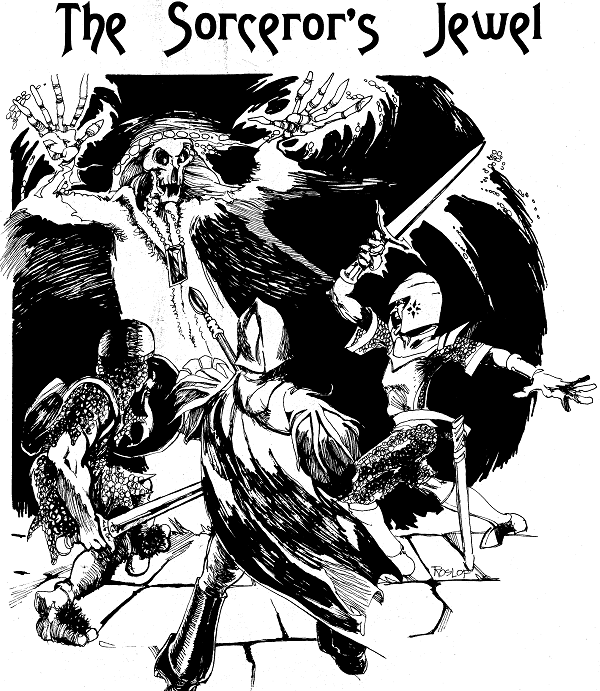
Dragon Reflections, by M.T. Black, is a regular column on Enworld that offers retrospectives of Dragon magazine in chronological order. This week they've reached issue #46, which among other content includes Holmes' second published Boinger and Zereth story, "The Sorcerer's Jewel":


Dragon Reflections #46


Black covers the entire magazine, so doesn't say too much about Holmes' story, just that it is "pretty typical D&D-inspired fiction", but the first commenter offers this gem:

I would point the reader to Tales of Peril: The Complete Boinger and Zereth Stories of John Eric Holmes by Black Blade Publishing. Over the span of months, me and my D&D group read the entire collection out-loud together, on nights we weren't up for playing TTRPGs. More than "typical", I say the stories are "archetypal." It was so interesting to see how one of the authors of BD&D interpreted and portrayed how the class and race traits work in a story. The stories are zany and fun. We laughed out loud many a time. I recommend the book. (And I'm not sure, but I believe they're all autographed and numbered too.)

I followed up on this to comment that the Black Blade ordering page:

"hasn't been updated, but from communication with Allan and John (the folks behind Black Blade), I've heard that the first printing of Tales of Peril has sold out, and they are planning a reprint. If anyone who reads this is interested in a copy, if you email them at the address on that page they will add you to a list for notification when it has been reprinted."

I also commented that:

"One interesting bit in Holmes' story is a reference to "under Witch's Hill, where the old Suloise city is supposed to be buried". I believe this is only reference to specific setting material from the World of Greyhawk in the Boinger and Zereth stories. Given that the World of Greyhawk folio, which as noted above was also reviewed in this issue, mentions "A lost, ruined city of the Old Suloise is said to be hidden somewhere in the Suss forest" (page 26), and the Sea of Dust has buried Suel cities (also page 26), this suggests that Holmes had a copy of the new WoG folio, or at least had heard about the material from Gygax."


"The Sorcerer's Jewel" versus "The Sorceror's Jewel"

The title of contents spell the title of the story as "The Sorcerer's Jewel", but Kim Mohan's editorial on the same page, and the formal title above Jim Roslof's art on page 8 spell it "The Sorceror's Jewel": 


However, given that "sorceror" is a fairly common misspelling, and that the word is correctly spelled "sorcerer" throughout the actual story, I'd suggest "The Sorcerer's Jewel" as the correct spelling. Tales of Peril (2017) titles it as "The Sorcerer's Jewel", except where it reproduces the title as part of Jim Roslof's art. 

Furthermore, this wasn't even the original title of story; a few years back I briefly saw a typed manuscript for this story that was instead titled "The Apprentice Treasure Hunter", which appears to reference the character of Tarkan, pictured above between Boinger and Zereth. It's unclear whether Holmes was asked to change the title, or whether Dragon simply changed it themselves. Along these lines, it's also possible the use of Suloise (see above) was also an editorial change or suggestion.

Interestingly, "The Sorcerer's Jewel" is also the title of 1939 story by Robert Bloch. I've read this and it doesn't seem related in any way to Holmes' story.

Monday, June 7, 2021

Virtual NTRPGCon 2021: The Prison of Doom

Mezzo the Unknowable,
pregen for The Prison of Doom

NTRPGCon 2021 was this past weekend, and while I didn't make it there in person this year, I did participate in one virtual game yesterday morning, Jonathan Perkel's The Prison of Doom, a dungeon for Holmes Basic based on one that he originally wrote as a kid back in the 1980s. I've known Jonathan a while; we first met at NTRPGCon in 2016, and then a few years later there he played Boinger the first time I ran In Search of the Brazen Head of Zenopus, and the last time I attended in person, I played in a DCC game of his. He's also the one who started the Holmes Basic Facebook group, which these days has over 2,000 members, making it the largest community of Holmes fans.

Here is the description of The Prison of Doom from the event listing:

"Long ago, the evil wizard Madrax built a a fearsome prison dungeon into which he could banish any threat to his rule. Will you be the first to escape? 

This game will be played using the classic HOLMES BASIC system with a few house rules. It harkens back to those late 1970s and early 80s adventures where the dungeons didn't really make a lot of sense, but were lots of fun anyway."

The genre of the scenario is dungeon escape, like A4 In the Dungeon of the Slave Lords; but I'll refrain from giving any other spoilers here since he's planning on running this again at future cons, but suffice to say that obstacles were overcome, monsters were meleed, treasure was taken, and Jonathan included a number of Holmesian touches in the dungeon.

For play he used several of my Holmes Ref sheets, including the character sheets for the pregens, and the M-U and Cleric Spell Reference Sheets, all of which can be found on the Holmes Ref page here. Because one attendee was a no-show, I ran two PCs, Mezzo the Unknowable and Lafsit the Battler, with names Jonathan generated from the Holmesian Random Name Generatoralso found in automated format in the upper right sidebar of this blog.

Jonathan added a few interesting "house rules" to the Holmes Basic base, which among others included dual wielding if your Dex was over 13, which worked the same as wielding a 2-handed weapon; the light/regular/heavy weapons rules from Blueholme, where light weapons take the worst of 2d6 for damage, and heavy the best of 2d6; and a bonus spell for clerics and magic-users for high prime requisites.

Friday, May 14, 2021

The Forgotten Smugglers' Cave #9: Waterfall Cavern

This is an installment of a new dungeon adventure set in the Portown milieu, which I'm writing for Holmes Basic D&D. You can find the Introduction here: Area 1.

Each entry includes part of a "pointcrawl" map showing the area & any exits, including links allowing you to navigate the dungeon:


Area 8 === 9. WATERFALL CAVERN
=== Area 11
||
Area 10

9. WATERFALL CAVERN: The water-filled passage from Area 8 opens into the west end of this natural cavern, also filled with water. The ceiling throughout this cavern is covered with a profusion of dripping stalactites. There is no natural light, but even at the far west end the sound of running water to the east can be heard over the dripping water. 

The source of this noise is a waterfall at the eastern end of the cavern, 100 feet away. The water streams out of a 10' diameter cave mouth and falls about 15 feet to the surface of the water in the cavern. The cavern turns south near the waterfall, leading to another passage to Area 10 (to be described).

Drop-ins. Dwelling amongst the stalactites here is a colony of giant rock crabs (1d3), which typically feed by dropping on fish in the water, but are not averse to broadening their diet. 

For each round spent in the room, there is a 1 in 12 chance of an attack by one crab (up to the total number). This will surprise on 1-5 in 6, If so, roll an attack against a random character. On a miss, there is still a 25% (3 in 12) chance that it instead hits and damages the watercraft the character is in. If combat goes against the crab it will scurry over the side of the boat into the water.

Giant Rock Crab (1d3): DX 3, AC 1, HD 2, hp 9, AT 2 claws for 1d8 each or drop for 1d12.

WaterfallCareful inspection of the area around the waterfall will reveal, on the right hand side, a series of handholds that lead up 15' to a narrow path next to the stream feeding the waterfall. At the base of these handholds, near the water, an metal rod has been driven into the rock, and can be used to tie up a boat.

The handholds are slick with moisture, but any thief can easily make the climb without chance of falling. Other characters will have 75% chance of reaching the top without slipping; if they do they will either fall back down into their watercraft, if it remained directly below, or into the water, which is cold and 15 feet deep.

At the bottom of the water, directly beneath the handholds, stands an upright suit of archaic bronze plate mail +2 (AC 2), holding the skeletal remains of a warrior who long ago fell from above and sunk here. The suit is completely covered in grime but fully intact due to its protective magic and being bronze, and a good cleaning is all that is needed to restore it.

There are two exits from this area, a prominent one to the south and a concealed one to the east, which can be found by following the links on the above map; if there is no link, the area is not yet posted.

Chronologically on this blog, the previous post installment was Area 8 and the next posted installment will be Area 10.

Monday, April 19, 2021

Scrum Con 2021: online April 24-25


This coming weekend, Scrum Con returns for the third time! This year's con will be solely virtual due to the ongoing pandemic; we hope to in-person gaming next year.

Going virtual allows us to expand to two days of games & more on Saturday, April 24th and Sunday, April 25th. Register for the con at our new website, scrum-con.com; the cost is $5, and there is currently no limit on the number of games you can register for. 

The following games and seminars currently have open seats:

Sat 10 AM-2 PM:

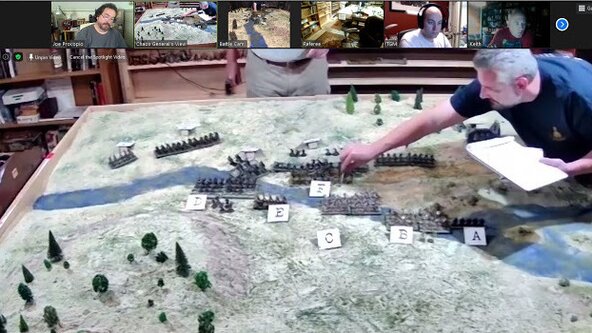
"Battle on the Borderland", a CHAINMAIL fantasy miniatures game run on a real sandtable.


Sat 2:30-6:30 PM:

"The Counterattack: Elves against the Dark Emperor", a Ral Partha Chaos Wars (2016 revived) miniatures scenario.

Sat 7-11 PM:

"The Garnet Town Gambit", a RIFTS Savage Worlds Adventure Game.

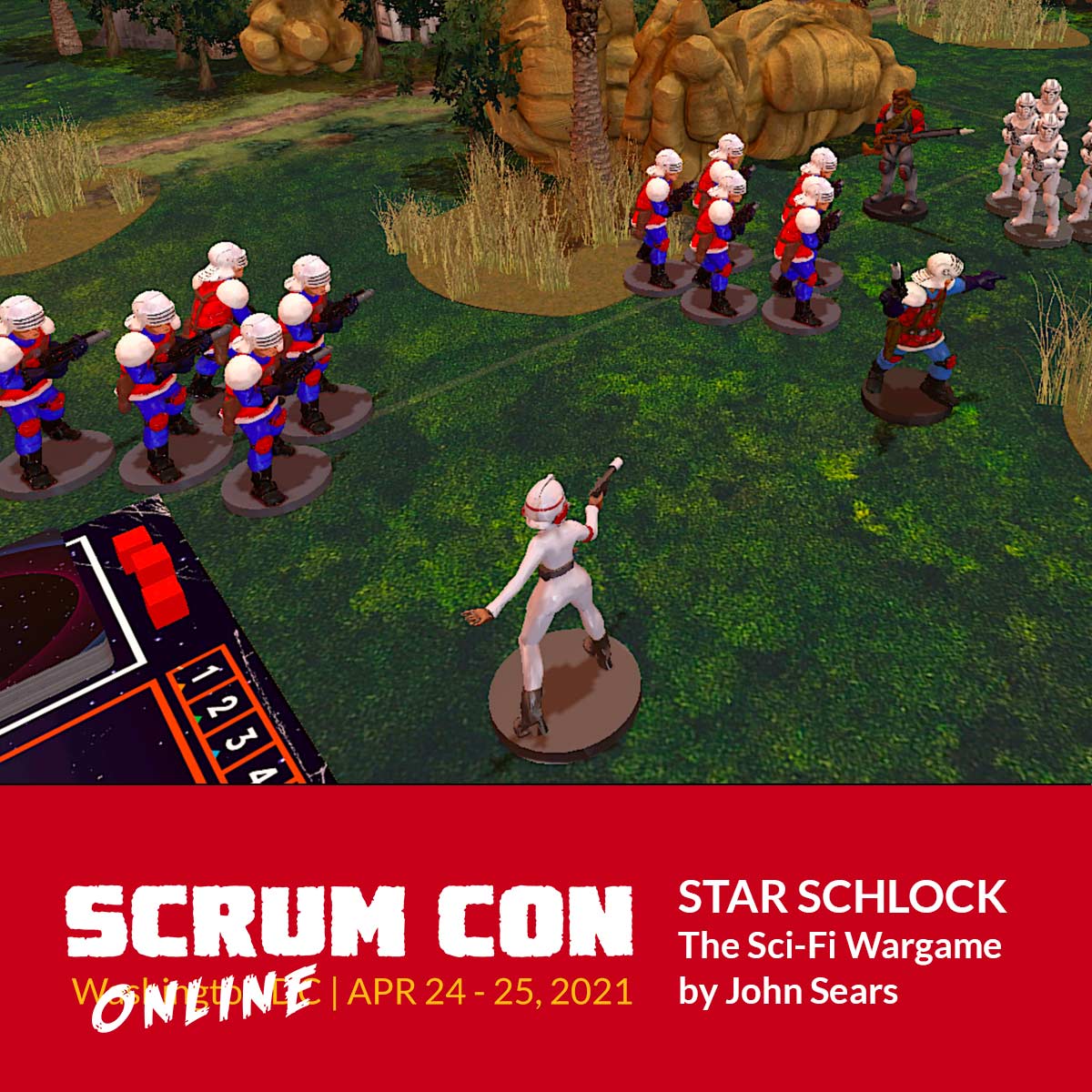
"Star Schlock - Battle for Verdo Prime": a tabletop miniatures skirmish game, based on 1980s Sci-fi Movies. See more here at the website for the game: Star Schlock.


Sun 11 AM-3 PM:

"Into the Dragon's Lair", a 5E D&D game for kids ages 9-14, run by a kid of like age (this one is free)

"Stringbags Out of Darkness", a "heavily modified Torpedo Raiders" WWII wargame scenario.

"Wampus Country: Into the Lumberlands", a Moldvay Basic D&D (aka B/X) game run by Erik Jensen of the Wampus Country blog (I'm signed up for this game).


Sun 1 PM:

Interview and Q&A with Jon Peterson, author of Playing at the World and The Elusive Shift.


Sun 3:30-7:30 PM:

"Ambush in Provence", a WWII tank-combat miniatures game run using the What a Tanker rules.

"In Deep Trouble", a fantasy miniatures skirmish game run using Crawlcraft, a custom system that blends D&D, Warcraft and MTG.


Friday, March 26, 2021

Aggroach (New Monster)

A new monster for the Forgotten Smugglers' Cave adventure, which starts here.


Illustration by Lore Suto


 Aggroach
 

Least Large Huge Giant (Adult)
Move 150 feet/turn 120 feet/turn 90 feet/turn 60 feet/turn,
30 feet flying
Hit Dice 1 hp 1/2 1 2
Armor Class 7 6 5 4
Treasure Type nil nil nil nil
Attacks 1 1 1 1
Damage 1 hp 1d4 1d6 1d8


A large, aggressive cockroach that has recently invaded the region of Portown, likely brought in with smuggled goods from afar. The earliest encountered specimens were only one foot long (the least aggroach*), but unfortunately these were merely the earliest instar (stage) after hatching. The most numerous of the forms, these are, luckily, often eaten by those hardy predators that can stomach them, like giant rats. The survivors, however, grow and toughen with each molt, until finally transforming into the adult form, the winged giant aggroach, which is as long as a halfling is tall.

An omnivorous hunter, an aggroach will attack by rearing up on its hindlegs and then lashing out with the razor sharp spines on its forelegs. Like their smaller kin, they are somewhat social, hunting in packs with similarly-sized members (e.g., 2d6 least, 1d10 large, 1d6 huge, 1d4 adults). 

When killed, an aggroach will release a "death stench" to warn away other members of its species (make a morale check or flee). This smell is revolting to humans and their kin, and thus anyone who delivers a killing melee blow to one must make a save vs poison or attack at -2 for 1d6 turns (save at +1 for the least, and -1 for the giant). It is rumored that various wizards in the area are now paying for intact larger specimens so that they might study the stench-producing glands in order to determine if they have any practical application in magical research.