This is the blog. Click here to go to the Zenopus Archives website.

Note: Many older posts on this blog are missing images, but can be viewed at the corresponding page in the Internet Archive

FEATURED POST

The Forgotten Smugglers' Cave: Index of Posts

An index of posts describing the Forgotten Smugglers' Cave, an adventure for Holmes Basic characters levels 2-4.                    ...

Saturday, March 31, 2012

The Influence of Warlock on Holmes Basic Combat, Part 2


A "Holmes Basic Combat"


The Blue Book contains a notorious "broken rule": all weapons do fixed 1d6 damage (pg 18), but "light weapons such as the dagger allow two blows per round" and two-handed weapons can be used only once every other round (pg 20). This rule as written wildly favors daggers (2d6 per round) over swords (1d6 per round) over two-handed swords (1d6 every other round). Not a big deal if only M-Us with poor AC are using daggers, but if all the fighters in plate & shield are also using daggers it gets ridiculous. Plus no one would ever use a two-handed weapon since you lose doubly on damage and AC (no shield).

There's been much discussion of where this came from, with theories ranging from the earlier Chainmail Man-to-Man rules or the upcoming AD&D rules. It often comes up when a new pair of eyes reads the Blue Book and thinks they are missing something. Most theories envision poor editing on the part of Holmes and/or TSR, which I don't deny. I also agree that Chainmail is the ultimate source of this rule, but I think I've discovered a more direct source: the Warlock combat system "Attack Matrix". I've previously described the Warlock system and how Holmes used it when he started, and made an earlier post about how it influenced the order of combat in the Blue Book.

I think the telling language is Holmes' use of the term "blows", which barely appears in OD&D (or the relevant section of AD&D), but is used in Chainmail and Warlock. In Chainmail, a weapon that is 4 classes above another (e.g., 1 vs 5) gets two blows per round, and one 8 classes above (e.g., 1 vs 9) gets three blows per round. Thus daggers (class 1) get one blow versus a sword (class 4), and three versus most two-handed weapons (e.g., two-handed sword, class 10). The weapon classes and chances for each to hit various types of armor are in the Man-To-Man-Melee Table in Appendix B (pg 41).

Warlock seems to have expanded the Chainmail MtM Table for its own Attack Matrix. Like the MtM Table, each weapon (dagger, hand axe, sword, flail, etc) has its own chances for hitting different ACs, although here in d% rather than 2d6 chances. Following these, each weapon is given a number of blows per combat "phase", the Warlock term for rounds. Finally, each is given a number of d6 Damage Dice. A dagger gets 4 attacks of 1d6 per phase; a long sword gets 3 attacks of 2d6; and a two-handed sword gets 1 attack of 3d6. These are balanced by different effectiveness against different ACs, particularly the lower ACs where two-handed weapons have more chance of hitting (similar to Chainmail MtM). Monsters have a similar table with multiple blows for smaller, faster attacks.

Comparing the three systems, Warlock is closer to what Holmes used - a dagger gets more attacks than sword (2 vs 1 in Holmes; 4 vs 3 in Warlock) or two-handed sword (4 vs 1 in each). Based on this, and the knowledge that Holmes used the Warlock supplement in his early years of playing, my conclusion is that Warlock is the immediate source for the rule in the Basic rulebook. This is not to say that Holmes was not also familiar with Chainmail; the Basic rulebook parry rule is closer to that in Chainmail than the rule in Warlock.

It remains that Holmes' version is unbalanced without the multiple damage dice and/or Weapon vs AC used in Warlock. It's unclear if this was overlooked or lost during editing. Next time I'll talk about simple ways to retain the Holmes rule but use it more effectively.

Friday, March 30, 2012

Storytelling with B2


A few nights ago my 4-year old son asked if we could finish reading the "castle book", by which he meant the module B2 Keep on the Borderlands. A week earlier, "The Warrior" had approached the gate, talked to the guards and the Corporal of the Watch, eaten fruit off the menu in the Tavern, met a Dwarf, stayed in a private room (his choice) at the Inn and bought equipment from the Provisioner. I used a few pictures from the module to help illustrate this, including the one above from the back of the module, and the two-part picture by DSL of the guard on the battlements hailing the mounted traveler on the drawbridge. He's been watching the 1967 Spiderman lately, so I thought he could handle the same level of danger/adventure.

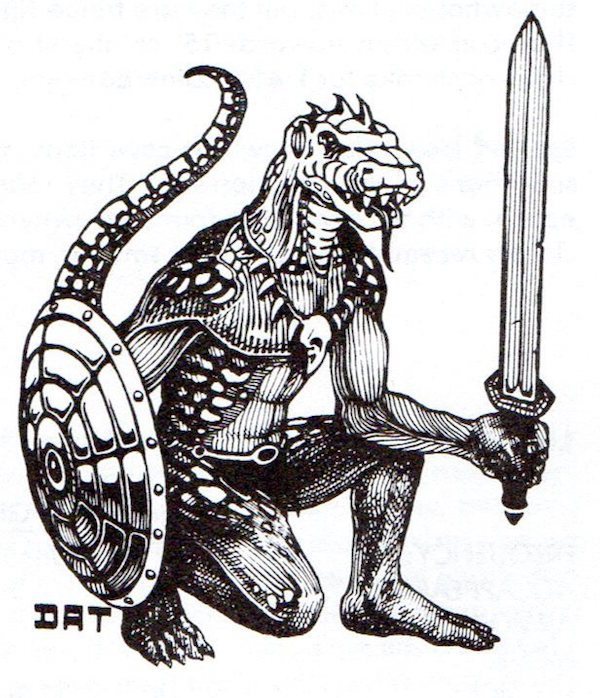
We started with a recap of the previous week's story. Now the Warrior had a meeting with the Castellan, who asked him to investigate the rumors of menacing caves in the woods, and gave him a potion of healing. He met the Dwarf by the fountain and they headed out. I showed him the Wilderness Map, pointing out the various features (road, river, hills, woods), and the numbers and the clearings that they would need to explore. He wanted to start with #1, so they headed south to the "stream" and wondered how to cross. After some discussion, they crossed near the islands where it turned out to be shallow and rocky. Heading into the swamp, they found a large dirt mound with a dark cave on the north side, around which were footprints in the mud with claws instead of toes. The Dwarf lit a torch, but didn't want to go in first. So the Warrior took out his sword and walked in a little way until he saw a pair of eyes and heard a voice growl, "Leave us alone". Of course, the Warrior didn't leave, so a Lizardman came forward out of the dark. I showed him the picture from the Monster Manual:


Many more eyes appeared behind him in the dark. The Warrior thought maybe he should "poke" the Lizardman with his sword, but the Dwarf suggested there were too many so they backed out of the cave. The Lizardman followed them and asked if they would be interested in a job getting rid of some spiders in the woods to the south, in exchange for a gold necklace. The Warrior agreed and they walked south into the tamarack stand. 

In the woods they eventually reached a clearing in the middle with lots of webs around. As Warrior walked into the clearing a large spider dropped on the Dwarf's shoulder and bit him! The Dwarf killed the spider but fell over, poisoned. Meanwhile two spiders came scurrying towards the Warrior. One sprung at him but he caught in the air with his sword. The other tried to bite his leg but he stomped on it and then stabbed it. The spiders dispatched, he checked on the Dwarf, who had a numb arm but was able to walk. They searched under the webs, where, among animal bones, they found the skeleton of an elf with an old shield. The Dwarf told the Warrior that an elf from the Keep once disappeared across the marshes. They put the skeleton in a sack to bring back to the Keep for burial.

At the edge of the woods they were met by a group of the Lizardmen, who gave them the necklace after verifying the spiders were dead. The Warrior and Dwarf then returned to the Keep and told the Castellan what they had found. The Castellan's Advisor was grateful to learn what had happened to his cousin, the elf who had perished, and let them keep the shield, which was magical, in return. And the Warrior wants to sell the necklace to buy some "fire fighter and police equipment". : )

Until next time...

Continued in: Storytelling With B2, Part II

Tuesday, March 27, 2012

35 years ago this month (Mar 77)

     Thirty-five years ago this month, The Dragon #5 (March 1977) featured the second short story by Gardner Fox about the Conan-esque hero, Niall of the Far Travels. See Grognardia's review of this story posted yesterday. The cover of this issue features a scene from the story illustrated by David C. Sutherland III. Fox would go on to have ten different Niall stories published in Dragon, more than any other author. Holmes included Gardner Fox in his short list of fantasy authors in the Blue Book (pg 41, 2nd print), which came out later that year. Fox was a special guest at that summer at Gen Con X, which was first advertised on the inside cover of this month's Dragon.

     Holmes also attended Gen Con X, around the same time the Basic Set was released. I still don't have any hard proof of the exact date of release - it could be anywhere from June to Sep '77. But in the Spring of '77 Holmes was probably editing the Basic Set, or perhaps had already finished his draft and submitted it to TSR, in advance of publication.

     Pages 4-5, 7-9 and 28 of the issue have an article titled "Witchcraft Supplement for Dungeons & Dragons" by an anonymous author. While the witch in this article is not fully described as a class, it possibly was responsible for Holmes' mention in the Blue Book that AD&D would contain a witch subclass. The witch would later appear as a full PC class for OD&D in The Dragon #20 (Nov 1978). Last year,on the OD&D Discussion Forums, paleologos provided an extract of the later version of the witch for the Holmes set (i.e., levels 1-3). The earlier version from #5 is more of a difficult NPC opponent for OD&D characters, with high level witches having gonzo magic items like Mountain Seeds:

"Similar to Hill Seeds in function but much deadlier. When pitched into the air thee gloves will swell to the size of a castle almost immediately. With one such seed a wizard could crush armies or destroy a town. They are safest when dropped from above, but can be thrown up from the ground if you are able to use teleportation and escape before it comes down."

Sunday, March 25, 2012

Blue Book Hydras


Seven-headed Hydra by David C. Sutherland III from page 29 of the Blue Book


While working on the Monster Reference Table for Holmes Basic, I was reminded that Hydras in these rules are given Hit Dice that "varies with number of heads". In the description, Holmes then notes that "Each head is represented by one hit die of 6 points, so a three headed hydra has 18 points, a 6 headed one, 36". This is more open-ended than either the original Hydra entry in Monsters & Treasure, or the versions in the Monster Manual or  the B/X Expert Set, which each limit Hydras to having 5-12 heads. Since Holmes places no limitation on the number of heads, and gives the specific examples of 3- and 6-headed Hydras, we can extrapolate the following table:


We can also postulate that a young Hydra starts with 1 head/1 HD, and add heads and HD as it ages (the above table can also be used for rolling a random Hydra with a d12).

This is one small way that Holmes made the original OD&D monster list more appropriate for Basic levels. I think it's often overlooked because (1) the illustration shows a seven-headed hydra (see above) and (2) everyone is more familiar with the 5-12 HD Hydra. To emphasize this feature I placed Hydras right after the 3HD monsters on the Monster Reference Table, making them entry 3-12. They could appear as a 3rd level monster if you use the table for Wandering Monsters as I previously suggested.

A few other notes:

---There's a silhouette of a body lying below the Hydra in the picture above. Presumably there was another fighter on the ledge who was taken out by the Hydra, which still has all 7 heads in action. Doesn't bode well for the sole remaining warrior.

---The 1st-3rd printings of the Blue Book contained an extra paragraph at the end of the entry for Giants that mentions Hydras among their "pets".


---The reference to Hydras as guards for Giants is from Monsters & Treasure, page 9. This paragraph (along with the entry for Nixies that I posted yesterday) was deleted from the second edition (Nov '78) of the Blue Book. I don't see any reference to Hydras in the descriptions of the various Giants in the Monster Manual.

Saturday, March 24, 2012

Now with Nixies!

I've revised the Holmes Monster Reference Table to include Nixies, which were found in the 1st-3rd prints (Lizard Logo) of the Basic rulebook, and were removed starting with the 2nd edition (Wizard Logo, Nov 1978). I thought I was at the limit for lines but managed to fit in one more line. This has the added bonus of bringing the table to an even 80 entries. Jeff Rients recently referred to the Monster List as the "Holmes 65"; my list is the "Holmes 80" due to separate lines for the various Dragons, Giant, Lycanthropes and Spiders.

Download link:

While this table is based on the Holmes list, it should work well for OD&D, as Holmes took most of the monster stats directly from the OD&D books.

As a bonus, here's the entry for Nixies from the 1st print for anyone who has a later print:


Friday, March 23, 2012

Obscure Art Friday: Balrog by Greg Bell


"Balrog" by Greg Bell from pg 13 of Dungeons & Dragons, Vol 2, Monsters & Treasure


This picture of a Balrog is from the LBBs (aka OD&D), specifically Vol 2, Monsters & Treasure, pg 13. It's by Greg Bell, who did much of the artwork in the LBBs, including the original covers. The Balrog is flying, perhaps to attack, and is shrouded in faint flames (which did not reproduce well in the printed picture). Also note that he is wearing boots and a bracer.

I have a later (OCE) set of the LBBs, and I didn't realize until recently that this picture was is of a Balrog. But in the 1st through 5th printings, this picture was actually labeled "Balrog". It was followed on page 14 by the monster entry for Balrogs. In the 6th printing many Tolkien references were removed. The entry for Balrog was deleted and replaced by a cartoon by Tom Wham. This Balrog picture was left in, but the title "Balrog" was removed. Which is why this picture is missing a name unlike most of Bell's monsters.

For those who also have a later printing, I've created a Balrog Reference Sheet that lists all of the places where Balrog-related information was removed from the LBBs and Chainmail. It also lists the Balrog references in Greyhawk, but not Eldritch Wizardry, which fundamentally changed the original Balrog by turning it into a Type VI demon.

I've always considered Balrogs as part of D&D, as Holmes included two of the original references in the Blue Book. See my previous post Balrogs in the Blue Book for a description of these.


Possible inspiration for Bell's Balrog...?

Thursday, March 22, 2012

Wizards.com blog post

Today I spotted this recent (3/15) blog post on Wizards.com featuring the Holmes Basic Set:

Basic Damage by alphastream1

Warning: only read if you can tolerate some Holmes criticism mixed with 4E praise.

"Our group's first reaction was one of confusion. We really were not prepared for a book that was more poorly worded than OD&D, but this actually may be. It is actually hard to tell whether elf and dwarf are a race or a distinct class, and the class features are never in one place."

This is a new one to me; I haven't really heard anyone say Holmes is less clear than OD&D. Holmes says that dwarves and halflings are "members of the fighter class" and elves are both fighters and M-Us. Perhaps they were bringing Moldvay-baggage to the table and were confused that Holmes didn't go that far with race=class.

"At the end of character generation we were pretty sure we had a few things wrong. Thankfully, the game is very simple. 9 pages contain the information for players. The rest is spells, monsters, items, and a smattering of info about running a campaign."

This is a good observation. Nine pages (~17 single sided sheets) for the players. In fact if you have the pdf that RPGnow used to sell, you could print off these pages and voilà! instant Holmes Players Handbook for your players.

The last part of the post has some real howlers from an OSR point-of-view. Basically how we can never go back to "Basic" since we've evolved into higher lifeforms that must have story elements that interact with our characters' ponderous backstories. He agonizes over the trap that the more recent versions of D&D have fallen into: the players spend so much time crafting their characters that they can't stand to have them die, so there's no real sense of danger. Luckily, a few of the commenters, including llenlleawg (who has been posting recently at OD&D Discussion), take him to task.